

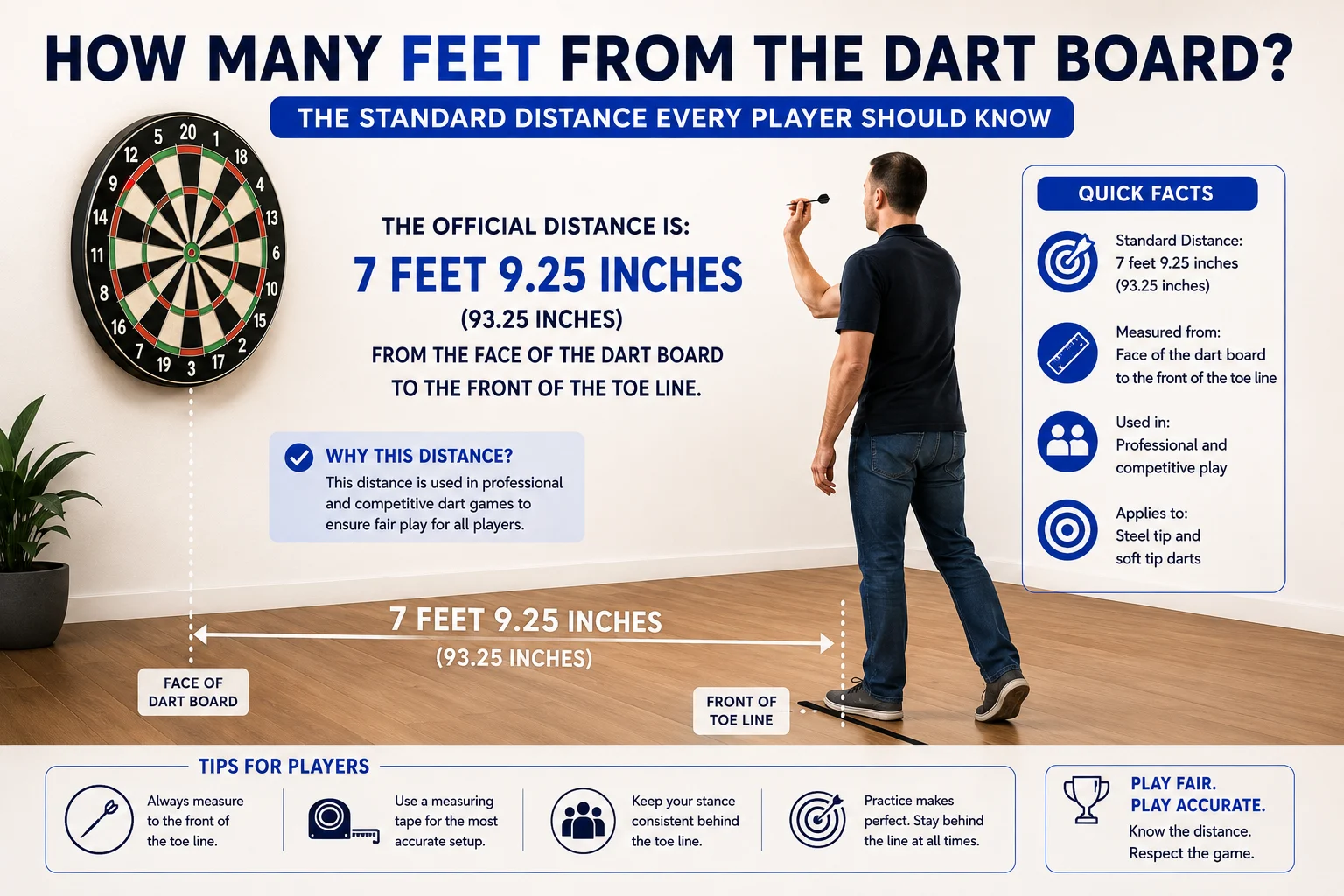
If you are setting up a dart board at home, one of the first questions you will ask is: how many feet from the dart board should you stand?
The answer depends on the type of darts you play. For standard steel tip darts, the official throwing distance is 7 feet 9.25 inches from the front of the dart board to the throw line, also called the “oche.” For soft tip darts, the distance is slightly longer.
Getting the correct dart board distance matters more than many people realize. Even being a few inches off can affect accuracy, consistency, and gameplay fairness. Whether you are building a home game room, practicing competitively, or simply enjoying darts with friends, proper setup makes a huge difference.
In this guide, you will learn the official dart board measurements, how to measure correctly, setup tips, room size recommendations, and common mistakes to avoid.
Official Dart Board Distance Explained
The official distance depends on whether you use steel tip darts or soft tip darts.
Steel Tip Dart Distance
For steel tip darts, the regulation throwing distance is:
| Measurement | Distance |
|---|---|
| Throw line to dart board face | 7 feet 9.25 inches |
| In inches | 93.25 inches |
| In centimeters | 237 cm |
This is the standard used by professional organizations like the Professional Darts Corporation (PDC).
The measurement starts from the front face of the dart board, not the wall behind it.
Soft Tip Dart Distance
Soft tip dart boards usually have a slightly longer throwing distance.
| Measurement | Distance |
|---|---|
| Throw line to board face | 8 feet |
| In inches | 96 inches |
| In centimeters | 244 cm |
Soft tip darts are common in arcades, bars, and electronic dart boards.
Why Dart Board Distance Matters
Some casual players guess the distance when setting up a dart board. However, accuracy in measurement is important for several reasons.
Better Accuracy
Throwing from the correct distance helps you develop muscle memory. Your arm movement becomes more consistent over time.
If you practice from the wrong distance, switching to regulation play later becomes difficult.
Fair Competition
Official distances ensure every player competes under the same conditions. This matters in leagues, tournaments, and even friendly games.
Improved Skill Development
Practicing at regulation distance helps beginners learn proper mechanics faster. It also prepares serious players for tournament play.
Standard Dart Board Measurements
The throwing distance is only one part of a proper dart setup. You also need the correct dart board height and positioning.
Distance From Board to Throw Line
The standard steel tip distance is:
7 feet 9.25 inches=93.25 inches
The measurement should begin at the front surface of the dart board and extend straight to the throw line.
Bullseye Height From Floor
The center of the bullseye should sit:
| Measurement | Height |
|---|---|
| Feet and inches | 5 feet 8 inches |
| Inches | 68 inches |
| Centimeters | 173 cm |
This height is standard for both steel tip and soft tip boards.
Diagonal Measurement Check
Many players use the diagonal method to confirm proper setup.
For steel tip darts:
| Diagonal Distance | Measurement |
|---|---|
| Bullseye to throw line | 9 feet 7.5 inches |
This method helps verify that both the height and throw distance are correct.
How to Measure Dart Board Distance Correctly
Setting up a dart board is simple if you follow the correct steps.
Step 1: Mount the Dart Board
Install the dart board securely on the wall. Make sure the bullseye height is exactly 5 feet 8 inches from the floor.
Use a level to keep the board straight.
Step 2: Measure the Throwing Distance
Measure from the front face of the board directly outward to the throw line.
Do not measure from the wall.
Step 3: Mark the Oche Line
The throw line, or oche, should be clearly marked.
You can use:
- Tape
- Wooden strips
- Rubber oche mats
- Painted floor lines
Step 4: Double Check Measurements
Use the diagonal measurement if needed to confirm accuracy.
Dart Board Distance Chart
Here is a quick reference chart for standard dart measurements.
| Setup Type | Throw Distance | Bullseye Height |
|---|---|---|
| Steel tip darts | 7 ft 9.25 in | 5 ft 8 in |
| Soft tip darts | 8 ft | 5 ft 8 in |
Metric Conversion Chart
| Measurement Type | Imperial | Metric |
|---|---|---|
| Steel tip throw line | 93.25 inches | 237 cm |
| Soft tip throw line | 96 inches | 244 cm |
| Bullseye height | 68 inches | 173 cm |
Best Room Size for a Dart Board Setup
Many homeowners underestimate how much space darts require.
Minimum Recommended Room Length
For comfortable play, your room should ideally be:
| Area | Recommended Space |
|---|---|
| Room length | 11–13 feet |
| Room width | 5–6 feet |
This allows enough room for players to stand and move safely.
Small Room Setups
If space is limited:
- Use wall protectors
- Install foldable dart cabinets
- Choose compact lighting
- Keep furniture away from the throw line
Garage and Basement Setups
Garages and basements are popular dart locations because they provide:
- More wall space
- Better safety
- Reduced noise indoors
- Room for spectators
Common Dart Board Setup Mistakes
Even experienced players sometimes make setup errors.
Measuring From the Wall Instead of the Board
This is one of the biggest mistakes.
Always measure from the front face of the dart board.
Incorrect Bullseye Height
If the bullseye is too high or low, throws become inconsistent.
Use a tape measure carefully before mounting.
Poor Lighting
Shadows make aiming harder.
Good dart lighting should:
- Illuminate the entire board evenly
- Reduce glare
- Prevent shadows around scoring areas
Unsafe Placement
Avoid placing dart boards near:
- Windows
- TVs
- Walkways
- Fragile decorations
Darts can bounce or miss the board unexpectedly.
Tips for Improving Accuracy at Regulation Distance
Once your dart board is properly set up, focus on improving your technique.
Use a Consistent Stance
Place your lead foot behind the oche line every time.
Keep your balance steady and avoid leaning too far forward.
Maintain a Relaxed Grip
Gripping too tightly affects release accuracy.
A smooth, relaxed grip helps create cleaner throws.
Practice Grouping
Instead of aiming only for bullseyes, practice grouping darts tightly together.
This builds precision and control.
Develop a Routine
Professional players often repeat the same steps before each throw.
Your routine might include:
- Setting your stance
- Aiming carefully
- Controlled breathing
- Smooth follow-through
Consistency improves results over time.
Home vs Professional Dart Board Setups
There are some differences between casual home setups and tournament-level installations.
| Feature | Home Setup | Professional Setup |
|---|---|---|
| Throw line | Tape or mat | Raised oche |
| Lighting | Basic room light | Dedicated LED system |
| Flooring | Carpet or tile | Non-slip flooring |
| Space | Flexible | Strict regulation |
For casual play, small adjustments are acceptable. However, serious players should follow official measurements exactly.
Choosing the Right Dart Board
The correct distance also depends on your dart board type.
Bristle Dart Boards
These are used for steel tip darts and are standard in professional play.
Benefits include:
- Self-healing sisal fibers
- Long lifespan
- Tournament compatibility
Electronic Dart Boards
Soft tip boards are popular for family entertainment.
Advantages include:
- Automatic scoring
- Safer plastic tips
- Multiplayer game modes
Safety Tips for Dart Board Areas
Safety matters, especially in homes with children.
Use a Dart Mat
A dart mat protects floors and marks the throwing distance clearly.
Install Wall Protection
Surround panels help prevent wall damage from missed throws.
Keep Extra Space Behind Players
Players need room for arm movement and stepping back safely.
How Professionals Practice
Professional dart players spend hours practicing from regulation distance.
Their training often includes:
- Scoring drills
- Double finish practice
- Accuracy routines
- Pressure simulations
Practicing from the correct distance builds consistency under competition conditions.
Why the Throw Line Is Called the Oche
The word “oche” is commonly used in darts, but many players do not know its origin.
The term likely came from old pub games where players stood behind a marked line or barrel marker while throwing darts.
Today, the oche refers officially to the throwing line in darts competition.
9. FAQs
1. How many feet from the dart board do you stand?
For steel tip darts, you stand 7 feet 9.25 inches from the front of the dart board. Soft tip darts use an 8-foot distance.
2. How high should a dart board be mounted?
The bullseye should be 5 feet 8 inches from the floor.
3. What is the official dart throwing line called?
The throwing line is called the “oche.”
4. Can I shorten the distance for beginners?
Yes, beginners and children sometimes use shorter distances while learning basic throwing techniques.
5. What room size is best for a dart board?
A room about 11–13 feet long provides enough space for comfortable dart play.
10. Conclusion
Knowing how many feet from the dart board to stand is essential for accurate and enjoyable play. For standard steel tip darts, the official distance is 7 feet 9.25 inches, while soft tip darts require an 8-foot throw distance.
Using the correct dart board setup improves consistency, fairness, and skill development. It also helps recreate a professional playing experience at home.
Whether you are a casual player or preparing for competitive matches, taking the time to measure your dart board properly will improve your game and make every throw feel more natural.
Discover More Articles
How Many Square Feet in a Pallet of Bricks?