
If you are planning a patio, walkway, wall, fireplace, or home exterior project, one of the first questions you may ask is: how many square feet in a pallet of bricks?
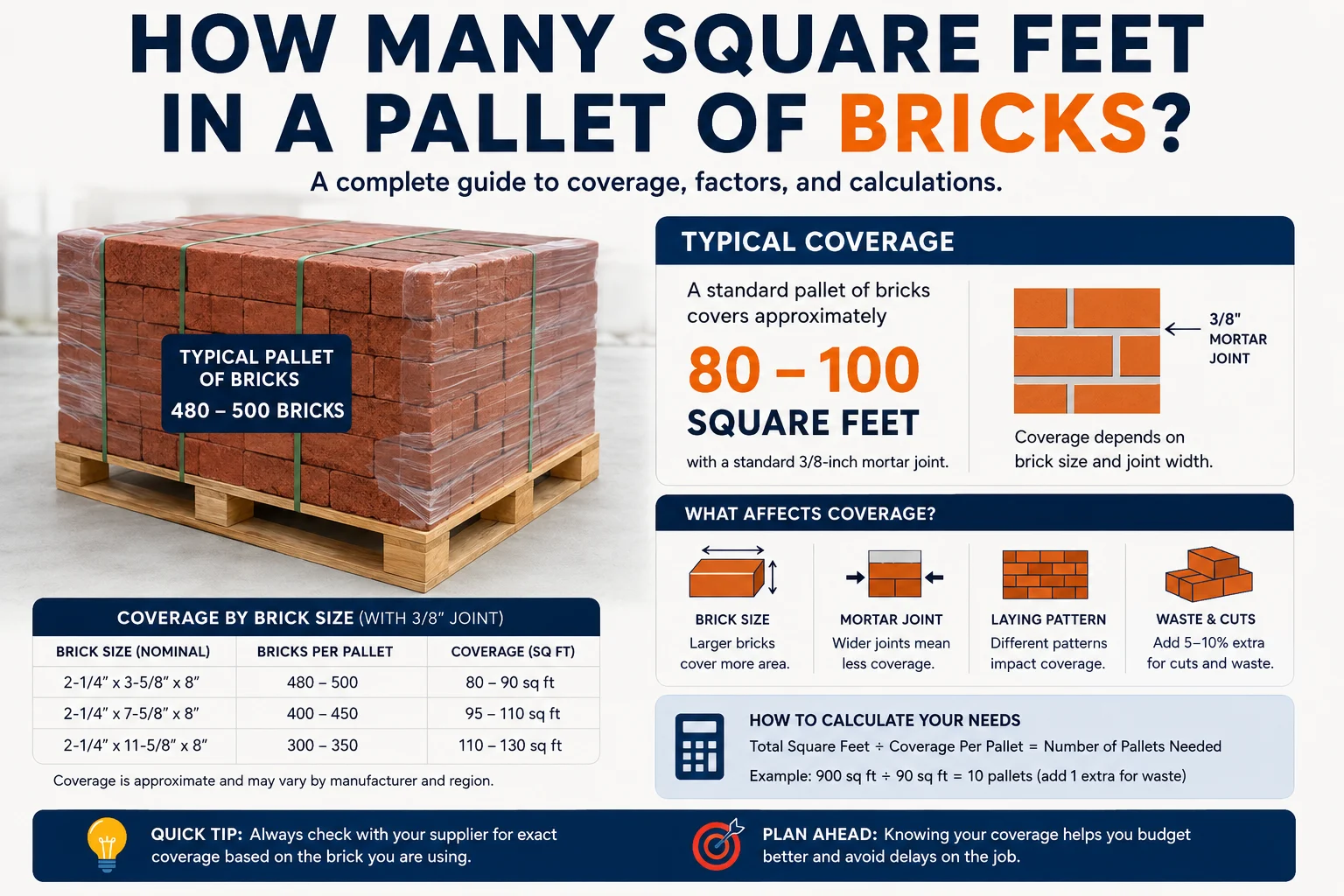
The answer depends on the type of brick, the brick size, the installation pattern, and whether the bricks are used for paving or wall construction. In general, a standard pallet of bricks covers between 100 and 500 square feet.
That is a big range, which is why understanding brick measurements is important before ordering materials.
In this guide, you will learn:
- Average square footage per pallet
- How many bricks come on a pallet
- Coverage by brick type
- Easy formulas for estimating
- Common mistakes to avoid
- Tips for ordering the right amount
By the end, you will know exactly how to estimate brick coverage for your project.
What Is a Pallet of Bricks?
A pallet of bricks is a bundled stack of bricks wrapped together for shipping and delivery. Brick manufacturers package bricks on pallets so they are easier to transport to construction sites.
The number of bricks on a pallet varies depending on:
- Brick size
- Brick thickness
- Manufacturer
- Weight limits
- Type of brick
Most standard pallets contain:
| Brick Type | Average Bricks Per Pallet |
|---|---|
| Modular bricks | 500–534 |
| Queen bricks | 350–400 |
| Paver bricks | 400–600 |
| Thin bricks | 700–1,000 |
Because brick dimensions differ, the square footage coverage also changes.
How Many Square Feet in a Pallet of Bricks?
A standard pallet of bricks usually covers:
| Brick Use | Average Square Foot Coverage |
|---|---|
| Wall bricks | 135–150 sq ft |
| Thin brick veneer | 200–250 sq ft |
| Brick pavers | 100–150 sq ft |
| Large paving bricks | 300–500 sq ft |
For traditional modular wall bricks, a pallet often covers around:
135 to 150 square feet
This estimate assumes standard mortar joints and normal installation spacing.
However, different brick styles can dramatically change coverage.
For example:
- Smaller bricks cover less area
- Larger pavers cover more area
- Thick mortar joints reduce coverage
- Decorative patterns increase waste
That is why contractors always calculate carefully before ordering materials.
Brick Coverage Chart by Brick Type
The easiest way to estimate square footage is by using a brick coverage chart.
Modular Bricks
Modular bricks are the most common bricks used for homes and walls in the United States.
Standard dimensions:
7.625 in×2.25 in×3.625 in
Coverage details:
| Item | Value |
|---|---|
| Bricks per square foot | 6.75 |
| Bricks per pallet | 500–534 |
| Coverage per pallet | 135–150 sq ft |
These bricks are ideal for:
- Exterior walls
- Fireplaces
- Chimneys
- Decorative facades
Queen Size Bricks
Queen bricks are slightly larger than modular bricks.
Because they are bigger, fewer bricks are needed per square foot.
| Item | Value |
|---|---|
| Bricks per square foot | 5.5 |
| Bricks per pallet | 350–400 |
| Coverage per pallet | 140–160 sq ft |
Queen bricks are popular for residential construction because they install faster.
Paver Bricks
Brick pavers are used for patios, sidewalks, and driveways.
Coverage varies widely because pavers come in many shapes and thicknesses.
| Paver Type | Coverage Per Pallet |
|---|---|
| Standard pavers | 100–120 sq ft |
| Large pavers | 200–500 sq ft |
| Thin patio pavers | 120–150 sq ft |
Some oversized concrete-style pavers can cover hundreds of square feet per pallet.
Thin Bricks
Thin brick veneer is lightweight and commonly used indoors.
These bricks are much thinner than traditional bricks.
| Item | Value |
|---|---|
| Coverage per pallet | 200–250 sq ft |
| Common use | Accent walls |
| Installation | Adhesive based |
Thin bricks are excellent for:
- Kitchen backsplashes
- Fireplace surrounds
- Interior feature walls
How to Calculate Brick Coverage
If you want accurate estimates, learn how to calculate brick coverage yourself.
The process is simple.
Step 1: Measure the Project Area
Measure the height and width of the space.
Use this formula:
Area=Length×Width
Example:
- Wall width = 20 feet
- Wall height = 8 feet
Calculation:
20×8=160 square feet
Your wall area is 160 square feet.
Step 2: Determine Brick Size
Different brick sizes require different quantities per square foot.
For example:
| Brick Type | Bricks Per Sq Ft |
|---|---|
| Modular | 6.75 |
| Queen | 5.5 |
| Engineer brick | 4.5 |
| Thin brick | 7–9 |
Always check the manufacturer’s specifications.
Step 3: Account for Mortar Joints
Mortar joints affect total coverage.
Standard mortar joints are usually:
83 inch
Wider joints reduce the number of bricks needed slightly.
Narrow joints increase the number required.
Step 4: Add Waste Allowance
Always add extra bricks for:
- Cuts
- Breakage
- Future repairs
- Pattern adjustments
Most contractors recommend adding:
5% to 10%
For complicated layouts, add even more.
Factors That Affect Square Footage
Many people assume all pallets cover the same area. That is not true.
Several factors change the final square footage.
Brick Dimensions
Larger bricks cover more area.
Smaller bricks require more units per square foot.
Even a small size difference changes pallet coverage significantly.
Mortar Thickness
Thicker mortar joints mean fewer bricks per square foot.
Thin mortar lines increase brick counts.
Installation Pattern
Patterns like:
- Herringbone
- Basket weave
- Diagonal layouts
often create more waste than straight running bond patterns.
Complex patterns may require 10–15% extra material.
Orientation and Layout
Vertical installations sometimes use more bricks than horizontal layouts.
Curved walkways and decorative edges also increase waste.
Real World Examples
Here are practical examples to help you estimate your own project.
Patio Project Example
Suppose you want a patio measuring:
- 12 feet × 12 feet
Calculation:
12×12=144 square feet
A standard pallet of paver bricks covering 120 square feet would not be enough.
You would need:
- About 1.2 pallets
- Rounded up to 2 pallets
Always round upward to avoid shortages.
House Wall Example
A brick accent wall measures:
- 30 feet wide
- 10 feet tall
Calculation:
30×10=300 square feet
If one pallet covers 150 square feet:
300÷150=2
You would need approximately two pallets.
Add 10% extra for waste.
Walkway Example
A walkway measures:
- 4 feet wide
- 25 feet long
Calculation:
4×25=100 square feet
One standard pallet of pavers may be enough depending on paver size.
Common Mistakes When Estimating Brick Coverage
Many DIY builders underestimate material needs.
Here are the most common mistakes.
Ignoring Waste
Broken bricks are normal during installation.
Ordering exact quantities usually leads to shortages.
Forgetting Mortar Space
Mortar joints change calculations.
Never estimate using brick dimensions alone.
Not Checking Manufacturer Specs
Brick sizes vary between manufacturers.
Two “standard” bricks may not have identical dimensions.
Ordering Different Production Batches
Brick colors can vary slightly between batches.
Always order enough material at one time.
Expert Tips for Ordering Brick Pallets
Professionals use a few simple tricks to avoid problems.
Order Extra Material
Buy at least 5–10% extra.
This protects against:
- Breakage
- Color mismatch
- Future repairs
Confirm Delivery Weight
Brick pallets are heavy.
Some pallets weigh:
2,000 to 3,000 pounds
Make sure your driveway or job site can handle the weight.
Ask About Coverage Guarantees
Some suppliers provide exact square footage estimates.
This can improve accuracy.
Match Brick Type to Project
Different bricks work better for different jobs.
For example:
| Project | Best Brick Type |
|---|---|
| Patio | Pavers |
| House wall | Modular bricks |
| Fireplace | Fire bricks |
| Interior accent wall | Thin brick |
Brick Pallet Coverage Comparison Table
Here is a quick comparison chart.
| Brick Type | Bricks Per Pallet | Approximate Coverage |
|---|---|---|
| Modular brick | 500–534 | 135–150 sq ft |
| Queen brick | 350–400 | 140–160 sq ft |
| Thin brick veneer | 700–1,000 | 200–250 sq ft |
| Standard pavers | 400–500 | 100–120 sq ft |
| Large pavers | Varies | 200–500 sq ft |
This table gives a good starting point for planning your project.
FAQs
How many square feet does one pallet of bricks cover?
A standard pallet of modular bricks usually covers about 135–150 square feet. Pavers and thin bricks may cover more or less depending on size.
How many bricks are on a pallet?
Most pallets contain between 400 and 600 bricks, although the exact number depends on brick dimensions and manufacturer packaging.
How do I calculate brick coverage?
Measure the total square footage of the project and divide by the coverage rate of the brick type you are using.
Do paver bricks cover more square footage?
Yes. Larger paving bricks can cover more square footage because each brick takes up more surface area.
Should I order extra bricks?
Yes. Experts recommend ordering 5–10% extra to account for waste, cuts, and future repairs.
Conclusion
Understanding how many square feet in a pallet of bricks is essential for planning any masonry project. While a standard pallet commonly covers between 135 and 150 square feet, actual coverage depends on brick size, mortar spacing, installation pattern, and project type.
Before ordering materials:
- Measure your project carefully
- Check manufacturer specifications
- Add extra bricks for waste
- Choose the correct brick style
Taking a few extra minutes to calculate brick coverage properly can save money, reduce delays, and prevent material shortages during construction.
Discover More Articles
How Many Feet to Stop at 60 MPH?