
If you have ever asked yourself, “how many sq feet is my yard,” you are not alone. Many homeowners need to know their yard size before starting landscaping, installing grass, building a patio, or buying fencing materials.
The good news is that measuring your yard is easier than most people think. With a few simple tools and basic math, you can calculate your yard square footage accurately in less than an hour.
Knowing your yard size helps you:
- Estimate landscaping costs
- Buy the correct amount of sod or seed
- Plan gardens and patios
- Install fencing
- Improve property value
- Compare lot sizes when buying a home
In this guide, you will learn exactly how to measure your yard, calculate square footage, avoid common mistakes, and use your measurements for real projects.
Why Knowing Your Yard Size Matters
Understanding your yard square footage can save both time and money. Many outdoor projects depend on accurate measurements.
Here are a few common examples:
| Project | Why Square Footage Matters |
|---|---|
| Sod installation | Helps estimate grass needed |
| Fertilizer | Prevents overuse or underuse |
| Irrigation systems | Determines sprinkler coverage |
| Fencing | Helps calculate perimeter |
| Patios and decks | Ensures correct material estimates |
| Property value | Larger yards may increase appeal |
Without accurate measurements, homeowners often overspend on materials or underestimate labor costs.
What Does Square Footage Mean?
Square footage is the total area inside a space measured in square feet.
A square foot is a square that measures:
1 foot×1 foot=1 square foot
For example:
- A space that is 10 feet long and 10 feet wide equals 100 square feet.
- A yard that measures 50 feet by 40 feet equals 2,000 square feet.
Square footage measures area, not distance.
How to Measure Your Yard in Square Feet
The easiest way to measure your yard is to divide it into simple shapes and calculate each section separately.
Measure a Rectangular Yard
Most yards are roughly rectangular. This is the simplest calculation.
First:
- Measure the length
- Measure the width
- Multiply the numbers
Use this formula:
Square Feet=Length×Width
Example:
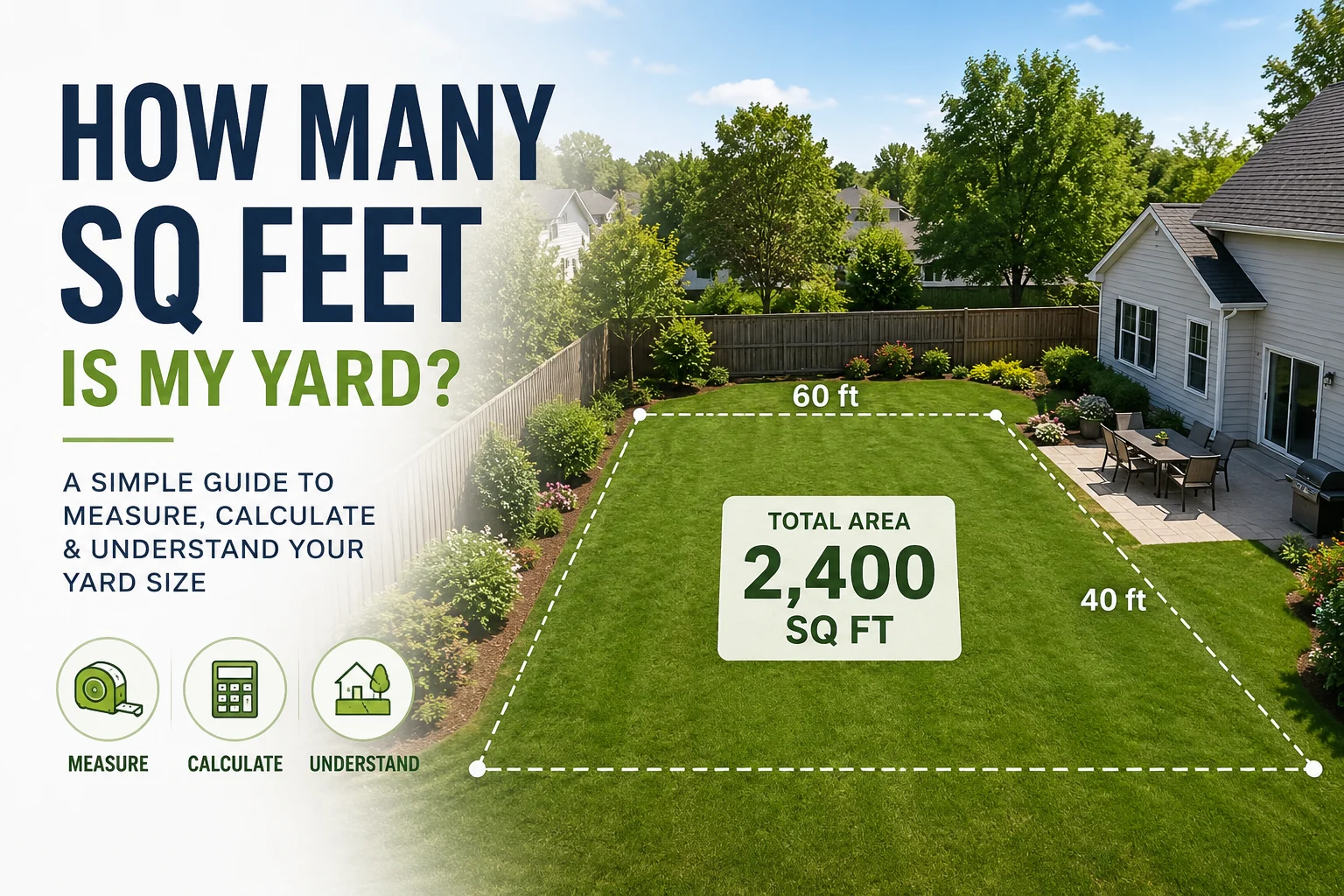
- Length = 60 feet
- Width = 40 feet
Calculation:
60×40=2400
Your yard is 2,400 square feet.
Measure a Circular Yard
Some yards include circular areas like garden beds or round lawns.
Use this formula:
A=πr2
r
A=πr2≈28.27
C=2πr≈18.85r = 3.00
Example:
- Radius = 10 feet
Calculation:
A=3.14×102=314
The area is about 314 square feet.
Measure an Irregular Yard
Many yards are not perfect rectangles.
The best approach is to:
- Divide the yard into smaller shapes
- Measure each section
- Add all areas together
For example:
| Section | Shape | Square Feet |
|---|---|---|
| Front lawn | Rectangle | 1,200 |
| Side strip | Rectangle | 300 |
| Garden corner | Triangle | 150 |
Total yard size:
1200+300+150=1650
Total = 1,650 square feet.
Square Footage Formulas Explained
Different yard shapes need different formulas.
Rectangle Formula
Use for:
- Backyards
- Lawns
- Garden plots
Formula:
A=l×w
Triangle Formula
Useful for angled sections.
Formula:
A=21bh
b
h
A=21bh≈24.00b = 8.0h = 6.0
Example:
- Base = 20 feet
- Height = 10 feet
Calculation:
A=21(20)(10)=100
Area = 100 square feet.
Circle Formula
Best for curved areas.
Formula:
A=πr2
r
A=πr2≈28.27
C=2πr≈18.85r = 3.00
Tools You Can Use to Measure Your Yard
Several tools can make measuring faster and more accurate.
Measuring Tape
A long tape measure works well for small to medium yards.
Best for:
- Straight property lines
- Garden beds
- Small lawns
Pros:
- Affordable
- Accurate
- Easy to use
Cons:
- Hard for large properties
Wheel Measure
A measuring wheel rolls along the ground and tracks distance.
Best for:
- Large yards
- Curved spaces
- Uneven ground
Pros:
- Faster than tape
- Easier for one person
Cons:
- Slightly less precise
Online Maps and Apps
Modern apps can estimate yard square footage using satellite imagery.
Popular options include:
- Google Maps
- Property survey websites
- Landscaping apps
These tools are convenient but may not be perfectly accurate.
For the best results:
- Compare app estimates with manual measurements
- Use updated property lines
Real World Yard Size Examples
Here are common residential yard sizes.
| Yard Type | Approximate Square Feet |
|---|---|
| Small city yard | 500–1,500 sq ft |
| Medium suburban yard | 2,000–5,000 sq ft |
| Large suburban yard | 6,000–10,000 sq ft |
| Half-acre lot | 21,780 sq ft |
| One-acre lot | 43,560 sq ft |
A typical suburban backyard is often around 2,500 square feet.
Yard Size Conversion Chart
Conversions help compare square feet with acres and other measurements.
| Measurement | Equivalent |
|---|---|
| 100 sq ft | 9.29 square meters |
| 1,000 sq ft | 0.023 acre |
| 5,000 sq ft | 0.115 acre |
| 10,000 sq ft | 0.23 acre |
| 43,560 sq ft | 1 acre |
This is especially useful for real estate listings.
Common Mistakes When Measuring Yard Size
Even simple yard measurements can go wrong.
Here are the most common mistakes.
Forgetting Irregular Shapes
Many people only measure the main rectangle and ignore corners or side areas.
Always include:
- Side yards
- Curved sections
- Garden extensions
Mixing Feet and Inches
Keep all measurements in feet.
For example:
- 6 inches = 0.5 feet
- 18 inches = 1.5 feet
Using mixed units creates inaccurate calculations.
Measuring the Entire Lot Instead of the Yard
Your property size and usable yard space may differ.
Driveways, garages, and the house itself are not lawn area.
Not Double Checking Measurements
Always measure twice.
Small errors can create large problems when ordering materials.
How Yard Square Footage Helps With Landscaping Projects
Once you know your yard size, planning projects becomes much easier.
Sod and Grass
Most sod is sold by square foot or pallet.
Example:
- Yard size = 2,000 sq ft
- Sod cost = $0.60 per sq ft
Calculation:
2000×0.60=1200
Estimated sod cost = $1,200.
Fertilizer
Fertilizer bags often cover specific lawn sizes.
Example:
- One bag covers 5,000 sq ft
- Your yard is 2,500 sq ft
You need about half a bag.
Using too much fertilizer can damage grass.
Fencing
Fence materials depend on perimeter, not square footage.
Still, larger yards usually require more fencing.
Measure all property edges carefully before buying materials.
Pavers and Patios
Outdoor hardscaping projects rely heavily on area calculations.
Knowing exact square footage helps you:
- Estimate pavers
- Budget materials
- Reduce waste
How to Estimate an Irregular Yard Quickly
Some yards have curves, slopes, or unusual borders.
Here is a simple shortcut method.
Step 1: Sketch the Yard
Draw the shape on paper.
Do not worry about perfect scale.
Step 2: Break It Into Shapes
Separate the yard into:
- Rectangles
- Triangles
- Circles
Step 3: Measure Each Section
Measure every piece individually.
Step 4: Add the Areas Together
Combine all calculations for total square footage.
This method works surprisingly well for:
- Corner lots
- Curved landscaping
- Large backyards
Professional Survey vs DIY Measurement
Should you hire a professional?
It depends on your goals.
| DIY Measurement | Professional Survey |
|---|---|
| Low cost | Higher cost |
| Fast | Very accurate |
| Good for landscaping | Best for legal boundaries |
| Simple tools | Uses surveying equipment |
DIY works well for:
- Lawn care
- Garden planning
- Sod installation
Professional surveys are better for:
- Property disputes
- Fence placement
- Home sales
- Construction permits
Expert Tips for Accurate Yard Measurements
Here are a few professional tips.
Use Stakes and String
Mark straight lines before measuring.
This improves accuracy.
Measure During Daylight
Shadows and poor visibility increase mistakes.
Use Consistent Units
Always use feet for every measurement.
Save a Yard Sketch
Keep a copy of your yard layout for future projects.
It will save time later.
FAQs
How do I find out how many square feet my yard is?
Measure the length and width of your yard in feet, then multiply them together. For irregular yards, divide the space into smaller shapes and add the areas.
What is the easiest way to measure yard size?
Using a measuring tape or measuring wheel is the easiest method. Online map tools can also help estimate square footage quickly.
How many square feet is a normal backyard?
A typical suburban backyard ranges from 2,000 to 5,000 square feet, though sizes vary by location and property type.
Can Google Maps measure my yard?
Yes. Google Maps and similar apps can estimate yard dimensions using satellite imagery, but manual measurements are usually more accurate.
How do I calculate square footage for an odd-shaped yard?
Break the yard into smaller rectangles, circles, or triangles. Measure each section separately and add the totals together.
Conclusion
If you have been wondering, “how many sq feet is my yard,” the answer is easier to find than you might think. By using simple measurements and basic formulas, you can accurately calculate your yard square footage for landscaping, fencing, gardening, and outdoor projects.
Whether your yard is rectangular, circular, or irregularly shaped, the key is to measure carefully and divide the space into manageable sections. Knowing your yard size helps prevent costly mistakes, improves planning, and makes every outdoor project more efficient.
With the right tools and calculations, you can confidently measure your yard and use the information for everything from sod installation to patio design.
Discover More Articles
How Many Square Feet Is a Typical Hotel Room?