
If you’re planning to rent, buy, or furnish a new home, you may be wondering how many square feet is a 3 bedroom apartment. The answer varies depending on the building, location, floor plan, and whether it’s a standard or luxury apartment.
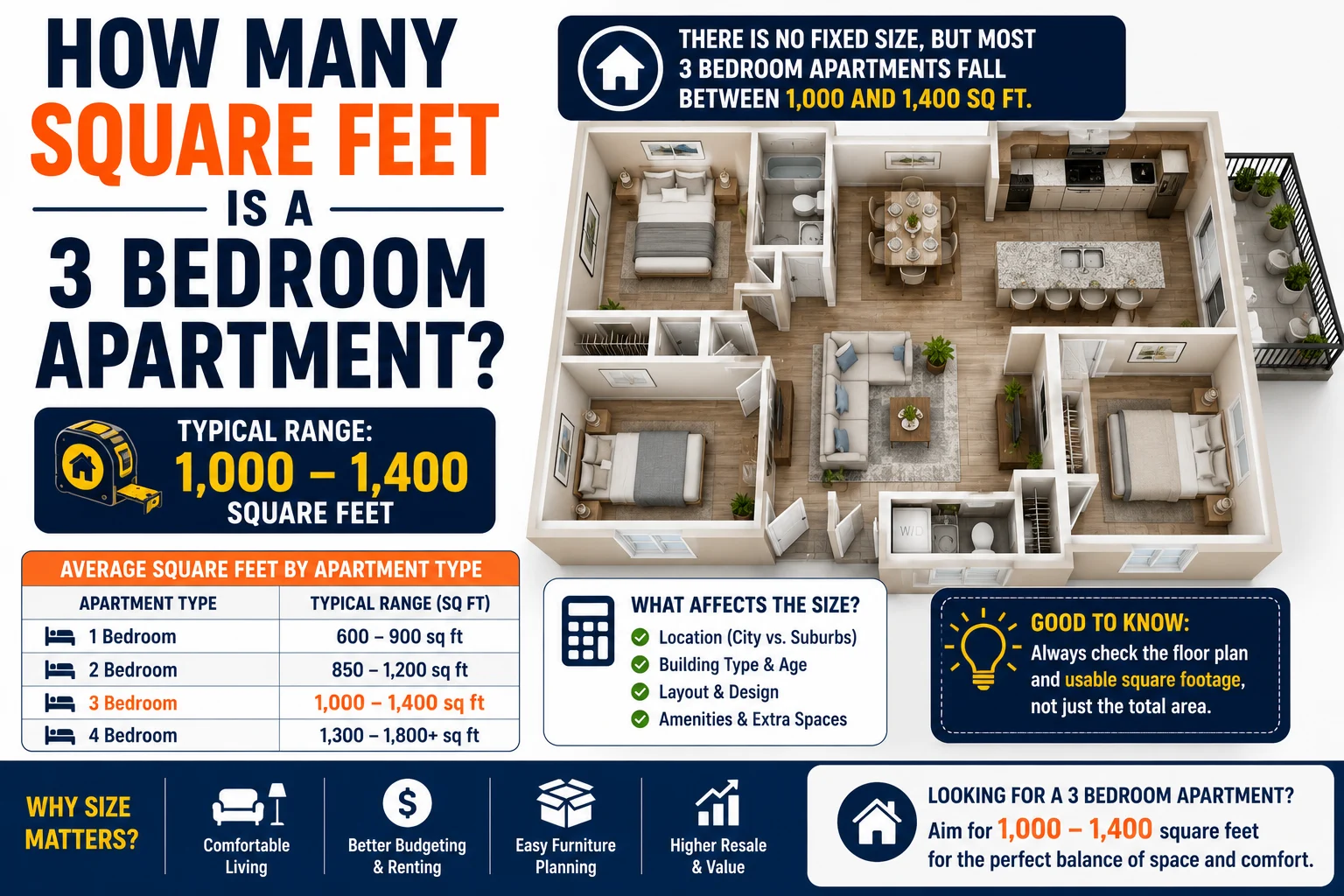
On average, a 3-bedroom apartment ranges from 1,000 to 1,500 square feet. Smaller units may be around 900 square feet, while larger or luxury apartments can exceed 1,800 square feet.
This guide explains average apartment sizes, compares different layouts, and helps you determine whether a 3-bedroom apartment offers enough space for your needs.
Quick Answer
A typical 3-bedroom apartment is between 1,000 and 1,500 square feet, with 1,200 square feet being a common average.
A=lw
A=6×4=24
4 rows by 6 columns = 24 square units.
w
w
l
l24 square unitsw = 6l = 4
Here’s a quick comparison:
| Apartment Type | Average Square Footage |
|---|---|
| Small | 900–1,000 sq ft |
| Standard | 1,000–1,300 sq ft |
| Large | 1,300–1,500 sq ft |
| Luxury | 1,500–2,000+ sq ft |
The actual size depends on the apartment’s design and amenities.
Average Size of a 3 Bedroom Apartment
There is no universal standard for apartment sizes, but most 3-bedroom apartments fall within a predictable range.
Small 3-Bedroom Apartments
Smaller apartments typically measure between 900 and 1,000 square feet. These units maximize space with compact bedrooms and open-concept living areas.
Average 3-Bedroom Apartments
Most standard apartments range from 1,000 to 1,300 square feet. They generally include:
- Three bedrooms
- One or two bathrooms
- Living room
- Kitchen
- Dining area
- Laundry closet or utility space
These layouts comfortably accommodate families of three to five people.
Large or Luxury Apartments
Luxury apartments usually range from 1,500 to over 2,000 square feet. They often feature:
- Spacious bedrooms
- Walk-in closets
- Multiple bathrooms
- Large kitchens
- Home office space
- Balconies or patios
Typical Room Dimensions
While layouts vary, the following room sizes are common in many 3-bedroom apartments.
| Room | Typical Size |
|---|---|
| Master Bedroom | 12 × 14 ft |
| Bedroom 2 | 10 × 12 ft |
| Bedroom 3 | 10 × 11 ft |
| Living Room | 14 × 18 ft |
| Kitchen | 10 × 12 ft |
| Dining Area | 8 × 10 ft |
These measurements contribute to a total apartment size of roughly 1,100–1,300 square feet.
Square Footage Comparison Chart
| Home Type | Average Size |
|---|---|
| Studio Apartment | 300–600 sq ft |
| One-Bedroom Apartment | 500–800 sq ft |
| Two-Bedroom Apartment | 800–1,200 sq ft |
| Three-Bedroom Apartment | 1,000–1,500 sq ft |
| Four-Bedroom House | 1,800–3,000+ sq ft |
This comparison helps you understand how a 3-bedroom apartment fits among other housing options.
What Can Fit in a 3 Bedroom Apartment?
A typical 3-bedroom apartment provides enough space for:
- Three bedrooms
- Living room
- Kitchen
- Dining area
- One or two bathrooms
- Laundry area
- Storage closets
Depending on the layout, you may also have room for:
- Home office
- Playroom
- Exercise area
- Guest room
Many modern apartments use open floor plans to make the living area feel larger.
Factors That Affect Apartment Size
Not all 3-bedroom apartments have the same square footage. Several factors influence the total size.
Building Age
Older apartment buildings often have larger rooms but more hallways, while newer buildings maximize usable living space.
Location
Apartments in major cities are generally smaller than those in suburban or rural areas due to higher land costs.
Floor Plan
Open-concept layouts can make a smaller apartment feel more spacious than one with many walls and hallways.
Amenities
Features such as walk-in closets, balconies, laundry rooms, and storage areas can increase the total square footage.
Is a 3 Bedroom Apartment Big Enough?
For many households, a 3-bedroom apartment provides ample living space.
It is often suitable for:
- Families with children
- Roommates
- Couples needing a home office
- Multi-generational households
- Remote workers
The key is choosing a layout that matches your lifestyle rather than focusing only on the total square footage.
Common Mistakes When Comparing Apartment Sizes
Avoid these common misconceptions:
- Assuming all 3-bedroom apartments are the same size.
- Comparing only square footage instead of layout.
- Ignoring storage space.
- Overlooking ceiling height and natural light.
- Forgetting to measure furniture before moving.
A well-designed 1,100-square-foot apartment may feel more spacious than a poorly designed 1,400-square-foot unit.
Expert Tips Before Renting or Buying
Before choosing a 3-bedroom apartment:
- Review the floor plan, not just the total square footage.
- Measure your existing furniture.
- Consider future storage needs.
- Check closet and cabinet space.
- Visit the apartment in person if possible.
- Compare usable living space rather than advertised square footage alone.
These steps help ensure the apartment meets your family’s needs.
FAQs
1. How many square feet is a typical 3 bedroom apartment?
Most 3-bedroom apartments range from 1,000 to 1,500 square feet, with around 1,200 square feet being common.
2. Is 1,000 square feet enough for a 3 bedroom apartment?
Yes. A well-designed 1,000-square-foot apartment can comfortably accommodate three bedrooms, especially with an open floor plan.
3. What is considered a large 3 bedroom apartment?
A 3-bedroom apartment larger than 1,500 square feet is generally considered spacious or luxury-sized.
4. Can a family of five live in a 3 bedroom apartment?
Yes. Many families of five comfortably live in a 3-bedroom apartment, depending on the layout and storage available.
5. Does square footage include balconies and garages?
In most cases, advertised apartment square footage includes the interior living area only. Balconies, patios, and garages are often measured separately.
Conclusion
Understanding how many square feet is a 3 bedroom apartment helps you choose the right home for your family and lifestyle. While sizes vary by location and design, most 3-bedroom apartments range from 1,000 to 1,500 square feet, with 1,200 square feet being a common average.
When comparing apartments, don’t focus solely on the total square footage. Consider the floor plan, room sizes, storage space, and overall layout to determine how functional the space will be. By evaluating both size and design, you’ll be better prepared to find a comfortable apartment that meets your needs now and in the future.