

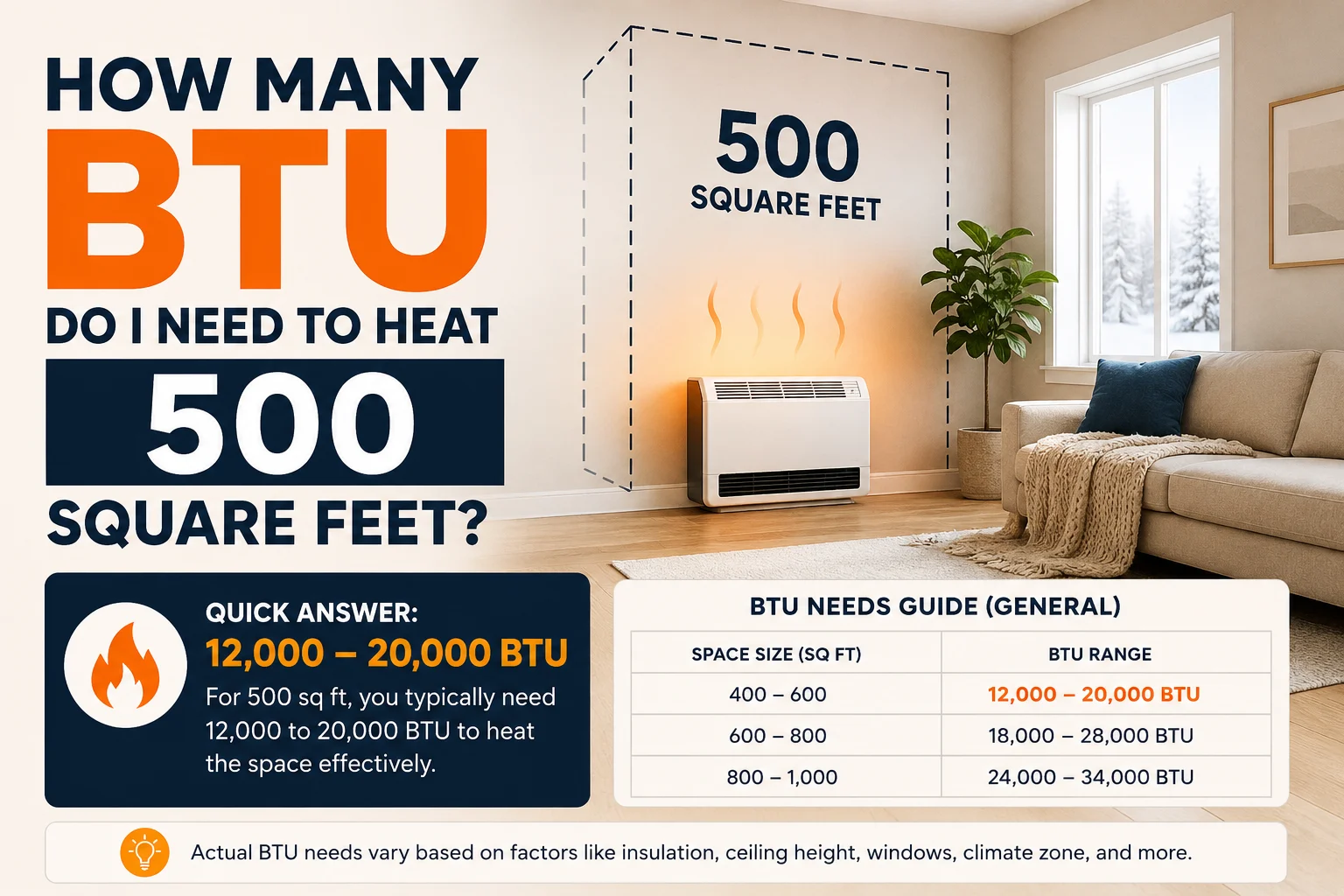
If you are wondering how many BTU do I need to heat 500 square feet, the short answer is that most spaces this size need between 10,000 and 20,000 BTUs depending on climate, insulation, ceiling height, and heater type.
Choosing the right BTU rating is important. A heater that is too small may struggle to warm the room, while an oversized unit can waste energy and create uneven temperatures. Whether you are heating an apartment, office, garage, cabin, or living room, understanding BTUs helps you stay comfortable and save money on energy bills.
In this guide, you will learn exactly how to calculate BTU requirements for a 500-square-foot area, what factors affect heating needs, and how to choose the best heater size for your space.
What Does BTU Mean?
BTU stands for British Thermal Unit. It measures the amount of heat needed to raise the temperature of one pound of water by one degree Fahrenheit.
In heating systems, BTUs tell you how much heat a heater or furnace can produce. The higher the BTU rating, the more heating power the unit has.
For example:
- Small electric heaters: 5,000–10,000 BTUs
- Medium room heaters: 10,000–20,000 BTUs
- Large furnaces: 40,000+ BTUs
When calculating heating needs, square footage is the starting point, but it is not the only factor.
General Rule for Heating 500 Square Feet
A common HVAC guideline is:
BTUs Needed=Square Feet×20 to 40
For a 500-square-foot room:
- Mild climate: about 10,000 BTUs
- Moderate climate: about 15,000 BTUs
- Cold climate: about 20,000 BTUs
Another quick estimate is:
500×30=15,000 BTUs
This means a typical home in an average climate usually needs around 15,000 BTUs to heat 500 square feet comfortably.
However, this number changes based on several conditions.
BTU Chart by Climate Zone
Climate has a huge effect on heating requirements. Homes in colder regions lose heat faster and need more BTUs.
| Climate Type | BTUs Per Sq Ft | BTUs for 500 Sq Ft |
|---|---|---|
| Warm Climate | 20 BTUs | 10,000 BTUs |
| Moderate Climate | 30 BTUs | 15,000 BTUs |
| Cold Climate | 40 BTUs | 20,000 BTUs |
Warm Climate Areas
If you live in a region with mild winters, such as southern states or coastal areas, 10,000 to 12,000 BTUs may be enough.
Moderate Climate Areas
Most homes in average winter conditions need around 15,000 BTUs.
Cold Climate Areas
In very cold regions with freezing temperatures, you may need 18,000 to 20,000 BTUs or more.
Factors That Affect BTU Requirements
Square footage alone does not give a perfect answer. Several factors influence how much heat your room needs.
Ceiling Height
Most BTU calculations assume an 8-foot ceiling.
If your room has vaulted or high ceilings, the heater must warm more air volume.
For example:
- Standard ceiling: 15,000 BTUs
- 10-foot ceiling: 18,000+ BTUs
Higher ceilings usually require 10–25% more heating power.
Insulation Quality
Well-insulated homes retain heat better.
Good insulation means:
- Lower energy bills
- Faster heating
- Smaller heater size needed
Poor insulation increases heat loss through:
- Walls
- Floors
- Attics
- Windows
An older home with weak insulation may require thousands of additional BTUs.
Windows and Doors
Large windows and drafty doors let heat escape quickly.
You may need more BTUs if your room has:
- Single-pane windows
- Sliding glass doors
- Air leaks
- Thin curtains
Energy-efficient windows can significantly reduce heating needs.
Sun Exposure
South-facing rooms often stay warmer because they receive more sunlight during the day.
Rooms with little natural sunlight usually need extra heating support.
Room Usage
Different spaces have different heating needs.
Examples:
- Bedrooms often need moderate heat
- Garages need more heat due to poor insulation
- Basements feel colder because they are underground
A 500-square-foot garage may require more BTUs than a well-insulated apartment of the same size.
How to Calculate BTUs for 500 Square Feet
You can estimate BTUs using a simple formula.
Room Area×Climate Factor=BTUs Needed
Step 1: Measure Square Footage
Multiply room length by width.
Example:
25×20=500 square feet
Step 2: Choose a Climate Factor
Typical factors:
- Warm climate: 20
- Moderate climate: 30
- Cold climate: 40
Step 3: Multiply
Example for moderate climate:
500×30=15,000 BTUs
So, a 15,000-BTU heater would usually work well.
Recommended Heater Types for 500 Square Feet
Different heaters provide different levels of efficiency and comfort.
Electric Space Heaters
Electric heaters are easy to install and work well for smaller rooms.
Pros:
- Portable
- Affordable
- No venting needed
Cons:
- Higher electricity costs
- Less effective for large open spaces
Most electric heaters for 500 square feet range from 10,000 to 15,000 BTUs.
Gas Heaters
Gas heaters provide powerful heating and lower operating costs in colder climates.
Pros:
- Fast heating
- Energy efficient
- Strong heat output
Cons:
- Requires ventilation
- Installation costs
Gas heaters are ideal for garages, workshops, and cabins.
Mini-Split Systems
Mini-splits offer both heating and cooling.
Pros:
- Very energy efficient
- Quiet operation
- Zoned heating
Cons:
- Higher upfront cost
A mini-split with around 12,000 to 18,000 BTUs often works well for 500 square feet.
Furnaces
Central furnaces heat entire homes rather than one room.
If your 500-square-foot area is part of a larger home, furnace sizing should consider the entire property, not just one room.
Professional HVAC sizing is recommended for furnaces.
Common Mistakes When Choosing Heater Size
Many homeowners make sizing errors that reduce comfort and increase energy costs.
Choosing a Heater That Is Too Small
An undersized heater:
- Runs constantly
- Struggles to maintain temperature
- Wears out faster
This leads to higher energy bills and uneven heating.
Choosing a Heater That Is Too Large
Oversized heaters can:
- Cycle on and off too often
- Waste energy
- Create hot and cold spots
Bigger is not always better.
Ignoring Insulation
Even the best heater cannot overcome severe heat loss.
Before buying a larger heater, improve:
- Insulation
- Weather sealing
- Window efficiency
Often, these upgrades reduce BTU requirements dramatically.
Energy Saving Tips When Heating 500 Square Feet
Heating costs can add up quickly during winter. These tips improve efficiency without sacrificing comfort.
Use a Programmable Thermostat
Smart thermostats help regulate temperatures automatically.
Benefits include:
- Lower energy bills
- Better comfort
- Reduced energy waste
Seal Air Leaks
Check for drafts around:
- Doors
- Windows
- Baseboards
Weather stripping and caulking are inexpensive but effective.
Maintain Your Heater
Dirty filters and neglected systems reduce efficiency.
Regular maintenance includes:
- Cleaning filters
- Checking vents
- Inspecting thermostats
Add Insulation
Insulation improvements can lower heating costs significantly.
Focus on:
- Attics
- Exterior walls
- Crawl spaces
Use Ceiling Fans
Reverse ceiling fan direction during winter.
This pushes warm air downward and improves room comfort.
BTU Comparison Table for Room Sizes
Here is a quick reference chart for heating different room sizes.
| Room Size | Mild Climate | Moderate Climate | Cold Climate |
|---|---|---|---|
| 200 sq ft | 4,000 BTUs | 6,000 BTUs | 8,000 BTUs |
| 300 sq ft | 6,000 BTUs | 9,000 BTUs | 12,000 BTUs |
| 400 sq ft | 8,000 BTUs | 12,000 BTUs | 16,000 BTUs |
| 500 sq ft | 10,000 BTUs | 15,000 BTUs | 20,000 BTUs |
| 600 sq ft | 12,000 BTUs | 18,000 BTUs | 24,000 BTUs |
This table provides general estimates only.
Expert Tips for Choosing the Right BTU
Here are a few practical recommendations from HVAC professionals:
- Round slightly upward if your room is drafty
- Choose Energy Star-certified systems when possible
- Avoid oversized heaters in small enclosed rooms
- Consider humidity levels because damp air feels colder
- Use zoned heating to improve efficiency
If you are uncertain, a professional HVAC load calculation gives the most accurate results.
FAQs
1. How many BTUs do I need to heat 500 square feet in winter?
Most homes need between 10,000 and 20,000 BTUs depending on climate and insulation quality.
2. Is 15,000 BTUs enough for 500 square feet?
Yes, 15,000 BTUs is usually enough for a well-insulated 500-square-foot room in a moderate climate.
3. Can a 10,000-BTU heater heat 500 square feet?
Yes, but mainly in warm climates or highly insulated spaces.
4. What size electric heater do I need for 500 sq ft?
Most electric heaters for 500 square feet range between 10,000 and 15,000 BTUs.
5. Do high ceilings increase BTU requirements?
Yes. Rooms with high ceilings require more heating power because there is more air volume to heat.
Conclusion
So, how many BTU do I need to heat 500 square feet? In most cases, you will need between 10,000 and 20,000 BTUs, with 15,000 BTUs being the average recommendation for standard homes in moderate climates.
The exact number depends on several factors, including insulation, ceiling height, windows, climate, and room usage. Choosing the correct BTU size helps improve comfort, lower energy bills, and extend the life of your heating system.
Before buying a heater, always consider your local weather conditions and the efficiency of your home. A properly sized heating system can make a major difference in both comfort and cost savings throughout the winter season.