

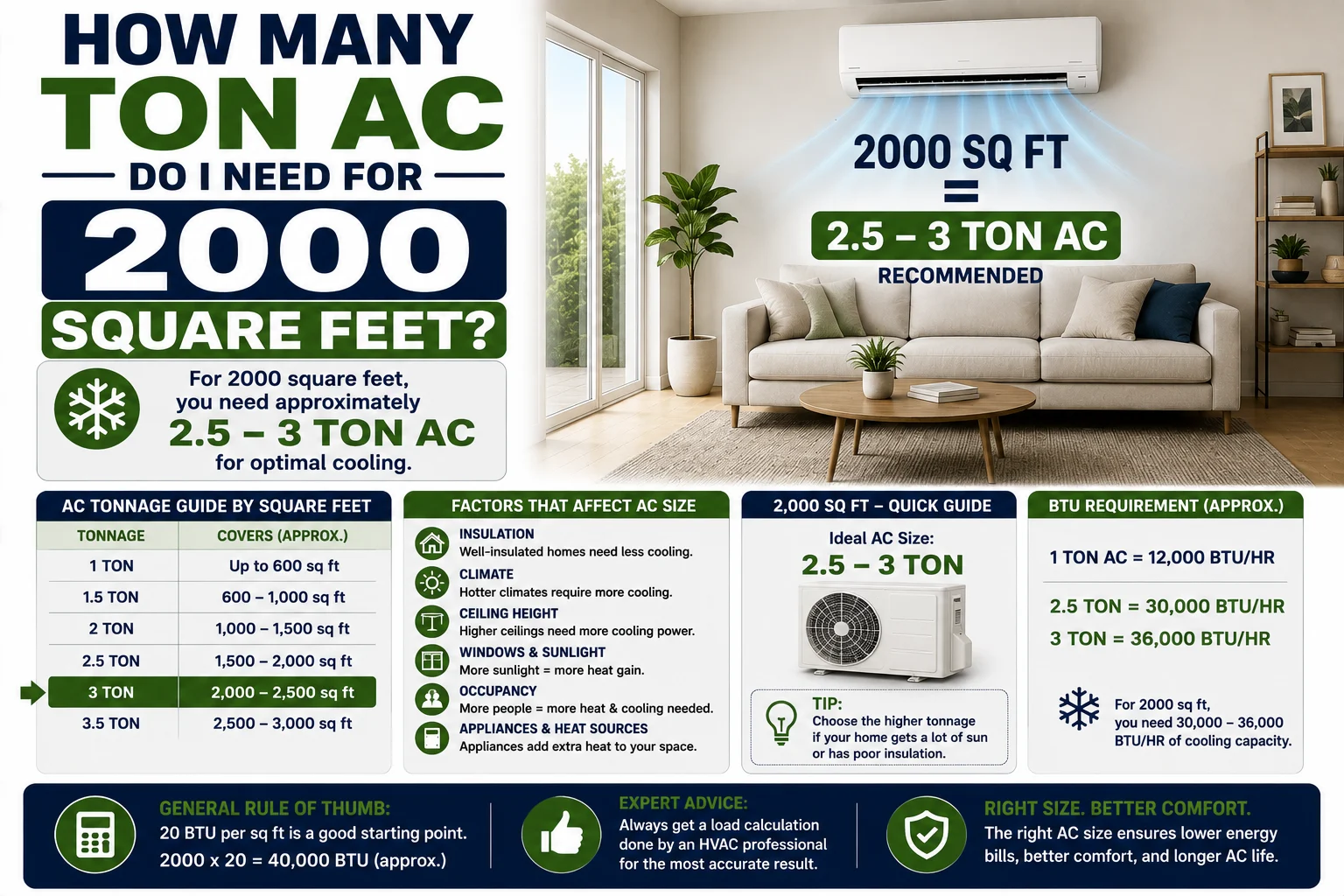
If you’re installing or replacing an air conditioner, one of the most important questions is how many tons of AC you need for 2,000 square feet.
As a general starting point, a 3.5-ton to 4-ton AC system may be appropriate for a 2,000-square-foot home under many typical conditions. However, there is no universal answer based on square footage alone.
A 3-ton system provides approximately 36,000 BTUs of cooling capacity, while a 3.5-ton system provides about 42,000 BTUs, and a 4-ton system provides about 48,000 BTUs.
For a well-insulated 2,000-square-foot home in a moderate climate, 3 tons may sometimes be sufficient. In a hotter climate, a 3.5- or 4-ton system may be more appropriate. The actual requirement depends on the home’s cooling load.
V=lwh
V=4×3×2=24
l
l
w
w
h
hl = 4h = 2w = 3
Give feedback
The best way to select an AC is therefore not simply to divide square footage by a fixed number. A professional HVAC load calculation considers insulation, windows, ceiling height, climate, orientation, occupancy, ductwork, and other sources of heat gain.
Quick Answer: What Size AC for 2,000 Square Feet?
For a 2,000-square-foot home, a reasonable preliminary range is:
3 to 4 tons of AC
The most appropriate size depends on the home’s construction and climate.
| AC Size | Approx. Cooling Capacity | Possible Application |
|---|---|---|
| 2.5 tons | 30,000 BTUs | Efficient home / mild climate |
| 3 tons | 36,000 BTUs | Efficient 2,000 sq ft home |
| 3.5 tons | 42,000 BTUs | Common middle option |
| 4 tons | 48,000 BTUs | Higher cooling load |
| 5 tons | 60,000 BTUs | Usually excessive for 2,000 sq ft unless load demands it |
These are planning estimates, not replacement for a professional load calculation.
How Many BTUs Does a 2,000-Square-Foot Home Need?
BTU stands for British thermal unit and is commonly used to describe an air conditioner’s cooling capacity.
A rough planning approach might place a 2,000-square-foot home somewhere around 36,000–48,000 BTUs, depending heavily on the climate and building characteristics.
Remember:
1 ton of AC = 12,000 BTUs
Therefore:
- 2.5 tons = 30,000 BTUs
- 3 tons = 36,000 BTUs
- 3.5 tons = 42,000 BTUs
- 4 tons = 48,000 BTUs
- 5 tons = 60,000 BTUs
The required BTU capacity should ultimately be determined by the home’s calculated cooling load rather than square footage alone.
Is a 3-Ton AC Enough for 2,000 Square Feet?
It can be.
A 3-ton AC provides approximately:
3 × 12,000 = 36,000 BTUs
A highly efficient 2,000-square-foot home may have a cooling load that can be handled by a 3-ton system.
This is more likely when the home has:
- Good insulation
- Energy-efficient windows
- Moderate outdoor temperatures
- Reasonable ceiling heights
- Limited direct sunlight
- Well-sealed walls and doors
- Efficient ductwork
However, a 3-ton system may struggle in a 2,000-square-foot house with substantial heat gain, especially in a very hot climate.
Is a 3.5-Ton AC Good for 2,000 Square Feet?
A 3.5-ton AC provides approximately 42,000 BTUs.
For many 2,000-square-foot homes, 3.5 tons can be a reasonable middle-ground estimate, but it isn’t automatically the correct size.
A 3.5-ton system may make sense when the home’s calculated cooling requirement falls around that capacity.
The key is to avoid choosing 3.5 tons simply because it falls between 3 and 4 tons.
Is a 4-Ton AC Enough for 2,000 Square Feet?
A 4-ton AC provides:
4 × 12,000 = 48,000 BTUs
A 4-ton system can cool a 2,000-square-foot house, but whether it’s the right choice depends on the actual cooling load.
In a hot climate or a home with substantial heat gain, 48,000 BTUs might be appropriate.
But if a well-insulated home only requires 36,000 BTUs, installing a 4-ton system could result in oversizing.
Is a 4-Ton AC Too Big for 2,000 Square Feet?
It can be, but not necessarily.
A 4-ton unit isn’t automatically oversized just because the home is 2,000 square feet.
The correct question is:
How much cooling does the house actually require?
For example, a poorly insulated home with large windows and high solar exposure can require substantially more cooling than a highly efficient home of the same size.
Oversizing can also cause problems such as:
- Short cycling
- Uneven temperatures
- Reduced humidity removal
- Increased wear
- Potentially higher energy consumption
That’s why professional sizing is important.
AC Size Chart for 2,000 Square Feet
Here’s a simplified comparison:
| AC Tonnage | BTU Capacity | General Consideration |
|---|---|---|
| 2 tons | 24,000 | Usually small for 2,000 sq ft |
| 2.5 tons | 30,000 | Possible in highly efficient homes |
| 3 tons | 36,000 | Possible in efficient/moderate conditions |
| 3.5 tons | 42,000 | Potential middle range |
| 4 tons | 48,000 | May suit higher cooling loads |
| 4.5 tons | 54,000 | Often unnecessary unless load demands it |
| 5 tons | 60,000 | Generally large for 2,000 sq ft |
This table should be used as a starting point rather than an equipment-selection guide.
How Climate Affects AC Size
Climate is one of the most important factors in determining air-conditioning capacity.
A 2,000-square-foot house in a mild climate may need considerably less cooling than a similar home in a very hot climate.
Mild climate
A smaller system may be sufficient, especially if the home is energy efficient.
Moderate climate
A 3- to 3.5-ton system could potentially be appropriate depending on the building.
Hot climate
A 3.5- to 4-ton system may be needed in some homes.
Very hot climate
Cooling loads can be significantly higher, particularly when insulation and windows are poor.
This is why using a generic “tons per square foot” formula can produce an inaccurate result.
How Insulation Affects AC Requirements
Insulation slows the transfer of heat into your home.
A well-insulated 2,000-square-foot house generally requires less cooling capacity than a poorly insulated house with identical dimensions.
Important areas include:
- Attic
- Exterior walls
- Floors
- Garage-adjacent walls
- Doors
- Windows
If your home has inadequate attic insulation, upgrading it may reduce the cooling load and improve comfort.
How Windows Affect AC Sizing
Windows can contribute substantial heat gain, particularly when they receive direct sunlight.
A home with:
- Large windows
- Older single-pane glass
- Unshaded west-facing windows
- Large areas of south-facing glass
may need more cooling than a similar home with modern energy-efficient windows and exterior shading.
Window coverings and exterior shading can reduce solar heat gain.
Ceiling Height Matters Too
Two homes can both measure 2,000 square feet while having very different volumes.
For example:
Home A
2,000 sq ft with 8-foot ceilings
Home B
2,000 sq ft with 12-foot ceilings
The second home contains substantially more conditioned air volume.
Vaulted ceilings and large open spaces can therefore affect the cooling requirement.
How Sun Exposure Affects a 2,000-Square-Foot Home
The amount of sunlight entering your home can influence cooling demand.
West-facing windows are particularly important because afternoon solar exposure can coincide with high outdoor temperatures.
A heavily shaded home may have a lower cooling load than a house of the same size exposed to direct sunlight throughout the afternoon.
How Many Tons of AC for 2,000 Square Feet in a Hot Climate?
For a hot climate, you may see estimates around 3.5 to 4 tons for a 2,000-square-foot home.
However, this is not a universal recommendation.
A well-insulated home with efficient windows may require less, while a poorly insulated home with high heat gain could require more.
Instead of automatically choosing 4 tons, have the cooling load calculated.
How Many Tons of AC for 2,000 Square Feet in a Moderate Climate?
In a moderate climate, 3 to 3.5 tons may be a reasonable preliminary range for some 2,000-square-foot homes.
Again, construction quality matters.
A highly efficient home might require less than 3 tons, while a poorly insulated home might require more.
How Many Tons of AC for 2,000 Square Feet in a Mild Climate?
In a mild climate, a well-insulated 2,000-square-foot home may require 2.5 to 3 tons of cooling capacity.
But don’t automatically downsize your system based on climate alone.
Other factors can increase cooling requirements.
What Is a Cooling Load Calculation?
A cooling load calculation determines how much heat an air conditioner needs to remove from a building.
Professional HVAC sizing considers factors such as:
- Outdoor design temperature
- Indoor design temperature
- Insulation
- Window area
- Window orientation
- Solar heat gain
- Ceiling height
- Building materials
- Occupants
- Appliances
- Lighting
- Air leakage
- Ductwork
- Ventilation
This provides a much more accurate result than a basic square-footage calculation.
Why You Shouldn’t Oversize Your AC
It might seem logical to purchase a larger AC because more cooling capacity sounds better.
But oversized systems can cause problems.
Short Cycling
A large system can cool the thermostat area quickly and shut off before completing a long, effective cooling cycle.
Poor Humidity Control
Air conditioning also removes moisture. Short cycles may reduce dehumidification.
Uneven Temperatures
Some areas may become comfortable while other rooms remain too warm or too cold.
Equipment Wear
Frequent starts and stops can increase mechanical stress.
The goal is to choose a system that closely matches the home’s cooling requirement.
What Happens If Your AC Is Undersized?
An undersized unit can also create problems.
Possible symptoms include:
- The AC runs continuously
- The house doesn’t reach the thermostat setting
- Rooms remain warm
- Cooling becomes inadequate during peak afternoon temperatures
- The system struggles during heat waves
However, these symptoms don’t automatically mean the AC is too small.
Dirty filters, refrigerant issues, poor ductwork, inadequate airflow, and insulation problems can produce similar symptoms.
2,000 Square Feet: 3 Ton vs. 4 Ton AC
The comparison is useful when you’re deciding between common equipment sizes.
| Feature | 3 Ton | 4 Ton |
|---|---|---|
| BTUs | 36,000 | 48,000 |
| Capacity difference | — | +12,000 BTUs |
| Possible use | Efficient/moderate-load home | Higher-load home |
| Risk if oversized | Lower | Higher if load is low |
| Best choice | Depends on load | Depends on load |
A 4-ton unit has 12,000 more BTUs of nominal capacity than a 3-ton unit.
That doesn’t mean it will cool a home better if the system is oversized.
How Many BTUs Per Square Foot for 2,000 Square Feet?
A simple rule of thumb sometimes used for preliminary estimates is to apply a BTU-per-square-foot range.
For example, if you assumed 18–24 BTUs per square foot:
2,000 × 18 = 36,000 BTUs
and:
2,000 × 24 = 48,000 BTUs
That produces a rough range of:
36,000–48,000 BTUs
which corresponds to:
3–4 tons
But this is only a rough estimate. Actual HVAC sizing should use a proper load calculation because BTU-per-square-foot rules can oversize or undersize certain homes.
How Much Electricity Does a 3- or 4-Ton AC Use?
Tonnage describes cooling capacity, not a fixed electricity consumption.
A 3-ton and 4-ton system can have different electrical requirements depending on:
- Efficiency
- Compressor technology
- Outdoor temperature
- Runtime
- Installation
- Duct losses
- Thermostat settings
- Equipment condition
A more efficient 4-ton system may consume less electricity over time than an inefficient 3-ton system under certain operating conditions.
When comparing equipment, look at the system’s efficiency ratings and estimated operating costs rather than tonnage alone.
How to Choose the Right AC for a 2,000-Square-Foot Home
Follow these steps before purchasing a system.
Step 1: Measure the Conditioned Area
Confirm that you’re calculating the area actually served by the AC.
Don’t automatically include:
- Unconditioned garages
- Attics
- Unfinished basements
- Outdoor areas
Step 2: Assess Insulation
Check the attic, walls, floors, doors, and windows.
Step 3: Consider Climate
Determine how hot your local summer conditions typically become.
Step 4: Evaluate Windows
Consider window size, age, orientation, and shading.
Step 5: Check Ductwork
Poorly designed or leaking ducts can reduce system performance.
Step 6: Get a Cooling Load Calculation
Ask an HVAC professional to calculate the home’s actual cooling load.
Step 7: Compare Efficiency
Once you know the required capacity, compare appropriately sized equipment based on efficiency, features, warranty, and installation quality.
Should You Replace Your Existing AC With the Same Tonnage?
Not necessarily.
If your old system is 4 tons, that doesn’t automatically mean your new system should also be 4 tons.
Older homes may have been fitted with systems based on simplified sizing rules.
Home improvements such as:
- New windows
- Better insulation
- Air sealing
- Roof improvements
- Duct modifications
can change the home’s cooling requirement.
Likewise, renovations or additions can increase it.
FAQs
1. How many tons of AC do I need for 2,000 square feet?
A broad preliminary range is 3 to 4 tons, or approximately 36,000–48,000 BTUs. The exact size depends on climate, insulation, windows, ceiling height, and the home’s cooling load.
2. Is a 3-ton AC enough for a 2,000-square-foot house?
It can be, especially in a well-insulated home with moderate cooling requirements. A 3-ton system provides approximately 36,000 BTUs.
3. Is a 4-ton AC too big for a 2,000-square-foot house?
Not necessarily. A 4-ton system can be appropriate when the home’s calculated cooling load requires approximately 48,000 BTUs. But it could be oversized for an efficient home with a lower cooling load.
4. How many BTUs do I need for 2,000 square feet?
A rough planning range may be around 36,000–48,000 BTUs, equivalent to 3–4 tons. A professional load calculation is more accurate than a generic BTU-per-square-foot rule.
5. What size AC is best for a 2,000-square-foot home?
There isn’t one universally correct size. 3, 3.5, or 4 tons could potentially be appropriate depending on the home’s cooling load.
6. Does climate affect the AC size I need?
Yes. Hotter climates generally increase cooling demand, while mild climates may require less capacity. Insulation and solar exposure can also have major effects.
7. Should I buy a larger AC to cool faster?
Not necessarily. Oversizing can lead to short cycling and inadequate humidity removal. The best system is appropriately sized for the home’s calculated cooling load.
Conclusion
So, how many tons of AC do you need for 2,000 square feet?
As a general starting point, a 3- to 4-ton air conditioner may be suitable for many 2,000-square-foot homes.
That translates to:
- 3 tons = 36,000 BTUs
- 3.5 tons = 42,000 BTUs
- 4 tons = 48,000 BTUs
A highly efficient home in a mild or moderate climate may need closer to 3 tons, while a home with greater heat gain or a hotter climate may require 3.5 or 4 tons.
However, square footage alone should not determine AC size. Insulation, windows, ceiling height, sunlight, climate, occupancy, ductwork, and other factors all affect cooling demand.
For the most reliable result, have a qualified HVAC professional perform a cooling-load calculation before purchasing your system. Correct sizing can improve comfort, humidity control, energy efficiency, and equipment performance.



Pingback: How Many Cubic Feet Are There in a Cubic Yard?