

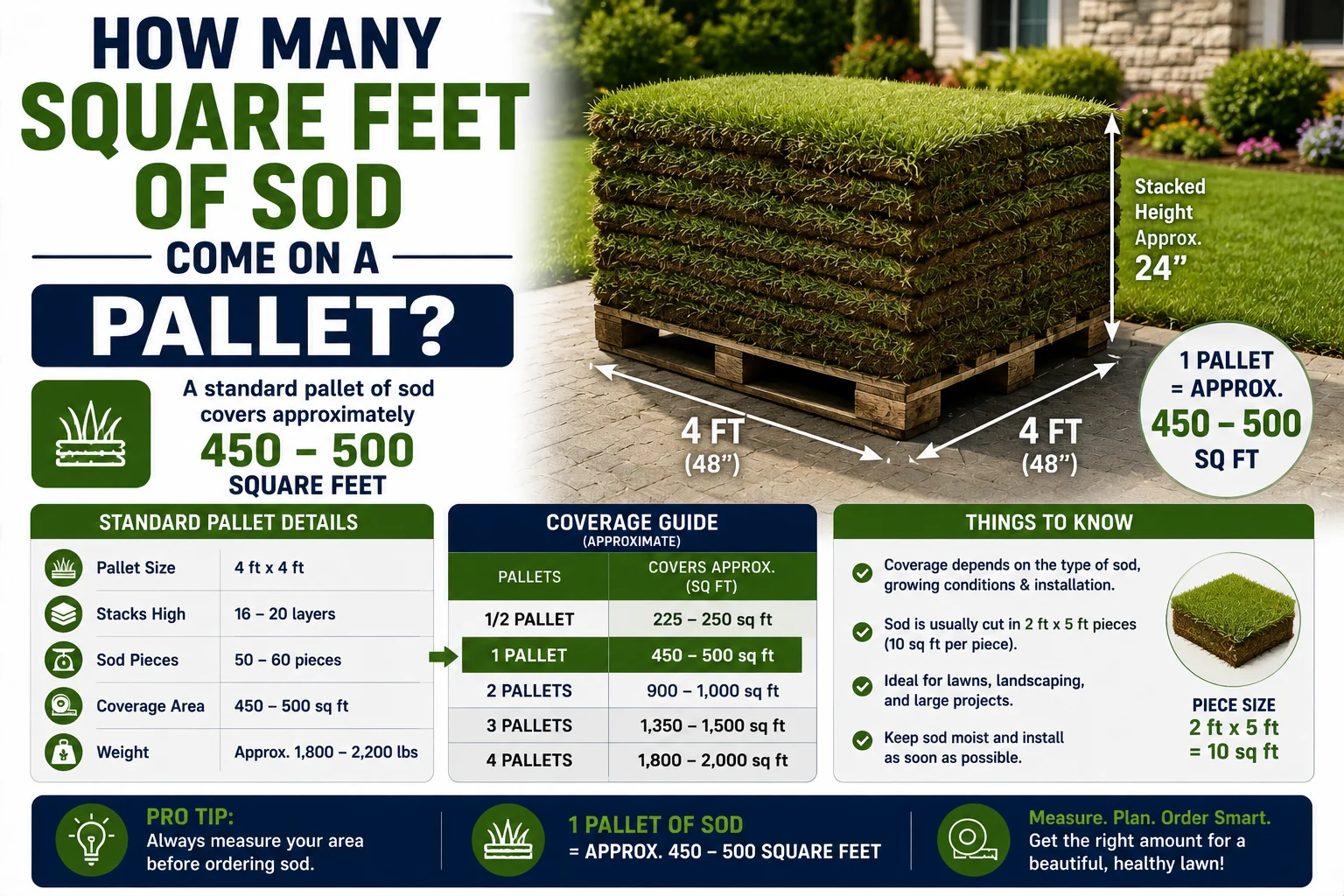
If you’re planning to install a new lawn, one of the first questions you’ll probably ask is, how many square feet of sod come on a pallet?
A typical pallet of sod covers approximately 400 to 600 square feet, although 450 or 500 square feet is a common planning figure. The exact amount depends on the grass variety, the sod farm, the size of each piece, and whether the sod is packaged as slabs, small rolls, or larger rolls.
For example, one supplier may sell a pallet containing 400 square feet, while another may stack 500 or 600 square feet on a pallet. Some large-roll systems can even reach around 700 square feet per pallet.
Therefore, there isn’t one universal pallet size.
Quick answer:
Most pallets of sod contain about 400–600 square feet, with 450–500 square feet being a common range.
The safest approach is to check the coverage listed by your specific sod supplier before calculating how many pallets to order.
Quick Answer: How Many Square Feet Are on a Pallet of Sod?
A pallet of sod commonly contains:
| Pallet Size | Approximate Coverage |
|---|---|
| Small pallet | 400 sq ft |
| Common pallet | 450 sq ft |
| Standard pallet | 500 sq ft |
| Large pallet | 600 sq ft |
| Some large-roll pallets | Up to 700 sq ft |
Sod Solutions, for example, lists pallet configurations of approximately 399, 452, and 503 square feet for slabs, 400–500 square feet for mini hand rolls, and 500–700 square feet for large rolls.
This is why you should use the actual pallet coverage provided by your supplier rather than assuming every pallet contains 500 square feet.
Why Does Sod Pallet Coverage Vary?
The amount of sod on a pallet isn’t standardized across every farm.
Several factors affect how much coverage a pallet provides:
- Grass variety
- Sod thickness
- Piece dimensions
- Roll size
- Slab size
- Harvesting method
- Regional practices
- Pallet weight limits
- Supplier packaging
A pallet isn’t simply filled until it reaches a fixed square-footage number. The grass has to be harvested, stacked, transported, and handled safely.
Different types of sod can therefore have noticeably different pallet configurations.
Common Sod Pallet Sizes
For residential projects, you’ll commonly encounter pallets containing approximately 400, 450, 500, or 600 square feet.
400-Square-Foot Pallet
A 400-square-foot pallet is common for certain warm-season sod products.
If your lawn measures 800 square feet:
800 ÷ 400 = 2 pallets
So you would need at least 2 pallets before allowing for installation waste.
450-Square-Foot Pallet
A 450-square-foot pallet is another common configuration.
For a 900-square-foot lawn:
900 ÷ 450 = 2 pallets
So two pallets theoretically provide exactly 900 square feet.
However, you may want additional material for trimming and irregular areas.
500-Square-Foot Pallet
A 500-square-foot pallet is one of the easiest figures to use when estimating a project.
For example:
1 pallet = 500 sq ft
2 pallets = 1,000 sq ft
3 pallets = 1,500 sq ft
4 pallets = 2,000 sq ft
This is why many general sod calculators use 500 square feet as a standard planning assumption.
600-Square-Foot Pallet
Some suppliers, particularly those selling larger rolls, offer pallets containing approximately 600 square feet.
For example:
600 sq ft × 2 pallets = 1,200 sq ft
If you’re ordering this type of sod, using a 500-square-foot assumption could cause you to overestimate the number of pallets required.
How Many Pieces of Sod Are on a Pallet?
The number of pieces depends on the size and format of the sod.
For example, a common cool-season roll may measure approximately:
2 feet × 5 feet
That equals:
10 square feet per roll
A 500-square-foot pallet would therefore contain approximately:
500 ÷ 10 = 50 rolls
So a 500-square-foot pallet can contain about 50 standard 2 × 5-foot rolls.
A 600-square-foot pallet using the same roll size would contain:
600 ÷ 10 = 60 rolls
However, not all sod is sold in 2 × 5-foot rolls.
Sod Rolls vs. Sod Slabs
Sod can come in different forms.
Sod Rolls
Rolls are long strips of grass and soil that can be unrolled across the lawn.
A common roll size is:
2 feet × 5 feet = 10 square feet
Rolls are frequently associated with cool-season grasses.
Sod Slabs
Slabs are flat rectangular pieces.
A commonly used slab size is approximately:
16 inches × 24 inches
That provides about:
2.67 square feet per slab
Sod Solutions notes that slab pallets can be configured around 399, 452, or 503 square feet, depending on the product and supplier.
Because piece sizes differ, the number of pieces on a pallet isn’t as important as the total square-foot coverage.
How to Calculate How Much Sod You Need
Before ordering sod, determine the square footage of the area you’re covering.
For a rectangular lawn, use:
Length × Width = Square Feet
For example, if your lawn is:
- 50 feet long
- 20 feet wide
Calculate:
50 × 20 = 1,000 square feet
So you need to cover 1,000 square feet.
Then divide the lawn area by the coverage of one pallet.
If your supplier’s pallet covers 500 square feet:
1,000 ÷ 500 = 2 pallets
Mathematically, two pallets cover the area.
But you should also consider waste.
How Much Extra Sod Should You Order?
It’s usually wise to order some extra sod rather than ordering exactly the measured square footage.
A common planning allowance is approximately 5% to 10% extra, depending on the shape and complexity of the lawn.
Extra material helps account for:
- Straight-edge cuts
- Curved borders
- Trees
- Flower beds
- Walkways
- Driveways
- Irregular lawn shapes
- Damaged pieces
- Small installation mistakes
For a simple rectangular lawn, you may need less extra material than for a yard containing many curves and obstacles.
Example: 1,000 Square Feet of Lawn
Suppose your lawn measures:
1,000 square feet
Add 10%:
1,000 × 1.10 = 1,100 square feet
If one pallet contains 500 square feet:
1,100 ÷ 500 = 2.2 pallets
Since you generally can’t rely on 0.2 of a full pallet unless your supplier specifically offers partial pallets, you’d normally need to plan for 3 pallets.
However, whether you actually need three full pallets depends on the supplier’s ordering policy and whether partial pallets are available.
How Many Pallets of Sod Do I Need for 500 Square Feet?
The answer depends on pallet size.
With a 400-sq-ft pallet:
500 ÷ 400 = 1.25
You would need 2 pallets if full pallets are required.
With a 500-sq-ft pallet:
500 ÷ 500 = 1
You would need 1 pallet, before adding waste.
With a 600-sq-ft pallet:
500 ÷ 600 = 0.83
One pallet would provide enough material.
How Many Pallets of Sod Do I Need for 1,000 Square Feet?
Using a 500-square-foot pallet:
1,000 ÷ 500 = 2
So:
2 pallets cover 1,000 square feet
Before installation, consider adding approximately 5%–10% for waste.
With 10% extra:
1,000 × 1.10 = 1,100 square feet
That means two 500-square-foot pallets would provide only 1,000 square feet, so you may need additional material or a supplier that offers partial pallets.
How Many Pallets of Sod Do I Need for 1,500 Square Feet?
Using 500-square-foot pallets:
1,500 ÷ 500 = 3
Therefore:
3 pallets cover 1,500 square feet
With a 10% allowance:
1,500 × 1.10 = 1,650 square feet
That could require additional sod depending on your supplier’s pallet size and ordering options.
How Many Pallets of Sod Do I Need for 2,000 Square Feet?
Using a 500-square-foot pallet:
2,000 ÷ 500 = 4
Therefore:
4 pallets = 2,000 square feet
With 10% extra:
2,000 × 1.10 = 2,200 square feet
If your supplier sells only full 500-square-foot pallets, you may need 5 pallets to have enough material.
How Many Pallets of Sod Do I Need for 2,500 Square Feet?
Using 500-square-foot pallets:
2,500 ÷ 500 = 5
Therefore:
5 pallets cover 2,500 square feet
With a 10% waste allowance:
2,500 × 1.10 = 2,750 square feet
At 500 square feet per pallet, that would be:
2,750 ÷ 500 = 5.5 pallets
So you may need 6 pallets if only full pallets are available.
How Many Pallets of Sod Do I Need for 5,000 Square Feet?
Using 500 square feet per pallet:
5,000 ÷ 500 = 10
Therefore:
10 pallets cover 5,000 square feet
With 5% extra:
5,000 × 1.05 = 5,250 square feet
With 10% extra:
5,000 × 1.10 = 5,500 square feet
That means you may need approximately 11 pallets if the sod comes in 500-square-foot full pallets.
Sod Pallet Coverage Chart
Here’s a quick reference using a 500-square-foot pallet:
| Lawn Size | Pallets Needed Before Waste |
|---|---|
| 400 sq ft | 1 |
| 500 sq ft | 1 |
| 750 sq ft | 2 |
| 1,000 sq ft | 2 |
| 1,250 sq ft | 3 |
| 1,500 sq ft | 3 |
| 2,000 sq ft | 4 |
| 2,500 sq ft | 5 |
| 3,000 sq ft | 6 |
| 4,000 sq ft | 8 |
| 5,000 sq ft | 10 |
| 10,000 sq ft | 20 |
These figures assume 500 square feet per pallet and don’t include extra material for waste.
How Many Square Feet Does One Roll of Sod Cover?
A commonly used sod roll measures:
2 feet × 5 feet
Therefore:
2 × 5 = 10 square feet
So one standard 2 × 5-foot roll covers approximately:
10 square feet
But roll sizes vary, so always check the dimensions supplied by your sod farm.
How Much Sod Is on a Pallet of 500 Square Feet?
If each roll covers 10 square feet:
500 ÷ 10 = 50 rolls
Therefore, a 500-square-foot pallet could contain approximately:
50 rolls
Again, this assumes each roll is exactly 2 × 5 feet.
How Much Sod Is on a 600-Square-Foot Pallet?
Using 2 × 5-foot rolls:
600 ÷ 10 = 60 rolls
So a 600-square-foot pallet would contain approximately:
60 rolls
Some suppliers use this configuration for larger-roll cool-season sod.
Does Grass Type Affect Pallet Size?
Yes.
Different grass varieties can be harvested and packaged differently.
Warm-season grasses commonly include:
- Bermuda
- Zoysia
- St. Augustine
- Centipede
Cool-season grasses commonly include:
- Kentucky bluegrass
- Tall fescue
- Fine fescue
- Perennial ryegrass
The packaging format can vary between these categories, which is one reason pallet coverage isn’t universal.
How to Measure an Irregular Lawn
Not every lawn is a perfect rectangle.
If your yard has an unusual shape, divide it into smaller sections.
For example:
- Section A = 500 sq ft
- Section B = 300 sq ft
- Section C = 200 sq ft
Total:
500 + 300 + 200 = 1,000 square feet
Then calculate the number of pallets based on the supplier’s coverage.
For a 500-square-foot pallet:
1,000 ÷ 500 = 2 pallets
Add your desired waste allowance afterward.
How to Calculate Sod for a Circular Area
For a circular lawn section, use:
Area = π × radius²
Suppose the radius is 10 feet:
3.14159 × 10 × 10 ≈ 314 square feet
So the area is approximately 314 square feet.
If your sod comes on 500-square-foot pallets, one pallet would provide enough coverage for the mathematical area, although actual installation requirements and waste should still be considered.
Should You Buy a Full Pallet or Individual Pieces?
For a very small lawn, buying a full pallet may not be necessary.
Individual pieces or rolls can be more practical for:
- Small patches
- Repairs
- Narrow strips
- Around trees
- Small garden areas
Full pallets generally make more sense for larger lawn installations.
Before ordering, ask your supplier whether they sell:
- Full pallets
- Half pallets
- Individual rolls
- Individual slabs
- Custom quantities
What to Ask the Sod Supplier
Before placing your order, ask these questions:
- How many square feet are on one pallet?
- What are the dimensions of each piece?
- Is the sod sold as rolls or slabs?
- How many pieces are included?
- How much does a full pallet weigh?
- Can you order a partial pallet?
- When will the sod be harvested?
- How quickly should it be installed after delivery?
- Is delivery included?
- What happens if the pallet contains damaged pieces?
These questions can prevent ordering mistakes.
How Quickly Should Sod Be Installed?
Fresh sod is perishable.
Once harvested, it is no longer receiving water and nutrients from the soil where it was grown. Heat can also build up inside stacked sod.
For that reason, you should plan the installation carefully and follow your supplier’s handling instructions. Some industry guidance recommends installing sod within roughly 24–48 hours, with faster installation particularly important during hot weather.
Don’t order a large amount of sod several days before you’re ready to install it unless the supplier specifically advises that it’s acceptable.
How Much Does a Pallet of Sod Weigh?
The weight varies considerably depending on:
- Grass type
- Soil thickness
- Moisture
- Pallet coverage
- Harvest conditions
A wet pallet can weigh substantially more than a dry pallet.
This matters when arranging transportation.
A full pallet of sod can be heavy enough that homeowners should carefully consider whether their vehicle, trailer, or truck is rated to carry it.
For larger orders, professional delivery is often the more practical option.
Does Pallet Size Affect Sod Cost?
Yes, it can.
When comparing prices, don’t look only at the price of one pallet.
Instead, calculate:
Price per square foot = Pallet price ÷ Square feet per pallet
For example:
Suppose one supplier charges $250 for a 500-square-foot pallet:
$250 ÷ 500 = $0.50 per sq ft
Another supplier charges $270 for a 600-square-foot pallet:
$270 ÷ 600 = $0.45 per sq ft
The second pallet costs more overall but provides more sod and has a lower cost per square foot.
Also consider delivery charges and whether the pallet contains the grass variety you actually need.
Common Mistakes When Ordering Sod by the Pallet
1. Assuming Every Pallet Has 500 Square Feet
500 square feet is common, but it isn’t universal.
Some pallets contain approximately 400, 450, 500, 600, or even more square feet depending on the product and supplier.
2. Forgetting Waste
Ordering exactly the measured lawn area can leave you short.
3. Measuring the Wrong Area
Don’t include patios, driveways, sheds, flower beds, or other areas that won’t receive sod.
4. Ignoring Piece Size
A pallet with 50 large rolls and a pallet with 100 small pieces could contain similar square footage.
5. Waiting Too Long to Install
Sod should be installed promptly after delivery, especially during hot weather.
6. Ignoring Delivery Access
Make sure the delivery truck and forklift can reach a suitable location.
FAQs
1. How many square feet of sod come on a pallet?
Most pallets contain approximately 400–600 square feet, with 450–500 square feet being a common range. Some large-roll configurations can contain around 600–700 square feet. The exact coverage depends on the supplier, grass type, and cut format.
2. Is 500 square feet a standard pallet of sod?
A 500-square-foot pallet is a common configuration, but it isn’t a universal industry standard. Always confirm the coverage with the sod supplier.
3. How many rolls of sod are on a 500-square-foot pallet?
If each roll measures 2 × 5 feet, each roll covers 10 square feet. Therefore, a 500-square-foot pallet contains approximately 50 rolls.
4. How many pallets of sod do I need for 1,000 square feet?
With 500 square feet per pallet:
1,000 ÷ 500 = 2 pallets
You may need additional material for waste and trimming.
5. How many pallets do I need for 2,000 square feet?
At 500 square feet per pallet, you need 4 pallets before adding extra material. With a 5–10% waste allowance, you may need additional sod depending on how the supplier sells it.
6. How much extra sod should I order?
A 5–10% allowance is commonly used to account for trimming, curves, obstacles, and damaged pieces. A simple rectangular lawn may require less waste than a highly irregular yard.
7. Does the type of grass affect pallet coverage?
Yes. Grass varieties and harvesting methods can use different piece sizes and pallet configurations. Warm-season sod may commonly be sold as slabs, while cool-season sod is often sold in rolls.
Conclusion
So, how many square feet of sod come on a pallet?
The most useful general answer is:
About 400–600 square feet per pallet
A 450- or 500-square-foot pallet is a common size for many residential sod orders, while some suppliers offer 400-square-foot pallets and others provide 600-square-foot or larger configurations.
The exact amount depends on the grass variety, sod piece size, harvesting method, supplier, and pallet configuration. That’s why you shouldn’t automatically assume that every pallet contains 500 square feet.
To estimate your order, first measure your lawn in square feet, add roughly 5–10% for trimming and waste, and then divide the total by the square footage provided by one pallet. Most importantly, confirm the pallet coverage with your local sod supplier before ordering. This simple step can help prevent buying too little or paying for more sod than your lawn requires.



Pingback: How Many Cubic Feet Equal 1 Cubic Yard?