

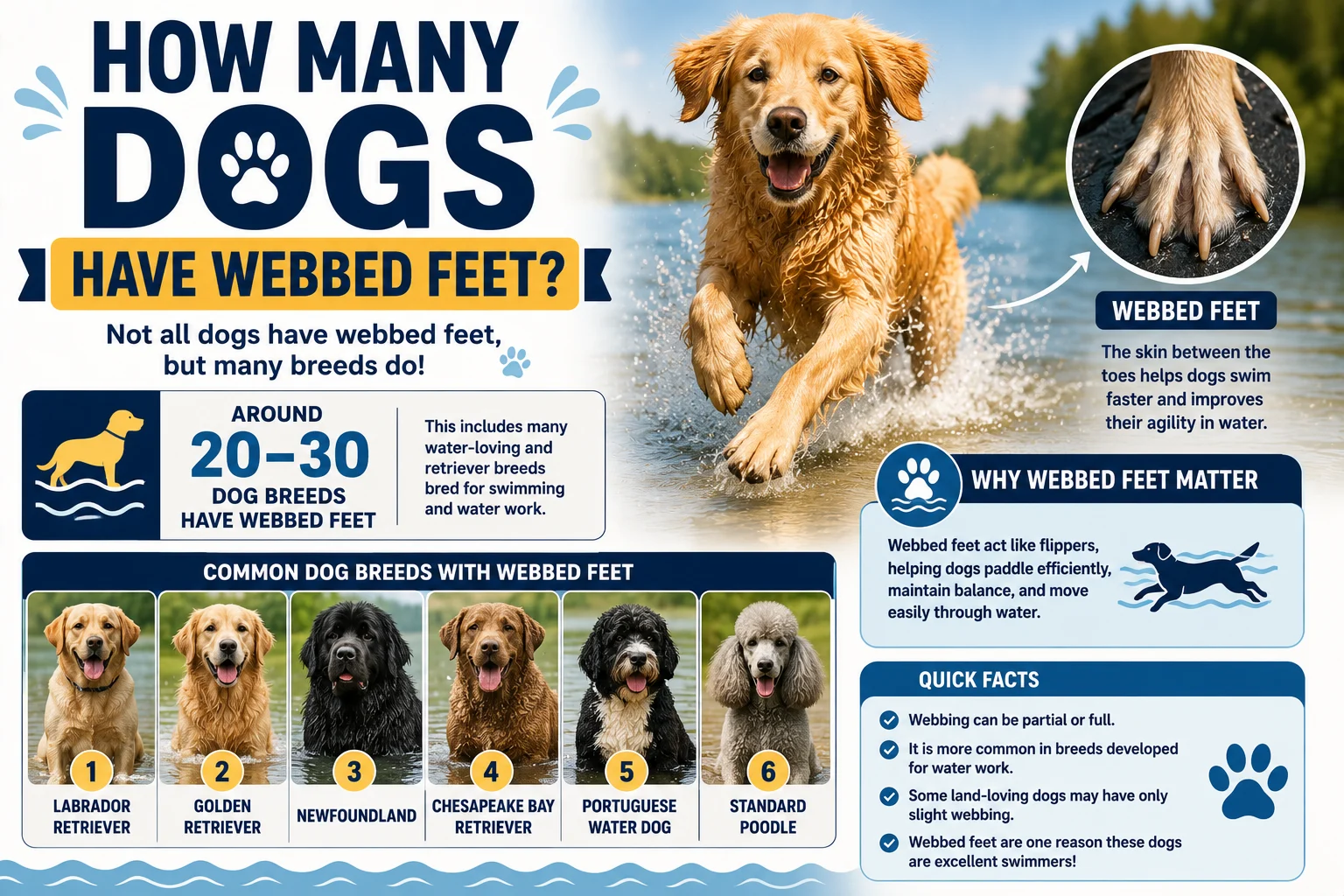
Have you ever looked closely at a dog’s paws and noticed a thin layer of skin between its toes? You may have wondered, how many dogs have webbed feet?
The interesting answer is that many dogs have some degree of natural webbing between their toes. In fact, the presence of interdigital skin is a normal part of canine paw anatomy. What varies from dog to dog is how extensive or noticeable that webbing is.
Some breeds have especially prominent webbing because they were developed for activities involving water, swimming, retrieving, or working in muddy terrain. Labrador Retrievers, Newfoundlands, Portuguese Water Dogs, Chesapeake Bay Retrievers, and several other water-oriented breeds are well known for their webbed-looking paws.
There isn’t a reliable universal percentage that tells us exactly what proportion of all dogs have “webbed feet,” because virtually all dogs have skin between their toes to some degree, while the amount of webbing varies by individual and breed.
So, rather than asking whether a dog has webbed feet in an all-or-nothing sense, it’s more accurate to ask how much interdigital webbing the dog has and how prominent it is.
Do Dogs Have Webbed Feet?
Yes, dogs generally have some webbing between their toes.
The skin connecting a dog’s toes is called interdigital webbing or interdigital skin.
Unlike the broad, continuous webbing seen in animals such as ducks, a dog’s toe webbing usually isn’t a large membrane extending between the entire length of the toes.
Instead, dogs have skin extending between their digits that helps connect and support the paw.
In certain breeds, this webbing is more substantial and noticeable.
How Many Dogs Actually Have Webbed Feet?
There isn’t a scientifically established percentage for the number of dogs with “webbed feet.”
That’s because webbing is not usually treated as a simple yes-or-no characteristic in dogs.
Most dogs have interdigital skin, but the amount varies.
A better way to describe dogs is:
- Some degree of webbing: Common among dogs
- Highly pronounced webbing: More characteristic of certain breeds
- Strong swimming adaptations: Especially common in water-oriented breeds
Therefore, saying that only a few specific breeds have webbed feet can be misleading.
Many dogs have some webbing, but certain breeds have paws that are particularly adapted for swimming.
Why Do Dogs Have Webbed Feet?
Webbing can provide several practical advantages.
One of the most important is helping a dog move through water or soft ground.
When a dog swims, its paws push against the water. A broader paw surface can help the dog generate propulsion.
Webbing can also help dogs:
- Paddle more effectively
- Move through muddy ground
- Spread their weight
- Maintain traction
- Navigate wet environments
The importance of these characteristics depends on the dog’s breed and lifestyle.
Which Dog Breeds Have Webbed Feet?
Several breeds are particularly well known for noticeable interdigital webbing.
Some of the best-known examples include:
- Labrador Retriever
- Newfoundland
- Portuguese Water Dog
- Chesapeake Bay Retriever
- American Water Spaniel
- Irish Water Spaniel
- Nova Scotia Duck Tolling Retriever
- German Wirehaired Pointer
- German Shorthaired Pointer
- Otterhound
Many of these breeds were developed for retrieving, swimming, hunting around water, or other activities where efficient movement through wet environments was useful.
1. Labrador Retriever
Labrador Retrievers are one of the most recognizable breeds associated with webbed feet.
Their paws are well suited to swimming, which is especially useful given the breed’s history as a retrieving dog.
Labradors have several physical characteristics that help them in water, including:
- Water-resistant coat
- Strong tail
- Broad chest
- Powerful limbs
- Webbed feet
Their webbing helps give the paw a broader surface for pushing against water.
2. Newfoundland
Newfoundlands are famous for their swimming ability.
They have large paws with noticeable webbing that can help them propel their substantial bodies through water.
Newfoundlands were historically associated with water-related work, particularly around Newfoundland’s fishing communities.
Their combination of size, strength, coat, and swimming-adapted paws makes them particularly capable in the water.
3. Portuguese Water Dog
Portuguese Water Dogs were historically used by fishermen and are strongly associated with water work.
Their feet have webbing that can help with swimming.
The breed’s physical characteristics reflect its working history around water, including a strong, athletic build and coat adapted to wet environments.
4. Chesapeake Bay Retriever
Chesapeake Bay Retrievers were developed as waterfowl retrievers.
They are strong swimmers and have feet adapted for moving through water.
Their webbed toes can help them push water while swimming, making the feet an important part of their working anatomy.
5. American Water Spaniel
American Water Spaniels were developed as hunting and retrieving dogs, particularly in environments involving water.
Their feet feature webbing that supports swimming and retrieving work.
The breed is relatively compact but athletic, making it capable of moving through both water and land.
6. Irish Water Spaniel
Irish Water Spaniels are another breed associated with water.
Their history as waterfowl retrievers means swimming ability was an important working trait.
Their paws have webbing that helps support their movement through water.
7. Nova Scotia Duck Tolling Retriever
The Nova Scotia Duck Tolling Retriever is a water-oriented retrieving breed.
It was developed to work around water and retrieve game.
Like other retrieving breeds, it has physical characteristics that support swimming and water work, including webbing between the toes.
8. German Shorthaired Pointer
German Shorthaired Pointers are versatile hunting dogs that can work on land and in water.
Their feet have webbing that can help with swimming and movement through wet terrain.
Their webbing isn’t necessarily as dramatic as that of some water-specialized breeds, but it can still be noticeable.
9. German Wirehaired Pointer
German Wirehaired Pointers are also versatile hunting dogs.
Their webbed feet can assist with swimming and navigating wet environments.
The breed was developed for varied hunting conditions, including work around water.
10. Otterhound
The Otterhound is another breed associated with water.
As its name suggests, the breed historically worked around waterways.
Its large, webbed feet contribute to its swimming ability.
Why Are Labrador Feet Webbed?
Labrador Retrievers are one of the most commonly mentioned examples when people search for dogs with webbed feet.
Their webbing is useful because Labradors have a long history as retrieving dogs.
A Labrador may need to:
- Enter cold water
- Swim after birds
- Retrieve objects
- Cross wetlands
- Move through muddy terrain
A broad, webbed paw can help generate forward thrust during swimming.
Are All Dogs Born With Webbed Feet?
Dogs are generally born with skin between their toes.
However, the appearance of that skin varies.
In some puppies, the webbing can look quite noticeable. In others, it may appear minimal.
As the dog grows, the paws change in size and shape, and the amount of visible webbing can become more or less noticeable.
The presence of interdigital skin alone doesn’t necessarily mean a dog belongs to a water breed.
Are Webbed Feet Normal in Dogs?
Yes.
Interdigital webbing is a normal feature of canine paws.
It generally isn’t something that indicates a health problem.
However, a sudden change in the appearance of the skin between the toes can be different.
For example, swelling, redness, bleeding, discharge, excessive licking, or pain can indicate a paw problem and should be evaluated by a veterinarian.
Do Webbed Feet Make Dogs Better Swimmers?
Not necessarily by themselves.
Webbing can help provide a broader surface for pushing against water, but swimming ability depends on many characteristics.
These include:
- Body shape
- Leg strength
- Paw structure
- Buoyancy
- Coat
- Coordination
- Confidence
- Experience
- Breed characteristics
A dog with webbed paws isn’t automatically a strong swimmer.
Can Dogs Without Noticeable Webbing Swim?
Yes.
Dogs don’t need highly visible webbing to swim.
Many dogs with relatively narrow-looking feet can swim effectively.
Swimming ability varies significantly between individual dogs.
Some breeds are naturally comfortable in water, while others may struggle because of their body shape or simply dislike swimming.
Do Webbed Feet Help Dogs Walk on Mud?
They can.
Webbing can help distribute the paw’s contact with soft surfaces.
When a dog walks through mud, snow, or other soft ground, a broader paw can potentially provide useful support.
This is one reason certain working breeds have feet well adapted to challenging terrain.
However, webbing isn’t the only factor determining how well a dog handles mud or snow.
Dog Webbed Feet vs. Duck Webbed Feet
Dog and duck feet are very different.
Duck feet
A duck has broad, obvious webbing connecting its toes and uses its feet as paddles.
Dog feet
Dogs generally have toes separated by interdigital skin rather than a large paddle-like membrane.
Certain dog breeds have more noticeable webbing, but even highly webbed dog paws aren’t structured like duck feet.
What Does Webbing Between a Dog’s Toes Look Like?
If you gently examine a dog’s paw, you may notice skin extending between the toes.
In a dog with prominent webbing, the skin can appear to extend relatively high between the digits.
The amount can differ:
Minimal webbing → More pronounced webbing → Highly noticeable webbing
The appearance can also vary between the front and rear feet.
Is Webbing the Same on All Four Feet?
Not necessarily.
A dog’s front and rear paws can have different shapes.
The amount of visible interdigital skin can also differ from one paw to another.
This is normal variation.
If you’re examining your dog and notice a difference, don’t assume it indicates a problem unless there are other symptoms such as swelling, pain, redness, or discharge.
Does Webbing Affect a Dog’s Speed?
Webbing isn’t primarily an adaptation for running speed.
Its most obvious potential benefit is related to:
- Swimming
- Soft terrain
- Paw support
- Traction
Running ability depends on many other factors, including leg structure, muscle, body proportions, and gait.
Can Webbed Feet Be a Genetic Trait?
Yes.
The structure and appearance of a dog’s paws are influenced by genetics.
Breed selection over generations can reinforce physical characteristics that are useful for particular jobs.
Water-oriented breeds were often selected for traits that supported swimming, retrieving, and working in aquatic environments.
However, the amount of webbing can still vary between individual dogs of the same breed.
Do Mixed-Breed Dogs Have Webbed Feet?
Yes.
Mixed-breed dogs can have noticeable interdigital webbing.
Their paw structure may reflect traits inherited from one or more breeds in their ancestry.
For example, a mixed-breed dog with Labrador or Newfoundland ancestry may have relatively prominent webbing.
However, you cannot reliably determine a dog’s ancestry solely by looking at its paws.
Does More Webbing Mean a Dog Is Better at Swimming?
No.
More visible webbing doesn’t guarantee better swimming ability.
A dog’s body structure and behavior are also important.
For example, some dogs have body shapes that make swimming difficult even if they have webbing.
Dogs with short snouts, very heavy bodies, or unusual proportions may need additional caution around water.
Never assume that a dog is safe in deep water simply because its paws appear webbed.
How to Check Your Dog’s Paws
If you want to see whether your dog has noticeable webbing:
Step 1: Choose a calm time
Don’t force your dog to hold its paw up if it is uncomfortable.
Step 2: Gently lift one paw
Support the paw rather than pulling on the toes.
Step 3: Look between the toes
You may see skin connecting the digits.
Step 4: Compare the paws
Look at both front and rear feet.
Step 5: Check for abnormalities
Look for:
- Redness
- Swelling
- Cuts
- Foreign objects
- Cracked skin
- Discharge
- Excessive licking
If something looks abnormal or your dog appears painful, contact a veterinarian.
FAQs
1. How many dogs have webbed feet?
There isn’t a reliable percentage for all dogs because some degree of interdigital webbing is normal canine anatomy. What varies is how extensive and noticeable the webbing is.
2. Which dog breeds have the most noticeable webbed feet?
Breeds strongly associated with water work include Labrador Retrievers, Newfoundlands, Portuguese Water Dogs, Chesapeake Bay Retrievers, American Water Spaniels, and Irish Water Spaniels.
3. Do all dogs have webbed feet?
Dogs generally have skin between their toes, but the degree of webbing varies. Not every dog has the prominent webbing people typically mean when they say “webbed feet.”
4. Why do Labradors have webbed feet?
Labradors were developed as retrieving dogs and have a long history of working around water. Their webbed paws can help provide propulsion while swimming.
5. Can dogs with webbed feet swim better?
Webbing can help with paddling, but it doesn’t guarantee swimming ability. Body shape, strength, coordination, confidence, and breed characteristics also matter.
6. Are webbed feet in dogs normal?
Yes. Interdigital skin is a normal part of canine paw anatomy. Sudden swelling, redness, pain, discharge, or other changes should be checked by a veterinarian.
7. Can mixed-breed dogs have webbed feet?
Yes. Mixed-breed dogs can inherit paw characteristics, including noticeable webbing, from their parents.
Conclusion
So, how many dogs have webbed feet?
The answer isn’t a specific percentage because webbing between the toes is a normal feature of canine paws, and the degree of webbing varies from dog to dog.
Some breeds have particularly noticeable webbing because their ancestors were selected for water-related work. Labrador Retrievers, Newfoundlands, Portuguese Water Dogs, Chesapeake Bay Retrievers, and various spaniels and pointers are well-known examples.
Webbed paws can help a dog push against water and may also provide advantages on soft or muddy surfaces. However, webbing alone doesn’t determine swimming ability.
If your dog has webbed-looking paws, there’s usually nothing unusual about it. The more important thing is to watch for changes such as swelling, redness, pain, bleeding, or excessive licking, which may indicate a paw problem requiring veterinary attention.