

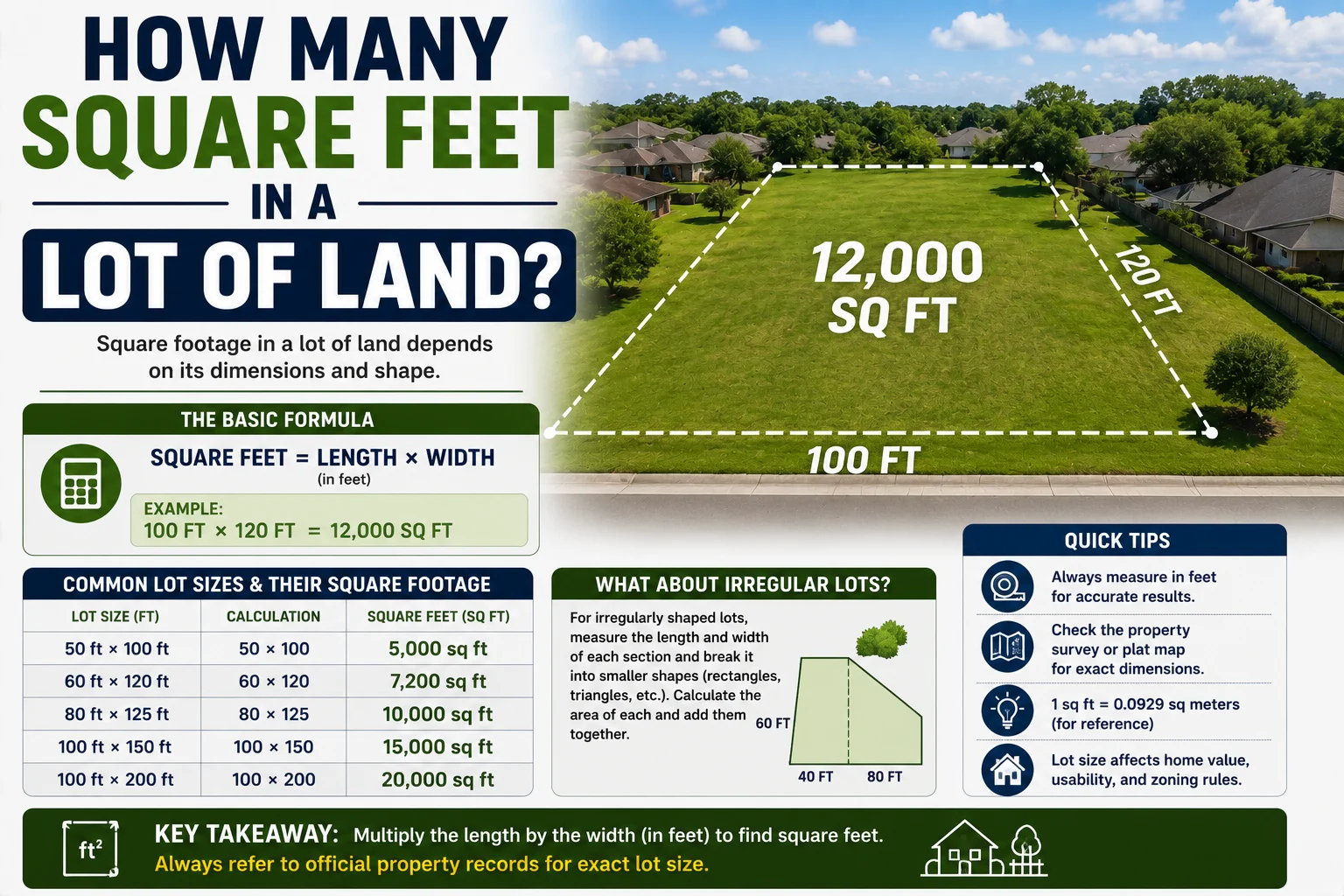
If you’re buying a home, planning to build a house, or comparing properties, you may wonder, how many square feet are in a lot of land?
The answer depends on the size and dimensions of the lot. Unlike an acre, which has a fixed area of 43,560 square feet, a “lot” does not have one universal size.
A residential lot might contain 5,000 square feet, 7,500 square feet, 10,000 square feet, 20,000 square feet, or much more. In rural areas, lots can be measured in fractions of an acre or several acres.
For example, a rectangular lot measuring 50 feet × 100 feet contains 5,000 square feet. A 60 × 100-foot lot contains 6,000 square feet, while an 80 × 100-foot lot contains 8,000 square feet.
A=lw
A=6×4=24
4 rows by 6 columns = 24 square units.
w
w
l
l24 square unitsw = 6l = 4
Give feedback
The key point is that there is no single square-foot measurement for a lot of land. You need the lot’s dimensions or acreage to determine its total area.
Quick Answer: How Many Square Feet Is a Lot?
A typical residential lot can vary widely, but common examples include:
| Lot Size | Square Feet |
|---|---|
| 40 × 100 ft | 4,000 sq ft |
| 50 × 100 ft | 5,000 sq ft |
| 60 × 100 ft | 6,000 sq ft |
| 70 × 100 ft | 7,000 sq ft |
| 80 × 100 ft | 8,000 sq ft |
| 100 × 100 ft | 10,000 sq ft |
| 100 × 150 ft | 15,000 sq ft |
| 0.25 acre | 10,890 sq ft |
| 0.5 acre | 21,780 sq ft |
| 1 acre | 43,560 sq ft |
These are examples rather than a universal definition of a “standard” lot.
Is There a Standard Lot Size?
No, there is no single standard lot size.
The size of residential lots depends on:
- Location
- Local zoning regulations
- Neighborhood design
- Property values
- Housing density
- Urban or rural setting
- Subdivision requirements
- Available land
- Utility requirements
Urban neighborhoods often have smaller lots because land is expensive and housing density is higher.
Suburban lots may provide several thousand to tens of thousands of square feet.
Rural properties can be measured in acres rather than thousands of square feet.
What Is the Average Lot Size?
There is no single average that applies to every location.
For general planning purposes, many residential lots fall somewhere between 5,000 and 15,000 square feet, but actual lot sizes can be significantly smaller or larger.
For example:
- Small urban lot: 2,500–5,000 sq ft
- Typical suburban lot: 5,000–15,000 sq ft
- Large suburban lot: 15,000–30,000+ sq ft
- Rural lot: 1 acre or more
These categories are broad examples, not official standards.
How Do You Calculate the Square Feet of a Lot?
If the lot is rectangular, calculating its area is straightforward.
Length × Width = Square Feet
For example, suppose a lot measures:
60 feet × 100 feet
Calculate:
60 × 100 = 6,000 square feet
Therefore, the lot contains:
6,000 square feet
Common Residential Lot Sizes
50 × 100-Foot Lot
A lot measuring 50 feet wide and 100 feet deep contains:
50 × 100 = 5,000 square feet
This is a relatively compact residential lot.
It may provide enough space for a house, driveway, yard, and other outdoor features, depending on local setbacks and zoning rules.
60 × 100-Foot Lot
A 60 × 100-foot lot contains:
60 × 100 = 6,000 square feet
This provides more width than a 50 × 100 lot.
The additional frontage can make a difference when planning a home’s footprint, driveway, garage, or landscaping.
70 × 100-Foot Lot
A 70 × 100-foot lot provides:
70 × 100 = 7,000 square feet
This is a reasonably sized residential lot in many suburban settings.
80 × 100-Foot Lot
An 80 × 100-foot lot contains:
80 × 100 = 8,000 square feet
The wider frontage can provide additional flexibility for house placement and outdoor space.
100 × 100-Foot Lot
A square lot measuring 100 feet on each side contains:
100 × 100 = 10,000 square feet
This is approximately 0.23 acre.
How Many Square Feet Are in a Quarter-Acre Lot?
A quarter acre contains:
10,890 square feet
This is because:
43,560 ÷ 4 = 10,890
A quarter-acre lot can have many different dimensions.
For example, it could be approximately:
- 100 × 108.9 feet
- 90 × 121 feet
- 80 × 136.1 feet
The dimensions don’t need to form a perfect square.
How Many Square Feet Are in a Half-Acre Lot?
A half acre contains:
21,780 square feet
The calculation is:
43,560 ÷ 2 = 21,780
A half-acre property provides substantially more land than a typical small urban residential lot.
Its actual dimensions can vary significantly.
How Many Square Feet Are in One Acre?
One acre contains exactly:
43,560 square feet
This is an important land measurement to remember.
For comparison:
- ¼ acre = 10,890 sq ft
- ½ acre = 21,780 sq ft
- ¾ acre = 32,670 sq ft
- 1 acre = 43,560 sq ft
- 2 acres = 87,120 sq ft
- 5 acres = 217,800 sq ft
Lot Size Conversion Chart
| Acres | Square Feet |
|---|---|
| 0.10 acre | 4,356 sq ft |
| 0.125 acre | 5,445 sq ft |
| 0.20 acre | 8,712 sq ft |
| 0.25 acre | 10,890 sq ft |
| 0.33 acre | 14,375 sq ft |
| 0.50 acre | 21,780 sq ft |
| 0.75 acre | 32,670 sq ft |
| 1 acre | 43,560 sq ft |
| 2 acres | 87,120 sq ft |
| 5 acres | 217,800 sq ft |
How Big Is a 5,000-Square-Foot Lot?
A 5,000-square-foot lot is relatively compact.
One possible rectangular configuration is:
50 × 100 feet = 5,000 square feet
Another possibility could be approximately:
70.7 × 70.7 feet
if the lot were square.
The same area can have many different dimensions.
How Big Is a 10,000-Square-Foot Lot?
A 10,000-square-foot lot is approximately:
0.23 acre
A common example is:
100 × 100 feet = 10,000 square feet
A 10,000-square-foot lot can provide considerable outdoor space, although the amount available for building depends on zoning setbacks and other restrictions.
How Big Is a 20,000-Square-Foot Lot?
A 20,000-square-foot lot is approximately:
0.46 acre
It is almost half an acre.
A rectangular lot could measure:
100 × 200 feet = 20,000 square feet
This size can provide substantial room for a home, driveway, landscaping, and recreational areas, subject to local regulations.
What Is a Good Lot Size for a House?
The appropriate lot size depends on your goals.
Small home
A lot of 4,000–6,000 square feet may be sufficient for some homes.
Typical suburban home
A lot of 7,000–12,000 square feet can provide a comfortable balance between house and yard.
Large home
A lot of 12,000–20,000+ square feet may offer more outdoor space.
Rural home
A property of 1 acre or more can provide significantly more land and privacy.
However, the size of the lot isn’t the only consideration.
Does a Bigger Lot Mean a Bigger House?
Not necessarily.
A larger lot doesn’t automatically allow you to build a larger house.
Local zoning regulations may establish:
- Maximum building coverage
- Setback requirements
- Maximum building height
- Floor-area restrictions
- Lot coverage limits
- Parking requirements
- Easements
- Environmental restrictions
For example, a 20,000-square-foot lot could have restrictions that prevent you from using the entire property for construction.
Always check local zoning and building regulations before purchasing land for construction.
Lot Size vs. House Square Footage
It’s important not to confuse lot square footage with house square footage.
Lot square footage
This measures the total land area.
House square footage
This measures the floor area of the house, depending on the applicable measurement standard.
For example, you could have:
8,000-square-foot lot
with a:
2,000-square-foot house
The remaining land isn’t necessarily all open yard because it may include:
- Driveway
- Garage
- Patio
- Walkways
- Landscaping
- Deck
- Shed
- Other structures
How Much Yard Is Left After Building a House?
Suppose you have:
10,000-square-foot lot
and a house footprint of:
2,000 square feet
A simple subtraction gives:
10,000 − 2,000 = 8,000 square feet
So, theoretically, 8,000 square feet remains outside the house footprint.
But the actual usable yard will be less if the property includes a driveway, garage, patio, shed, pool, or other structures.
Setbacks and easements can also affect how the land can be used.
Does Lot Shape Matter?
Yes.
Two lots can contain exactly the same square footage but have very different shapes.
For example:
50 × 100 = 5,000 square feet
and approximately:
70.7 × 70.7 = 5,000 square feet
Both have about the same area, but their frontage and depth are very different.
A narrow, deep lot may provide less flexibility for certain house designs than a wider lot of the same area.
Square Lot vs. Rectangular Lot
A square lot can sometimes make planning easier because its dimensions are balanced.
For example:
100 × 100 = 10,000 square feet
A rectangular lot could have the same area:
50 × 200 = 10,000 square feet
But the two properties can feel completely different.
The 50 × 200-foot lot is much narrower and deeper.
This can affect:
- House orientation
- Driveway placement
- Garage location
- Backyard space
- Privacy
- Landscaping
- Building setbacks
How to Calculate an Irregular Lot
Not every property is a perfect rectangle.
If a lot has an irregular shape, divide it into manageable sections.
For example, if you can separate the property into two rectangles:
Section A
50 × 100 = 5,000 sq ft
Section B
30 × 50 = 1,500 sq ft
Add them:
5,000 + 1,500 = 6,500 square feet
For complex parcels, a professional survey or official property records provide a more reliable measurement than estimating from a sketch.
How Many Square Feet Is a Lot in a City?
City lots are often smaller than suburban or rural properties because land is more expensive and development is denser.
A city residential lot might contain:
- 2,500 sq ft
- 3,000 sq ft
- 4,000 sq ft
- 5,000 sq ft
- 6,000 sq ft
- 7,500 sq ft
But local conditions vary considerably.
Some urban neighborhoods have much larger lots, while some dense developments have extremely small parcels.
How Many Square Feet Is a Suburban Lot?
Suburban lots are often larger than dense urban lots.
Common examples may include:
6,000–15,000 square feet
Larger suburban developments may have lots of:
20,000 square feet or more
Again, there is no universal suburban lot size.
How Many Square Feet Is a Rural Lot?
Rural properties are frequently measured in acres.
For example:
- 1 acre = 43,560 sq ft
- 2 acres = 87,120 sq ft
- 5 acres = 217,800 sq ft
- 10 acres = 435,600 sq ft
A rural “lot” can therefore contain hundreds of thousands of square feet.
What Is the Difference Between a Lot and a Parcel?
The words lot and parcel are sometimes used interchangeably in everyday real estate conversations, but they can have different meanings depending on the legal and planning context.
A parcel generally refers to a specific piece of land recognized in property records.
A lot may refer to a defined piece of land within a subdivision or development.
The exact terminology depends on local property and planning systems.
How to Find the Square Footage of Your Lot
If you own or are considering purchasing property, several sources may provide lot-size information:
- Property deed
- Tax assessment records
- County or municipal property records
- Subdivision plat
- Property listing
- Professional land survey
For construction or legal boundary decisions, don’t rely solely on a real estate listing.
A professional survey can establish property boundaries and dimensions.
FAQs
1. How many square feet are in a lot of land?
There is no fixed number. A residential lot might contain 5,000, 7,500, 10,000, 20,000 square feet, or more. The size depends on the property and location.
2. How many square feet is a standard residential lot?
There is no universal standard. Many residential lots fall within several thousand to tens of thousands of square feet, depending on local development patterns and regulations.
3. How many square feet are in a quarter acre?
A quarter acre contains exactly 10,890 square feet.
4. How many square feet are in half an acre?
Half an acre contains exactly 21,780 square feet.
5. How many square feet are in one acre?
One acre contains exactly 43,560 square feet.
6. Is 5,000 square feet a good lot size?
It can be. A 5,000-square-foot lot can accommodate a house and outdoor space, but the usable area depends on the house footprint, setbacks, driveway, zoning, and other restrictions.
7. How do I calculate the square footage of a lot?
For a rectangular lot, multiply its length by its width:
Length × Width = Square Feet
For irregular properties, divide the shape into sections or use an official survey.
Conclusion
So, how many square feet are in a lot of land?
There is no single answer, because a lot can be almost any size depending on its location, zoning, neighborhood, and intended use.
Some common examples include:
- 50 × 100 ft = 5,000 sq ft
- 60 × 100 ft = 6,000 sq ft
- 70 × 100 ft = 7,000 sq ft
- 80 × 100 ft = 8,000 sq ft
- 100 × 100 ft = 10,000 sq ft
- ¼ acre = 10,890 sq ft
- ½ acre = 21,780 sq ft
- 1 acre = 43,560 sq ft
When evaluating a property, don’t look at square footage alone. Lot dimensions, shape, zoning, setbacks, easements, and buildable area can be just as important as the total number of square feet.