

If you work in real estate, construction, land development, or property appraisal, you’ll often need to convert acres into square feet. One of the most common questions is:
How many square feet are in one-half acre?
Quick Answer
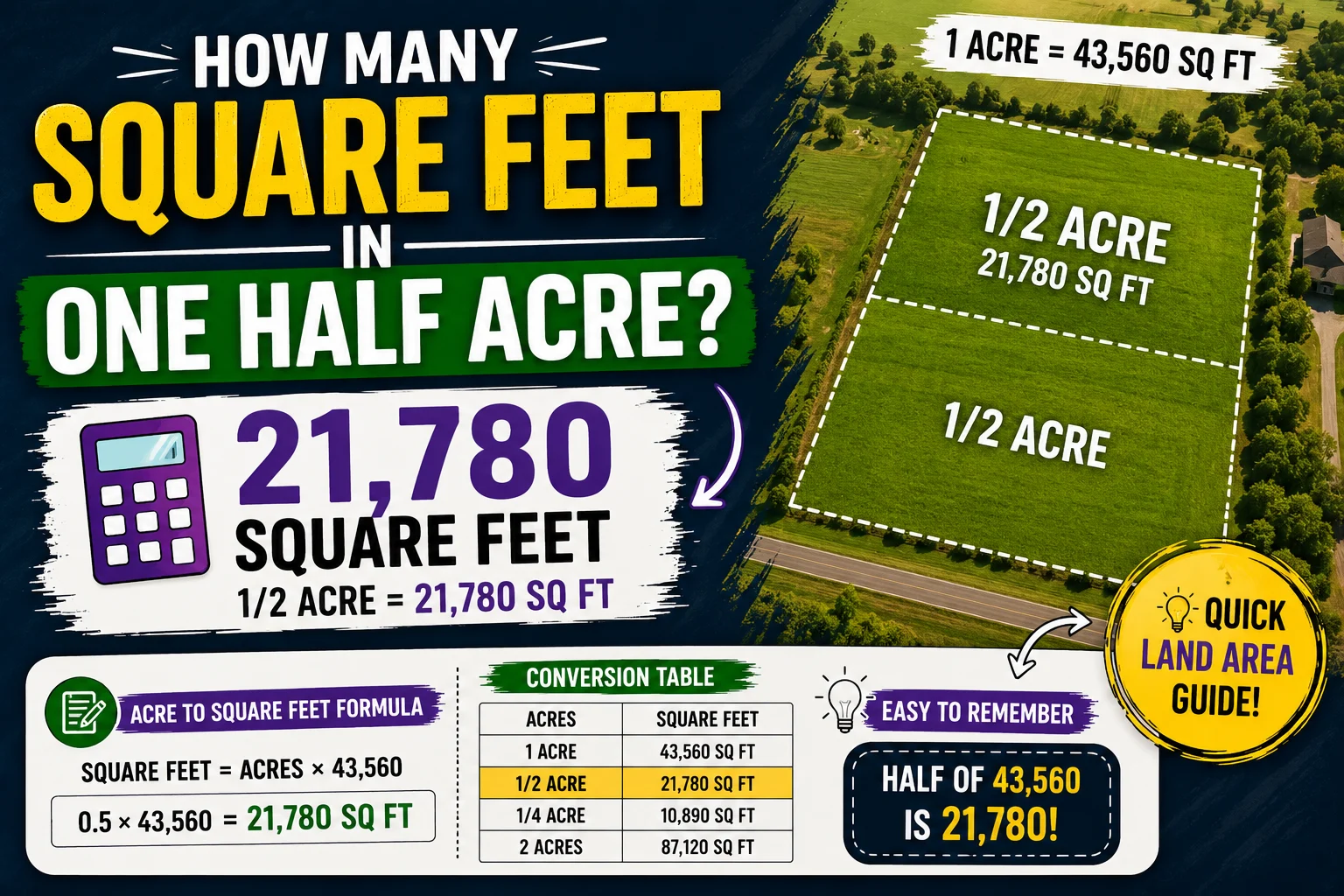
A half acre equals:
21,780 square feet
This measurement is based on the standard conversion:
- 1 acre = 43,560 square feet
Therefore:
21,780 × 2 = 43,560 square feet
Knowing this conversion helps real estate professionals estimate lot sizes, compare listings, calculate land value, and explain property dimensions to buyers.
Quick Conversion
- 1 acre = 43,560 square feet
- ½ acre = 21,780 square feet
- ¼ acre = 10,890 square feet
- 2 acres = 87,120 square feet
How Is Half an Acre Calculated?
Half an acre is simply half of the area contained in one acre.
Calculation:
21,780 square feet × 2 = 43,560 square feet
So:
½ acre = 21,780 square feet
This value remains the same regardless of the property’s shape.
Why Shape Doesn’t Matter
Many people imagine a half-acre lot as a perfect rectangle or square.
In reality, an acre measures area—not shape.
A half-acre lot can be:
- Square
- Rectangular
- Irregular
- Triangular
- Curved
As long as the total area equals 21,780 square feet, it is still half an acre.
Property Dimension Examples
Real estate professionals often need to estimate possible lot dimensions.
Here are several examples that equal approximately 21,780 square feet.
| Width | Length | Area |
|---|---|---|
| 100 ft | 217.8 ft | 21,780 sq ft |
| 120 ft | 181.5 ft | 21,780 sq ft |
| 150 ft | 145.2 ft | 21,780 sq ft |
| 90 ft | 242 ft | 21,780 sq ft |
| 60 ft | 363 ft | 21,780 sq ft |
These are only examples many other dimension combinations are possible.
Square Half-Acre Dimensions
If a half-acre lot were perfectly square:
Square root of 21,780 ≈ 147.6 feet
Approximate dimensions:
- 147.6 ft × 147.6 ft
Very few residential lots are perfectly square, but this is useful for visualization.
Half Acre Compared to Other Lot Sizes
| Lot Size | Square Feet |
| 1/10 acre | 4,356 |
| 1/8 acre | 5,445 |
| 1/4 acre | 10,890 |
| 1/3 acre | 14,520 |
| 1/2 acre | 21,780 |
| 3/4 acre | 32,670 |
| 1 acre | 43,560 |
Acre to Square Feet Conversion Chart
| Acres | Square Feet |
| 0.25 | 10,890 |
| 0.50 | 21,780 |
| 0.75 | 32,670 |
| 1 | 43,560 |
| 2 | 87,120 |
| 5 | 217,800 |
| 10 | 435,600 |
Square Feet to Acres Conversion
Use this formula:
Acres = Square Feet ÷ 43,560
Examples:
- 21,780 sq ft = 0.5 acre
- 43,560 sq ft = 1 acre
- 87,120 sq ft = 2 acres
Why Real Estate Professionals Use Square Feet
Although land is often marketed in acres, square footage provides more precision when:
- Comparing residential lots
- Estimating building footprints
- Determining setbacks
- Planning subdivisions
- Preparing appraisals
- Calculating land value
- Reviewing zoning requirements
Square feet also make it easier for buyers to compare properties.
Real Estate Examples
Residential Home
A suburban home on a ½-acre lot offers space for:
- A house
- Driveway
- Garage
- Backyard
- Patio
- Landscaping
Luxury Property
Higher-end homes frequently sit on half-acre or larger lots, allowing room for:
- Swimming pools
- Outdoor kitchens
- Guest houses
- Tennis or basketball courts
Rural Property
In rural areas, a half-acre may provide enough space for:
- Gardens
- Workshops
- Small barns
- Recreational areas
Half Acre Compared to Football Fields
A standard American football field (including end zones) measures about 57,600 square feet.
A half-acre is:
- About 38% of a football field.
This comparison helps buyers visualize lot size.
Metric Conversion
For international transactions:
- ½ acre ≈ 2,023 square meters
- 1 acre ≈ 4,047 square meters
Tips for Buyers and Agents
When discussing half-acre lots:
- Confirm the official survey rather than relying on listing descriptions.
- Explain that dimensions can vary even if the area stays the same.
- Review easements and setbacks that may reduce usable space.
- Check local zoning regulations before estimating buildable area.
These details help clients make informed decisions.
FAQs
How many square feet are in half an acre?
A half-acre contains 21,780 square feet.
Is a half-acre always the same shape?
No. Half an acre measures area, not shape.
What are common half-acre lot dimensions?
Examples include:
- 100 × 217.8 feet
- 120 × 181.5 feet
- 150 × 145.2 feet
Many combinations produce the same total area.
How many square meters are in half an acre?
Approximately 2,023 square meters.
Is half an acre considered a large lot?
In many suburban neighborhoods, yes. A half-acre provides significantly more outdoor space than the average residential lot.
How do I convert acres into square feet?
Multiply the number of acres by 43,560.
How do I convert square feet into acres?
Divide the square footage by 43,560.
Common Mistakes to Avoid
- Assuming every half-acre lot has identical dimensions.
- Confusing area with frontage.
- Forgetting that easements can reduce usable land.
- Estimating lot size without reviewing the property survey.
Using official survey data ensures accurate property information.
Quick Facts
- ½ acre = 21,780 square feet
- 1 acre = 43,560 square feet
- ½ acre ≈ 2,023 square meters
- A half-acre can have many different dimensions.
- Square footage is often more useful than acreage when comparing residential lots.
Final Thoughts
A half-acre contains exactly 21,780 square feet, making it one of the most common residential lot sizes in many markets. While the property’s dimensions may vary, the total area remains the same. For real estate professionals, understanding acre-to-square-foot conversions helps with pricing, marketing, appraisals, development planning, and communicating property size clearly to clients. Combining acreage with practical dimension examples also makes listings easier for buyers to understand.