

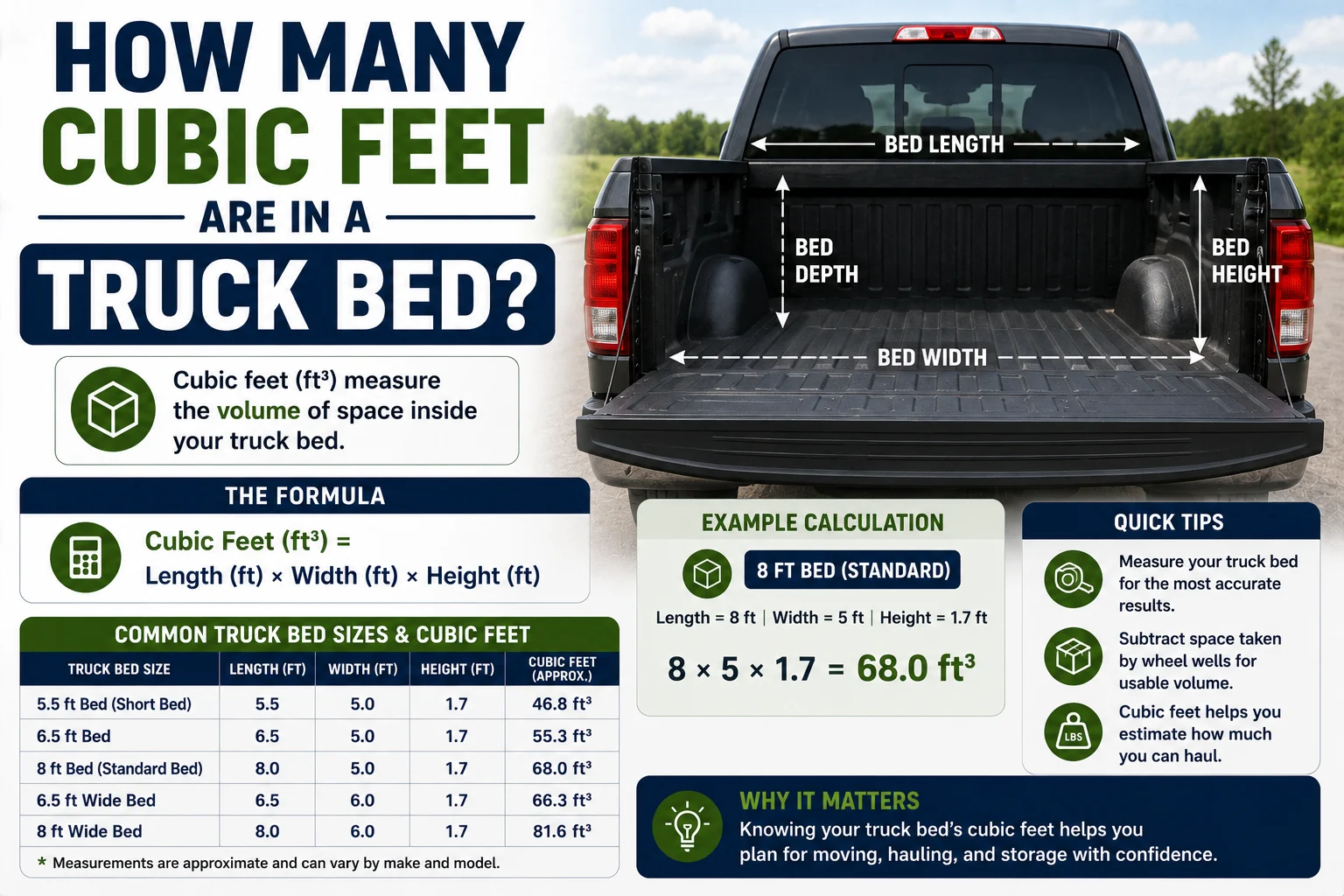
If you’re planning to haul mulch, firewood, soil, furniture, tools, camping equipment, or other materials, you may wonder how many cubic feet are in a truck bed.
There isn’t one universal answer because pickup truck beds come in different lengths, widths, and depths. A compact pickup may have considerably less cargo volume than a full-size truck with an 8-foot bed.
As a general estimate, pickup truck beds can hold roughly 35 to 70+ cubic feet of material, depending on the truck and how its bed is configured. A typical full-size pickup with a 6- to 6.5-foot bed may provide around 50–60 cubic feet of theoretical bed volume when calculated from its interior dimensions.
However, cubic-foot capacity is only an estimate. Wheel wells take up space, and you shouldn’t load material above the safe height of the bed or exceed the truck’s payload rating.
The most accurate way to determine the volume is to measure the usable interior dimensions and multiply them.
Quick Answer
How many cubic feet are in a truck bed?
A typical pickup truck bed may contain approximately:
- Compact truck: 30–45 cubic feet
- 5.5-foot full-size bed: roughly 40–55 cubic feet
- 6–6.5-foot bed: roughly 50–65 cubic feet
- 8-foot bed: roughly 60–80+ cubic feet
These are broad estimates because actual dimensions vary significantly among truck models.
For a simple calculation:
Cubic feet = Length × Width × Depth
V=s3
V=(3)3=27.00
s
s s = 3
Give feedback
For example, a bed measuring 6 feet long, 5 feet wide, and 1.5 feet deep would have a theoretical volume of:
6 × 5 × 1.5 = 45 cubic feet
The actual usable volume will be lower because of wheel wells and the truck’s specific interior shape.
What Does Cubic Feet Mean for a Truck Bed?
A cubic foot is a measurement of volume.
One cubic foot represents a space measuring:
1 foot × 1 foot × 1 foot
Truck-bed capacity is often discussed in cubic feet because a pickup isn’t simply carrying a flat surface—it has a three-dimensional cargo area.
For example, if a truck bed were exactly:
- 6 feet long
- 5 feet wide
- 1.5 feet deep
the theoretical volume would be:
6 × 5 × 1.5 = 45 cubic feet
This doesn’t necessarily mean you can safely load 45 cubic feet of every material. The truck’s payload rating, cargo shape, wheel wells, and safe loading height all matter.
How to Calculate the Cubic Feet of a Truck Bed
The basic formula is:
Volume = Length × Width × Depth
All three measurements should be in feet.
For example, suppose your truck bed measures:
- Length = 6 feet
- Width = 5 feet
- Depth = 1.5 feet
Calculate:
6 × 5 × 1.5 = 45 cubic feet
Therefore, the theoretical volume is:
45 cubic feet
If your measurements are in inches, convert them to feet first.
For example:
72 inches ÷ 12 = 6 feet
Why Truck Bed Cubic Feet Varies
Truck beds aren’t standardized to one size.
Capacity changes depending on:
Bed length
Common pickup bed lengths include approximately:
- 5 feet
- 5.5 feet
- 6 feet
- 6.5 feet
- 8 feet
Bed width
The usable width varies between truck models and is affected by the wheel wells.
Bed depth
Some beds are deeper than others.
Wheel wells
Wheel arches occupy part of the interior cargo area, reducing the usable floor width.
Bed shape
Not every truck bed is a perfect rectangular box.
For these reasons, a simple length × width × depth calculation should be considered an estimate unless you’re using precise usable interior dimensions.
How Many Cubic Feet Are in a 5-Foot Truck Bed?
A 5-foot pickup bed can typically hold around:
35–50 cubic feet
depending on the truck’s width and depth.
For example, a hypothetical bed measuring:
- 5 feet long
- 4.8 feet wide
- 1.5 feet deep
would have:
5 × 4.8 × 1.5 = 36 cubic feet
So its theoretical volume would be about 36 cubic feet.
Actual usable capacity would be somewhat lower.
How Many Cubic Feet Are in a 5.5-Foot Truck Bed?
A 5.5-foot bed might provide roughly:
40–55 cubic feet
of theoretical volume.
For example:
5.5 × 5 × 1.5 = 41.25 cubic feet
So a hypothetical 5.5-foot bed with those dimensions would contain approximately 41.25 cubic feet.
Actual dimensions vary considerably between compact, midsize, and full-size pickups.
How Many Cubic Feet Are in a 6-Foot Truck Bed?
A 6-foot truck bed commonly falls around:
45–60 cubic feet
as a rough theoretical range.
For example, using dimensions of:
- 6 feet long
- 5 feet wide
- 1.5 feet deep
the calculation is:
6 × 5 × 1.5 = 45 cubic feet
So the theoretical volume would be 45 cubic feet.
A deeper or wider bed could have substantially more volume.
How Many Cubic Feet Are in a 6.5-Foot Truck Bed?
A 6.5-foot bed may provide approximately:
50–65 cubic feet
of theoretical cargo volume.
For example:
6.5 × 5 × 1.5 = 48.75 cubic feet
That gives approximately 48.75 cubic feet before accounting for wheel wells and irregularities.
How Many Cubic Feet Are in an 8-Foot Truck Bed?
An 8-foot bed provides significantly more cargo length.
A rough estimate is:
60–80+ cubic feet
depending on width and depth.
For example, a hypothetical 8-foot bed measuring 5 feet wide and 1.5 feet deep would have:
8 × 5 × 1.5 = 60 cubic feet
So its theoretical volume would be:
60 cubic feet
An actual bed can differ based on its dimensions and interior design.
Truck Bed Size and Estimated Cubic Feet
| Approx. Bed Length | Rough Theoretical Volume |
|---|---|
| 5 ft | 35–50 cu ft |
| 5.5 ft | 40–55 cu ft |
| 6 ft | 45–60 cu ft |
| 6.5 ft | 50–65 cu ft |
| 8 ft | 60–80+ cu ft |
These are general estimates, not manufacturer specifications. Always measure the specific truck if exact volume is important.
How Many Cubic Feet Does a Full-Size Truck Bed Hold?
A full-size pickup with a standard 6- to 6.5-foot bed can often provide roughly:
50–65 cubic feet of theoretical volume
But “full-size truck” describes the vehicle category, not a single standardized bed size.
For example, a full-size pickup may be available with:
- Short bed
- Standard bed
- Long bed
Therefore, two full-size trucks can have different cargo volumes.
How Many Cubic Feet Does a Short-Bed Truck Hold?
Short-bed pickups typically have beds around 5 to 5.5 feet long.
A reasonable general estimate is:
35–55 cubic feet
However, compact and full-size short beds can have very different widths and depths.
The actual truck model’s dimensions should be used for an accurate calculation.
Truck Bed Volume vs. Payload Capacity
It’s important to understand that cubic feet and payload capacity are not the same thing.
Cubic feet
Measures how much space the truck bed provides.
Payload capacity
Measures how much weight the vehicle can safely carry.
For example, a truck might have enough space to hold a large quantity of gravel, but the weight of that gravel could exceed the truck’s payload rating.
This is especially important when hauling:
- Gravel
- Sand
- Concrete
- Soil
- Rocks
- Firewood
- Construction materials
A truck bed can have plenty of empty space while the vehicle is already at its maximum safe payload.
How Many Cubic Feet of Mulch Fit in a Truck Bed?
Mulch is commonly sold by the cubic yard, making cubic-foot calculations particularly useful.
Since:
1 cubic yard = 27 cubic feet
If your truck bed can theoretically hold 54 cubic feet:
54 ÷ 27 = 2 cubic yards
So a 54-cubic-foot bed could theoretically hold about 2 cubic yards when filled to the calculated capacity.
However, you must consider the truck’s payload rating because mulch has weight, and different types of mulch have different densities.
How Many Cubic Feet of Soil Fit in a Truck Bed?
Soil can be considerably heavier than materials such as dry mulch.
If a truck bed has 50 cubic feet of theoretical volume, that doesn’t mean you should fill it completely with soil.
The safe amount depends on:
- Soil density
- Moisture content
- Truck payload rating
- Bed configuration
- Passenger weight
- Other cargo
For heavy materials, weight is often the limiting factor rather than volume.
How Many Cubic Feet of Gravel Fit in a Truck Bed?
Gravel is even more important to calculate by weight.
A typical truck bed might have enough volume for a large quantity of gravel, but gravel is dense and can quickly exceed a pickup’s payload capacity.
For this reason, never determine the safe load based solely on cubic feet.
Instead:
- Determine the material’s approximate weight per cubic foot.
- Multiply by the amount you intend to carry.
- Compare the result with the truck’s allowable payload.
- Follow the manufacturer’s loading recommendations.
How Many Cubic Feet Are in a Truck Bed Full of Firewood?
Firewood volume depends on how tightly the wood is stacked.
A truck bed may theoretically hold 40–60 cubic feet, but the actual amount of firewood depends on:
- Log length
- Log diameter
- Stacking method
- Gaps between logs
- Bed size
- Safe loading height
Firewood is also relatively heavy, so payload capacity must be considered.
How Many Cubic Yards Fit in a Truck Bed?
Because:
1 cubic yard = 27 cubic feet
you can convert truck-bed volume into cubic yards with:
Cubic yards = Cubic feet ÷ 27
For example, if a truck bed has a theoretical volume of 54 cubic feet:
54 ÷ 27 = 2 cubic yards
Therefore:
54 cubic feet = 2 cubic yards
A 45-cubic-foot bed would contain:
45 ÷ 27 = 1.67 cubic yards
So it would be approximately 1.67 cubic yards.
Truck Bed Cubic Feet to Cubic Yards Chart
| Truck Bed Volume | Approx. Cubic Yards |
|---|---|
| 27 cu ft | 1 yd³ |
| 36 cu ft | 1.33 yd³ |
| 40 cu ft | 1.48 yd³ |
| 45 cu ft | 1.67 yd³ |
| 50 cu ft | 1.85 yd³ |
| 54 cu ft | 2 yd³ |
| 60 cu ft | 2.22 yd³ |
| 72 cu ft | 2.67 yd³ |
| 81 cu ft | 3 yd³ |
This conversion is useful when purchasing landscaping materials.
Does a Truck Bed’s Tonneau Cover Change Its Cubic-Foot Capacity?
A tonneau cover generally doesn’t change the physical volume of the truck bed itself.
However, it can affect how you use that space.
For example, a low-profile cover may prevent you from carrying unusually tall objects. A hard cover may also restrict the type of cargo that can be loaded.
The underlying bed volume remains determined by its dimensions.
Can You Measure a Truck Bed Yourself?
Yes.
You can estimate your truck bed’s volume with a tape measure.
Step 1: Measure the length
Measure from the inside of the front wall to the inside of the tailgate.
Step 2: Measure the width
Measure the usable interior width.
For a more accurate estimate, account for the wheel wells.
Step 3: Measure the depth
Measure from the bed floor to the usable top of the bed.
Step 4: Convert measurements to feet
If necessary, divide inches by 12.
Step 5: Multiply
Use:
Length × Width × Depth = Cubic feet
Remember that a truck bed is not necessarily a perfect rectangular box, so this provides an estimate.
Example: Calculating Truck Bed Volume
Suppose your truck bed measures:
- 72 inches long
- 60 inches wide
- 18 inches deep
Convert each measurement into feet:
72 ÷ 12 = 6 feet
60 ÷ 12 = 5 feet
18 ÷ 12 = 1.5 feet
Now multiply:
6 × 5 × 1.5 = 45 cubic feet
Therefore:
Estimated truck-bed volume = 45 cubic feet
The actual usable volume will be somewhat different if wheel wells or other features reduce the available space.
Why You Shouldn’t Fill a Truck Bed Above the Rails
A common mistake is assuming that a truck bed can safely be filled as high as physically possible.
That’s not always safe.
Overloading or improperly securing cargo can:
- Reduce braking performance
- Affect steering
- Increase stopping distance
- Damage suspension components
- Cause cargo to fall onto the road
- Create a serious safety hazard
Heavy materials are particularly dangerous because they can exceed the truck’s payload capacity long before the bed appears full.
Common Mistakes When Estimating Truck Bed Volume
1. Assuming Every Truck Bed Is the Same
A 5.5-foot bed and an 8-foot bed obviously don’t have the same volume.
2. Ignoring Wheel Wells
Wheel wells reduce usable space.
3. Confusing Cubic Feet With Payload
Volume measures space; payload measures weight.
4. Filling the Bed Without Checking Weight
Dense materials can exceed payload limits surprisingly quickly.
5. Assuming a Rectangular Shape Is Exact
Truck beds have curves, wheel arches, and other features that affect actual usable volume.
FAQs
1. How many cubic feet are in a truck bed?
A typical pickup truck bed can contain approximately 35–80+ cubic feet, depending on its length, width, and depth. Many full-size 6- to 6.5-foot beds fall roughly in the 50–65 cubic-foot range when estimated from their dimensions.
2. How many cubic feet are in a 6-foot truck bed?
A 6-foot truck bed may have approximately 45–60 cubic feet of theoretical volume, depending on its width and depth.
3. How many cubic feet are in an 8-foot truck bed?
An 8-foot bed may have approximately 60–80+ cubic feet of theoretical volume, depending on the specific truck’s dimensions.
4. How many cubic yards are in a truck bed?
It depends on the bed’s volume. For example, a 54-cubic-foot bed equals approximately 2 cubic yards, because one cubic yard contains 27 cubic feet.
5. How do I calculate truck bed cubic feet?
Measure the length, width, and depth in feet and multiply:
Length × Width × Depth = Cubic feet
6. How many cubic feet of mulch can a pickup truck hold?
The amount depends on the bed size. A bed with 54 cubic feet of theoretical volume could hold about 2 cubic yards of mulch by volume, but the truck’s payload rating must also be considered.
7. Can I carry a full truck bed of gravel?
Not necessarily. Gravel is heavy, so the truck’s payload capacity may be reached before the bed is full.
8. Does a longer truck bed always have more cubic feet?
Usually, a longer bed provides more volume when width and depth are similar, but actual capacity depends on all three dimensions.
Conclusion
So, how many cubic feet are in a truck bed?
There isn’t one universal answer because pickup trucks come with different bed lengths, widths, and depths. As a broad estimate, a pickup bed may hold approximately 35 to 80+ cubic feet, while many full-size trucks with 6- to 6.5-foot beds fall around 50–65 cubic feet of theoretical volume.
The simplest way to calculate your specific truck bed is:
Length × Width × Depth = Cubic feet
For example, a 6-foot × 5-foot × 1.5-foot bed has a theoretical volume of 45 cubic feet.
If you’re hauling mulch, soil, gravel, firewood, or other bulk materials, remember that volume isn’t the same as safe carrying capacity. Always check your truck manufacturer’s payload rating and account for passengers and other cargo before loading.