

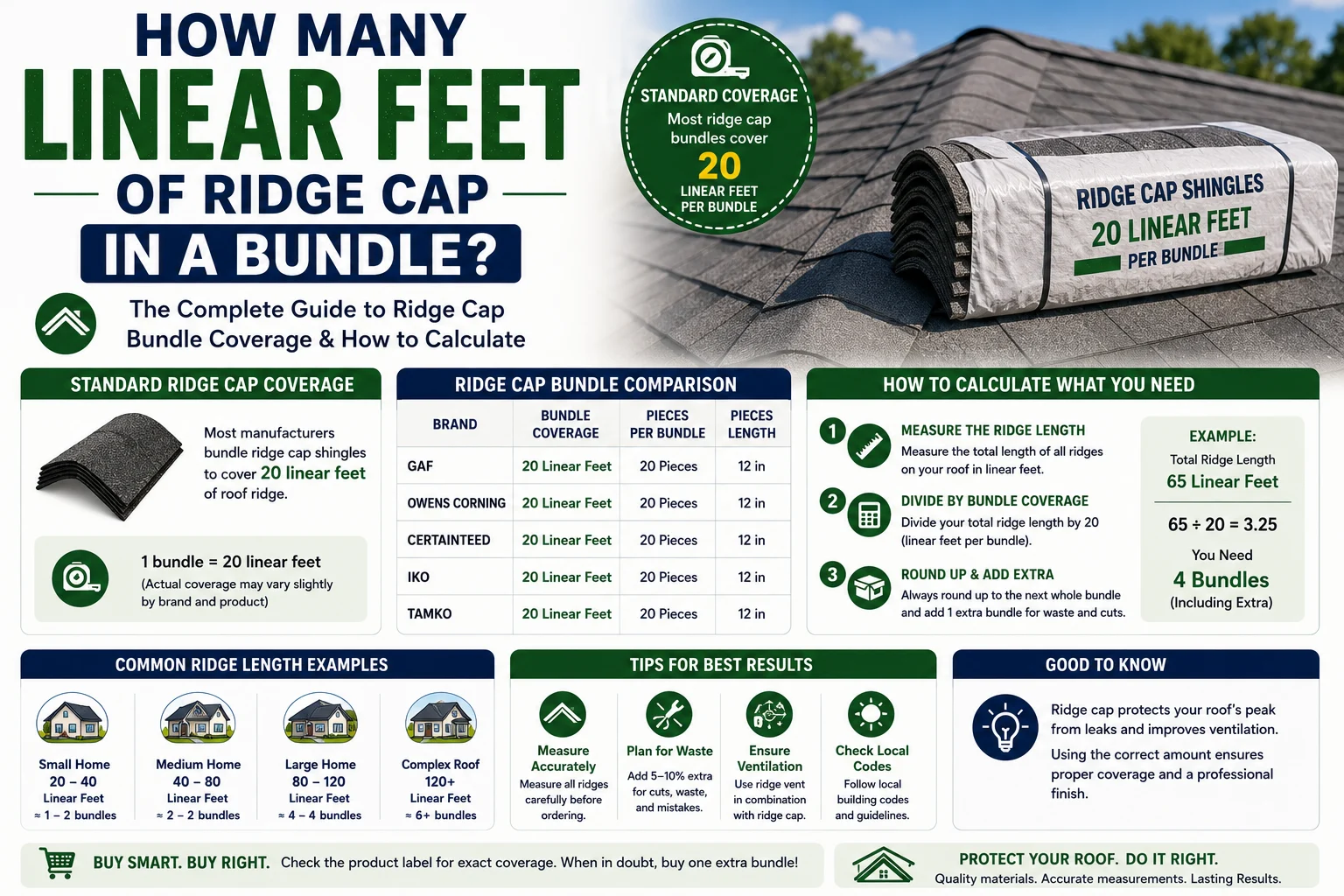
If you are replacing or installing a roof, you may be wondering, how many linear feet of ridge cap in a bundle. The answer depends on the type of shingles and the manufacturer, but most standard bundles of ridge cap shingles cover about 20 to 35 linear feet.
For many roofing products, a bundle of ridge cap shingles covers approximately:
- 20 linear feet with a 5-inch exposure.
- 25 linear feet with a 6-inch exposure.
- 33 linear feet with a 7-inch exposure.
Because different manufacturers produce different ridge cap products, it is always a good idea to check the packaging before beginning your roofing project.
This guide explains ridge cap coverage, how to calculate the number of bundles you need, and the factors that affect total coverage.
Quick Answer
Most bundles of ridge cap shingles cover between 20 and 35 linear feet, depending on the exposure and shingle design.
| Exposure Per Shingle | Approximate Coverage Per Bundle |
|---|---|
| 5 inches | 20 linear feet |
| 6 inches | 25 linear feet |
| 7 inches | 33 linear feet |
A common estimate used by roofers is about 20 linear feet per bundle.
What Is Ridge Cap?
Ridge cap shingles are specially designed roofing shingles installed along:
- The roof ridge.
- Roof hips.
- Roof peaks.
- Roof intersections.
Their purpose is to:
- Protect the roof from water infiltration.
- Improve ventilation.
- Cover exposed roofing materials.
- Enhance the roof’s appearance.
Unlike regular shingles, ridge cap shingles are designed to bend over the peak of the roof.
Standard Ridge Cap Coverage Chart
The following chart shows typical coverage estimates.
| Bundle Type | Average Coverage |
|---|---|
| Standard ridge cap | 20–25 linear feet |
| High-profile ridge cap | 18–22 linear feet |
| Hip-and-ridge shingles | 25–35 linear feet |
| Three-tab cut shingles | 20 linear feet |
Actual coverage varies by manufacturer and installation method.
Factors That Affect Ridge Cap Coverage
Several factors determine how many linear feet one bundle can cover.
Type of Shingles
Different ridge cap products use different sizes and designs.
Examples include:
- Three-tab shingles
- Architectural ridge caps
- High-profile ridge caps
- Pre-cut ridge shingles
Thicker products usually cover less distance.
Exposure Length
Exposure refers to the visible portion of each installed shingle.
Common exposures:
- 5 inches
- 6 inches
- 7 inches
A larger exposure increases total coverage.
Manufacturer Specifications
Roofing manufacturers may package different quantities per bundle.
Always check:
- Product labels
- Installation instructions
- Coverage charts
How to Calculate Ridge Cap Coverage
Estimating the amount of ridge cap you need is simple.
Step 1: Measure the Roof Ridge
Use a tape measure to determine the total length of:
- Roof ridges
- Hips
- Peaks
For example:
- Main ridge: 40 feet
- Hip sections: 20 feet
Total:
40 + 20 = 60 linear feet.
Step 2: Check the Bundle Coverage
Suppose each bundle covers 20 linear feet.
Step 3: Divide the Total Length
60 ÷ 20 = 3 bundles.
You would need three bundles of ridge cap shingles.
Coverage by Ridge Cap Type
Standard Three-Tab Ridge Cap
Coverage:
- Approximately 20 linear feet per bundle.
Common uses:
- Basic residential roofs.
Architectural Ridge Cap
Coverage:
- Around 20–25 linear feet.
Benefits:
- Better appearance.
- Improved durability.
High-Profile Ridge Cap
Coverage:
- About 18–22 linear feet.
Benefits:
- Enhanced curb appeal.
- Stronger wind resistance.
Hip-and-Ridge Shingles
Coverage:
- Approximately 25–35 linear feet.
Benefits:
- Easier installation.
- Uniform appearance.
Common Roofing Examples
Here are some sample calculations.
| Roof Ridge Length | Bundles Needed (20 ft Coverage) |
|---|---|
| 20 feet | 1 bundle |
| 40 feet | 2 bundles |
| 60 feet | 3 bundles |
| 80 feet | 4 bundles |
| 100 feet | 5 bundles |
Always round up when buying materials.
Mistakes to Avoid
Many homeowners underestimate the amount of ridge cap required.
Avoid these common mistakes.
Forgetting Roof Hips
Many roofs have hips in addition to ridges.
Ignoring Waste
Roofing projects create some waste.
Experts recommend ordering:
- 5–10% extra material.
Assuming All Bundles Are the Same
Different brands provide different coverage amounts.
Measuring Incorrectly
Double-check all roof measurements before purchasing supplies.
Tips for Buying Ridge Cap Shingles
For the best results:
- Measure every ridge and hip.
- Match ridge cap shingles to your roof style.
- Check manufacturer specifications.
- Purchase extra material.
- Consider local weather conditions.
Planning ahead helps avoid delays and additional costs.
Ridge Cap vs. Regular Shingles
Many people wonder whether they can use regular shingles instead of ridge cap shingles.
| Feature | Ridge Cap | Regular Shingles |
|---|---|---|
| Flexibility | High | Lower |
| Appearance | Better | Basic |
| Weather protection | Excellent | Moderate |
| Ease of installation | Easy | Moderate |
Although some roofers cut three-tab shingles into ridge caps, dedicated ridge cap products generally provide better performance.
FAQs
How many linear feet does one bundle of ridge cap cover?
Most bundles cover between 20 and 35 linear feet, depending on the product and exposure.
How many bundles of ridge cap do I need for 60 feet?
If each bundle covers 20 linear feet, you will need three bundles.
Does ridge cap coverage vary by manufacturer?
Yes. Different brands package different numbers of shingles and recommend different exposure lengths.
Can regular shingles be used as ridge cap?
Sometimes, but specially designed ridge cap shingles usually offer better durability and appearance.
Should I buy extra ridge cap shingles?
Yes. Most professionals recommend purchasing 5–10% extra to account for waste and future repairs.
Conclusion
Now you know the answer to how many linear feet of ridge cap in a bundle. Most bundles cover between 20 and 35 linear feet, although the exact amount depends on the product and installation method.
Before starting your roofing project, carefully measure all ridges and hips, check the manufacturer’s specifications, and buy a little extra material. Accurate planning will help ensure a smooth installation and a long-lasting roof.