

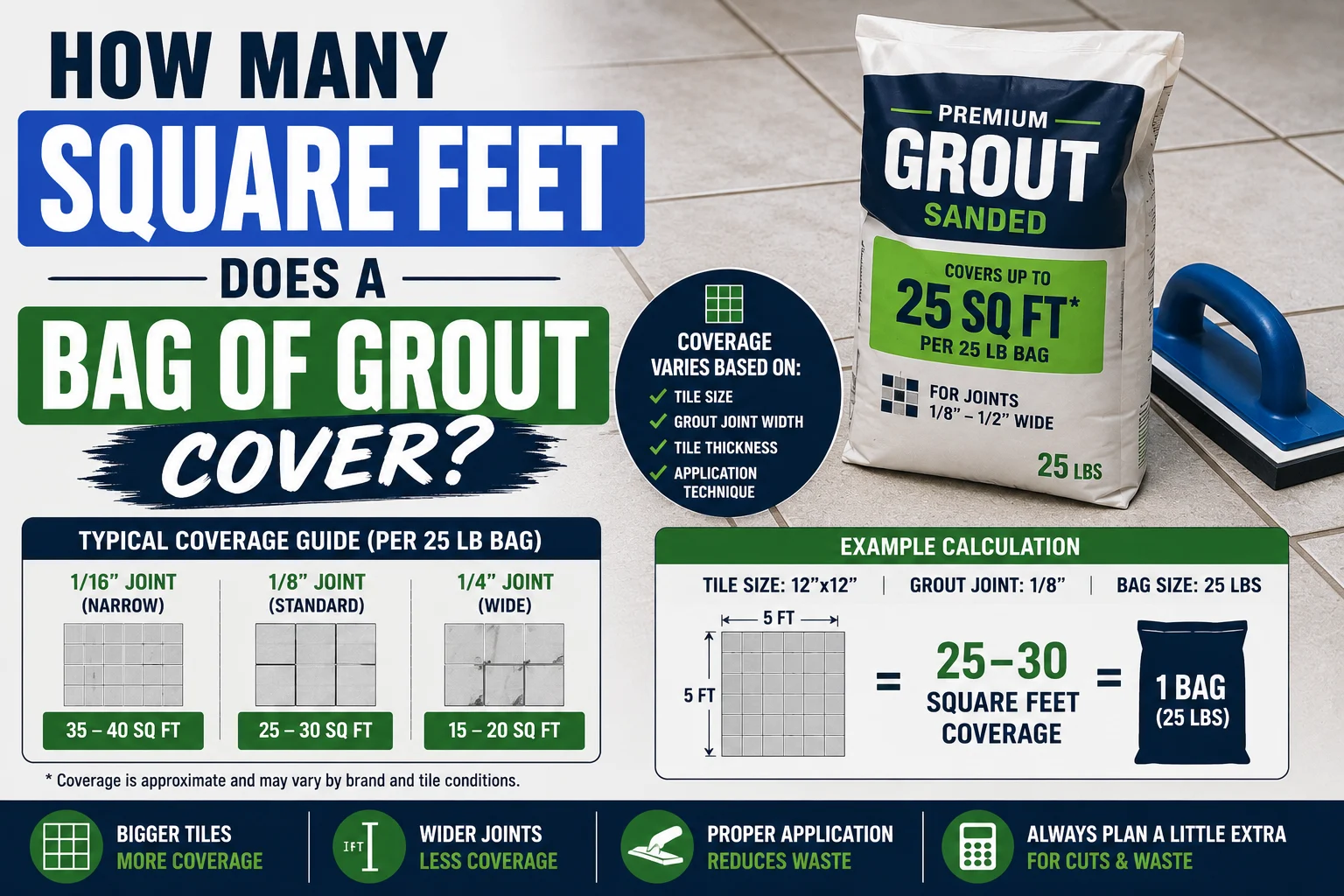
If you’re installing tile, one of the most common questions is how many square feet does a bag of grout cover?
There isn’t one universal answer because grout coverage depends on several factors. The most important are bag size, tile dimensions, tile thickness, and grout joint width.
As a general estimate, a standard bag of grout may cover anywhere from roughly 20 to more than 200 square feet, depending on the product and installation conditions. A small-format tile with wide grout joints can use far more grout than large-format tile with narrow joints.
For example, a 25-pound bag may cover a relatively large area when used with large tiles and narrow joints. The same bag could cover a much smaller area when used with small tiles and wide grout lines.
The manufacturer’s coverage chart is the best source for a specific grout product.
In this guide, you’ll learn how grout coverage works, how to estimate the amount needed, and how tile size and joint width can dramatically change your calculation.
Quick Answer: How Many Square Feet Does a Bag of Grout Cover?
A bag of grout does not have a fixed square-foot coverage rate.
Depending on the product, tile size, grout joint width, and tile thickness, one bag can cover very different amounts of tile.
As a broad planning guide:
| Grout Bag Size | Possible Coverage Range* |
|---|---|
| 5 lb | About 10–60+ sq ft |
| 10 lb | About 20–120+ sq ft |
| 25 lb | About 50–250+ sq ft |
| 50 lb | About 100–500+ sq ft |
*These are broad estimates for planning only. Actual coverage can vary significantly.
A 25-pound bag, for example, might cover around 100 square feet with one tile installation but considerably more or less with another.
Always use the manufacturer’s coverage chart when available.
Why Doesn’t One Bag of Grout Cover a Fixed Area?
Grout fills the spaces between tiles.
That means the amount required depends on how much space exists between those tiles.
Consider two floors that are both 100 square feet.
Floor A
Uses large 24 × 24-inch tiles with narrow 1/8-inch joints.
Floor B
Uses small 2 × 2-inch tiles with 1/4-inch joints.
Both floors have the same surface area, but Floor B has dramatically more grout joints.
As a result, Floor B can require much more grout.
This is why simply asking how many square feet one bag covers isn’t enough. You also need to know the tile and joint specifications.
The Main Factors That Affect Grout Coverage
Several variables determine how much grout you’ll use.
1. Tile Size
Tile size has a major effect on grout consumption.
Large tiles have fewer joints per square foot.
Small tiles have more joints.
For example, a 24 × 24-inch tile creates fewer grout lines than a 4 × 4-inch tile covering the same area.
Generally:
Larger tiles = less grout
Smaller tiles = more grout
2. Grout Joint Width
Joint width is another major factor.
A 1/8-inch grout joint requires less material than a 1/4-inch joint.
Increasing the joint width increases the amount of space that must be filled.
For example:
- 1/16-inch joint → relatively low grout usage
- 1/8-inch joint → moderate grout usage
- 1/4-inch joint → higher grout usage
- 3/8-inch joint → significantly higher usage
The wider the joint, the more grout you’ll generally need.
3. Tile Thickness
Thicker tiles create deeper grout joints.
A 3/8-inch-thick tile doesn’t require the same amount of grout as a 5/8-inch-thick tile when all other dimensions remain the same.
Greater depth means more volume that must be filled.
Therefore:
Thicker tile = potentially more grout
4. Grout Type
Different grout products have different coverage characteristics.
Common types include:
- Cementitious grout
- Sanded grout
- Unsanded grout
- Polymer-modified grout
- Epoxy grout
Their mixing ratios, density, and recommended applications can vary.
Don’t assume that a 25-pound bag of one product covers the same area as a 25-pound bag of another product.
5. Tile Layout
The tile pattern can also influence grout usage.
A straightforward grid layout may produce a different amount of cutting and joint configuration than a more complex design.
Patterns such as:
- Herringbone
- Basketweave
- Offset
- Diagonal
- Mosaic
can affect installation waste and grout requirements.
How to Estimate Grout Coverage
The easiest way to estimate grout requirements is to use the manufacturer’s coverage chart.
Most grout manufacturers provide tables based on:
- Tile length
- Tile width
- Tile thickness
- Joint width
- Bag size
Find your tile dimensions and grout-joint width in the table and use the corresponding coverage.
This is generally more reliable than relying on a generic online estimate.
If no coverage chart is available, you can estimate grout volume mathematically.
Basic Grout Coverage Formula
A simplified way to estimate grout consumption is to consider the total volume of the grout joints.
The basic idea is:
Grout volume = Joint length × Joint width × Joint depth
For a tiled surface, you need to account for both horizontal and vertical joints.
The exact calculation becomes more complex as tile sizes, patterns, corners, and irregular areas change.
That’s why manufacturer’s calculators and coverage charts are useful for real projects.
Example: 12 × 12-Inch Tile
Suppose you’re installing 12 × 12-inch tiles over 100 square feet.
Assume:
- 12 × 12-inch tile
- 1/8-inch grout joint
- Standard tile thickness
There are relatively few grout joints compared with smaller tiles.
A typical 25-pound bag may cover a substantial portion of the installation, but the exact amount depends on the grout product and tile thickness.
The manufacturer’s coverage chart should be checked before purchasing.
Example: 6 × 6-Inch Tile
Now imagine covering the same 100 square feet with 6 × 6-inch tiles.
There will be more individual tiles and more grout joints.
That means the grout requirement increases.
Even though both projects cover exactly:
100 square feet
the 6 × 6-inch installation can use more grout than the 12 × 12-inch installation.
Example: 2 × 2-Inch Mosaic Tile
Mosaic tile can use substantially more grout because there are many more joints per square foot.
A 100-square-foot mosaic installation can require considerably more grout than a 100-square-foot large-format tile installation.
This is one reason grout estimates should never be based on square footage alone.
For mosaics, always check the manufacturer’s coverage information carefully.
Grout Coverage by Tile Size
The following general comparison shows how tile size affects grout usage.
| Tile Size | Relative Grout Usage |
| 24 × 24 in | Low |
| 18 × 18 in | Low |
| 12 × 24 in | Low to moderate |
| 12 × 12 in | Moderate |
| 8 × 8 in | Moderate |
| 6 × 6 in | Moderate to high |
| 4 × 4 in | High |
| 2 × 2 in | Very high |
| Small mosaic | Very high |
This isn’t a substitute for a manufacturer’s coverage chart because joint width and depth also matter.
How Grout Joint Width Changes Coverage
Imagine using the same 12 × 12-inch tiles.
If you use a narrow grout joint, there is less space to fill.
If you increase the joint width, there is more space between every tile.
For example:
| Joint Width | Grout Requirement |
| 1/16 in | Very low |
| 1/8 in | Low |
| 3/16 in | Moderate |
| 1/4 in | Higher |
| 3/8 in | High |
The wider the joint, the lower the square-foot coverage of the same bag.
How Many Bags of Grout Do You Need for 100 Square Feet?
There is no single answer.
For a large-format tile with narrow joints, one bag might cover a large portion of 100 square feet.
For small tiles with wide joints, you may need multiple bags.
The correct approach is:
Step 1: Identify your tile size.
Step 2: Measure the grout-joint width.
Step 3: Determine tile thickness.
Step 4: Find the grout product you’re using.
Step 5: Check the manufacturer’s coverage chart.
Step 6: Calculate the total bags required.
Step 7: Consider a small allowance for waste and touch-ups.
How Much Grout Do You Need for 500 Square Feet?
Suppose your project covers 500 square feet.
You cannot simply divide 500 by a generic number because coverage depends on the tile installation.
For example, if a particular grout product covers 100 square feet per bag for your tile and joint configuration:
500 ÷ 100 = 5 bags
If the same product only covers 75 square feet under different conditions:
500 ÷ 75 ≈ 6.67 bags
You would need to plan for the appropriate whole-bag quantity.
This example shows why actual product coverage matters.
How Much Grout Do You Need for a Bathroom?
A typical bathroom can have several different tile applications:
- Floor tile
- Shower walls
- Tub surround
- Backsplash
- Accent tile
- Shower floor
Each section may use different tile sizes and joint widths.
For example, a bathroom floor might use 12 × 24-inch tiles while the shower walls use 4 × 4-inch tiles.
The same bag of grout could therefore cover very different areas in each location.
For the most accurate estimate, calculate each tile area separately.
Grout for Floor Tile vs. Wall Tile
The basic coverage principles are the same, but the installation details can differ.
Floor Tile
Floor tile often uses:
- Larger tiles
- Wider or moderate joints
- Thicker tile
Large-format floor tile may therefore require less grout per square foot than small mosaics.
Wall Tile
Wall installations can use:
- Subway tile
- Ceramic tile
- Porcelain tile
- Glass mosaic
- Small decorative tile
Small wall tiles can have many grout joints and may consume more grout per square foot.
How Much Extra Grout Should You Buy?
It’s smart to have a small amount of extra material available.
Reasons include:
- Mixing loss
- Spillage
- Installation waste
- Uneven joints
- Repairs
- Future touch-ups
- Difficult corners
However, don’t automatically purchase a huge excess.
A reasonable additional allowance depends on the project.
For a simple installation with reliable measurements, a small reserve may be enough. Complex patterns, mosaics, and irregular spaces can require more planning.
What Happens If You Don’t Buy Enough Grout?
Running out of grout in the middle of a project can create several problems.
You may need to:
- Stop installation
- Make another store trip
- Find the same product
- Match the color
- Mix another batch
- Deal with potential color differences
Grout color can sometimes vary between batches or if the mixing and curing process differs.
For this reason, it’s better to calculate carefully and keep a small amount available for future repairs.
Can You Use Leftover Grout Later?
Possibly, but storage matters.
Dry cement-based grout should be kept in a dry, sealed environment according to the manufacturer’s instructions.
Moisture can cause powder products to harden or deteriorate.
For leftover mixed grout, storage is generally not a practical option because many grout products have limited working times.
Always follow the manufacturer’s storage and disposal instructions.
Common Mistakes When Estimating Grout
Mistake 1: Using Only Square Footage
Two 100-square-foot floors can require very different amounts of grout.
Mistake 2: Ignoring Joint Width
A wider joint can dramatically increase grout consumption.
Mistake 3: Forgetting Tile Thickness
Deeper joints require more material.
Mistake 4: Assuming All 25-Pound Bags Cover the Same Area
Different products have different coverage rates.
Mistake 5: Forgetting Mosaic Tile
Mosaic installations can require significantly more grout.
Mistake 6: Buying Exactly the Calculated Amount
A small reserve can be helpful for installation waste and future repairs.
Tips for Getting an Accurate Grout Estimate
Before buying grout, gather these details:
- Total tile area
- Tile length
- Tile width
- Tile thickness
- Grout-joint width
- Grout type
- Product name
- Bag size
- Installation pattern
Then check the manufacturer’s coverage chart.
If your project uses several tile sizes, calculate each area separately.
For example:
Bathroom floor: 80 sq ft of 12 × 24 tile
Shower walls: 100 sq ft of 4 × 4 tile
Accent strip: 15 sq ft of mosaic
Each section may have a different grout consumption rate.
Adding them together only after calculating each section will produce a more useful estimate.
Grout Coverage Quick Reference
Because grout coverage varies, the following should be treated as a planning guide rather than exact product specifications.
| Installation | Expected Grout Usage |
| Large tile + narrow joints | Lower |
| Large tile + wide joints | Moderate |
| Medium tile + narrow joints | Moderate |
| Small tile + narrow joints | Moderate to high |
| Small tile + wide joints | High |
| Mosaic tile | Very high |
| Deep joints | Higher |
| Thin joints | Lower |
The most accurate coverage figure always comes from the grout manufacturer.
FAQs
1. How many square feet does a bag of grout cover?
There is no universal coverage rate. A bag may cover anywhere from a few dozen to several hundred square feet depending on its weight, tile size, grout-joint width, tile thickness, and grout type. Check the manufacturer’s coverage chart for an accurate figure.
2. How many square feet does a 25-pound bag of grout cover?
A 25-pound bag can cover widely different areas depending on the installation. It might cover around 50 to 250 or more square feet in different applications. Large tiles with narrow joints generally provide higher coverage than small tiles with wide joints.
3. How much grout do I need for 100 square feet?
The answer depends on the tile and grout specifications. A 100-square-foot floor with large tiles and narrow joints will generally require less grout than 100 square feet of small mosaic tile. Use the product’s coverage chart to determine the number of bags.
4. Does tile size affect grout coverage?
Yes. Smaller tiles create more grout joints per square foot, which generally increases grout consumption. Large-format tiles have fewer joints and usually require less grout.
5. Does a wider grout joint use more grout?
Yes. A wider joint creates more space that must be filled. For example, a 1/4-inch joint generally requires more grout than a 1/8-inch joint when the tile size and thickness are otherwise the same.
Conclusion
So, how many square feet does a bag of grout cover? There isn’t one fixed answer. Grout coverage depends mainly on bag size, tile dimensions, tile thickness, grout-joint width, and the specific grout product.
A large-format tile installation with narrow joints may allow one bag to cover a relatively large area. In contrast, small tiles, mosaics, wide grout joints, and deeper joints can significantly increase grout consumption.
For the most accurate estimate, measure your total tile area and identify the tile size, thickness, and joint width. Then check the manufacturer’s coverage chart for your specific grout product.
If you’re working on a bathroom, kitchen, floor, backsplash, or shower, calculate each tile section separately when different tile sizes are involved. Finally, consider keeping a small amount of extra grout available for installation waste and future repairs.
Taking a few minutes to calculate grout coverage before purchasing materials can help prevent shortages, unnecessary trips to the store, and wasted money.