

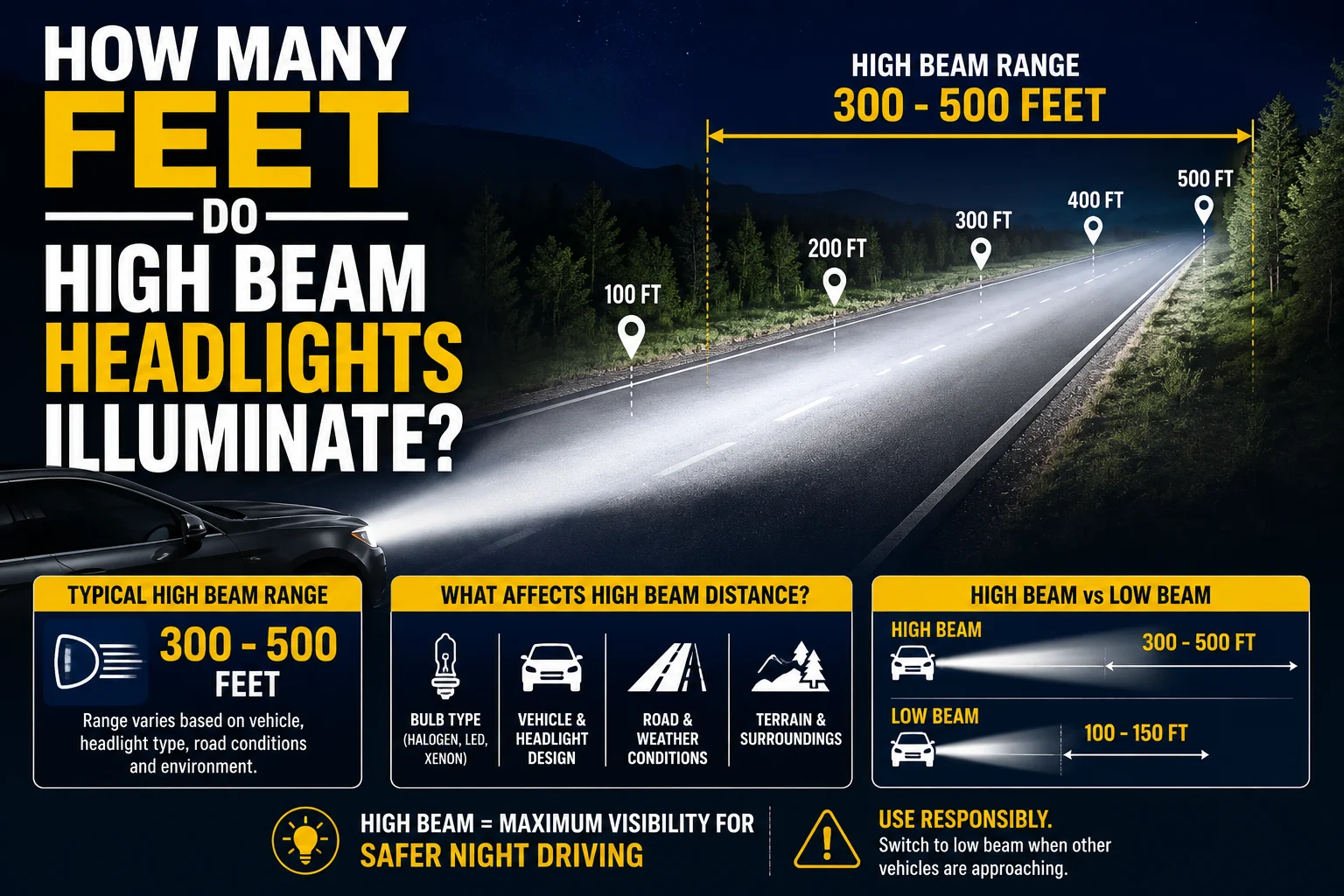
If you’ve ever driven on a dark road and wondered how many feet do high beam headlights illuminate, the answer depends on the vehicle, headlight design, road conditions, and how the lights are aimed.
As a general rule, high beam headlights can illuminate roughly 350 to 500 feet or more ahead of a vehicle under favorable conditions. Some modern vehicles with advanced lighting systems may provide useful visibility beyond this range.
High beams are designed to project light farther down the road than low beams. This extra distance gives drivers more time to identify hazards, curves, pedestrians, animals, and other objects when traveling on dark roads.
However, the maximum distance at which light is visible isn’t necessarily the same as the distance at which a driver can clearly recognize a hazard.
High beams also need to be used responsibly. They should generally be switched to low beams when approaching other vehicles or when following another vehicle closely because the bright light can create dangerous glare.
This guide explains high-beam range, low-beam visibility, factors that affect illumination, and how to use high beams safely.
Quick Answer: How Many Feet Do High Beams Illuminate?
High beam headlights commonly provide useful forward illumination in the range of approximately 350 to 500 feet, although the actual distance varies considerably between vehicles and lighting systems.
Some headlights may illuminate objects farther away, particularly newer systems with advanced optics.
For comparison:
| Headlight Setting | Typical Forward Visibility |
|---|---|
| Low beams | About 150–250 feet |
| High beams | About 350–500+ feet |
| Advanced lighting systems | Can vary significantly |
These are general ranges rather than guaranteed distances for every vehicle.
Headlight performance depends on:
- Headlight technology
- Lens condition
- Bulb condition
- Beam pattern
- Headlight aim
- Road conditions
- Weather
- Vehicle design
- Driver eyesight
- Road surface
- Surrounding darkness
Therefore, don’t treat a specific number of feet as a universal legal or safety standard.
What Are High Beam Headlights?
High beam headlights, sometimes called main beams or full beams, are designed to provide stronger and farther-reaching forward illumination.
Unlike low beams, which are shaped to illuminate the road ahead while limiting glare, high beams project light farther down the roadway.
Drivers commonly use high beams on:
- Dark rural roads
- Unlit highways
- Remote roads
- Roads with little or no street lighting
The goal is to increase the amount of road and surrounding area visible at greater distances.
High beams are not intended for every nighttime driving situation.
When other vehicles are nearby, the bright beam can shine directly into another driver’s eyes and temporarily reduce their ability to see.
How Far Can High Beam Headlights Shine?
The actual range of high beams varies by vehicle.
A traditional headlight system may provide useful illumination several hundred feet ahead. Modern LED and advanced adaptive lighting systems can have different beam patterns and may provide stronger or more controlled illumination.
It’s important to distinguish between illumination range and recognition range.
Illumination Range
This refers to how far the headlight beam reaches.
Recognition Range
This refers to how far away the driver can actually identify something as a hazard.
For example, you might see a small reflective object hundreds of feet away, but you may not be able to clearly identify a dark pedestrian at the same distance.
This distinction matters because safe nighttime driving depends on recognizing hazards early enough to react.
Why High Beams Illuminate Farther Than Low Beams
High beams use a different beam pattern from low beams.
Low beams are designed to concentrate light closer to the vehicle and downward toward the road.
High beams project more light toward the distance.
This difference helps explain why high beams can provide substantially greater forward visibility.
Imagine driving on a completely dark road.
With low beams, you may have a limited area of roadway visible ahead.
Switching to high beams can extend the visible road area significantly, giving you more time to respond to an unexpected obstacle.
High Beam vs. Low Beam Headlights
The two settings serve different purposes.
| Feature | Low Beams | High Beams |
| Main purpose | Normal nighttime driving | Maximum forward visibility |
| Beam direction | Lower and more controlled | Higher/farther |
| Typical range | Shorter | Longer |
| Glare risk | Lower | Higher |
| Best use | Traffic and populated areas | Dark roads with no nearby traffic |
| Use around oncoming vehicles | Yes | Usually switch off |
| Use when following closely | Yes | Usually switch off |
The important point is that more light isn’t always safer.
High beams are beneficial when used in the right conditions but can be dangerous when they create glare for other drivers.
How Many Feet Do Low Beam Headlights Illuminate?
Low beams generally illuminate a shorter distance than high beams.
A commonly cited practical range is roughly 150 to 250 feet, although actual performance varies.
Low beams are designed to provide enough forward visibility for ordinary nighttime driving while reducing glare for other road users.
Their beam pattern typically emphasizes the roadway directly ahead rather than projecting maximum light toward distant objects.
This makes low beams the appropriate setting in many situations involving:
- Oncoming traffic
- Vehicles ahead
- City streets
- Well-lit roads
- Areas with frequent traffic
How Much More Road Can You See With High Beams?
The difference can be substantial.
Suppose a vehicle’s low beams provide useful visibility to approximately 200 feet while its high beams provide useful visibility to approximately 400 feet.
The high beams would provide approximately twice the forward distance.
That extra distance can give a driver more time to:
- Notice an obstacle
- Identify a curve
- Detect an animal
- See road debris
- Reduce speed
- Prepare for changing road conditions
However, the extra visibility only helps if the driver uses the additional time appropriately.
High beams don’t eliminate the need to drive at a safe speed.
What Affects How Far High Beams Illuminate?
The advertised or expected range of headlights is only part of the story.
Several factors can reduce or improve visibility.
1. Headlight Technology
Different lighting technologies produce different beam patterns and output characteristics.
Common types include:
- Halogen
- HID
- LED
- Adaptive LED systems
Newer systems may offer more precise beam control, but technology alone doesn’t guarantee better visibility.
2. Headlight Aim
Proper headlight alignment is extremely important.
If headlights are aimed too low, they may not illuminate far enough ahead.
If they’re aimed too high, they can create glare for other drivers.
A vehicle with powerful headlights can still perform poorly if the lights aren’t correctly aimed.
3. Dirty Headlight Lenses
Cloudy, yellowed, scratched, or dirty lenses can reduce light output.
Even if the bulbs are functioning correctly, the beam reaching the road may be weaker or less focused.
Keeping headlights clean can improve visibility.
4. Weather
Fog, rain, snow, and dust can significantly affect headlight performance.
Light can reflect from moisture or particles in the air, creating glare and reducing contrast.
This means high beams aren’t necessarily the best choice in every dark-weather situation.
5. Road Conditions
A dark asphalt road may absorb more light than a light-colored surface.
Road markings, signs, and reflective materials can also appear much brighter than objects that don’t reflect light.
6. Windshield Condition
A dirty or scratched windshield can scatter light and create glare.
Keeping the windshield clean inside and outside can improve nighttime visibility.
7. Driver Vision
Headlights don’t determine visibility by themselves.
Age, eyesight, fatigue, and visual conditions can affect how quickly a driver recognizes objects at night.
How Far Should You Drive With High Beams?
High beams can help you see farther, but your driving speed should still allow you to stop safely within the distance you can reasonably see.
This is sometimes described as the assured clear distance ahead concept.
For example, if your headlights illuminate a dark road several hundred feet ahead, you need enough time and distance to respond to anything you can reasonably detect.
Driving too fast for the visible road area can be dangerous even when the headlights are working properly.
High beams should be treated as a visibility aid, not permission to drive faster.
When Should You Use High Beams?
High beams are most useful when the road ahead is dark and there is little risk of causing glare.
Typical situations include:
- Rural roads without streetlights
- Empty country roads
- Dark stretches of highway
- Remote roads
- Roads with limited ambient lighting
Before activating high beams, check for other vehicles.
You should be prepared to switch back to low beams when necessary.
When Should You Turn Off High Beams?
High beams should generally be switched off when they could interfere with another driver’s vision.
Situations include:
Approaching an Oncoming Vehicle
Bright high beams can shine directly into the other driver’s eyes.
Switching to low beams helps reduce glare.
Following Another Vehicle
If you’re close behind another vehicle, your high beams can reflect from its mirrors.
This can distract or blind the driver ahead.
Driving in Well-Lit Areas
Streetlights and other lighting may provide enough visibility that high beams aren’t necessary.
Poor Visibility Conditions
In fog, heavy rain, or snow, high beams can sometimes create additional glare and reduce useful contrast.
Always follow local traffic laws regarding high-beam use because exact requirements vary by jurisdiction.
Why High Beam Glare Is Dangerous
Glare can temporarily reduce another driver’s ability to see.
When a bright light enters the eyes, the pupils and visual system need time to adjust.
This can make it harder to identify:
- Lane markings
- Pedestrians
- Road edges
- Traffic signs
- Vehicles
- Obstacles
A driver who is temporarily dazzled may have to slow down or look away from the light source.
That’s why proper high-beam etiquette is an important part of nighttime safety.
Do LED Headlights Illuminate Farther?
LED headlights can provide excellent illumination, but the answer isn’t simply “LEDs always shine farther.”
Headlight performance depends on the entire lighting system, including:
- LED design
- Optics
- Reflectors
- Projectors
- Beam pattern
- Headlight aim
- Vehicle software
- Lens design
A well-designed LED system can provide strong, precise illumination.
However, a poorly designed or misaligned system may not perform as expected.
The same principle applies to halogen and other headlight technologies.
Do High Beams Help You See Animals?
They can.
Animals such as deer and other wildlife can be difficult to see on dark roads.
High beams may help drivers identify animals farther ahead, particularly on rural roads without streetlights.
However, animals can move suddenly.
If you see an animal or wildlife warning sign:
- Reduce speed
- Scan both sides of the road
- Watch the road edge
- Avoid sudden swerving
- Be prepared for additional animals
High beams improve visibility but don’t eliminate the risk of animals entering the roadway.
High Beam Visibility at Different Speeds
The farther your headlights illuminate the road, the more time you have to react.
For example, consider a simplified scenario where high beams provide useful visibility to approximately 400 feet.
At a higher speed, the vehicle covers those 400 feet much faster.
That means increased headlight range doesn’t automatically make high-speed nighttime driving safe.
Your reaction time includes:
- Seeing the hazard
- Recognizing the hazard
- Deciding what to do
- Moving your foot to the brake
- Vehicle braking distance
The vehicle also needs additional distance to stop after the brakes are applied.
Therefore, speed should always match road, weather, traffic, and visibility conditions.
How to Improve Nighttime Headlight Visibility
You don’t necessarily need brighter bulbs to improve visibility.
Try these practical steps:
Keep Headlights Clean
Remove dirt, mud, road salt, and debris from the lenses.
Check Headlight Alignment
Misaligned headlights can reduce forward visibility or increase glare.
Keep the Windshield Clean
Clean both the inside and outside of the windshield.
Replace Damaged Lenses
Cracked or severely cloudy lenses can affect beam quality.
Check Bulbs
A weak or failing bulb can reduce illumination.
Use High Beams Responsibly
Use them when appropriate and switch to low beams when other drivers may be affected.
Slow Down When Visibility Drops
Headlights cannot compensate for fog, heavy rain, snow, or severe darkness.
Common Mistakes With High Beams
Mistake 1: Leaving High Beams On Around Traffic
This can cause dangerous glare.
Mistake 2: Assuming Brighter Always Means Better
Excessively bright or poorly aimed headlights can reduce safety for other road users.
Mistake 3: Ignoring Headlight Alignment
Incorrect aim can dramatically affect the useful beam pattern.
Mistake 4: Driving Too Fast for Visibility
Seeing farther doesn’t mean you can safely drive at any speed.
Mistake 5: Using High Beams in Dense Fog
The reflected light can sometimes make visibility worse.
Mistake 6: Ignoring Local Laws
High-beam requirements and restrictions vary by location. Drivers should follow the laws applicable where they are driving.
High Beam Headlight Range Chart
The following chart provides a general comparison:
| Headlight Type/Setting | Approximate Useful Range |
| Low beams | 150–250 ft |
| Standard high beams | 350–500+ ft |
| Advanced systems | Varies by vehicle |
| Reflective signs/objects | May be visible much farther |
These are approximate ranges, not specifications for every vehicle.
The actual distance can change considerably depending on lighting design, road conditions, weather, and driver vision.
Frequently Asked Questions
1. How many feet do high beam headlights illuminate?
High beam headlights commonly provide useful forward illumination of approximately 350 to 500 feet, although some vehicles may provide more or less depending on their lighting system, beam pattern, and conditions.
2. How far do low beam headlights illuminate?
Low beams commonly provide useful illumination for approximately 150 to 250 feet, although the actual range varies between vehicles and conditions.
3. Are high beams always better for nighttime driving?
No. High beams provide greater forward visibility, but they can create dangerous glare for other drivers. Low beams are usually more appropriate when other vehicles are nearby.
4. Do LED headlights shine farther than halogen headlights?
Not necessarily. LED systems can provide excellent illumination, but actual range depends on the complete headlight design, optics, beam pattern, and alignment.
5. How far should I be able to see with high beams?
There isn’t one universal distance that applies to every vehicle. High beams are designed to illuminate farther down the road than low beams, often several hundred feet, but drivers should always adjust speed to visibility and road conditions.
Conclusion
So, how many feet do high beam headlights illuminate? In general, high beams can provide useful forward illumination of roughly 350 to 500 feet or more, depending on the vehicle and lighting system. Low beams typically provide a shorter useful range, often around 150 to 250 feet.
The exact distance depends on headlight technology, beam design, alignment, lens condition, weather, road surface, and the driver’s vision. Modern LED and adaptive systems may offer different levels of range and beam control.
Most importantly, high beams should be used strategically. They are valuable on dark, unlit roads because they can help you identify hazards farther ahead. However, switch to low beams when approaching other vehicles or when following another vehicle closely, and follow your local traffic laws.
For safer nighttime driving, keep your headlights and windshield clean, make sure the headlights are properly aimed, and always choose a speed that allows you to respond safely to what you can see ahead.