

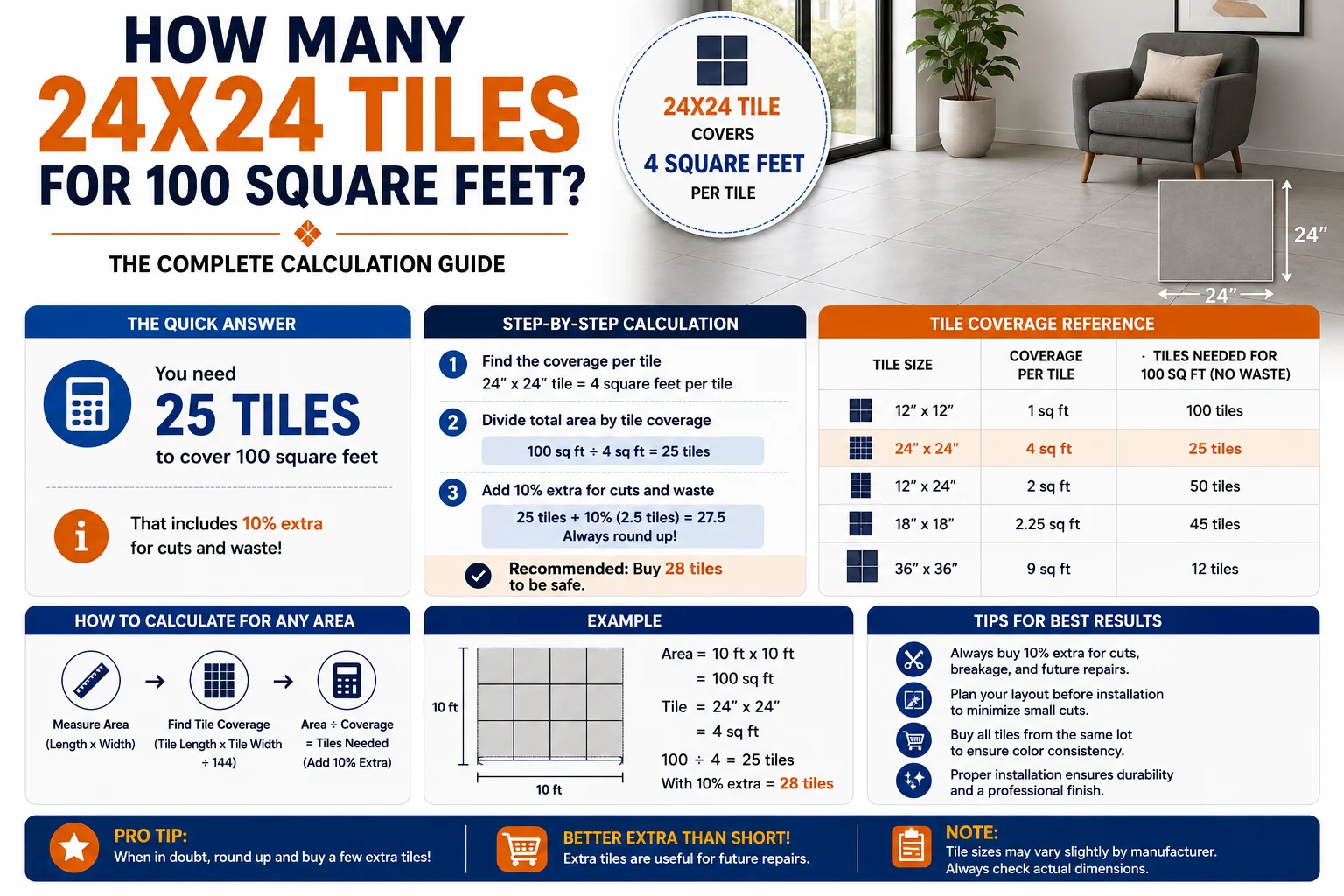
If you’re planning a flooring or renovation project, you may be wondering, how many 24×24 tiles for 100 square feet. The good news is that the calculation is simple.
A standard 24×24 tile measures 2 feet by 2 feet, which means each tile covers 4 square feet. To cover 100 square feet, you need:
100 ÷ 4 = 25 tiles
Therefore, you will need 25 tiles to cover exactly 100 square feet.
However, most professionals recommend purchasing extra tiles to account for cuts, waste, breakage, and future repairs.
This guide explains the math behind the calculation, provides helpful charts, and offers practical tips for your next tile project.
Quick Answer
A 24×24-inch tile covers 4 square feet.
For a 100-square-foot area:
- Area to cover: 100 square feet
- Coverage per tile: 4 square feet
- Tiles required: 25
| Room Size | Number of 24×24 Tiles |
|---|---|
| 50 sq ft | 13 tiles |
| 100 sq ft | 25 tiles |
| 150 sq ft | 38 tiles |
| 200 sq ft | 50 tiles |
For most projects, buy an additional 10–15% to cover waste.
Understanding 24×24 Tile Size
The dimensions “24×24” refer to inches.
Since there are 12 inches in one foot:
- 24 inches = 2 feet
- 24 inches = 2 feet
Each tile measures:
- Length: 2 feet
- Width: 2 feet
The tile area can be visualized as a square.
A=s2
A=42=16
4 rows by 4 columns = 16 square units.
s
s16 square unitss = 4s = 4
This means one tile covers:
2 × 2 = 4 square feet
How to Calculate the Number of Tiles
Follow these steps to determine how many tiles you need.
Step 1: Measure the Room
Measure the room’s length and width.
For example:
- Length: 10 feet
- Width: 10 feet
The room area is:
A=lw
A=6×4=24
4 rows by 6 columns = 24 square units.
w
w
l
l24 square unitsw = 6l = 4
A 10-foot by 10-foot room contains 100 square feet.
Step 2: Find the Area of One Tile
A 24×24 tile equals:
- 2 feet × 2 feet
Coverage:
4 square feet per tile
Step 3: Divide the Room Area by the Tile Area
Calculation:
100 ÷ 4 = 25
You need exactly 25 tiles.
Tile Coverage Chart
The following chart shows how many 24×24 tiles are needed for different room sizes.
| Area to Cover | Tiles Needed |
|---|---|
| 25 sq ft | 7 tiles |
| 50 sq ft | 13 tiles |
| 75 sq ft | 19 tiles |
| 100 sq ft | 25 tiles |
| 125 sq ft | 32 tiles |
| 150 sq ft | 38 tiles |
| 200 sq ft | 50 tiles |
| 300 sq ft | 75 tiles |
Always round up if the calculation produces a decimal.
How Many Extra Tiles Should You Buy?
Experts recommend buying additional tiles for:
- Cutting around corners
- Fitting around cabinets
- Breakage during installation
- Future repairs
- Pattern matching
Recommended Overages
| Installation Type | Extra Tiles |
|---|---|
| Straight layout | 10% |
| Diagonal layout | 15% |
| Complex patterns | 15–20% |
For a 100-square-foot room:
- Base requirement: 25 tiles
- With 10% extra: 28 tiles
- With 15% extra: 29 tiles
Buying a few extra tiles can save time and money later.
Common Projects That Use 24×24 Tiles
Large-format tiles are popular because they create a clean, modern appearance.
Common uses include:
- Living rooms
- Kitchens
- Bathrooms
- Hallways
- Patios
- Garages
- Commercial spaces
Because they have fewer grout lines, 24×24 tiles can make small rooms appear larger.
Factors That Affect Tile Quantity
Several factors can increase the number of tiles you need.
Grout Lines
Wider grout lines slightly change the overall coverage.
Tile Layout
Diagonal layouts require more cuts and create additional waste.
Room Shape
Irregular rooms often need more tiles than square rooms.
Obstacles
Features such as:
- Kitchen islands
- Bathtubs
- Cabinets
- Columns
can affect your calculations.
Common Mistakes to Avoid
Many homeowners underestimate the number of tiles needed.
Avoid these mistakes:
Forgetting Waste
Always buy extra tiles.
Measuring Incorrectly
Double-check all room measurements before ordering.
Ignoring Tile Orientation
Different installation patterns require different quantities.
Not Accounting for Future Repairs
Manufacturers may discontinue tile styles, making replacements difficult to find.
Tips for a Successful Tile Installation
For the best results:
- Measure the room carefully.
- Purchase extra tiles.
- Check tile boxes for matching colors.
- Plan the layout before installation.
- Use spacers for even grout lines.
- Save leftover tiles.
Proper planning can prevent costly mistakes.
24×24 Tiles Compared to Other Sizes
| Tile Size | Coverage per Tile |
|---|---|
| 12×12 inches | 1 sq ft |
| 18×18 inches | 2.25 sq ft |
| 24×24 inches | 4 sq ft |
| 24×48 inches | 8 sq ft |
Larger tiles cover more space and reduce the number of grout lines.
FAQs
How many 24×24 tiles do I need for 100 square feet?
You need 25 tiles to cover exactly 100 square feet.
How much area does one 24×24 tile cover?
One 24×24 tile covers 4 square feet.
Should I buy extra tiles?
Yes. Most professionals recommend purchasing 10–15% extra.
How many 24×24 tiles do I need for 200 square feet?
You will need 50 tiles for 200 square feet.
Are 24×24 tiles good for small rooms?
Yes. Large-format tiles can make small spaces look larger because they create fewer grout lines.
Conclusion
Now you know the answer to how many 24×24 tiles for 100 square feet. Since each tile covers 4 square feet, you need 25 tiles to cover the area.
Before starting your project, remember to buy extra tiles for cuts and future repairs. Accurate measurements and proper planning will help ensure a smooth installation and a professional-looking result.