
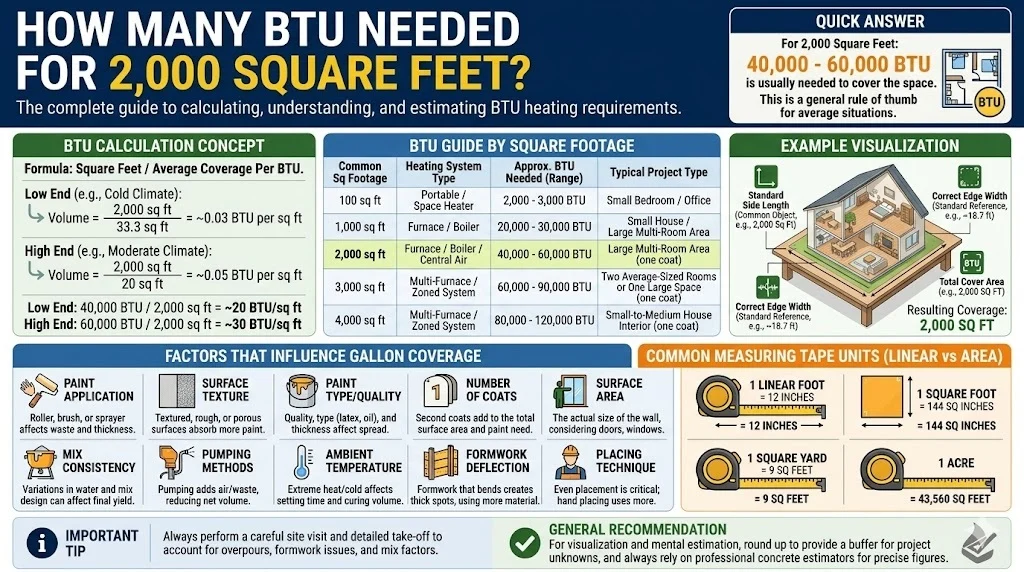
If you are installing a new heating or cooling system, one of the most important questions is:
“How many BTUs are needed for 2,000 square feet?”
BTU sizing is essential for:
- Home comfort
- Energy efficiency
- Lower utility bills
- Proper HVAC performance
- Longer equipment lifespan
An HVAC system that is too small may struggle to maintain temperature, while an oversized system can waste energy and create humidity or comfort problems.
In general:
A 2,000-square-foot home typically needs between 36,000 and 48,000 BTUs for cooling.
For heating, the required BTUs can vary more widely depending on climate and insulation.
In this complete guide, you will learn:
- What BTUs are
- How many BTUs are needed for 2,000 sq ft
- Cooling and heating estimates
- HVAC tonnage conversions
- Factors affecting BTU requirements
- Real-world examples
- Common sizing mistakes
- Energy-saving tips
- Frequently asked questions
Let’s begin.
What Is a BTU?
BTU stands for:
- British Thermal Unit
A BTU measures:
- The amount of energy needed to raise the temperature of one pound of water by 1°F
In HVAC systems:
- BTUs measure heating and cooling capacity
Higher BTUs mean:
- More heating or cooling power
Quick Answer: BTUs for 2,000 Square Feet
Cooling Estimate
Most HVAC professionals estimate:
20–25 BTUs per square foot
For a 2,000 sq ft home:
Lower Estimate
2000×20=40000 BTUs
Higher Estimate
2000×25=50000 BTUs
Result:
A 2,000-square-foot home generally requires 40,000–50,000 BTUs for cooling.
Most homes fall near:
- 42,000–48,000 BTUs
AC Tonnage Equivalent
Air conditioners are often measured in:
- Tons
Conversion:
1 ton=12000 BTUs
For 2,000 square feet:
Example
48000÷12000=4 tons
Result:
A 2,000 sq ft home typically needs a 3.5 to 4 ton AC system.
Heating BTU Requirements for 2,000 Sq Ft
Heating needs depend heavily on:
- Climate
- Insulation
- Ceiling height
- Air leakage
Typical heating estimates:
| Climate | BTUs Needed |
|---|---|
| Warm climate | 30,000–40,000 BTUs |
| Moderate climate | 40,000–60,000 BTUs |
| Cold climate | 60,000–80,000 BTUs |
Why BTU Requirements Vary
Not every 2,000-square-foot home needs the same HVAC capacity.
Several important factors affect sizing.
1. Climate Zone
Hot Climates
Homes in:
- Texas
- Arizona
- Florida
Need more cooling power.
Cold Climates
Homes in:
- Minnesota
- Canada
- Northern states
Need more heating BTUs.
2. Insulation Quality
Good insulation reduces:
- Heat gain in summer
- Heat loss in winter
Well-insulated homes may need:
- Smaller systems
3. Ceiling Height
Standard HVAC calculations assume:
- 8-foot ceilings
Higher ceilings increase:
- Air volume
- BTU demand
4. Windows and Sunlight
Large windows increase:
- Solar heat gain
South- and west-facing windows often require:
- Additional cooling capacity
5. Number of Occupants
People generate heat naturally.
More occupants can increase:
- Cooling load
6. Appliances and Electronics
Heat-producing devices include:
- Ovens
- TVs
- Computers
- Gaming systems
These add to cooling demand.
Common HVAC Sizing Chart
| Home Size | BTUs Needed | Approximate AC Size |
|---|---|---|
| 500 sq ft | 10,000–12,000 | 1 ton |
| 1,000 sq ft | 18,000–24,000 | 1.5–2 tons |
| 1,500 sq ft | 30,000–36,000 | 2.5–3 tons |
| 2,000 sq ft | 40,000–50,000 | 3.5–4 tons |
| 2,500 sq ft | 50,000–60,000 | 4–5 tons |
Real-World Examples
Well-Insulated Home
Home:
- 2,000 sq ft
- Moderate climate
- Modern insulation
Estimated cooling:
- Around 42,000 BTUs
Hot Climate Home
Home:
- 2,000 sq ft
- Large windows
- Hot southern climate
Estimated cooling:
- 48,000–50,000 BTUs
Older Home
Older homes often have:
- Poor insulation
- Air leaks
May require:
- Larger HVAC systems
Why Proper HVAC Sizing Matters
Correct sizing improves:
- Comfort
- Efficiency
- Humidity control
- Equipment lifespan
Problems With an Undersized System
A system that is too small may:
- Run continuously
- Fail to maintain temperature
- Increase utility bills
- Wear out faster
Problems With an Oversized System
Oversized systems may:
- Short cycle
- Waste energy
- Cause uneven temperatures
- Leave excess humidity indoors
Bigger is not always better.
Manual J Load Calculation
Professional HVAC contractors use:
- Manual J calculations
This method considers:
- Climate
- Insulation
- Windows
- Orientation
- Occupancy
- Construction materials
- Air leakage
Manual J is far more accurate than square-foot estimates alone.
Central AC vs Mini Split Systems
BTU needs apply to:
- Central HVAC systems
- Ductless mini splits
- Heat pumps
Central Air Systems
Designed for:
- Whole-home cooling
Typically use:
- Ductwork
Mini Split Systems
Advantages:
- Zoned cooling
- High efficiency
- Flexible installation
Good for:
- Additions
- Multi-zone homes
- Renovations
SEER Ratings and Efficiency
BTUs measure capacity, but efficiency matters too.
SEER
SEER stands for:
- Seasonal Energy Efficiency Ratio
Higher SEER ratings generally mean:
- Lower electricity bills
Energy-Saving Tips
Improve Insulation
Better insulation reduces HVAC demand.
Seal Air Leaks
Prevent conditioned air from escaping.
Use Ceiling Fans
Fans improve comfort and airflow.
Install Energy-Efficient Windows
Modern windows reduce heat transfer.
Replace Dirty Filters
Clean filters improve efficiency and airflow.
Common BTU Sizing Mistakes
Using Square Footage Alon
Many factors affect sizing.
Oversizing the System
Oversized systems can reduce comfort.
Ignoring Climate
Climate dramatically affects BTU needs.
Forgetting Ceiling Height
Higher ceilings require more BTUs.
Portable AC BTUs for 2,000 Sq Ft
Portable AC units are usually:
- Too small for an entire 2,000 sq ft home
Multiple units or central air may be necessary.
Window AC Units for 2,000 Sq Ft
Window AC units are best for:
- Individual rooms
Whole-house cooling usually requires:
- Central HVAC
- Multiple mini splits
Heating Systems for 2,000 Sq Ft
Common options include:
- Furnaces
- Heat pumps
- Boilers
- Electric heating systems
BTU requirements vary by:
- Fuel type
- Climate
- Home efficiency
FAQs
How many BTUs are needed for 2,000 square feet?
Typically:
- 40,000–50,000 BTUs for cooling
What size AC for 2,000 sq ft?
Usually:
- 3.5–4 tons
Is 36,000 BTUs enough for 2,000 sq ft?
Possibly in:
- Mild climates
- Well-insulated homes
But often:
- Slightly undersized
How many BTUs for heating 2,000 sq ft?
Typically:
- 40,000–80,000 BTUs depending on climate
Can insulation reduce BTU needs?
Yes.
Good insulation significantly improves efficiency.
What is the best way to size HVAC equipment?
A professional:
- Manual J load calculation
Provides the most accurate sizing.
Final Thoughts
So, how many BTUs are needed for 2,000 square feet?
Most 2,000-square-foot homes require approximately 40,000–50,000 BTUs for cooling.
This typically equals:
- A 3.5 to 4 ton air conditioning system
However, actual requirements depend on:
- Climate
- Insulation
- Ceiling height
- Windows
- Sun exposure
- Occupancy
- Home efficiency
Proper HVAC sizing helps improve:
- Comfort
- Energy savings
- Humidity control
- System lifespan
- Overall indoor air quality
Whether you are choosing a furnace, central AC, heat pump, or mini split system, understanding BTU requirements helps you make smarter heating and cooling decisions for your home.