

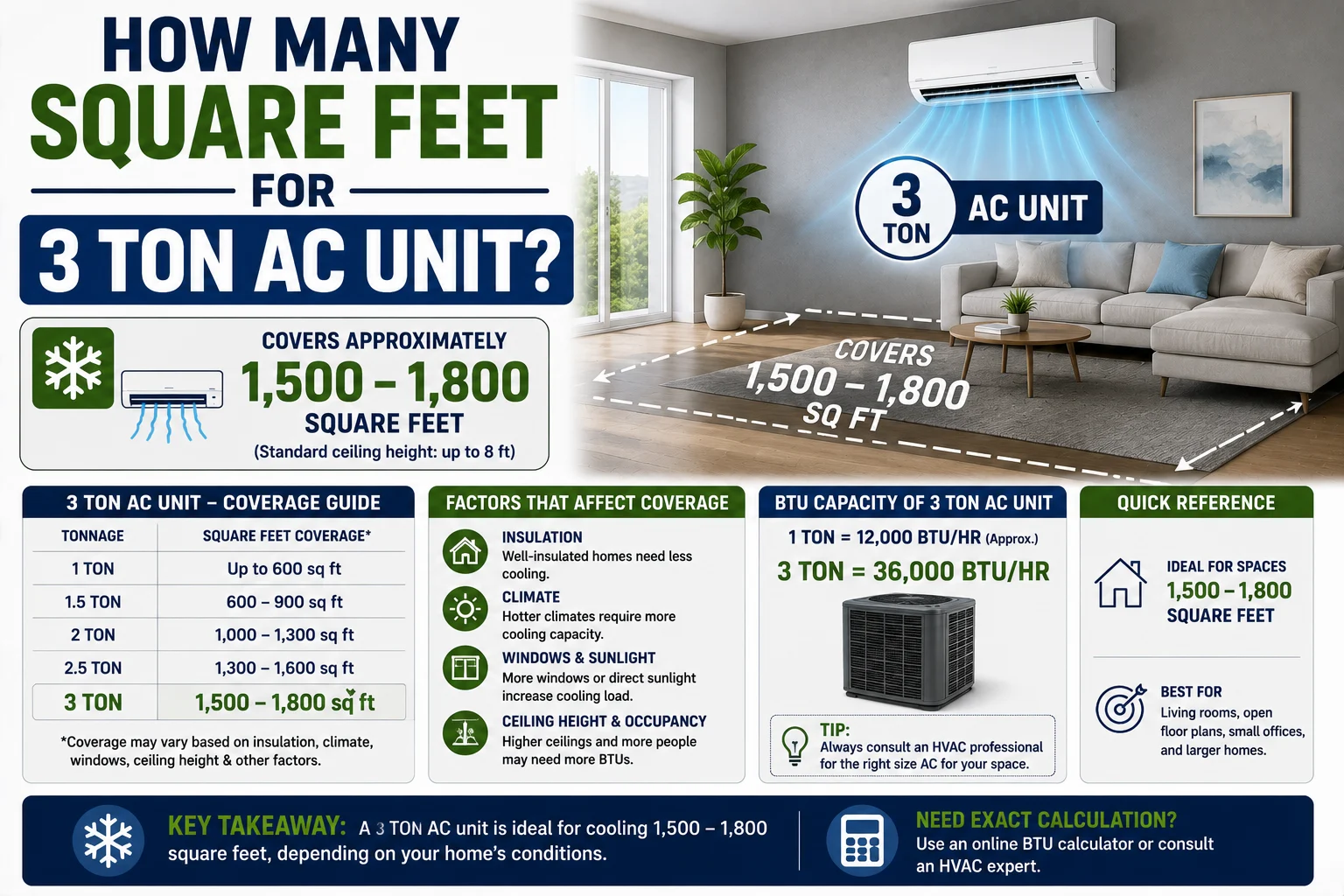
If you’re replacing an air conditioner or installing central AC for a home, one of the first questions you may have is: how many square feet does a 3-ton AC unit cover?
A 3-ton air conditioner provides approximately 36,000 BTUs of cooling capacity. As a broad starting estimate, a 3-ton AC unit can often cool around 1,500 to 2,100 square feet in a typical residential setting.
However, there is no universal square-footage number for a 3-ton AC.
The correct size depends on factors such as climate, insulation, ceiling height, windows, sunlight, occupancy, ductwork, and the home’s overall heat gain.
For a relatively well-insulated home in a moderate climate, about 1,800 square feet is a useful rule-of-thumb reference for a 3-ton system. A home in a very hot climate or with poor insulation may require a different capacity.
A=lw
A=6×4=24
4 rows by 6 columns = 24 square units.
w
w
l
l24 square unitsw = 6l = 4
Give feedback
Quick Answer: How Many Square Feet for a 3-Ton AC Unit?
A 3-ton AC unit equals approximately 36,000 BTUs.
As a general residential estimate, a 3-ton system may cool approximately:
1,500–2,100 square feet
A common midpoint is around:
1,800 square feet
But this is only a starting point. AC sizing should ideally be based on a cooling-load calculation, not square footage alone.
| AC Size | BTUs | Approximate Residential Area* |
|---|---|---|
| 1.5 ton | 18,000 | 700–1,000 sq ft |
| 2 ton | 24,000 | 1,000–1,400 sq ft |
| 2.5 ton | 30,000 | 1,250–1,700 sq ft |
| 3 ton | 36,000 | 1,500–2,100 sq ft |
| 3.5 ton | 42,000 | 1,750–2,400 sq ft |
| 4 ton | 48,000 | 2,000–2,800 sq ft |
| 5 ton | 60,000 | 2,500–3,500 sq ft |
*These are broad planning ranges, not precise equipment-sizing recommendations.
What Does a 3-Ton AC Unit Mean?
The word “ton” in air conditioning doesn’t refer to the physical weight of the equipment.
Instead, an AC ton describes its cooling capacity.
One ton of cooling equals approximately:
12,000 BTUs per hour
Therefore:
3 × 12,000 = 36,000 BTUs
So:
3 tons = 36,000 BTUs
A 3-ton AC can theoretically remove approximately 36,000 BTUs of heat per hour under its rated conditions.
Is a 3-Ton AC the Same as 36,000 BTUs?
Yes, in terms of nominal cooling capacity:
1 ton = 12,000 BTUs
Therefore:
3 tons = 36,000 BTUs
This makes it easier to compare AC systems because manufacturers may advertise equipment by either tonnage or BTU capacity.
How Many Square Feet Can a 3-Ton AC Cool?
The answer depends heavily on the building.
A general planning range is approximately:
1,500–2,100 square feet
For example:
- 1,500 sq ft: A 3-ton unit may be more than sufficient in some mild, well-insulated homes.
- 1,800 sq ft: A 3-ton system may be a reasonable starting point under average conditions.
- 2,000 sq ft: A 3-ton system could work depending on climate and construction.
- 2,100+ sq ft: A 3-ton system may or may not be enough, depending on the cooling load.
This is why two homes with the same square footage can require different AC sizes.
Is a 3-Ton AC Enough for 1,500 Square Feet?
A 3-ton AC may be enough for a 1,500-square-foot home and could potentially be oversized under some conditions.
For example, a well-insulated 1,500-square-foot home in a moderate climate may have a relatively low cooling load.
However, a 1,500-square-foot home in a very hot climate with:
- Poor insulation
- Large windows
- High ceilings
- Strong sun exposure
could have a significantly higher cooling requirement.
The home’s actual heat gain should determine the final equipment size.
Is a 3-Ton AC Enough for 1,800 Square Feet?
It can be.
A 3-ton system is often considered a reasonable starting point for a home around 1,800 square feet, assuming typical construction and moderate cooling conditions.
However, square footage alone cannot confirm that 36,000 BTUs is the correct capacity.
Factors such as insulation, windows, climate, orientation, and ceiling height can shift the requirement significantly.
Is a 3-Ton AC Enough for 2,000 Square Feet?
A 3-ton AC may be enough for 2,000 square feet, particularly if the home is energy efficient and the climate is moderate.
However, if the house experiences substantial heat gain, a 3-ton system may struggle to maintain the desired indoor temperature during the hottest part of the day.
A professional HVAC load calculation is the best way to determine whether 36,000 BTUs is appropriate.
Is a 3-Ton AC Enough for 2,500 Square Feet?
For many homes, 3 tons may not be enough for 2,500 square feet, particularly in hot climates.
However, a highly efficient home with excellent insulation and low heat gain could have a lower cooling load than expected.
You should not automatically install a 4- or 5-ton system simply because the house is 2,500 square feet.
Proper sizing is more important than following a square-footage chart.
3-Ton AC Square Footage by Climate
Climate can have a major impact on AC sizing.
A 3-ton unit may cover different amounts of space depending on local weather conditions.
| Climate Conditions | Possible 3-Ton Coverage |
|---|---|
| Mild climate | Up to ~2,000–2,100+ sq ft |
| Moderate climate | ~1,700–2,000 sq ft |
| Hot climate | ~1,500–1,800 sq ft |
| Very hot / high heat gain | May require less area |
These figures are illustrative rather than engineering calculations.
A home with excellent insulation in a hot climate can sometimes outperform a poorly insulated home in a milder climate.
How Insulation Affects a 3-Ton AC
Insulation helps reduce heat transfer between the outdoors and indoors.
A well-insulated house generally requires less cooling capacity than a poorly insulated house of the same size.
Well-insulated home
A 3-ton AC may cool a larger area more effectively.
Poorly insulated home
The same 3-ton system may struggle because heat enters the building faster.
Important areas include:
- Attic insulation
- Exterior walls
- Floors
- Windows
- Doors
- Air leaks
Improving insulation and air sealing can sometimes reduce the cooling load without increasing AC size.
How Ceiling Height Affects a 3-Ton AC
Square footage doesn’t tell the whole story.
Consider two homes that each have 1,800 square feet.
Home A
8-foot ceilings
Home B
12-foot ceilings
Home B contains considerably more air volume and may have a different cooling load.
High ceilings can also affect air distribution and temperature stratification.
If your home has vaulted ceilings or large open spaces, don’t rely exclusively on a basic square-footage chart.
How Windows Affect AC Sizing
Windows can contribute significantly to heat gain.
A home with:
- Large windows
- Older single-pane glass
- Unshaded west-facing windows
- Significant afternoon sunlight
may require more cooling than a similar home with energy-efficient windows and exterior shading.
Window treatments, shade trees, exterior awnings, and efficient glazing can reduce solar heat gain.
How Sun Exposure Affects a 3-Ton AC
The direction and amount of sunlight entering a home can affect cooling requirements.
West-facing windows are particularly important because they can receive strong afternoon sunlight when outdoor temperatures are already high.
A 1,800-square-foot house with heavy afternoon solar exposure may have a substantially different cooling load from a shaded 1,800-square-foot house.
How Many BTUs Does a 3-Ton AC Have?
A 3-ton AC has:
36,000 BTUs of nominal cooling capacity
The calculation is:
3 tons × 12,000 BTUs = 36,000 BTUs
This is the number you’ll often see when comparing central air-conditioning equipment.
3-Ton AC vs. 2-Ton AC
A 2-ton AC provides:
2 × 12,000 = 24,000 BTUs
A 3-ton system provides:
3 × 12,000 = 36,000 BTUs
Therefore, a 3-ton system has approximately 50% more nominal cooling capacity than a 2-ton system.
| Feature | 2-Ton AC | 3-Ton AC |
|---|---|---|
| Nominal BTUs | 24,000 | 36,000 |
| Relative capacity | Lower | Higher |
| Typical use | Smaller homes | Medium-sized homes |
| Square footage | Varies | Varies |
| Exact sizing | Load calculation | Load calculation |
3-Ton AC vs. 3.5-Ton AC
A 3.5-ton system provides:
3.5 × 12,000 = 42,000 BTUs
Compared with a 3-ton system:
- 3 ton = 36,000 BTUs
- 3.5 ton = 42,000 BTUs
The difference is:
42,000 − 36,000 = 6,000 BTUs
A 3.5-ton unit isn’t automatically better. If your home’s cooling load only requires 36,000 BTUs, oversizing can create comfort and efficiency problems.
3-Ton AC vs. 4-Ton AC
A 4-ton system provides:
4 × 12,000 = 48,000 BTUs
So:
| AC Size | Cooling Capacity |
|---|---|
| 2 ton | 24,000 BTUs |
| 2.5 ton | 30,000 BTUs |
| 3 ton | 36,000 BTUs |
| 3.5 ton | 42,000 BTUs |
| 4 ton | 48,000 BTUs |
| 5 ton | 60,000 BTUs |
The right size depends on the home’s actual cooling load.
What Happens If a 3-Ton AC Is Too Small?
An undersized AC may struggle to keep up with demand.
Possible signs include:
- The system runs continuously
- Indoor temperature remains above the thermostat setting
- Rooms stay warm during peak afternoon hours
- The system struggles on very hot days
- Cooling is inconsistent
However, these symptoms can also result from poor ductwork, inadequate insulation, refrigerant problems, dirty filters, or other HVAC issues.
What Happens If a 3-Ton AC Is Too Large?
Oversizing an AC can also create problems.
A system that is significantly larger than the home’s cooling load may:
- Short-cycle
- Turn on and off frequently
- Remove less humidity
- Produce uneven comfort
- Increase equipment wear
- Potentially waste energy
An air conditioner needs enough run time to effectively condition the space.
Therefore, the goal isn’t to install the largest system possible.
The goal is to install the appropriately sized system.
Why Square Footage Isn’t Enough
You might see rules such as “one ton per X square feet,” but these are only rough estimates.
A proper HVAC sizing calculation considers the home’s cooling load, which can include:
- Outdoor design temperature
- Building envelope
- Insulation
- Windows
- Solar heat gain
- Ceiling height
- Number of occupants
- Lighting
- Appliances
- Air leakage
- Ductwork
- Orientation
This explains why two 2,000-square-foot houses may require different AC capacities.
How to Know if You Need a 3-Ton AC
A 3-ton system may be worth considering when:
- Your home’s calculated cooling load is close to 36,000 BTUs
- Your existing system is approximately 3 tons and adequately sized
- The home is around 1,500–2,100 square feet
- The climate and construction support that capacity
- A qualified HVAC professional recommends it
If you’re replacing an existing system, don’t automatically assume the old unit was correctly sized. Older systems can be oversized or undersized.
3-Ton AC for a Single-Story Home
A single-story home can sometimes be easier to cool because conditioned air doesn’t have to move between floors.
However, factors such as:
- Attic insulation
- Roof exposure
- Ceiling height
- Window placement
- Duct layout
still matter.
A well-insulated single-story 1,800-square-foot house may work well with a 3-ton system, but the final size should be based on the cooling load.
3-Ton AC for a Two-Story Home
A two-story home can present different challenges.
Upper floors may become warmer because heat naturally rises and because of greater exposure to the roof.
A single 3-ton system may cool the entire house, but proper duct design and airflow are important.
In some homes, zoning or separate systems may provide better comfort.
How Much Electricity Does a 3-Ton AC Use?
A 3-ton rating tells you the cooling capacity, not exactly how much electricity the system consumes.
Electrical consumption depends on:
- Efficiency rating
- Compressor technology
- Outdoor temperature
- Indoor temperature setting
- Runtime
- System condition
- Duct losses
- Installation quality
Two 3-ton AC systems can have significantly different energy consumption.
When comparing new systems, look at the applicable efficiency ratings rather than assuming all 3-ton units use the same amount of electricity.
How Long Should a 3-Ton AC Run?
There isn’t one fixed runtime that applies to every home.
During hot weather, an appropriately sized system may run for extended periods as it maintains the indoor temperature.
Longer cycles can help with:
- Temperature stability
- Humidity removal
- Efficient operation
Constant operation while the home remains too warm, however, can indicate that the system is undersized or that another HVAC/building problem needs attention.
How to Improve the Performance of a 3-Ton AC
If you already have a 3-ton system, several measures can improve comfort and efficiency:
1. Replace or clean the air filter
A dirty filter restricts airflow.
2. Maintain the outdoor unit
Keep vegetation and debris away from the condenser.
3. Check ductwork
Leaking or poorly insulated ducts can waste conditioned air.
4. Improve insulation
Better insulation can reduce heat entering the home.
5. Seal air leaks
Weatherstripping and air sealing can reduce unwanted heat transfer.
6. Use shading
Blinds, curtains, awnings, and exterior shade can reduce solar heat gain.
7. Schedule professional maintenance
Regular service can help identify airflow and equipment problems.
FAQs
1. How many square feet does a 3-ton AC unit cool?
A 3-ton AC provides approximately 36,000 BTUs and may commonly cool around 1,500–2,100 square feet, depending on climate, insulation, windows, ceiling height, and other factors.
2. Is a 3-ton AC enough for 1,800 square feet?
It can be. 1,800 square feet is within a common planning range for a 3-ton system, but the correct size depends on the home’s actual cooling load.
3. Is a 3-ton AC enough for 2,000 square feet?
It may be sufficient in a well-insulated home with moderate heat gain. In a very hot climate or poorly insulated house, a different capacity may be required.
4. How many BTUs is a 3-ton AC?
A 3-ton AC has approximately 36,000 BTUs of nominal cooling capacity.
5. Is a 3-ton AC too big for 1,500 square feet?
It could be, particularly in a well-insulated home or moderate climate. However, the cooling load—not square footage alone—should determine the correct capacity.
6. Can a 3-ton AC cool 2,500 square feet?
It may be possible in an exceptionally efficient home with low heat gain, but 3 tons may be insufficient for many 2,500-square-foot homes, particularly in hot climates.
7. Should I choose a 3-ton AC based only on square footage?
No. Square footage is useful for an initial estimate, but proper AC sizing should consider the home’s cooling load, insulation, windows, climate, ceiling height, occupancy, and other factors.
Conclusion
So, how many square feet is a 3-ton AC unit designed to cover?
A 3-ton air conditioner provides approximately:
36,000 BTUs
As a broad residential guideline, it may cool approximately:
1,500 to 2,100 square feet
A home around 1,800 square feet is a useful midpoint example, but this should not be treated as a universal rule.
Climate, insulation, windows, ceiling height, sunlight, occupancy, ductwork, and the building envelope can all change the amount of cooling required. A poorly insulated 1,800-square-foot home may need more capacity than a highly efficient home of the same size.
For the most accurate answer, have the home’s cooling load calculated before purchasing equipment. Choosing the right-sized 3-ton system is more important than simply matching a BTU number to square footage.



Pingback: How Many Cubic Feet Are There in a Cubic Yard?