
If you are wondering how many square feet is 40 x 60, the answer is simple:
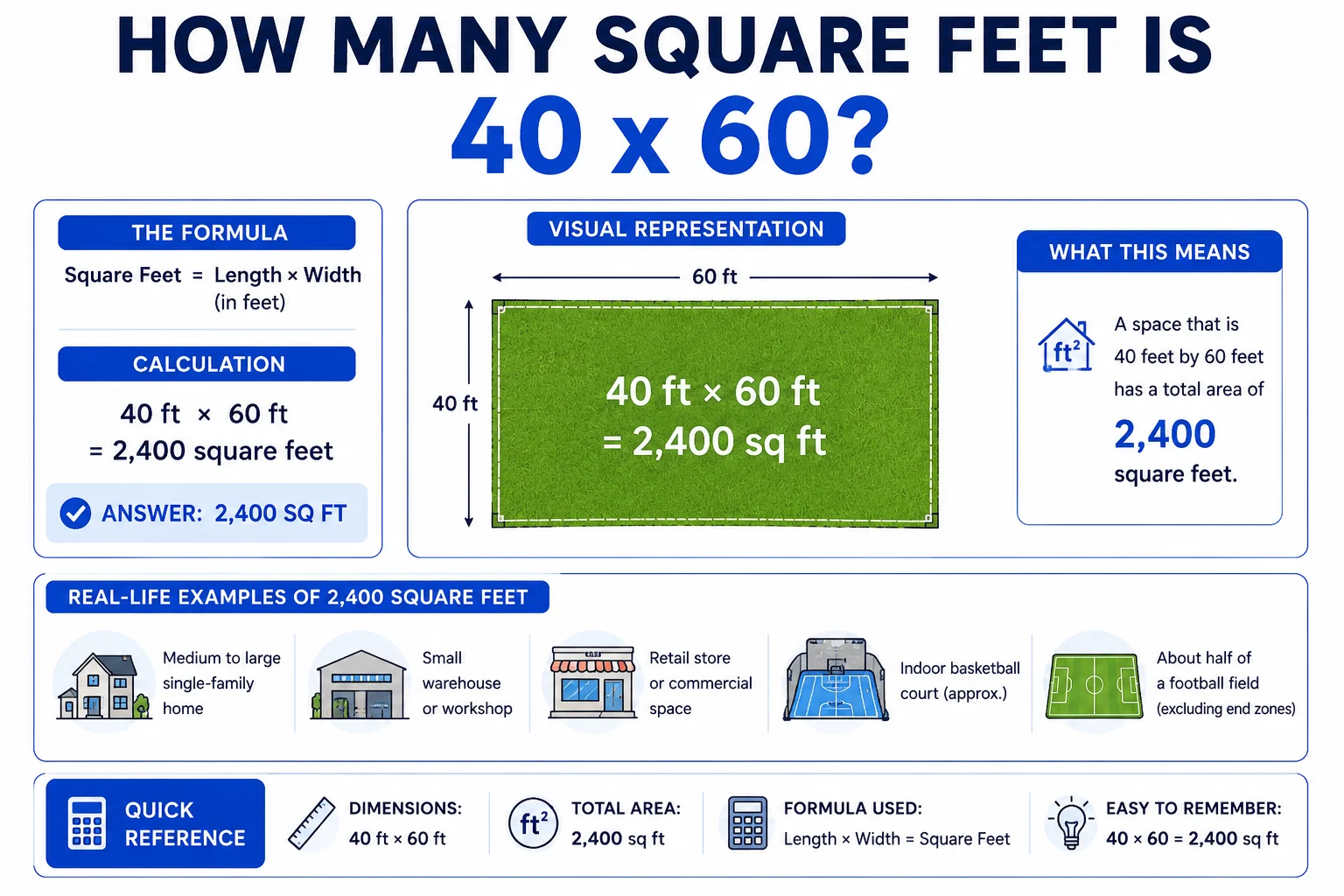
A 40 x 60 space equals 2,400 square feet.
This measurement is commonly used for homes, garages, workshops, pole barns, warehouses, and commercial buildings. Understanding square footage helps you plan layouts, estimate construction costs, compare properties, and determine how much usable space you have.
To calculate square feet, you multiply the length by the width:
40×60=2400
So, a building or area measuring 40 feet wide and 60 feet long contains 2,400 square feet of total space.
In this guide, you’ll learn how square footage works, how to calculate it correctly, what a 40×60 building looks like in real life, and how this size compares to other common structures.
Understanding Square Footage
Square footage measures the total area inside a two-dimensional space. It tells you how much floor space an area covers.
For example:
- A room that is 10 feet by 10 feet equals 100 square feet
- A garage measuring 20 feet by 20 feet equals 400 square feet
- A building that is 40 feet by 60 feet equals 2,400 square feet
Square footage matters because it helps with:
- Construction planning
- Real estate pricing
- Flooring estimates
- Interior design
- Storage planning
- Heating and cooling calculations
The larger the square footage, the more usable space you have.
How to Calculate the Square Feet of 40 x 60
Calculating square footage is easy once you know the basic formula.
Formula for Square Footage
Use this formula:
Square Feet=Length×Width
For a 40 x 60 space:
- Length = 60 feet
- Width = 40 feet
Now multiply them together:
60×40=2400
The total equals:
2,400 square feet
Step-by-Step Example
Here’s the full process:
| Measurement | Value |
|---|---|
| Width | 40 feet |
| Length | 60 feet |
| Formula | Width × Length |
| Calculation | 40 × 60 |
| Total Area | 2,400 square feet |
This formula works for nearly all rectangular spaces.
How Big Is a 40 x 60 Space?
Many people can calculate square footage but still struggle to picture the actual size. A 40×60 building is quite large and offers a lot of flexibility.
A 2,400-square-foot building can comfortably fit:
- A large family home
- A four-car garage
- A workshop with storage
- A commercial workspace
- A barn with equipment storage
- A gym or studio
Visual Comparisons
To better understand the size, compare it to these common spaces:
| Space Type | Approximate Size |
|---|---|
| Standard one-car garage | 240 sq ft |
| Two-car garage | 400–600 sq ft |
| Small apartment | 600–900 sq ft |
| Average U.S. home | 1,800–2,400 sq ft |
| 40 x 60 building | 2,400 sq ft |
A 40 x 60 structure is about the size of a full modern family home.
Real-World Example
Imagine a large workshop with:
- Two vehicle bays
- A storage room
- A small office
- Open work space
A 40×60 layout provides enough room for all of these features while still feeling spacious.
Common Uses for a 40 x 60 Building
One reason 40×60 buildings are popular is versatility. The size works well for residential, agricultural, and commercial purposes.
Homes
A 2,400-square-foot house is considered spacious for many families.
A typical 40×60 home might include:
- 3–4 bedrooms
- 2 bathrooms
- Open kitchen
- Living room
- Dining area
- Laundry room
- Garage
This size gives enough room for comfortable living without becoming difficult to maintain.
Garages
A 40×60 garage is ideal for:
- Multiple vehicles
- Boats
- RV storage
- Tool storage
- Repair work
Many car enthusiasts choose this size because it allows room to work around vehicles comfortably.
Workshops
A 40×60 workshop can support:
- Woodworking
- Metal fabrication
- Auto repair
- Equipment storage
- Manufacturing projects
The open layout gives flexibility for machinery and workstations.
Pole Barns and Agricultural Buildings
Farmers often use 40×60 buildings for:
- Tractor storage
- Hay storage
- Livestock shelters
- Feed storage
- Equipment maintenance
Because the space is large and efficient, it works well in agricultural settings.
40 x 60 Square Foot Comparison Chart
Here’s how a 40×60 building compares to other common dimensions.
| Dimensions | Square Feet |
|---|---|
| 20 x 20 | 400 sq ft |
| 20 x 40 | 800 sq ft |
| 30 x 40 | 1,200 sq ft |
| 30 x 50 | 1,500 sq ft |
| 40 x 40 | 1,600 sq ft |
| 40 x 60 | 2,400 sq ft |
| 50 x 60 | 3,000 sq ft |
| 60 x 80 | 4,800 sq ft |
This chart helps you compare different building sizes quickly.
Planning a 40 x 60 Building
Before building or buying a 40×60 structure, proper planning is important.
Layout Ideas
The layout depends on how you plan to use the space.
Here are some common layout ideas:
Residential Layout
- 4 bedrooms
- Large kitchen
- Open living room
- Attached garage
Workshop Layout
- Equipment zone
- Storage shelves
- Office corner
- Vehicle access area
Barn Layout
- Equipment parking
- Feed storage
- Animal stalls
- Utility room
Good planning helps maximize every square foot.
Cost Considerations
Construction costs vary depending on:
- Materials
- Location
- Labor
- Interior finishes
- Plumbing and electrical work
In general, larger buildings cost more, but the cost per square foot may decrease with size.
A simple metal building may cost much less than a fully finished home.
Important Measurements
Besides square footage, consider:
- Ceiling height
- Door width
- Interior wall placement
- Storage needs
- Driveway access
These details affect how useful the building becomes.
Benefits of a 40 x 60 Building
A 40×60 structure offers many advantages.
Plenty of Usable Space
With 2,400 square feet, you have room for:
- Living
- Storage
- Business operations
- Recreation
- Equipment
Flexible Design Options
The open footprint allows many layout styles.
You can divide the interior into separate rooms or leave it open.
Strong Resale Value
Larger buildings often attract buyers because they provide flexibility.
Multi-Purpose Functionality
A single 40×60 structure can combine:
- Garage space
- Workspace
- Office area
- Storage
This reduces the need for multiple buildings.
Common Mistakes When Calculating Square Feet
Even though the math is simple, mistakes still happen.
Confusing Linear Feet With Square Feet
Linear feet measure length only.
Square feet measure total area.
A 40-foot wall is not the same as 40 square feet.
Forgetting to Multiply Both Dimensions
Some people add the dimensions instead of multiplying them.
Incorrect:
- 40 + 60 = 100
Correct:
- 40 × 60 = 2,400
Ignoring Irregular Shapes
If a building has extensions or unusual layouts, divide it into smaller rectangles and calculate each section separately.
Estimating Instead of Measuring
Always use accurate measurements before buying materials or planning construction.
Small mistakes can become expensive.
Expert Tips for Measuring Square Footage
Professionals use a few simple methods to ensure accurate calculations.
Use Consistent Units
Measure everything in feet before calculating square footage.
Double-Check Measurements
Even a one-foot error changes the total significantly.
Include Interior Space Carefully
Some calculations include garages and unfinished areas, while others do not.
Clarify what counts toward usable square footage.
Use Digital Tools
Online square footage calculators can help confirm your math.
Still, understanding the formula yourself is important.
Why Square Footage Matters in Real Estate
Square footage affects:
- Home value
- Property taxes
- Insurance costs
- Rental rates
- Construction estimates
In most cases, larger homes and buildings cost more because they provide additional usable space.
However, layout and functionality matter too.
A well-designed 2,400-square-foot building may feel larger than a poorly designed 3,000-square-foot structure.
Is a 40 x 60 Building Large Enough?
For many people, yes.
A 40×60 building is large enough for:
- Comfortable family living
- Small businesses
- Vehicle storage
- Workshops
- Agricultural use
The size strikes a balance between spaciousness and affordability.
It’s large enough to feel open while still being manageable.
FAQs
1. How many square feet is 40 x 60?
A 40 x 60 space equals 2,400 square feet.
2. Is a 40×60 building considered large?
Yes. A 40×60 building is considered large and can support residential, commercial, agricultural, or workshop use.
3. How do you calculate square feet?
Multiply the length by the width:
Length × Width = Square Feet
4. Can a 40×60 building be used as a home?
Yes. Many homes are around 2,400 square feet, making a 40×60 layout suitable for family living.
5. How many cars fit in a 40×60 garage?
Depending on layout, a 40×60 garage can fit 4–8 vehicles comfortably.
Conclusion
So, how many square feet is 40 x 60?
The answer is 2,400 square feet.
This size is large enough for homes, garages, workshops, barns, and commercial spaces. By multiplying the length and width, you can quickly calculate square footage for almost any rectangular area.
A 40×60 building offers flexibility, functionality, and plenty of usable space. Whether you’re planning construction, comparing properties, or estimating material costs, understanding square footage helps you make smarter decisions.
Now that you know the square footage of a 40 x 60 space, you can confidently plan layouts, budgets, and future projects with greater accuracy.