

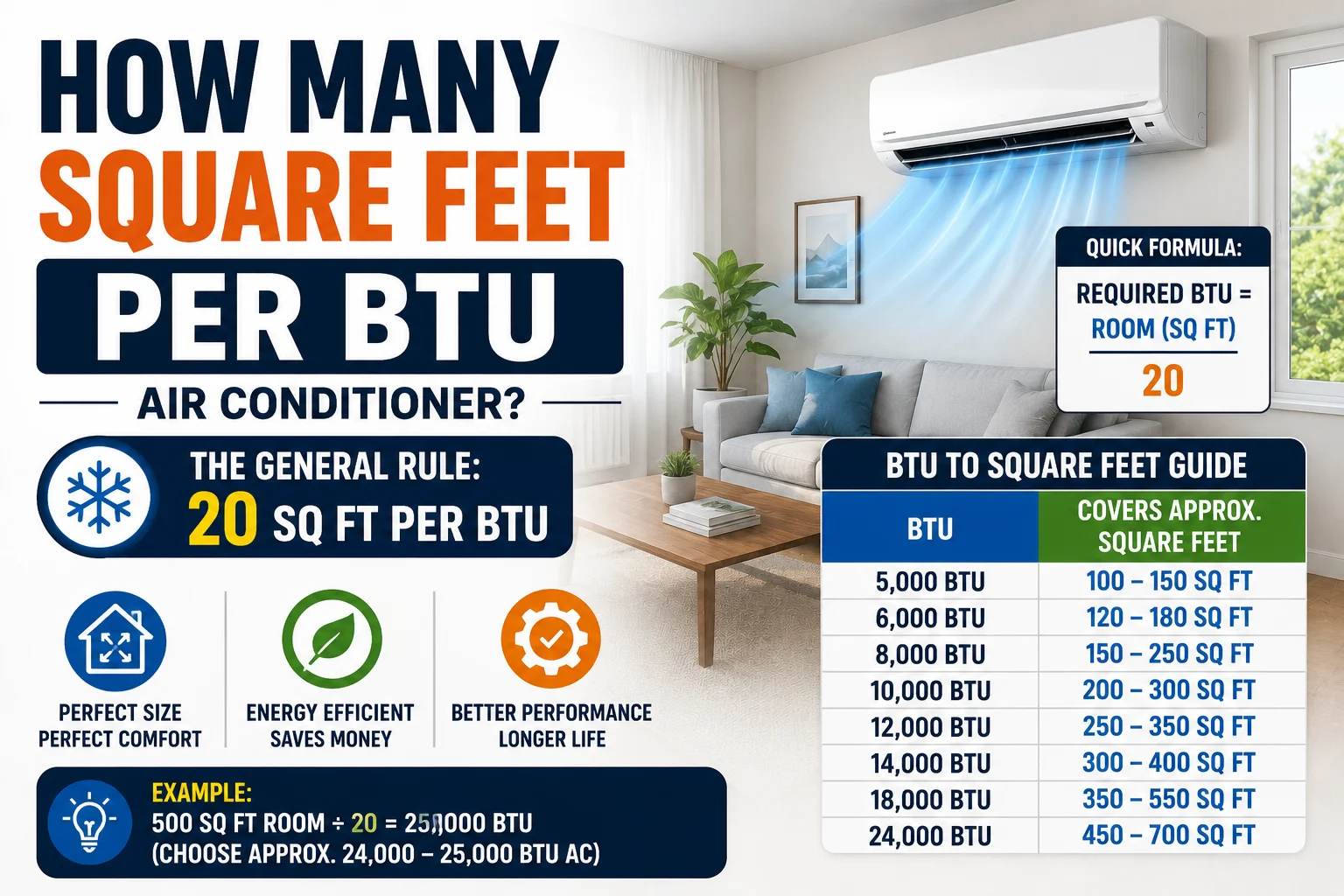
Choosing the right air conditioner starts with understanding how many square feet per BTU air conditioner can effectively cool. If the unit is too small, it will struggle to keep the room comfortable. If it’s too large, it may cool the space too quickly without properly removing humidity, leading to wasted energy and uneven temperatures.
As a general guideline, you’ll need about 20 BTUs of cooling capacity per square foot of living space under average conditions. For example, a 12,000 BTU air conditioner can typically cool 500–600 square feet, while an 18,000 BTU unit is suitable for 700–1,000 square feet, depending on insulation, ceiling height, and climate.
This guide explains BTU ratings, provides room size charts, and helps you choose the right air conditioner for your home.
Quick Answer
A simple rule of thumb is:
- 20 BTUs per square foot
This means:
| Room Size | Recommended BTU |
|---|---|
| 150 sq ft | 5,000–6,000 BTU |
| 250 sq ft | 6,000–8,000 BTU |
| 350 sq ft | 8,000–10,000 BTU |
| 450 sq ft | 10,000–12,000 BTU |
| 550 sq ft | 12,000–14,000 BTU |
| 700 sq ft | 14,000–18,000 BTU |
| 1,000 sq ft | 18,000–24,000 BTU |
These values are estimates for rooms with average insulation and standard 8-foot ceilings.
What Does BTU Mean?
BTU stands for British Thermal Unit, which measures how much heat an air conditioner can remove from a room in one hour.
A higher BTU rating means greater cooling capacity.
For example:
- 6,000 BTU = Small bedroom
- 12,000 BTU = Large room or studio apartment
- 24,000 BTU = Small home or multiple connected rooms
Why BTUs Matter
Correct BTU sizing helps:
- Maintain comfortable temperatures
- Reduce electricity costs
- Improve humidity control
- Extend the life of your air conditioner
- Prevent excessive cycling
Choosing the right capacity ensures better efficiency and comfort.
BTU Coverage Chart by Square Footage
| BTU Rating | Approximate Coverage |
|---|---|
| 5,000 BTU | 100–150 sq ft |
| 6,000 BTU | 150–250 sq ft |
| 8,000 BTU | 250–350 sq ft |
| 10,000 BTU | 350–450 sq ft |
| 12,000 BTU | 450–600 sq ft |
| 14,000 BTU | 500–700 sq ft |
| 18,000 BTU | 700–1,000 sq ft |
| 24,000 BTU | 1,000–1,400 sq ft |
| 30,000 BTU | 1,400–1,600 sq ft |
| 36,000 BTU | 1,600–2,000 sq ft |
This chart serves as a starting point. Actual cooling needs depend on several factors beyond square footage.
How Many Square Feet Does Each BTU Air Conditioner Cool?
Small Rooms
Air conditioners between 5,000 and 8,000 BTUs are ideal for:
- Bedrooms
- Home offices
- Small apartments
- Dorm rooms
Coverage ranges from 100 to 350 square feet.
Medium Rooms
Units rated between 10,000 and 14,000 BTUs typically cool:
- Living rooms
- Large bedrooms
- Studio apartments
- Kitchens
Coverage ranges from 350 to 700 square feet.
Large Rooms
Air conditioners rated 18,000 BTUs or more are suitable for:
- Open-concept living spaces
- Small homes
- Finished basements
- Multi-room areas
Coverage ranges from 700 to 2,000 square feet, depending on the unit size.
Factors That Affect BTU Requirements
Square footage is only one part of the equation.
Climate
Homes in hotter regions require more cooling capacity than those in mild climates.
Insulation
Well-insulated homes lose less cool air, reducing the required BTU capacity.
Older homes with poor insulation may need a larger air conditioner.
Ceiling Height
Standard sizing assumes 8-foot ceilings.
If your ceilings are higher, you’ll need additional BTUs because there is more air volume to cool.
Sun Exposure
Rooms with:
- Large windows
- South-facing exposure
- Skylights
often require more cooling than shaded rooms.
Number of Occupants
Each person generates body heat.
If several people regularly occupy a room, you may need additional BTUs to maintain comfort.
How to Calculate the Right BTU Size
Use this simple formula:
Recommended BTU = Room Area × 20
For example:
Room size = 400 square feet
Calculation:
400 × 20 = 8,000 BTUs
To visualize how room area is calculated:
A=lw
A=6×4=24
4 rows by 6 columns = 24 square units.
w
w
l
l24 square unitsw = 6l = 4
If your room has high ceilings, lots of windows, or receives direct sunlight, increase the BTU estimate accordingly.
BTU to AC Ton Conversion
Central air systems are often rated in tons rather than BTUs.
| AC Size | BTUs |
|---|---|
| 1 Ton | 12,000 BTU |
| 1.5 Ton | 18,000 BTU |
| 2 Ton | 24,000 BTU |
| 2.5 Ton | 30,000 BTU |
| 3 Ton | 36,000 BTU |
| 3.5 Ton | 42,000 BTU |
| 4 Ton | 48,000 BTU |
| 5 Ton | 60,000 BTU |
This conversion is useful when comparing window units with central HVAC systems.
Real-World Examples
Example 1: Bedroom
Room size:
12 × 12 feet
Area:
144 square feet
Recommended AC:
5,000–6,000 BTU
Example 2: Living Room
Room size:
20 × 20 feet
Area:
400 square feet
Recommended AC:
8,000–10,000 BTU
Example 3: Studio Apartment
Area:
550 square feet
Recommended AC:
12,000–14,000 BTU
Common Sizing Mistakes
Avoid these common errors:
- Buying the largest air conditioner available
- Ignoring insulation quality
- Forgetting ceiling height
- Overlooking climate conditions
- Choosing a unit based only on price
- Not accounting for sunlight and occupancy
Proper sizing improves comfort and energy efficiency.
Expert Tips
To choose the best air conditioner:
- Measure your room accurately.
- Use BTU charts as a starting point.
- Consider insulation and local climate.
- Look for high-efficiency models with good CEER or SEER ratings.
- Clean filters regularly to maintain performance.
- For whole-home systems, request a Manual J load calculation from an HVAC professional.
FAQs
1. How many square feet does a 12,000 BTU air conditioner cool?
A 12,000 BTU unit typically cools 450–600 square feet, depending on room conditions.
2. How many BTUs do I need per square foot?
A common guideline is 20 BTUs per square foot for average residential spaces.
3. Is it better to oversize an air conditioner?
No. An oversized unit may cool the room too quickly, cycle on and off frequently, and remove less humidity.
4. What size air conditioner do I need for a 1,000-square-foot home?
A home of this size generally requires 18,000–24,000 BTUs, although insulation, climate, and layout can affect the recommendation.
5. Does ceiling height affect BTU requirements?
Yes. Higher ceilings increase the volume of air in the room, so additional BTUs may be needed to cool the space effectively.
Conclusion
If you’re wondering how many square feet per BTU air conditioner you need, a reliable rule of thumb is about 20 BTUs per square foot. This guideline helps you estimate the right air conditioner size for most rooms, but factors such as insulation, ceiling height, climate, sun exposure, and occupancy also influence the ideal capacity.
Using a BTU coverage chart and considering your room’s unique characteristics will help you choose an air conditioner that delivers consistent comfort, better humidity control, and improved energy efficiency. For whole-home systems, a professional HVAC load calculation remains the most accurate way to determine the proper size.
Planning to buy a new AC? Use this guide and BTU chart to compare models, estimate your cooling needs, and select the right air conditioner for your space.