

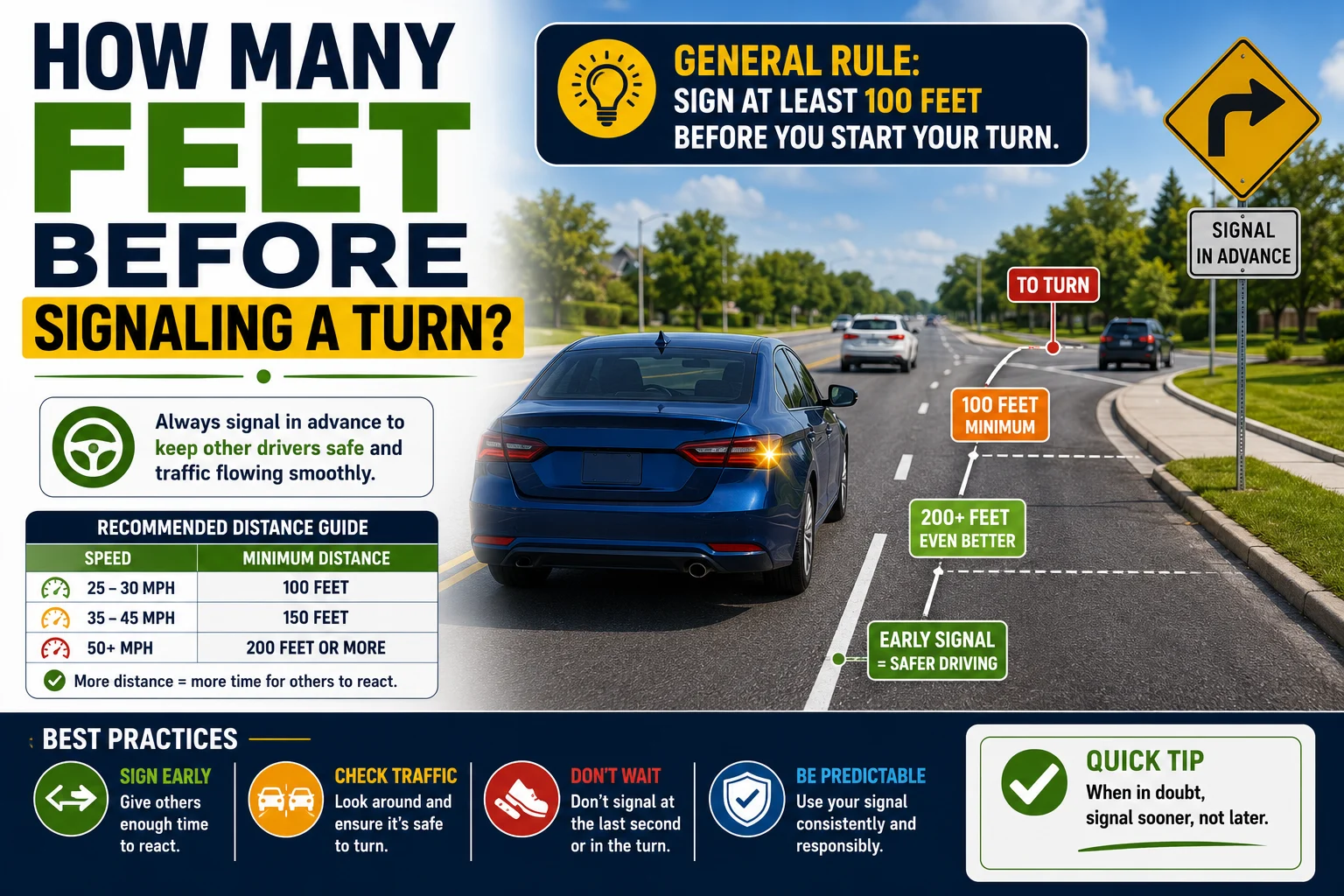
If you’re learning to drive or preparing for a road test, you may be wondering how many feet before signaling a turn. Using your turn signal correctly is one of the simplest yet most important ways to communicate with other drivers, cyclists, and pedestrians.
In most U.S. states, the general rule is to signal continuously for at least 100 feet before making a turn. This gives other road users enough time to react to your intended movement and helps reduce the risk of collisions.
Although the 100-foot rule is widely used, some states have slightly different requirements. This guide explains the standard rule, why it matters, state variations, and tips for signaling correctly every time.
Quick Answer
In most U.S. states, you should activate your turn signal at least 100 feet before making a turn.
This applies to both:
- Left turns
- Right turns
Using your signal early gives other drivers enough warning to slow down, change lanes if necessary, or prepare to stop.
The Standard 100-Foot Rule
The most commonly taught rule in driver’s education is:
Signal continuously for at least 100 feet before turning.
Why 100 feet?
At normal city driving speeds, 100 feet provides several seconds of advance notice. This allows surrounding traffic to recognize your intention and respond safely.
The rule generally applies when:
- Turning at intersections
- Entering a driveway
- Leaving a parking lot
- Turning into a business or private road
Many state driver’s manuals and road tests expect drivers to follow this standard.
Why Is Signaling 100 Feet Early Important?
Using your turn signal early improves safety for everyone on the road.
Benefits include:
- Warns drivers behind you.
- Alerts pedestrians and cyclists.
- Reduces rear-end collision risk.
- Helps traffic flow smoothly.
- Demonstrates safe driving habits during road tests.
Failing to signal in time can confuse other drivers and increase the chance of an accident.
State Laws May Vary
While 100 feet is the most common legal requirement, traffic laws are established by individual states.
For example:
- Many states require signaling at least 100 feet before turning.
- Some states specify different distances or use wording such as “continuously during the last 100 feet.”
- Certain situations, such as highways or low-speed residential streets, may involve additional guidance in state driving manuals.
If you’re preparing for a driver’s license exam, review your state’s driver’s handbook to ensure you’re following local requirements.
How to Signal Correctly
Proper signaling involves more than simply switching on the indicator.
Before a Left Turn
- Check your mirrors.
- Activate your left turn signal at least 100 feet before the turn.
- Slow down gradually.
- Check for pedestrians and oncoming traffic.
- Complete the turn safely.
Before a Right Turn
- Check mirrors and blind spots.
- Signal at least 100 feet before turning.
- Move toward the right side of the lane if appropriate.
- Yield to pedestrians and cyclists.
- Make the turn smoothly.
Before Changing Lanes
Although lane-change rules vary by state, drivers should generally:
- Signal several seconds before moving.
- Check mirrors.
- Check blind spots.
- Change lanes only when it is safe.
Estimating 100 Feet
Many drivers wonder what 100 feet looks like on the road.
Here are some helpful comparisons:
- About 5–6 average car lengths.
- Approximately one-third of a standard city block.
- Roughly the length of a basketball court plus a little extra.
You don’t need to measure the distance precisely while driving. The goal is to signal early enough to give other road users clear notice.
Common Driving Test Mistakes
Driving examiners frequently deduct points for signaling errors such as:
- Signaling too late.
- Forgetting to signal.
- Turning on the signal after braking.
- Canceling the signal too early.
- Leaving the signal on after completing the turn.
Practicing good signaling habits before your test can improve both safety and your chances of passing.
Expert Safe Driving Tips
Follow these best practices every time you drive:
- Signal before you begin slowing down whenever possible.
- Continue signaling until the turn is completed.
- Always check mirrors and blind spots before turning or changing lanes.
- Never assume other drivers know your intentions.
- Use your turn signal even when no other vehicles appear to be nearby.
Consistent signaling helps build safe driving habits that protect everyone on the road.
FAQs
1. How many feet before signaling a turn should I activate my signal?
In most U.S. states, you should signal at least 100 feet before making a turn.
2. Is the 100-foot rule used on driving tests?
Yes. Many driver’s license road tests expect applicants to signal approximately 100 feet before turning, although exam requirements may vary by state.
3. Do I need to signal when turning into my own driveway?
In many places, yes. If the turn affects other road users, you should use your turn signal even when entering a private driveway.
4. Should I signal before braking?
Yes. Whenever practical, activate your turn signal before you begin slowing down so other drivers understand why you’re reducing speed.
5. Do all states require exactly 100 feet?
No. While 100 feet is the most common standard, individual state traffic laws may differ. Always follow your state’s driver’s handbook and local regulations.
Conclusion
Knowing how many feet before signaling a turn is an essential part of safe and responsible driving. In most U.S. states, the recommended and often legally required distance is at least 100 feet before making a turn. Signaling early gives other drivers, cyclists, and pedestrians enough time to react, reducing confusion and helping prevent accidents.
Whether you’re preparing for a driving test or simply improving your driving habits, remember to signal early, check your mirrors and blind spots, and complete every turn smoothly and safely. Following these practices not only helps you comply with traffic laws but also makes the road safer for everyone.