

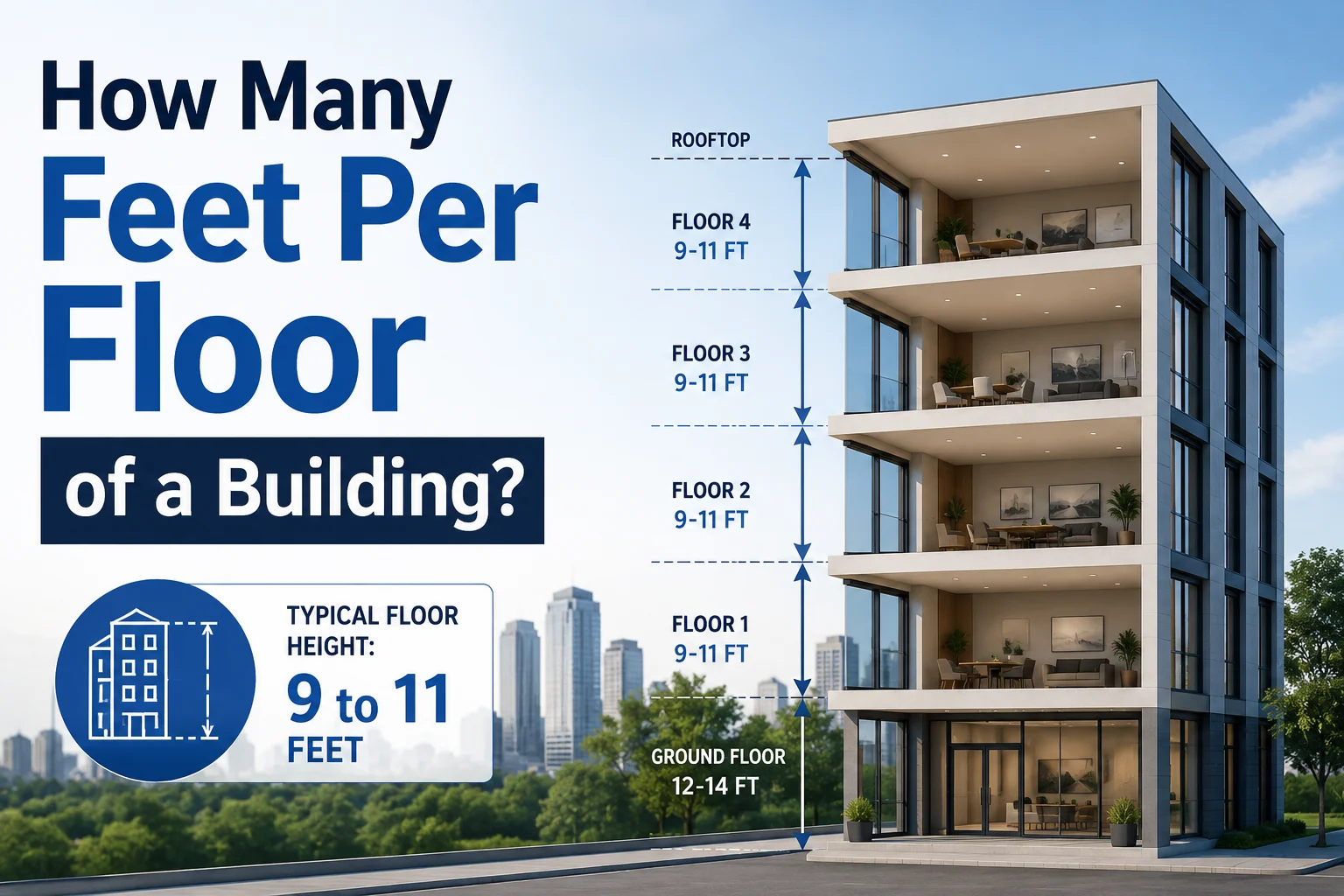
If you are wondering how many feet per floor of a building, the short answer is:
Most buildings average 10 to 14 feet per floor.
The exact height depends on the type of building:
- Single-family homes: 9–10 feet per floor
- Apartment buildings: 10–12 feet per floor
- Office buildings: 12–14 feet per floor
- Skyscrapers: 12–20+ feet per floor
- Parking garages: 10–12 feet per level
So, when estimating building height, many people use 10 feet per floor for residential buildings and 12 to 14 feet per floor for commercial buildings.
Quick Answer
- Residential buildings: 9–10 feet per floor
- Apartments/condos: 10–12 feet per floor
- Office buildings: 12–14 feet per floor
- Skyscrapers: 12–20 feet or more
- Common rule of thumb: 10 feet per floor
Standard Residential Floor Heights
In most modern homes, one story is about 9 to 10 feet tall from floor to floor.
This includes:
- Ceiling height (typically 8–9 feet)
- Floor framing and structural materials
- Mechanical systems
Typical Home Ceiling Heights
| Ceiling Height | Total Story Height |
|---|---|
| 8 feet | 9–10 feet |
| 9 feet | 10–11 feet |
| 10 feet | 11–12 feet |
A two-story house is often around 18 to 22 feet tall, depending on roof design.
Commercial Building Floor Heights
Commercial buildings require more space for:
- HVAC ducts
- Electrical systems
- Fire sprinklers
- Raised floors
- Suspended ceilings
As a result, commercial floors are usually 12 to 14 feet tall.
Common Commercial Heights
| Building Type | Average Height Per Floor |
|---|---|
| Office building | 12–14 feet |
| Retail store | 14–20 feet |
| Hotel | 10–12 feet |
| Hospital | 12–16 feet |
Skyscraper Floor Heights
Tall buildings vary significantly based on function and design.
Office Towers
Most office skyscrapers use 12–15 feet per floor.
Luxury Residential Towers
High-end apartments often use 10–14 feet per floor.
Mechanical Floors
Some floors are much taller to house building systems.
Observation Levels
These can exceed 20 feet in height.
For example, iconic towers like Empire State Building include floors of varying heights depending on their purpose.
Floor-to-Floor Height vs Ceiling Height
These two terms are often confused.
Ceiling Height
The distance from the finished floor to the finished ceiling.
Floor-to-Floor Height
The total distance from one finished floor to the next floor above.
This includes:
- Structural slabs
- Beams
- Mechanical systems
- Ceiling cavities
Example:
- 9-foot ceiling
- 1.5 feet of structural and mechanical space
- Total floor-to-floor height = 10.5 feet
Height Examples by Number of Stories
Using the common 10-foot-per-floor rule:
| Number of Floors | Approximate Height |
|---|---|
| 1 floor | 10 feet |
| 2 floors | 20 feet |
| 3 floors | 30 feet |
| 5 floors | 50 feet |
| 10 floors | 100 feet |
| 20 floors | 200 feet |
For office buildings using 13 feet per floor:
| Number of Floors | Approximate Height |
|---|---|
| 10 floors | 130 feet |
| 20 floors | 260 feet |
| 50 floors | 650 feet |
Why Floor Heights Vary
Several factors affect how many feet each floor occupies.
Building Purpose
Offices need more space than homes.
Mechanical Systems
Large ductwork increases floor depth.
Structural Design
Steel and concrete systems have different requirements.
Architectural Style
Luxury buildings often feature higher ceilings.
Building Codes
Local regulations may influence minimum heights.
Real-World Examples
Two-Story House
Typically 18–22 feet tall before adding the roof.
Five-Story Apartment Building
Usually 50–60 feet tall.
Ten-Story Office Building
Often 120–140 feet tall.
Fifty-Story Skyscraper
Can exceed 600 feet depending on design.
Common Mistakes
Assuming Every Floor Is Exactly 10 Feet
This is only a rough estimate.
Ignoring Roof Height
The roof can add significant height to residential buildings.
Confusing Ceiling Height With Story Height
Story height includes much more than the visible ceiling.
Forgetting Mechanical Floors
Skyscrapers often have extra-tall utility floors.
Expert Tips
Use 10 Feet Per Floor for Quick Estimates
Best for homes and simple calculations.
Use 12–14 Feet for Office Buildings
More accurate for commercial structures.
Add Roof Height Separately
Especially important for houses.
Check Architectural Plans for Precision
Design drawings provide exact floor-to-floor dimensions.
Historical Perspective
Older buildings often had:
- 8-foot ceilings in modest homes
- 12–15 foot ceilings in historic commercial buildings
Modern construction balances comfort, energy efficiency, and construction costs.
FAQs
1. How many feet is one floor of a building?
Most floors are 10 to 14 feet tall, depending on building type.
2. How tall is a two-story house?
Usually 18 to 22 feet, plus roof height.
3. How tall is a 10-story building?
Approximately 100 to 140 feet.
4. Are office floors taller than residential floors?
Yes, office buildings typically have taller floor-to-floor heights.
5. Is 10 feet per floor a good estimate?
Yes, it is a widely used rule of thumb for general calculations.
Conclusion
So, how many feet per floor of a building?
The most practical answer is:
About 10 feet per floor for residential buildings and 12 to 14 feet per floor for commercial buildings.
This estimate includes ceiling height, structural materials, and mechanical systems. Whether you are calculating the height of a house, apartment building, or skyscraper, understanding average floor heights makes it easier to estimate building dimensions accurately.