

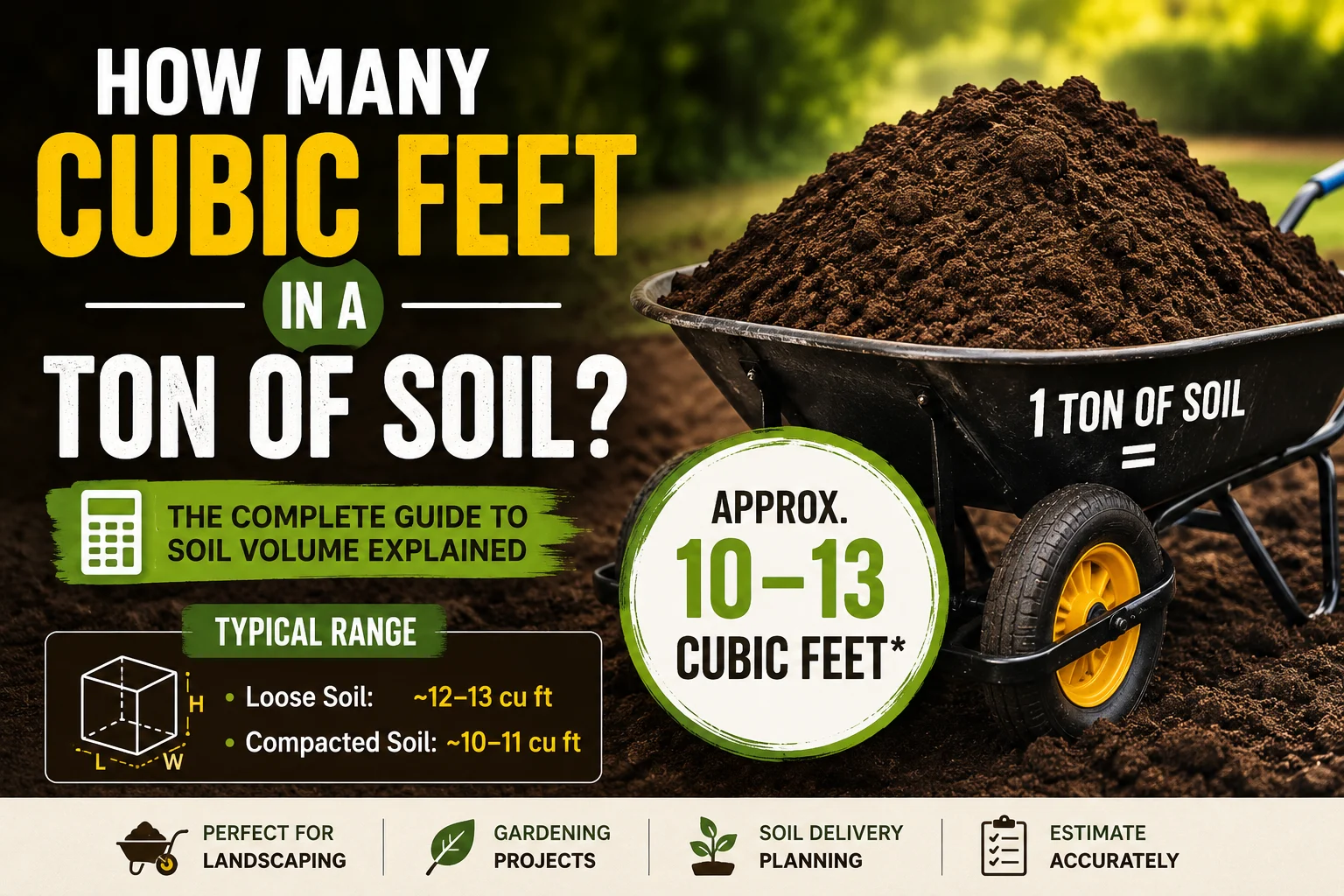
If you’re ordering soil for a garden, landscaping project, or construction job, you’ve probably wondered how many cubic feet in a ton of soil. The answer isn’t always straightforward because soil is sold by both weight (tons) and volume (cubic feet or cubic yards). Since different soils have different densities, one ton of soil can occupy more or less space.
For most landscaping projects, one ton of soil equals approximately 20 to 24 cubic feet, with 22 cubic feet being a commonly used average. However, the exact volume depends on whether the soil is dry, wet, loose, or compacted.
This guide explains everything you need to know, including conversion formulas, charts, examples, and expert tips to help you estimate the right amount of soil.
Quick Answer
Here’s the simple answer most people are looking for.
| Soil Type | Approximate Cubic Feet per Ton |
|---|---|
| Dry Topsoil | 24–26 cu ft |
| Average Topsoil | 22–24 cu ft |
| Garden Soil | 20–23 cu ft |
| Fill Dirt | 18–22 cu ft |
| Wet Soil | 16–20 cu ft |
| Compacted Soil | 15–18 cu ft |
Average estimate:
1 ton of soil ≈ 22 cubic feet
This estimate works well for most residential landscaping and gardening projects.
Why There Isn’t One Exact Answer
Unlike water, soil doesn’t have a fixed density. Several factors affect how much space one ton occupies.
Soil Density
Density is the biggest factor.
Loose, fluffy soil contains more air pockets, so one ton takes up more space. Dense or compacted soil weighs more in the same amount of space.
Moisture Content
Water significantly changes soil weight.
After heavy rain, soil becomes much heavier while occupying nearly the same volume. That means one wet ton of soil contains fewer cubic feet than one dry ton.
Soil Type
Different soil blends weigh differently.
Examples include:
- Sandy soil
- Clay soil
- Garden soil
- Topsoil
- Compost-rich soil
- Fill dirt
Each has its own average bulk density.
Cubic Feet in a Ton of Different Soil Types
The following table provides practical estimates used by landscapers.
| Soil Material | Cubic Feet per Ton |
|---|---|
| Screened Topsoil | 22–24 |
| Garden Soil | 20–23 |
| Sandy Soil | 23–25 |
| Clay Soil | 18–20 |
| Fill Dirt | 18–22 |
| Compost Blend | 25–30 |
| Wet Soil | 16–20 |
These values are averages. Always confirm with your supplier if you need precise measurements.
Soil Density Conversion Table
Most soil conversion calculations are based on density.
| Density (lb/cu ft) | Cubic Feet per Ton |
|---|---|
| 75 | 26.7 |
| 80 | 25.0 |
| 85 | 23.5 |
| 90 | 22.2 |
| 95 | 21.1 |
| 100 | 20.0 |
| 110 | 18.2 |
| 120 | 16.7 |
Since one U.S. ton equals 2,000 pounds, the formula is simple:
Cubic Feet = 2,000 ÷ Density
Formula to Convert Tons to Cubic Feet
The general formula is:
Cubic Feet = Weight (lb) ÷ Density (lb/cu ft)
Since one ton equals 2,000 pounds:
Cubic Feet = 2,000 ÷ Soil Density
Example 1
Topsoil density = 90 lb/cu ft
Calculation:
2,000 ÷ 90
= 22.2 cubic feet
Example 2
Loose compost soil = 75 lb/cu ft
2,000 ÷ 75
= 26.7 cubic feet
Example 3
Wet clay soil = 120 lb/cu ft
2,000 ÷ 120
= 16.7 cubic feet
Convert Cubic Feet Back to Tons
Sometimes you know the volume instead of the weight.
Use this formula:
Tons = (Cubic Feet × Density) ÷ 2,000
Example:
25 cubic feet of soil
Density = 90 lb/cu ft
25 × 90 = 2,250 pounds
2,250 ÷ 2,000 = 1.13 tons
Cubic Feet vs Cubic Yards
Many suppliers sell soil by the cubic yard rather than the cubic foot.
Here are the standard conversions.
| Measurement | Equivalent |
|---|---|
| 1 cubic yard | 27 cubic feet |
| 1 cubic foot | 0.037 cubic yards |
| 22 cubic feet | 0.81 cubic yards |
| 27 cubic feet | 1 cubic yard |
If one ton equals approximately 22 cubic feet, then:
1 ton ≈ 0.8 cubic yards
Practical Landscaping Examples
Understanding these conversions helps avoid buying too much or too little soil.
Raised Garden Bed
Suppose your raised bed measures:
- Length: 8 feet
- Width: 4 feet
- Depth: 1 foot
Volume:
8 × 4 × 1
= 32 cubic feet
If one ton provides about 22 cubic feet:
32 ÷ 22
≈ 1.45 tons
You’ll need about 1½ tons of soil.
Lawn Repair
A lawn needs 44 cubic feet of topsoil.
44 ÷ 22
= 2 tons
Tree Planting
Large landscaping trees often require 15–25 cubic feet of backfill.
One ton is usually enough for one mature tree, depending on the hole size.
Soil Coverage Chart
This chart estimates how much area one ton of soil covers at different depths.
| Depth | Coverage from 1 Ton (22 cu ft) |
|---|---|
| 1 inch | 264 sq ft |
| 2 inches | 132 sq ft |
| 3 inches | 88 sq ft |
| 4 inches | 66 sq ft |
| 6 inches | 44 sq ft |
| 12 inches | 22 sq ft |
These estimates are useful when planning gardens, lawns, flower beds, or leveling projects.
Common Mistakes When Estimating Soil
Many homeowners underestimate or overestimate their soil needs. Avoid these common errors:
- Assuming every soil has the same density.
- Ignoring moisture content.
- Mixing cubic yards and cubic feet.
- Forgetting to account for soil settling after installation.
- Ordering the exact amount without allowing for waste.
Ordering an extra 5–10% is often a smart choice for landscaping projects.
Expert Tips
Professionals use several strategies to improve estimation accuracy.
Know Your Supplier’s Measurements
Some suppliers sell by weight, while others sell by volume. Confirm which unit is being used before placing an order.
Measure Carefully
Always measure:
- Length
- Width
- Depth
Use feet for all dimensions to avoid conversion mistakes.
Consider Soil Compression
Freshly placed soil settles over time. If you’re filling raised beds or planting areas, adding a little extra helps maintain the desired level.
Check Soil Moisture
Wet soil weighs much more than dry soil. If you’re comparing prices from different suppliers, ask whether the quoted tonnage is based on dry or moist material.
Use Average Density for Planning
If you don’t know the exact density, use:
90 lb/cu ft
This gives the commonly accepted estimate of about 22 cubic feet per ton.
Why Accurate Soil Calculations Matter
Knowing how many cubic feet are in a ton of soil saves both time and money.
Accurate estimates help you:
- Avoid multiple deliveries.
- Reduce material waste.
- Stay within budget.
- Plan landscaping projects efficiently.
- Ensure consistent soil depth for healthy plants.
Whether you’re installing a lawn, building raised beds, or grading a yard, understanding the relationship between weight and volume makes project planning much easier.
FAQs
1. How many cubic feet are in one ton of topsoil?
Most topsoil ranges from 22 to 24 cubic feet per ton, depending on moisture and density.
2. How many cubic yards is one ton of soil?
One ton of average soil is about 0.8 cubic yards because one cubic yard equals 27 cubic feet.
3. Does wet soil have fewer cubic feet per ton?
Yes. Wet soil is denser, so one ton occupies less space than dry soil.
4. How do I calculate cubic feet from tons?
Use this formula:
Cubic Feet = 2,000 ÷ Soil Density (lb/cu ft)
For average soil at 90 lb/cu ft:
2,000 ÷ 90 = 22.2 cubic feet.
5. Is one ton enough for a raised garden bed?
For many standard raised beds, one ton is enough for approximately 22 cubic feet of fill. Measure your bed’s dimensions to confirm the exact amount needed.
Conclusion
Understanding how many cubic feet in a ton of soil is essential for successful gardening, landscaping, and construction projects. While there isn’t a single universal answer, one ton of average soil typically equals about 22 cubic feet, with most soil types ranging from 20 to 24 cubic feet depending on density and moisture.
By using the conversion formulas, density tables, and coverage charts in this guide, you can estimate soil needs with confidence, reduce waste, and avoid costly ordering mistakes. Whether you’re filling raised beds, leveling a yard, or planning a large landscaping project, accurate weight-to-volume calculations will help you buy the right amount of soil the first time.