
If you’re planning a landscaping, gardening, or construction project, you may be asking how many square feet in one cubic yard. The answer isn’t as simple as a single number because a cubic yard measures volume, while a square foot measures area. To convert between them, you must know the depth of the material being spread.
A cubic yard contains 27 cubic feet. Depending on the depth, one cubic yard can cover anywhere from 324 square feet at a 1-inch depth to 27 square feet at a 12-inch depth.
This guide explains the conversion formula, provides coverage charts, and includes practical examples for mulch, soil, gravel, concrete, and more.
Quick Answer
One cubic yard equals:
- 27 cubic feet
- 0.7646 cubic meters
- 46,656 cubic inches
However, the square footage depends on the material’s depth.
| Depth | Coverage from 1 Cubic Yard |
|---|---|
| 1 inch | 324 sq ft |
| 2 inches | 162 sq ft |
| 3 inches | 108 sq ft |
| 4 inches | 81 sq ft |
| 6 inches | 54 sq ft |
| 12 inches | 27 sq ft |
Why There Isn’t One Exact Answer
Many people search for “how many square feet in one cubic yard,” expecting a single number. In reality, square feet and cubic yards measure different things.
- Square feet measure a flat surface (area).
- Cubic yards measure three-dimensional space (volume).
Because of this, you need to know how deep the material will be spread before converting.
Area vs. Volume
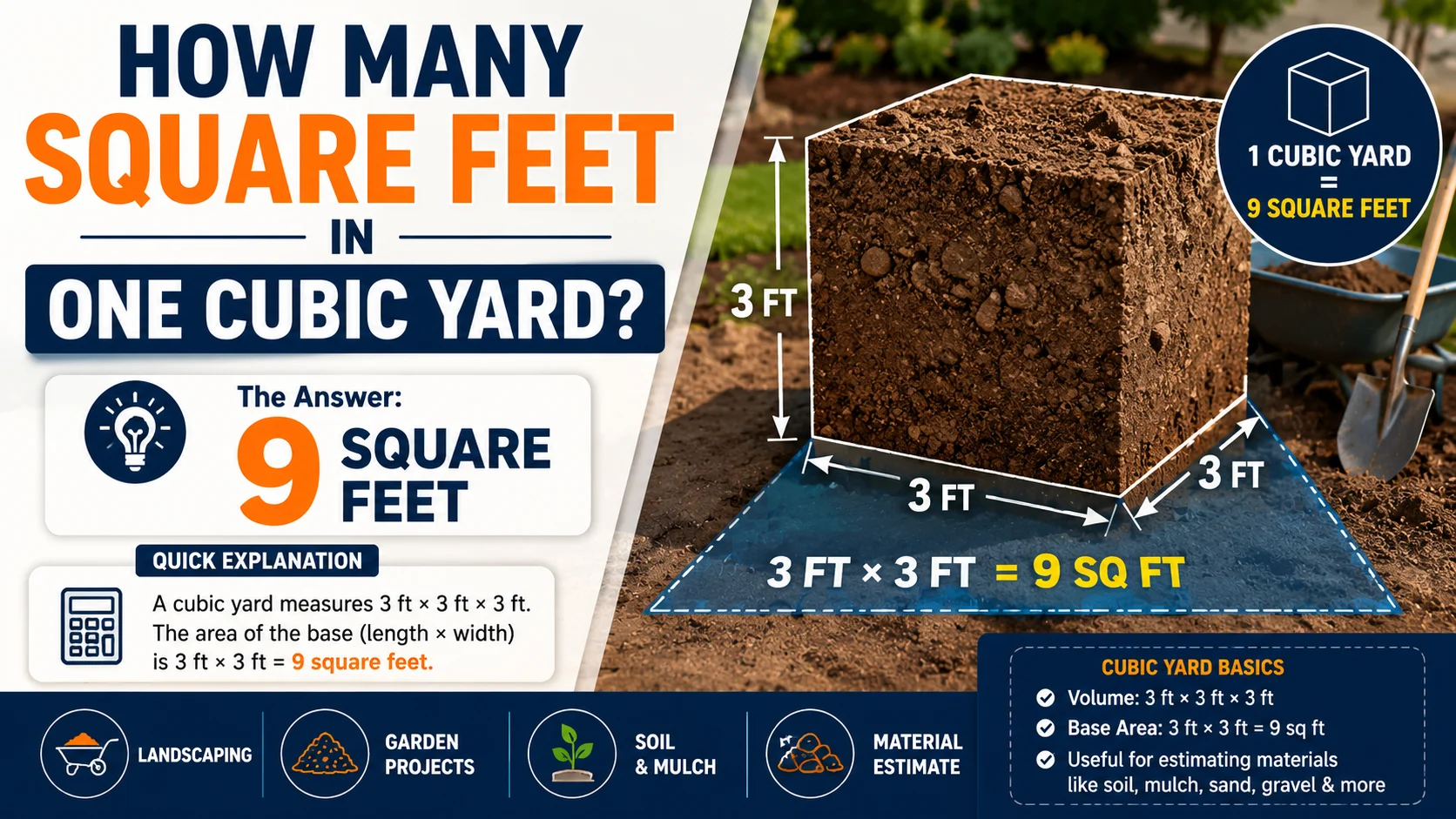
Think of a cubic yard as a box measuring:
- 3 feet long
- 3 feet wide
- 3 feet high
This equals 27 cubic feet of material.
If you spread that material over a larger area, it becomes thinner. If you spread it over a smaller area, it becomes deeper.
Why Depth Matters
For example:
- A thin 1-inch layer of mulch covers a large area.
- A 6-inch layer of gravel covers much less.
- A 12-inch layer of soil covers even less.
That’s why every landscaping calculator asks for depth before estimating material quantities.
Cubic Yard to Square Feet Formula
To calculate coverage:
Square Feet = (Cubic Yards × 27) ÷ Depth (in feet)
For one cubic yard:
Square Feet = 27 ÷ Depth (feet)
Since many projects use inches, convert inches to feet first:
- 1 inch = 1/12 foot
- 2 inches = 2/12 foot
- 3 inches = 3/12 foot
- 4 inches = 4/12 foot
- 6 inches = 6/12 foot
Coverage Chart by Depth
| Material Depth | Square Feet Covered by 1 Cubic Yard |
|---|---|
| 1 inch | 324 sq ft |
| 2 inches | 162 sq ft |
| 3 inches | 108 sq ft |
| 4 inches | 81 sq ft |
| 5 inches | 65 sq ft |
| 6 inches | 54 sq ft |
| 8 inches | 40.5 sq ft |
| 10 inches | 32.4 sq ft |
| 12 inches | 27 sq ft |
This chart is useful for estimating mulch, topsoil, sand, gravel, and concrete.
Real-World Examples
Mulch
Most mulch is spread 2–3 inches deep.
One cubic yard covers:
- 162 square feet at 2 inches
- 108 square feet at 3 inches
This is ideal for flower beds and around trees.
Topsoil
For lawn repair, topsoil is often applied at 3–4 inches.
Coverage:
- 108 square feet at 3 inches
- 81 square feet at 4 inches
Gravel
Driveways usually require 4–6 inches of gravel.
Coverage:
- 81 square feet at 4 inches
- 54 square feet at 6 inches
Concrete
A concrete slab is commonly 4 inches thick.
One cubic yard of concrete covers approximately:
81 square feet
This estimate is widely used for patios, sidewalks, and shed foundations.
Cubic Yard to Cubic Feet Conversion
Before converting to square feet, it’s helpful to know the relationship between cubic yards and cubic feet.
| Cubic Yards | Cubic Feet |
|---|---|
| 1 | 27 |
| 2 | 54 |
| 3 | 81 |
| 5 | 135 |
| 10 | 270 |
Knowing this conversion makes it easier to estimate material quantities for larger projects.
Common Uses
Understanding cubic yard coverage is useful for many home improvement projects, including:
- Landscaping
- Garden beds
- Mulch installation
- Topsoil replacement
- Gravel driveways
- Concrete slabs
- Sand for pavers
- Compost spreading
- Playground surfaces
Using the correct coverage estimate helps you avoid buying too much or too little material.
Common Mistakes
Avoid these common errors when converting cubic yards to square feet:
- Assuming there is a fixed square footage for every cubic yard.
- Forgetting to account for material depth.
- Mixing cubic feet with square feet.
- Ignoring settling or compaction of materials like soil and mulch.
- Ordering the exact amount without allowing for waste.
Adding an extra 5–10% of material is often recommended for most projects.
Expert Tips
- Measure the length and width of your project area accurately.
- Decide on the desired material depth before calculating.
- Use inches for landscaping projects and convert to feet when using formulas.
- Round up your order to avoid shortages.
- Check with your supplier if the material compacts after installation.
Following these tips can save time, money, and unnecessary trips for additional materials.
FAQs
1. How many square feet does one cubic yard cover?
It depends on the depth. At 3 inches deep, one cubic yard covers 108 square feet. At 4 inches deep, it covers 81 square feet.
2. Is one cubic yard always the same number of square feet?
No. Square footage changes based on how deep the material is spread.
3. How many cubic feet are in one cubic yard?
One cubic yard equals 27 cubic feet.
4. How much area does one cubic yard of concrete cover?
A cubic yard of concrete covers about 81 square feet when poured 4 inches thick.
5. How many square feet does one cubic yard of mulch cover?
At a 2-inch depth, one cubic yard covers about 162 square feet. At a 3-inch depth, it covers 108 square feet.
Conclusion
Understanding how many square feet in one cubic yard is essential for landscaping, gardening, and construction projects. Because a cubic yard measures volume and square feet measure area, the conversion depends entirely on the depth of the material.
As a general rule, one cubic yard equals 27 cubic feet and covers 324 square feet at a 1-inch depth, 162 square feet at 2 inches, 108 square feet at 3 inches, and 81 square feet at 4 inches. By using the formulas and coverage charts in this guide, you can estimate material needs accurately, reduce waste, and complete your project with confidence.