

Choosing the correct BTU rating is important. An air conditioner that is too small will struggle to cool the room, while one that is too large may cool too quickly without removing enough humidity, leaving your home feeling damp and uncomfortable.
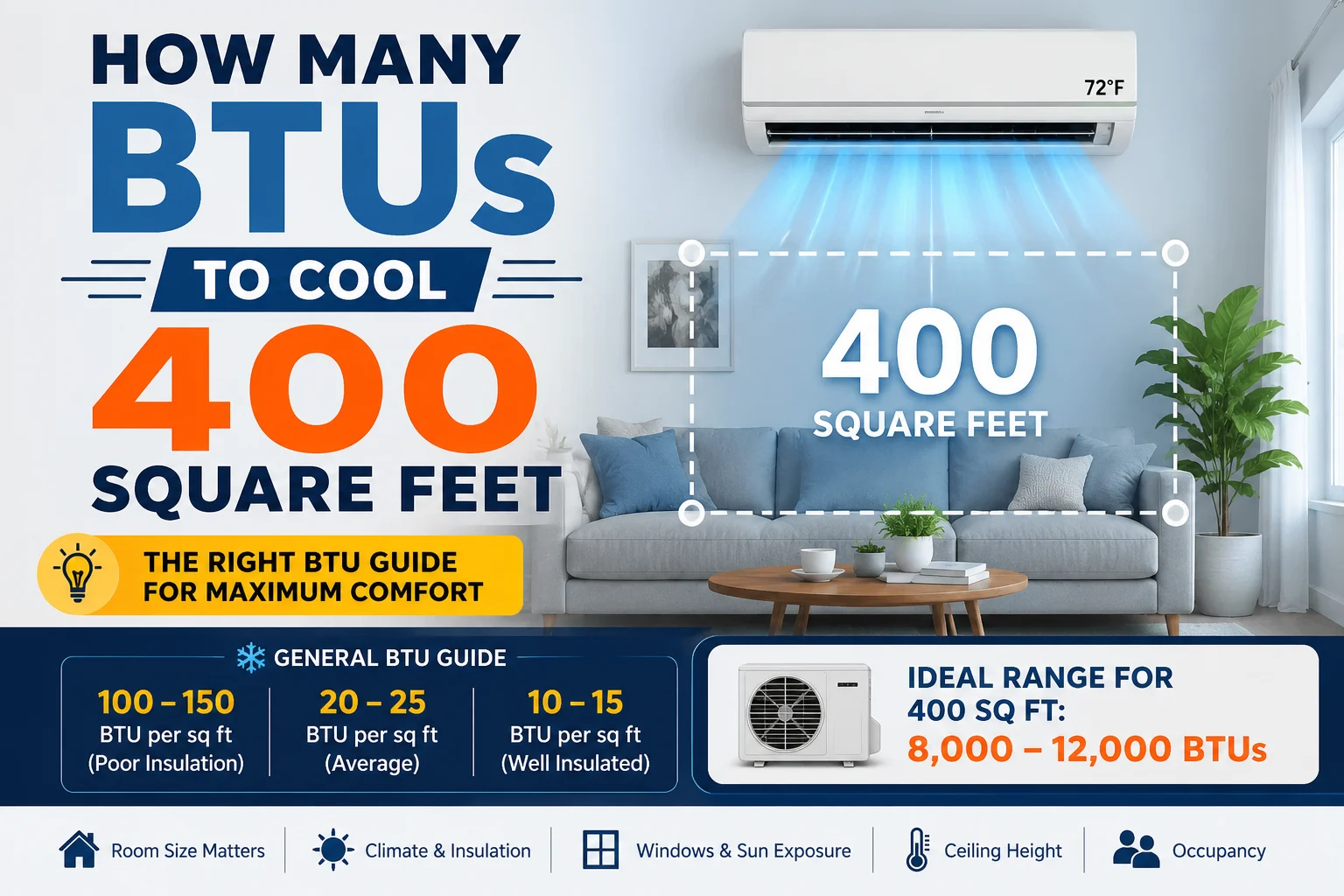
For most residential spaces, a 400-square-foot room typically requires an air conditioner with 8,000 to 10,000 BTUs, although several factors—such as ceiling height, insulation, climate, sunlight, and occupancy—can increase or decrease the ideal size.
In this guide, you’ll learn exactly how BTU sizing works, which air conditioner is best for a 400-square-foot room, and how to choose the right cooling capacity for maximum comfort and energy efficiency.
Quick Answer: How Many BTUs for 400 Square Feet?
For most homes:
| Room Size | Recommended BTUs |
|---|---|
| 350 sq ft | 8,000–9,000 BTUs |
| 400 sq ft | 8,000–10,000 BTUs |
| 450 sq ft | 9,000–10,000 BTUs |
| 500 sq ft | 10,000–12,000 BTUs |
If your room receives heavy afternoon sunlight or has poor insulation, selecting a unit closer to 10,000 BTUs usually provides better comfort.
What Does BTU Mean?
BTU stands for British Thermal Unit.
A BTU measures the amount of heat an air conditioner can remove from a room every hour.
The higher the BTU rating:
- The larger the room it can cool
- The faster it removes heat
- The greater its cooling capacity
However, bigger is not always better. Oversized units often short-cycle, wasting energy and reducing humidity control.
Recommended BTU Size for a 400-Square-Foot Room
For average residential conditions:
- Well-insulated room: 8,000 BTUs
- Average room: 9,000 BTUs
- Sunny or warm room: 10,000 BTUs
- High ceilings or multiple occupants: 10,000–12,000 BTUs
These recommendations assume an 8-foot ceiling and normal household use.
BTU Sizing Chart by Room Size
| Room Size | Recommended BTUs |
| 150 sq ft | 5,000 BTUs |
| 200 sq ft | 6,000 BTUs |
| 250 sq ft | 6,000–7,000 BTUs |
| 300 sq ft | 7,000–8,000 BTUs |
| 350 sq ft | 8,000–9,000 BTUs |
| 400 sq ft | 8,000–10,000 BTUs |
| 450 sq ft | 9,000–10,000 BTUs |
| 500 sq ft | 10,000–12,000 BTUs |
| 600 sq ft | 12,000–14,000 BTUs |
| 700 sq ft | 14,000–16,000 BTUs |
Factors That Affect BTU Requirements
Although room size is the biggest factor, several other conditions affect the ideal BTU rating.
1. Ceiling Height
Most BTU recommendations assume an 8-foot ceiling.
If your room has:
- 9-foot ceilings
- 10-foot ceilings
- Vaulted ceilings
you’ll need additional cooling capacity because there is more air to cool.
2. Sun Exposure
Rooms with:
- Large south-facing windows
- West-facing windows
- Skylights
receive significantly more heat during the day.
These rooms often require an additional 10–20% more BTUs.
3. Insulation Quality
A well-insulated home keeps cool air inside.
Poor insulation allows outside heat to enter quickly, forcing your air conditioner to work harder.
Older homes often benefit from a slightly larger BTU rating.
4. Number of Occupants
Each person produces body heat.
If more than two people regularly occupy the room, additional cooling capacity may be needed.
Examples include:
- Family rooms
- Home offices
- Game rooms
5. Kitchen Appliances
Rooms connected to kitchens often become warmer because of:
- Ovens
- Stovetops
- Dishwashers
- Refrigerators
These heat sources may justify moving up to the next BTU level.
Is an 8,000-BTU Air Conditioner Enough?
For many homeowners, yes.
An 8,000-BTU unit works well if:
- The room is well insulated.
- Ceiling height is 8 feet.
- There are only one or two occupants.
- The room receives limited direct sunlight.
However, if any of these conditions change, a larger unit may perform better.
When Should You Choose 10,000 BTUs?
A 10,000-BTU air conditioner is usually the better option when:
- The room receives afternoon sun.
- You live in a hot climate.
- The room has high ceilings.
- Several people occupy the room.
- The room contains multiple electronics.
A slightly larger unit can maintain more consistent comfort during extreme summer temperatures.
Common Cooling Scenarios
| Room Type | Recommended BTUs |
| Bedroom | 8,000 BTUs |
| Living room | 9,000 BTUs |
| Home office | 8,000–9,000 BTUs |
| Family room | 9,000–10,000 BTUs |
| Studio apartment | 10,000 BTUs |
Signs Your Air Conditioner Is Too Small
Your current AC may be undersized if:
- It runs continuously.
- The room never reaches the desired temperature.
- Utility bills remain high.
- Certain areas stay warm.
- Humidity remains high indoors.
These are common indicators that more BTUs may be required.
Window AC vs. Portable AC vs. Mini Split
Choosing the right type of air conditioner is just as important as choosing the correct BTU rating. Each system has its own advantages depending on your budget, installation preferences, and long-term cooling needs.
| Feature | Window AC | Portable AC | Mini Split |
|---|---|---|---|
| Typical BTU Range | 5,000–24,000 | 8,000–14,000 | 9,000–36,000+ |
| Installation | Easy | Very Easy | Professional |
| Energy Efficiency | Good | Fair | Excellent |
| Cooling Performance | Very Good | Moderate | Outstanding |
| Noise Level | Moderate | Loudest | Quietest |
| Best For | Bedrooms, living rooms | Apartments, rentals | Whole-home or permanent cooling |
| Average Cost | $200–$700 | $300–$800 | $2,000–$6,000 installed |
Window Air Conditioner
A window AC is often the most affordable and efficient option for cooling a single 400-square-foot room. Most homeowners choose models between 8,000 and 10,000 BTUs.
Pros
- Affordable
- Easy to install
- Energy efficient
- Reliable cooling
Cons
- Blocks part of the window
- Not ideal for every window style
Portable Air Conditioner
Portable units are convenient because they can be moved from room to room.
Pros
- No permanent installation
- Easy to relocate
- Good for renters
Cons
- Usually less efficient than window units
- Louder operation
- Occupies floor space
For a 400-square-foot room, choose a portable model with a true cooling capacity appropriate for the space, as portable AC ratings may differ from window units.
Mini Split Air Conditioner
Mini split systems provide the highest level of comfort and efficiency.
Pros
- Extremely quiet
- Excellent energy efficiency
- No window required
- Precise temperature control
Cons
- Higher upfront cost
- Professional installation required
If you’re looking for a permanent cooling solution, a mini split is often the best long-term investment.
Buying Tips for Cooling 400 Square Feet
Before purchasing an air conditioner, consider these factors.
Measure the Room Carefully
Calculate:
Length × Width
This gives the square footage needed for proper sizing.
Check Ceiling Height
Rooms with ceilings higher than 8 feet contain more air volume and may require additional BTUs.
Look for ENERGY STAR® Models
Energy-efficient units:
- Reduce electricity bills
- Cool more effectively
- Have better long-term value
Consider the Climate
Homes in hotter regions generally benefit from selecting the higher end of the recommended BTU range.
Read Noise Ratings
If you’re installing the unit in a bedroom or office, look for quieter models with lower decibel (dB) ratings.
Common BTU Sizing Mistakes
Avoid these common errors when choosing an air conditioner.
Buying Too Small
An undersized unit:
- Runs continuously
- Struggles to cool the room
- Wears out faster
- Uses more electricity
Buying Too Large
An oversized unit:
- Short cycles
- Doesn’t remove enough humidity
- Creates uneven temperatures
- May increase energy consumption
Ignoring Sunlight
Rooms with large windows often need additional cooling capacity.
Forgetting Occupancy
Extra people, computers, televisions, and appliances all generate heat that affects cooling requirements.
How to Improve Cooling Efficiency
Even the correctly sized air conditioner performs better when paired with good energy-saving habits.
Consider:
- Closing curtains during the hottest part of the day
- Sealing air leaks around doors and windows
- Cleaning air filters every month
- Keeping vents unobstructed
- Using ceiling fans to improve air circulation
- Setting the thermostat between 74°F and 78°F during summer
These simple steps can reduce cooling costs and improve comfort.
FAQs
How many BTUs do I need for 400 square feet?
Most homes require 8,000 to 10,000 BTUs, depending on insulation, sunlight, ceiling height, and occupancy.
Is 8,000 BTUs enough for 400 square feet?
Yes, if the room is well insulated, has standard 8-foot ceilings, and receives average sunlight.
Is 10,000 BTUs too much for 400 square feet?
Not necessarily. A 10,000-BTU unit is often appropriate for sunny rooms, warm climates, or spaces with higher ceilings.
Which is better for a 400-square-foot room: window AC or portable AC?
A window air conditioner is generally more efficient and provides better cooling performance than a portable unit of similar capacity.
Can one mini split cool 400 square feet?
Yes. A properly sized mini split—typically around 9,000 BTUs—can efficiently cool a 400-square-foot room.
What happens if my air conditioner has too many BTUs?
An oversized unit may cool the room too quickly without removing enough moisture, leaving the air feeling cool but humid.
Does insulation affect BTU requirements?
Yes. Better insulation reduces heat gain and can allow a smaller air conditioner to cool the room effectively.
Final Thoughts
Selecting the correct BTU rating is one of the most important decisions when buying an air conditioner. While 8,000 to 10,000 BTUs is the recommended range for cooling 400 square feet, the ideal capacity depends on your home’s insulation, ceiling height, climate, sun exposure, and daily usage.
For most homeowners, an 8,000-BTU unit works well in average conditions, while a 9,000- or 10,000-BTU air conditioner provides additional cooling power for warmer or more demanding environments. Taking a few extra minutes to evaluate your room’s unique characteristics will help you choose an air conditioner that delivers efficient, reliable, and comfortable cooling for years to come.