
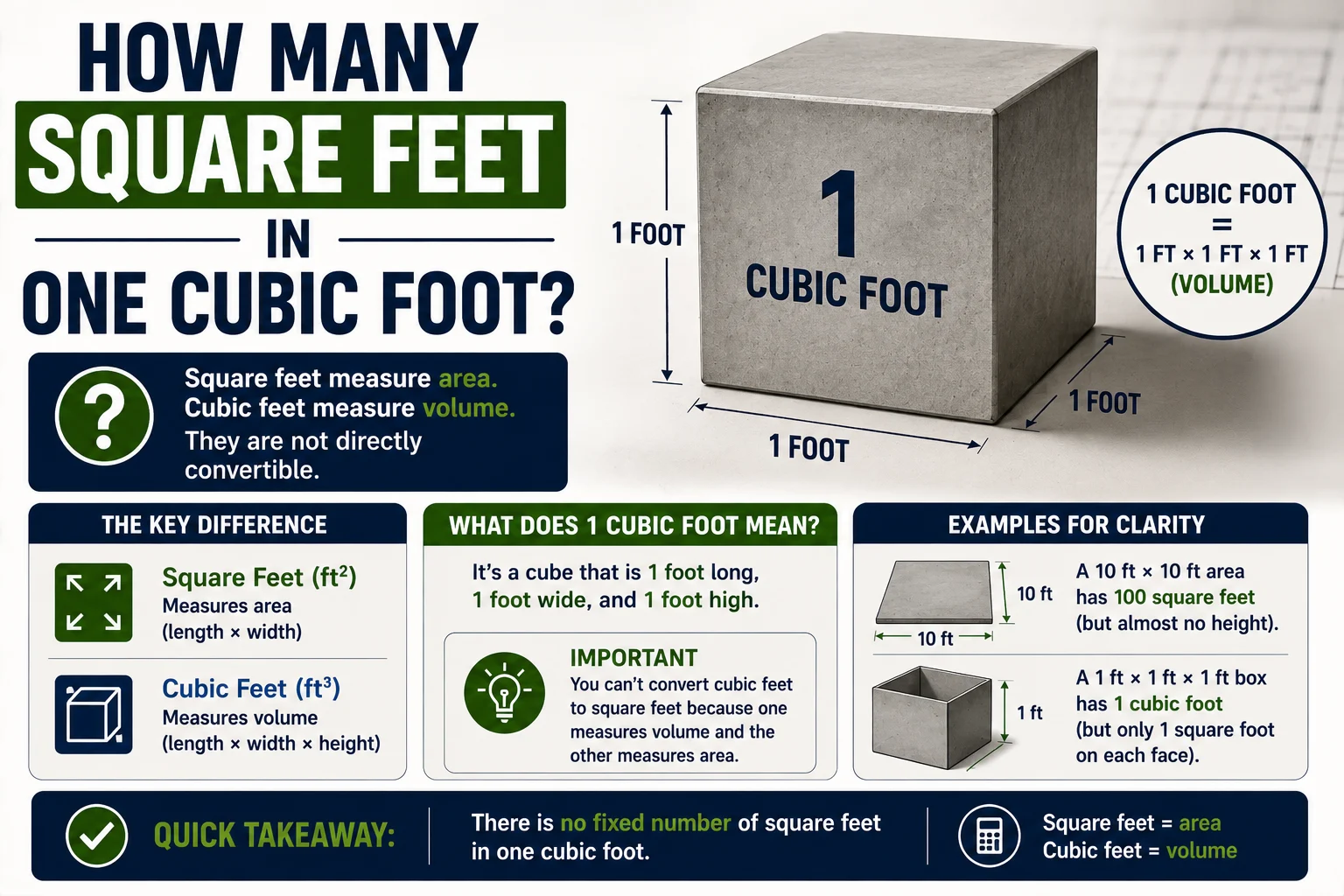
If you’re wondering how many square feet in one cubic foot, there is an important point to understand: square feet and cubic feet cannot be directly converted into each other without knowing the depth or height.
A square foot measures area, while a cubic foot measures volume.
For example, 1 cubic foot of material could cover:
- 1 square foot at a depth of 1 foot
- 2 square feet at a depth of 0.5 foot
- 4 square feet at a depth of 0.25 foot
- 12 square feet at a depth of 1 inch
The amount of square footage that one cubic foot covers therefore depends on how thick or deep the material is spread.
The basic relationship is:
Square feet = Cubic feet ÷ depth in feet
So, there isn’t one fixed answer to how many square feet in one cubic foot. You need the depth to calculate the area.
This distinction is especially useful when working with soil, mulch, concrete, gravel, flooring materials, insulation, and other products sold by volume.
Quick Answer: How Many Square Feet Are in One Cubic Foot?
1 cubic foot does not equal a fixed number of square feet.
That’s because:
- Square feet (ft²) measure two-dimensional area.
- Cubic feet (ft³) measure three-dimensional volume.
To determine how much area 1 cubic foot covers, use:
Square feet = 1 cubic foot ÷ depth in feet
For example, if 1 cubic foot is spread 1 foot deep:
1 ÷ 1 = 1 square foot
If it is spread 0.5 foot deep:
1 ÷ 0.5 = 2 square feet
If it is spread 0.25 foot deep:
1 ÷ 0.25 = 4 square feet
Therefore, depth determines the square footage.
What Is a Square Foot?
A square foot is a unit of area.
One square foot is the area of a square measuring:
1 foot × 1 foot
So:
1 ft × 1 ft = 1 square foot
Square feet are commonly used to measure:
- Rooms
- Houses
- Floors
- Walls
- Roofs
- Lawns
- Gardens
- Patios
- Driveways
- Land areas
For example, a room that is 10 feet long and 12 feet wide has:
10 × 12 = 120 square feet
The measurement describes the surface area, not the volume of the room.
What Is a Cubic Foot?
A cubic foot is a unit of volume.
One cubic foot is the volume of a cube measuring:
1 foot × 1 foot × 1 foot
Therefore:
1 × 1 × 1 = 1 cubic foot
Cubic feet are used to measure three-dimensional space or material volume.
They are commonly used for:
- Concrete
- Soil
- Mulch
- Gravel
- Water
- Storage
- Air
- Lumber
- Insulation
- Shipping containers
Unlike square feet, cubic feet include a third dimension: height or depth.
Why Can’t Square Feet and Cubic Feet Be Directly Converted?
The key difference is dimensionality.
A square-foot measurement has two dimensions:
Length × Width
A cubic-foot measurement has three:
Length × Width × Height
Because cubic feet include an additional dimension, you cannot convert cubic feet to square feet without knowing that third dimension.
For example, imagine a box containing exactly 1 cubic foot.
If the box is:
1 foot × 1 foot × 1 foot
its bottom has an area of:
1 × 1 = 1 square foot
But another box could contain the same 1 cubic foot while having a much larger floor area and a smaller height.
This is why 1 cubic foot doesn’t always represent 1 square foot.
How to Calculate Square Feet From Cubic Feet
When you know the volume and depth, the calculation is straightforward.
Formula
Square feet = Cubic feet ÷ depth in feet
For one cubic foot:
Square feet = 1 ÷ depth
The depth must be expressed in feet.
For example, suppose you have 1 cubic foot of soil and want to spread it 0.5 foot deep.
Calculate:
1 ÷ 0.5 = 2 square feet
So 1 cubic foot of soil covers 2 square feet at a depth of 6 inches.
How Many Square Feet Does 1 Cubic Foot Cover?
The answer changes depending on the depth.
| Depth | Depth in Feet | Area Covered by 1 Cubic Foot |
|---|---|---|
| 12 inches | 1 ft | 1 sq ft |
| 6 inches | 0.5 ft | 2 sq ft |
| 4 inches | 0.333 ft | 3 sq ft |
| 3 inches | 0.25 ft | 4 sq ft |
| 2 inches | 0.167 ft | 6 sq ft |
| 1 inch | 0.0833 ft | 12 sq ft |
| 0.5 inch | 0.0417 ft | 24 sq ft |
This table shows why there is no single answer to the question.
As the depth decreases, the same volume covers more surface area.
How Many Square Feet Does 1 Cubic Foot Cover at 1 Inch Deep?
This is a common practical question for landscaping and construction.
One cubic foot contains:
12 inches × 12 inches × 12 inches
If you spread that volume to a depth of 1 inch, the material covers:
12 square feet
Therefore:
1 cubic foot at 1 inch deep = 12 square feet
This is useful when estimating small amounts of:
- Soil
- Mulch
- Gravel
- Compost
- Sand
How Many Square Feet Does 1 Cubic Foot Cover at 2 Inches Deep?
First convert 2 inches into feet:
2 ÷ 12 = 0.1667 feet
Then use:
1 ÷ 0.1667 ≈ 6 square feet
So:
1 cubic foot covers approximately 6 square feet at 2 inches deep.
This is a useful estimate for landscaping materials.
How Many Square Feet Does 1 Cubic Foot Cover at 3 Inches Deep?
Convert 3 inches to feet:
3 ÷ 12 = 0.25 feet
Then:
1 ÷ 0.25 = 4 square feet
Therefore:
1 cubic foot covers 4 square feet at a depth of 3 inches.
How Many Square Feet Does 1 Cubic Foot Cover at 4 Inches Deep?
Four inches equals:
4 ÷ 12 = 0.3333 feet
Now calculate:
1 ÷ 0.3333 ≈ 3 square feet
Therefore:
1 cubic foot covers approximately 3 square feet at 4 inches deep.
How Many Square Feet Does 1 Cubic Foot Cover at 6 Inches Deep?
Six inches equals:
6 ÷ 12 = 0.5 feet
Then:
1 ÷ 0.5 = 2 square feet
So:
1 cubic foot covers 2 square feet at a depth of 6 inches.
How Many Square Feet Does 1 Cubic Foot Cover at 12 Inches Deep?
Twelve inches equals exactly:
1 foot
Therefore:
1 ÷ 1 = 1 square foot
So:
1 cubic foot covers 1 square foot when spread 12 inches deep.
This is the simplest example because all three dimensions are 1 foot.
Cubic Feet to Square Feet Conversion Chart
For quick reference:
| Cubic Feet | Depth | Approx. Square Feet |
| 1 cu ft | 1 inch | 12 sq ft |
| 1 cu ft | 2 inches | 6 sq ft |
| 1 cu ft | 3 inches | 4 sq ft |
| 1 cu ft | 4 inches | 3 sq ft |
| 1 cu ft | 6 inches | 2 sq ft |
| 1 cu ft | 8 inches | 1.5 sq ft |
| 1 cu ft | 10 inches | 1.2 sq ft |
| 1 cu ft | 12 inches | 1 sq ft |
The depth is what determines the coverage.
How to Calculate Cubic Feet From Square Feet
The calculation can also work in reverse.
If you know the area and depth, you can calculate the required cubic feet.
Formula
Cubic feet = Square feet × depth in feet
For example, suppose you have a 100-square-foot garden and want to add 3 inches of soil.
Convert 3 inches to feet:
3 ÷ 12 = 0.25 feet
Then:
100 × 0.25 = 25 cubic feet
You would need approximately 25 cubic feet of soil.
This formula is widely used for landscaping and construction estimates.
Example: Soil Coverage
Suppose you have 1 cubic foot of garden soil and want to spread it over a garden.
At 1 inch deep
1 ÷ (1/12) = 12 square feet
At 3 inches deep
1 ÷ (3/12) = 4 square feet
At 6 inches deep
1 ÷ (6/12) = 2 square feet
The same amount of soil covers different areas depending on how thickly you spread it.
Example: Mulch Coverage
Mulch is often sold by cubic feet or cubic yards, while the area you want to cover is measured in square feet.
Suppose you have 10 cubic feet of mulch and want to spread it 3 inches deep.
Three inches is:
3 ÷ 12 = 0.25 feet
Use:
10 ÷ 0.25 = 40 square feet
So 10 cubic feet of mulch can cover approximately:
40 square feet at 3 inches deep
This type of calculation can help you estimate how much landscaping material to buy.
Example: Concrete
Concrete is usually ordered by cubic yards rather than square feet because concrete has both surface area and thickness.
Suppose you need a 100-square-foot slab that is 4 inches thick.
Convert 4 inches to feet:
4 ÷ 12 = 0.3333 feet
Then:
100 × 0.3333 ≈ 33.33 cubic feet
To convert cubic feet to cubic yards:
33.33 ÷ 27 ≈ 1.23 cubic yards
So you would need approximately 1.23 cubic yards of concrete, before accounting for waste and other practical considerations.
Square Feet vs. Cubic Feet
Understanding the difference between these units is important.
| Feature | Square Feet | Cubic Feet |
| Measures | Area | Volume |
| Dimensions | 2 | 3 |
| Formula | Length × Width | Length × Width × Height |
| Common use | Floors, rooms, land | Soil, concrete, storage |
| Symbol | ft² | ft³ |
| Requires depth? | No | Yes |
The easiest way to remember the difference is:
Square feet = surface area
Cubic feet = three-dimensional volume
Can You Convert 1 Cubic Foot to Square Feet?
Yes, but only if you know the depth.
For example:
- At 1-foot depth: 1 cubic foot = 1 square foot
- At 6-inch depth: 1 cubic foot = 2 square feet
- At 3-inch depth: 1 cubic foot = 4 square feet
- At 1-inch depth: 1 cubic foot = 12 square feet
So asking for a direct conversion without giving the depth is incomplete.
How Many Square Feet Are in a Cubic Yard?
A cubic yard also measures volume, so it cannot be directly converted into square feet without knowing depth.
One cubic yard equals:
27 cubic feet
At a depth of 1 inch, one cubic yard covers:
27 × 12 = 324 square feet
At 2 inches:
27 × 6 = 162 square feet
At 3 inches:
27 × 4 = 108 square feet
At 6 inches:
27 × 2 = 54 square feet
This is especially useful for mulch, soil, gravel, and other landscaping materials.
How Many Cubic Feet Do You Need for a Certain Area?
To calculate the volume needed for a particular area, use:
Cubic feet = Square feet × depth in feet
Example
Suppose you have a 200-square-foot area and need material 2 inches deep.
Convert 2 inches:
2 ÷ 12 = 0.1667 feet
Then:
200 × 0.1667 ≈ 33.34 cubic feet
So you need approximately 33.3 cubic feet of material.
For real-world projects, it’s usually wise to account for some extra material because actual coverage can vary.
Common Mistakes When Converting Square Feet and Cubic Feet
Mistake 1: Treating Them as the Same Unit
A square foot measures area, while a cubic foot measures volume.
They are not interchangeable.
Mistake 2: Forgetting the Depth
You cannot determine square footage from cubic footage without knowing the depth.
Mistake 3: Using Inches Instead of Feet
If the formula requires depth in feet, convert inches first.
For example:
3 inches = 3/12 = 0.25 feet
Mistake 4: Confusing Cubic Yards With Square Yards
A cubic yard measures volume, while a square yard measures area.
Mistake 5: Ignoring Material Settling
Soil, mulch, gravel, and similar materials can settle after installation. The amount purchased may therefore need to be higher than the theoretical calculation.
Practical Tips for Accurate Calculations
Before buying materials, follow these steps:
1. Measure the Area
Find the length and width of the space.
Length × Width = Square Feet
2. Determine the Desired Depth
Measure or decide how thick the material should be.
3. Convert Inches to Feet
Divide the depth in inches by 12.
4. Calculate Volume
Multiply square footage by depth in feet.
Square Feet × Depth = Cubic Feet
5. Add a Reasonable Allowance
For landscaping and construction materials, actual conditions may cause some loss or settling.
Real-World Uses of Square-Foot and Cubic-Foot Calculations
These calculations are useful in many projects.
Landscaping
Calculate how much soil, mulch, compost, or gravel is needed.
Concrete Work
Calculate the volume needed for slabs, sidewalks, and footings.
Home Improvement
Estimate insulation or other materials based on space dimensions.
Storage
Calculate the amount of three-dimensional storage space available.
Gardening
Determine how much soil is required for raised beds.
Construction
Calculate material volume based on surface area and thickness.
Understanding the relationship between area and volume can prevent both overbuying and underbuying.
Frequently Asked Questions
1. How many square feet are in one cubic foot?
There is no fixed number. One cubic foot can cover different amounts of square footage depending on the depth. At 1 foot deep, it covers 1 square foot; at 1 inch deep, it covers 12 square feet.
2. How many square feet does 1 cubic foot cover at 3 inches?
One cubic foot covers approximately 4 square feet at 3 inches deep.
The calculation is:
1 ÷ 0.25 = 4 square feet
3. How many square feet does 1 cubic foot cover at 6 inches?
One cubic foot covers 2 square feet at a depth of 6 inches.
Six inches equals 0.5 foot, so:
1 ÷ 0.5 = 2 square feet
4. Can you convert cubic feet directly to square feet?
No. You need to know the depth or height. Cubic feet measure volume, while square feet measure area.
5. How do you convert cubic feet to square feet?
Divide the volume in cubic feet by the depth in feet:
Square feet = Cubic feet ÷ depth in feet
For example, 5 cubic feet spread 5 inches deep requires first converting 5 inches to feet, then dividing the volume by that depth.
Conclusion
So, how many square feet in one cubic foot? There is no single fixed conversion because square feet measure area and cubic feet measure volume. A cubic-foot measurement includes length, width, and depth, while square footage only measures length and width.
To find the area that a cubic-foot volume can cover, you need to know the depth:
Square feet = Cubic feet ÷ depth in feet
For example, 1 cubic foot covers 12 square feet at 1 inch deep, 4 square feet at 3 inches deep, 2 square feet at 6 inches deep, and 1 square foot at 12 inches deep.
This calculation is particularly useful for estimating soil, mulch, gravel, concrete, and other materials sold by volume.
When planning a project, measure the area first, determine the desired depth, convert the depth to feet, and then calculate the required cubic footage. This simple process can help you estimate materials accurately and avoid costly measurement mistakes.
Remember: cubic feet tell you how much material you have; square feet tell you how much surface area it can cover at a specific depth.