

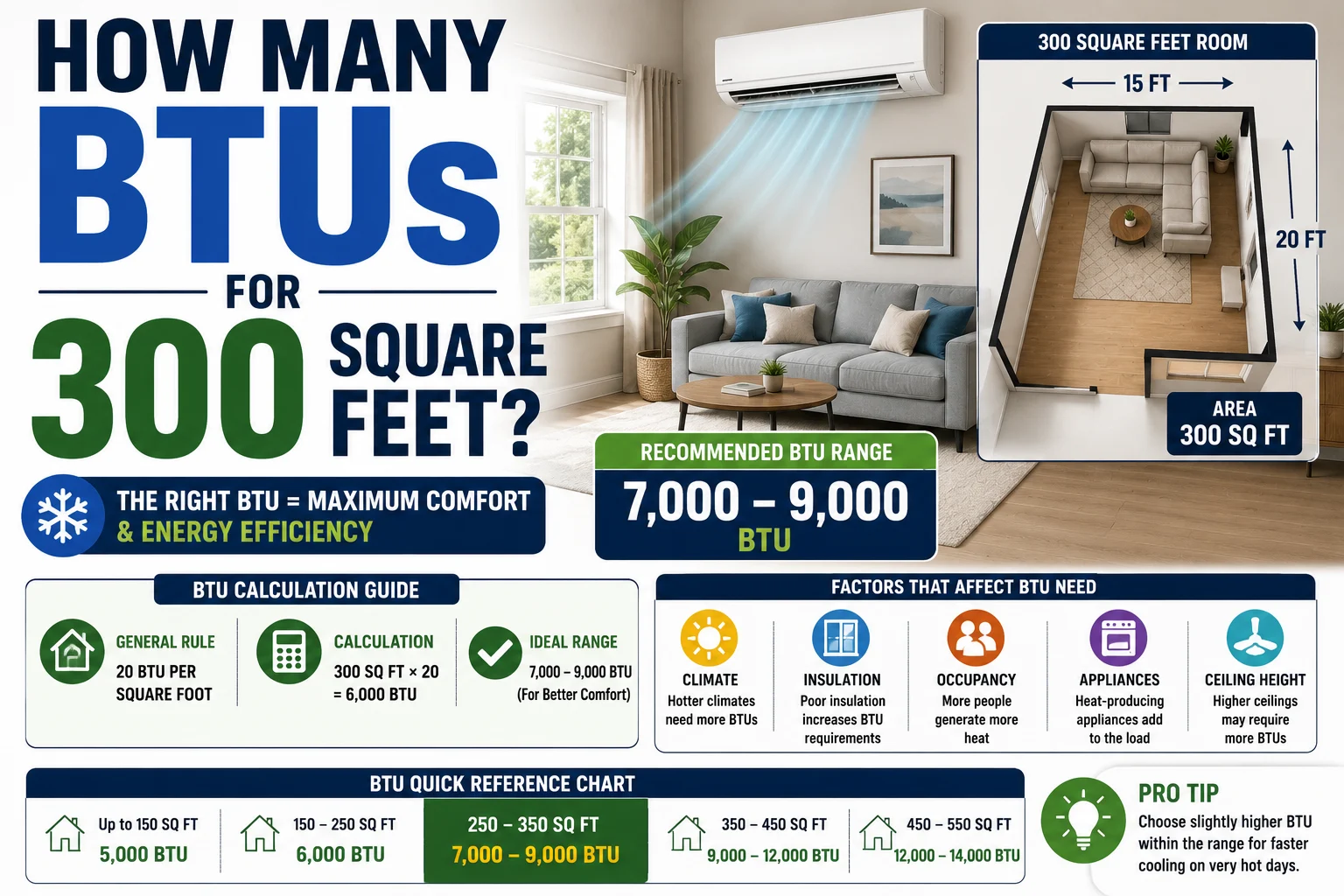
If you’re trying to cool a bedroom, office, apartment, or other small space, you may be asking how many BTUs for 300 square feet.
For a typical 300-square-foot room, an air conditioner in the range of approximately 6,000 to 8,000 BTUs may be appropriate, depending on the room’s conditions and local climate.
A commonly used starting point is around 6,000 BTUs for a 300-square-foot room under average conditions. However, the correct capacity can change when the room has high ceilings, poor insulation, lots of sunlight, several occupants, or unusually hot outdoor temperatures.
BTU stands for British thermal unit. In air conditioning, the BTU rating describes the unit’s cooling capacity.
The goal is not simply to buy the largest AC possible. An oversized unit can cool the room quickly without adequately removing humidity, while an undersized unit may run continuously and struggle to maintain the desired temperature.
Quick Answer: How Many BTUs for 300 Square Feet?
For a typical 300-square-foot room, start with approximately:
6,000 BTUs
Depending on the room and climate, you may need approximately:
6,000–8,000 BTUs
A basic guide looks like this:
| Room Size | Approx. AC Capacity |
|---|---|
| 150 sq ft | 5,000 BTU |
| 200 sq ft | 5,000 BTU |
| 250 sq ft | 6,000 BTU |
| 300 sq ft | 6,000 BTU |
| 350 sq ft | 7,000–8,000 BTU |
| 400 sq ft | 8,000 BTU |
| 500 sq ft | 10,000 BTU |
These are general sizing estimates. Actual cooling requirements depend on more than floor area.
What Does BTU Mean for an Air Conditioner?
BTU stands for British thermal unit.
In air conditioning, BTUs are commonly used to describe how much heat an AC can remove from a space over a given period.
A higher BTU rating generally means greater cooling capacity.
For example:
- 5,000 BTU = lower cooling capacity
- 6,000 BTU = moderate small-room capacity
- 8,000 BTU = greater capacity
- 10,000 BTU = greater still
However, higher capacity isn’t automatically better.
An air conditioner should be appropriately matched to the room.
How Do You Calculate BTUs for 300 Square Feet?
A simple starting point is to match room size with an appropriate cooling capacity.
For a 300-square-foot room, a basic estimate may put the requirement around 6,000 BTUs.
However, room conditions can change the result.
Important factors include:
- Climate
- Sun exposure
- Ceiling height
- Insulation
- Number of people
- Number of windows
- Window size
- Heat-producing appliances
- Room orientation
- Whether the space is above an unconditioned area
The 300-square-foot figure should represent the actual floor area that the AC is expected to cool.
For example, a room measuring:
15 × 20 feet = 300 square feet
would be a typical example of a 300-square-foot space.
Is 5,000 BTU Enough for 300 Square Feet?
A 5,000 BTU air conditioner may be undersized for a typical 300-square-foot room.
It can potentially work in a well-insulated space with favorable conditions, but 5,000 BTUs is generally associated with smaller rooms.
For example, if a room has:
- Good insulation
- Low sunlight exposure
- Standard ceiling height
- Few occupants
- Mild outdoor temperatures
a lower-capacity unit may perform better than it would in a heavily exposed room.
Before choosing a 5,000 BTU unit for 300 square feet, check the manufacturer’s recommended room size and consider your climate.
Is 6,000 BTU Enough for 300 Square Feet?
For many average 300-square-foot rooms, 6,000 BTUs is a reasonable starting point.
For example, consider a 300-square-foot bedroom with:
- Standard ceiling height
- Average insulation
- Moderate sunlight
- One or two occupants
- Normal indoor heat sources
A 6,000 BTU AC may provide suitable cooling.
However, the exact requirement can be higher if the room receives significant afternoon sunlight or has poor insulation.
Is 8,000 BTU Too Much for 300 Square Feet?
An 8,000 BTU unit isn’t automatically too large for a 300-square-foot room.
It may make sense when the room has conditions that increase its cooling load.
For example:
- Very hot climate
- Poor insulation
- Large windows
- Strong direct sunlight
- High ceiling
- Several occupants
- Significant heat-producing equipment
However, oversizing can also create problems.
An oversized AC may cool the air quickly but cycle off before it has enough time to remove moisture effectively. In humid conditions, proper sizing is particularly important.
Factors That Change BTU Requirements
Room size is only one part of AC sizing.
1. Climate
A room in a very hot climate may require more cooling capacity than the same room in a mild climate.
Outdoor temperature and humidity affect the amount of heat entering the building.
2. Sunlight
Direct sunlight can significantly increase heat gain.
A room with large south- or west-facing windows may require more cooling than a shaded room of the same size.
3. Insulation
Good insulation slows heat transfer.
Poorly insulated walls and ceilings allow more heat to enter the room, increasing cooling demand.
4. Ceiling Height
A room with a standard 8-foot ceiling has less air volume than a room with a 12-foot ceiling.
If the ceiling is unusually high, room volume becomes more important than floor area alone.
5. Number of People
People generate heat.
A room occupied by several people may require more cooling than a room occupied by one person.
6. Appliances
Computers, televisions, refrigerators, cooking equipment, and other electrical devices can add heat.
A home office with multiple computers may have a higher cooling load than a similarly sized bedroom.
How Many BTUs for a 300-Square-Foot Bedroom?
A typical 300-square-foot bedroom may need approximately 6,000 BTUs under average conditions.
For example:
15 × 20 feet = 300 square feet
If the room has:
- 8-foot ceilings
- Good insulation
- Limited direct sunlight
- One or two occupants
- No major heat-producing appliances
a unit around 6,000 BTUs may be a reasonable starting point.
If the bedroom is poorly insulated or exposed to intense afternoon sun, a different capacity may be more appropriate.
How Many BTUs for a 300-Square-Foot Living Room?
Living rooms can have different cooling requirements than bedrooms.
They may have:
- More people
- Larger windows
- Televisions
- Lighting
- Open floor plans
- More frequent door opening
For an enclosed 300-square-foot living room, 6,000–8,000 BTUs may be a reasonable general range depending on conditions.
If the living room connects directly to a kitchen or another large open area, calculating only the living room’s 300 square feet may underestimate the cooling load.
How Many BTUs for a 300-Square-Foot Office?
A home office may require additional cooling because computers, monitors, printers, and other equipment generate heat.
For a basic 300-square-foot office, approximately 6,000 BTUs may work under average conditions.
But consider a room with:
- Multiple desktop computers
- Several monitors
- Servers
- Printers
- Many occupants
- Strong sunlight
In that situation, additional cooling capacity may be needed.
How Many BTUs for a 300-Square-Foot Garage?
Garages can be difficult to cool because they often have:
- Large doors
- Limited insulation
- Hot concrete
- Direct sunlight
- Poor air sealing
A 300-square-foot garage may therefore require more cooling capacity than a similarly sized bedroom.
Don’t assume that a 6,000 BTU AC will perform the same way in both spaces.
If you’re converting a garage into a living area, insulation, air sealing, windows, and local building requirements should also be considered.
300 Square Feet AC Size Chart
Here’s a practical comparison:
| Room Condition | Approx. Capacity to Consider |
| Well-insulated, shaded | Around 5,000–6,000 BTU |
| Average room | Around 6,000 BTU |
| Sunny room | Around 6,000–8,000 BTU |
| Poor insulation | Around 7,000–8,000+ BTU |
| High ceiling | May require additional capacity |
| Several occupants | May require additional capacity |
| Very hot climate | May require additional capacity |
These ranges are starting points rather than a substitute for a detailed cooling-load calculation.
Window AC vs. Portable AC for 300 Square Feet
The stated BTU capacity of an AC isn’t always directly comparable across different types of portable cooling equipment.
Window AC
A window air conditioner is installed in a window or opening.
Advantages include:
- Efficient cooling for a single room
- Generally strong cooling performance
- Doesn’t take up much floor space
- Good option for dedicated rooms
Portable AC
A portable air conditioner sits inside the room and typically exhausts hot air through a hose.
Advantages include:
- Easier to move
- No permanent window installation
- Useful for renters
- Can be stored when not needed
When comparing portable units, pay attention to the applicable cooling-capacity rating and the manufacturer’s room-size recommendation rather than comparing numbers without context.
6,000 BTU vs. 8,000 BTU for 300 Square Feet
Choosing between 6,000 and 8,000 BTUs depends on the room.
| Factor | 6,000 BTU | 8,000 BTU |
| Typical 300 sq ft room | Often suitable | May be more than needed |
| Strong sunlight | May struggle | More capacity |
| Good insulation | Suitable | Potentially oversized |
| Poor insulation | May struggle | Potentially better |
| Several occupants | May struggle | More capacity |
| Humid conditions | Proper sizing important | Could be oversized |
The best choice isn’t simply the unit with the highest BTU number.
Can a 10,000 BTU AC Cool 300 Square Feet?
Yes, a 10,000 BTU AC can physically cool a 300-square-foot space, but it may be considerably larger than necessary under normal conditions.
Oversizing can result in:
- Short cycling
- Less effective dehumidification
- Uneven comfort
- Higher upfront cost
- Potentially inefficient operation
However, there may be situations where a higher capacity is justified, such as unusual heat gain or an open space that is larger than the measured 300 square feet.
Proper sizing is more important than simply selecting the largest available unit.
What Happens If an AC Is Too Small?
An undersized air conditioner may struggle to keep the room comfortable.
Possible symptoms include:
- AC runs almost continuously
- Room never reaches the target temperature
- Unit struggles during the hottest part of the day
- Increased energy use
- Reduced comfort
- Excessive wear from long operating periods
For example, a 5,000 BTU unit may struggle in a poorly insulated 300-square-foot room during extreme heat.
What Happens If an AC Is Too Large?
Oversizing can also create problems.
An oversized unit may:
- Cool the room too quickly
- Cycle on and off frequently
- Remove less humidity
- Produce uneven temperatures
- Cost more initially
In humid climates, moisture removal is especially important.
The goal is to select a capacity that matches the actual cooling load.
Example: Calculating the Size for a 300-Square-Foot Room
Imagine a room measuring:
15 × 20 feet
Area:
15 × 20 = 300 square feet
Now assume:
- Standard ceiling
- Average insulation
- Moderate sunlight
- Two occupants
- No unusual heat sources
A starting point of approximately 6,000 BTUs may be reasonable.
Now change the conditions.
Suppose the same room has:
- Poor insulation
- Large west-facing windows
- Strong afternoon sunlight
- Several computers
- Four occupants
The cooling requirement may increase.
This illustrates why square footage alone cannot determine the exact AC size.
Does Ceiling Height Affect BTU Requirements?
Yes.
Most basic room-size charts assume a relatively standard ceiling height.
Consider two rooms that both have 300 square feet.
Room A
15 × 20 feet × 8-foot ceiling
Volume:
2,400 cubic feet
Room B
15 × 20 feet × 12-foot ceiling
Volume:
3,600 cubic feet
Room B contains significantly more air volume.
However, air conditioner sizing isn’t based on room volume alone. Heat gain through the building envelope, windows, occupancy, climate, and other factors also matter.
If your ceiling is much higher than standard, use a more detailed sizing method.
How Climate Affects AC Size
Climate is one of the most important factors in cooling requirements.
A 300-square-foot room in a mild climate may need less capacity than the same room in an extremely hot region.
Hot weather increases heat transfer into the building.
Humidity also matters because the air conditioner must remove both sensible heat and, in many cases, moisture.
If you’re buying an AC for a particularly hot climate, don’t rely solely on a generic room-size chart.
Does Sunlight Increase BTU Requirements?
Yes.
Direct sunlight through windows can add significant heat to a room.
A 300-square-foot room with:
- Large uncovered windows
- Afternoon sun
- Dark exterior exposure
- Poor window insulation
may require more cooling than a shaded room.
Curtains, blinds, exterior shading, and energy-efficient windows can reduce solar heat gain.
How to Make a 300-Square-Foot Room Easier to Cool
Even the right-sized AC can struggle if excessive heat enters the room.
Try these strategies:
Improve Insulation
Proper wall and ceiling insulation reduces heat transfer.
Seal Air Leaks
Seal gaps around doors, windows, and other openings.
Block Direct Sunlight
Use blinds, shades, curtains, or exterior shading.
Keep Doors and Windows Closed
This prevents cooled air from escaping.
Reduce Indoor Heat
Turn off unnecessary lights and electronics.
Maintain the AC
Clean filters and follow the manufacturer’s maintenance instructions.
Common Mistakes When Choosing an AC for 300 Square Feet
Mistake 1: Buying the Largest AC
More BTUs aren’t always better.
Mistake 2: Ignoring Climate
Outdoor conditions strongly affect cooling needs.
Mistake 3: Ignoring Sunlight
A sunny room can require more cooling.
Mistake 4: Forgetting Ceiling Height
Very high ceilings can change the cooling load.
Mistake 5: Ignoring Insulation
Poor insulation can cause significant heat gain.
Mistake 6: Cooling an Open Floor Plan
If the 300-square-foot room opens into another space, the AC may effectively need to cool a much larger area.
Mistake 7: Comparing Portable and Window AC Ratings Without Context
Different capacity-rating conventions can make direct comparisons misleading.
Expert Tips for Choosing an AC for 300 Square Feet
Check the Manufacturer’s Room-Size Rating
Use the manufacturer’s guidance as a starting point.
Consider the Entire Space
Measure all connected areas that the AC is expected to cool.
Don’t Ignore Humidity
Cooling and dehumidification are both important for comfort.
Choose an Efficient Model
Look beyond BTUs and compare efficiency ratings and operating costs.
Consider Variable-Speed Technology
Some modern systems can adjust their output instead of constantly running at full capacity.
Get a Professional Load Calculation for Major Installations
For central AC, mini-splits, or permanent HVAC systems, a proper load calculation is more reliable than a simple square-foot rule.
FAQs
1. How many BTUs do I need for 300 square feet?
A typical 300-square-foot room may need around 6,000 BTUs under average conditions. Depending on climate, sunlight, insulation, ceiling height, and occupancy, approximately 6,000–8,000 BTUs may be appropriate.
2. Is a 5,000 BTU AC enough for 300 square feet?
It may work under favorable conditions, but 5,000 BTUs can be undersized for many 300-square-foot rooms. Check the manufacturer’s recommended room size and consider your local climate.
3. Is 6,000 BTUs enough for a 300-square-foot room?
For many average rooms, 6,000 BTUs is a reasonable starting point. Rooms with heavy sunlight, poor insulation, high ceilings, or several occupants may require more capacity.
4. Is 8,000 BTUs too much for 300 square feet?
Not necessarily. An 8,000 BTU unit may be appropriate in a room with significant heat gain. However, an oversized AC can cycle too frequently and may not dehumidify as effectively.
5. What size AC do I need for a 300-square-foot bedroom?
For a typical 300-square-foot bedroom, approximately 6,000 BTUs may be a reasonable starting point. Adjust the selection based on climate, insulation, sunlight, ceiling height, and occupants.
Conclusion
So, how many BTUs for 300 square feet? For a typical room with standard ceilings, average insulation, moderate sunlight, and normal occupancy, around 6,000 BTUs is a useful starting point.
Depending on the room’s conditions, you may need approximately 6,000–8,000 BTUs.
Remember that square footage is only one part of air-conditioner sizing. Climate, insulation, windows, sunlight, ceiling height, occupancy, appliances, humidity, and the layout of the space can all change the actual cooling requirement.
As a quick guide:
- 5,000 BTU: May be suitable for smaller or favorable spaces
- 6,000 BTU: Common starting point for a typical 300 sq ft room
- 8,000 BTU: May suit rooms with greater heat gain
- 10,000 BTU: Often more capacity than a typical 300 sq ft room requires
For a window or portable AC, compare the unit’s stated capacity with its manufacturer room-size recommendations. For central air conditioning or a permanent HVAC installation, a professional cooling-load calculation is the most reliable way to determine the correct capacity.