

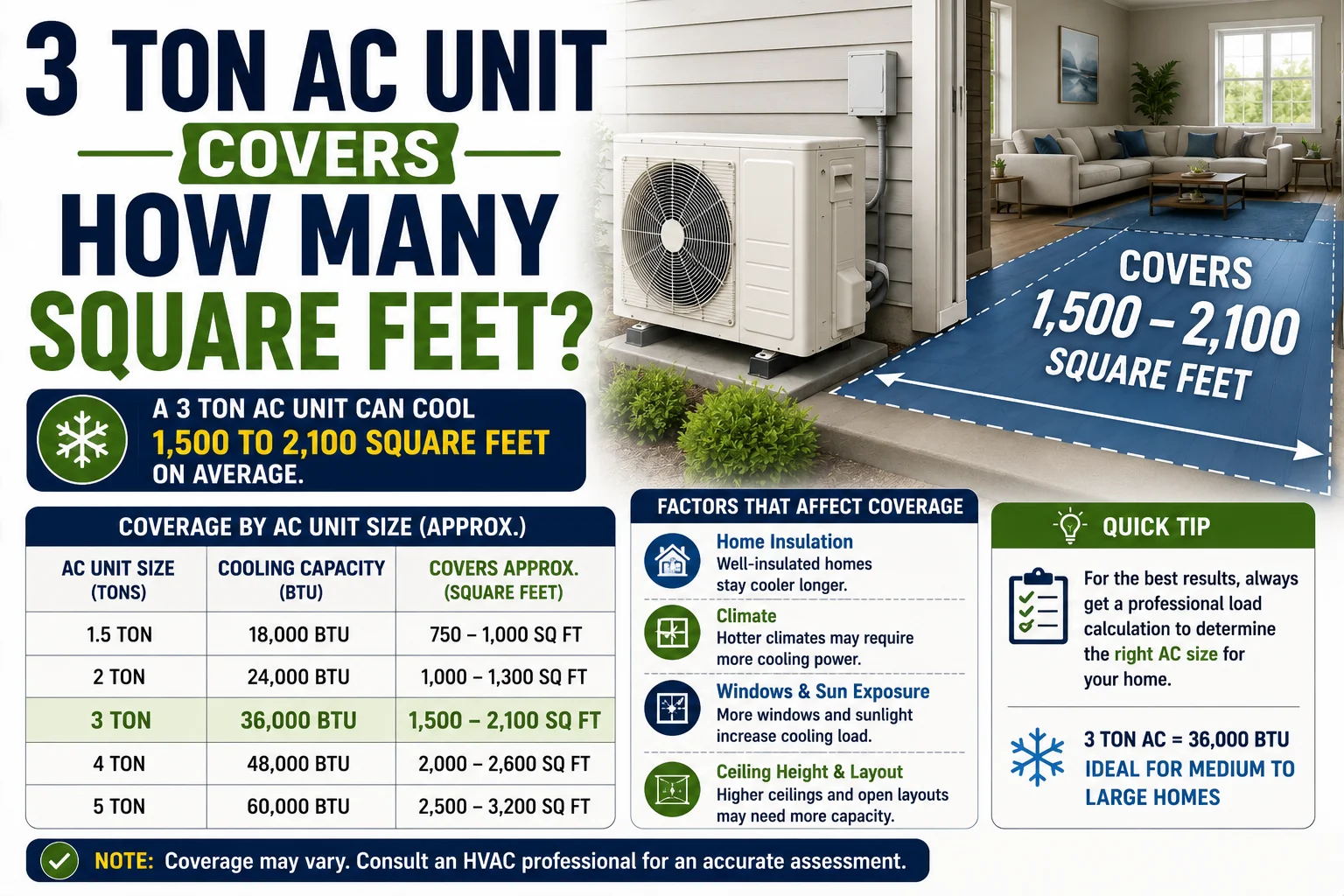
If you’re wondering 3 ton AC unit covers how many square feet, a 3-ton air conditioner can often cool approximately 1,500 to 1,800 square feet under typical residential conditions.
A 3-ton AC has a nominal cooling capacity of:
3 tons × 12,000 BTU per ton = 36,000 BTU
That doesn’t mean every 3-ton system will cool exactly the same amount of space. The correct AC size depends on much more than square footage.
Factors such as:
- Climate
- Insulation
- Ceiling height
- Number and size of windows
- Sun exposure
- Home orientation
- Number of occupants
- Ductwork
- Air leakage
- Building materials
can all change the cooling requirement.
For example, a well-insulated 1,800-square-foot home in a moderate climate may work well with a properly selected 3-ton system. A poorly insulated home in a very hot climate may need more capacity—or may require improvements to insulation and ductwork rather than simply installing a larger AC.
This guide explains what a 3-ton AC means, how much space it can cool, and how to determine whether it is appropriate for your home.
Quick Answer: How Many Square Feet Does a 3 Ton AC Cover?
A 3-ton AC unit typically covers about 1,500 to 1,800 square feet in many residential applications.
However, this is only a general estimate.
A 3-ton system provides approximately:
36,000 BTU of cooling capacity
Here’s a useful comparison:
| AC Size | Approx. BTU Capacity | Common Square-Foot Range* |
|---|---|---|
| 1.5 ton | 18,000 BTU | 600–900 sq ft |
| 2 ton | 24,000 BTU | 900–1,200 sq ft |
| 2.5 ton | 30,000 BTU | 1,200–1,500 sq ft |
| 3 ton | 36,000 BTU | 1,500–1,800 sq ft |
| 3.5 ton | 42,000 BTU | 1,800–2,100 sq ft |
| 4 ton | 48,000 BTU | 2,000–2,400 sq ft |
| 5 ton | 60,000 BTU | 2,500–3,000 sq ft |
*These are broad planning ranges, not a substitute for a professional cooling-load calculation.
What Does “3 Ton” Mean in an AC Unit?
The word ton doesn’t refer to the physical weight of the air conditioner.
In HVAC, a ton is a measurement of cooling capacity.
One ton of cooling equals approximately:
12,000 BTU per hour
Therefore:
3 × 12,000 = 36,000 BTU/hour
A 3-ton AC is therefore rated at approximately 36,000 BTU per hour of nominal cooling capacity.
This capacity is used to remove heat from the home.
The larger the cooling load, the more capacity the air conditioner may need. But simply choosing the largest available unit isn’t a good sizing strategy.
How Many BTUs Is a 3 Ton AC?
A 3-ton air conditioner has a nominal capacity of:
36,000 BTU/hour
The calculation is:
3 tons × 12,000 BTU = 36,000 BTU
BTU stands for British thermal unit.
In HVAC, BTUs are commonly used to describe the rate at which an air-conditioning system can remove heat.
So these terms are closely related:
3-ton AC = approximately 36,000 BTU/hour
This is why you may see an HVAC system described as either a 3-ton system or a 36,000-BTU system.
Is a 3 Ton AC Good for 1,500 Square Feet?
A 3-ton AC can potentially be suitable for a 1,500-square-foot home, but whether it is the right size depends on the home’s cooling load.
If the home has:
- Good insulation
- Energy-efficient windows
- Average ceiling heights
- Properly sealed ducts
- Moderate heat gain
- A suitable climate
a 3-ton system may provide more than enough cooling capacity.
In a very hot climate, however, the same 1,500-square-foot home could have a significantly higher cooling demand.
That’s why square footage should be treated as a starting point rather than the final answer.
Is a 3 Ton AC Enough for 1,800 Square Feet?
A 3-ton AC can be appropriate for an approximately 1,800-square-foot home under favorable conditions.
For example, an efficiently insulated 1,800-square-foot house with standard ceilings and well-sealed windows may have a cooling load that fits within the capacity of a 3-ton system.
However, a home with:
- Poor insulation
- Large unshaded windows
- High ceilings
- Significant air leakage
- An extremely hot climate
- Poor ductwork
may require a different system size.
The best way to know is to have the home’s cooling load calculated rather than relying solely on square footage.
Can a 3 Ton AC Cool 2,000 Square Feet?
It may be able to cool a 2,000-square-foot home in some situations, but 2,000 square feet is outside the common rule-of-thumb range often associated with a 3-ton system.
Whether it works depends on the actual heat gain of the building.
For example, a highly efficient home may require less cooling capacity than an older, poorly insulated house of the same size.
Instead of automatically moving from 3 tons to 3.5 or 4 tons, consider the actual cooling-load calculation.
An oversized AC can also create problems.
Why Square Footage Isn’t Enough to Size an AC
Two homes with exactly the same floor area can have very different cooling requirements.
Consider two 1,800-square-foot houses.
House A
- Modern insulation
- Low-E windows
- Shaded exterior
- Efficient ductwork
- Moderate ceiling height
House B
- Older insulation
- Large sunny windows
- Poorly sealed ducts
- High ceilings
- Significant air leakage
Although both homes are 1,800 square feet, House B may gain considerably more heat.
Therefore, both homes don’t necessarily need the same AC capacity.
Factors That Affect 3 Ton AC Sizing
1. Climate
Climate is one of the biggest factors.
Homes in hotter regions generally experience greater cooling demand.
A house in a mild climate may require less capacity than the same-sized house in an extremely hot climate.
2. Insulation
Good insulation slows heat transfer between the outside and inside of the home.
Poor insulation allows more outdoor heat to enter.
This means a well-insulated home may require less cooling capacity.
Attic insulation is particularly important because roofs can receive substantial solar heat.
3. Windows
Windows can contribute significantly to heat gain.
Large windows facing the sun can increase cooling demand.
Energy-efficient windows, shades, blinds, exterior shading, and trees can help reduce solar heat entering the house.
4. Ceiling Height
Square footage measures floor area, not the total volume of air inside the house.
A home with 10-foot ceilings contains more interior volume than one with 8-foot ceilings.
Very high ceilings can therefore affect HVAC requirements.
5. Ductwork
Even a correctly sized AC can perform poorly if the duct system is inefficient.
Problems can include:
- Leaking ducts
- Poor insulation
- Incorrect duct sizing
- Restricted airflow
- Poorly balanced registers
Before replacing an AC, inspect the entire HVAC system.
6. Air Leakage
Gaps around doors, windows, ducts, vents, and other building openings can allow outdoor air into the home.
More air leakage generally means the AC has to work harder.
Air sealing can improve comfort and energy efficiency.
7. Number of Occupants
People generate body heat.
A home with many occupants can therefore have a higher cooling load than a similarly sized home with fewer people.
Appliances, lighting, electronics, and cooking also contribute heat.
3 Ton AC Square Footage by Home Conditions
A general planning comparison can look like this:
| Home Condition | Potential 3-Ton Suitability |
| Excellent insulation, moderate climate | May cool larger area |
| Good insulation, average climate | Often around 1,500–1,800 sq ft |
| Average insulation, warm climate | May fit lower end of range |
| Poor insulation, hot climate | May be insufficient |
| High ceilings and large windows | Cooling load may increase |
| Energy-efficient home | May cool more area |
This illustrates why there is no single square-foot number that applies to every house.
How to Calculate Approximate AC Size
A simple rule of thumb can provide a starting estimate, but it should not replace a professional load calculation.
A commonly used rough planning range is approximately 20–25 BTU per square foot, although the appropriate figure varies considerably by climate and building conditions.
For a 1,800-square-foot home:
At 20 BTU/sq ft:
1,800 × 20 = 36,000 BTU
That equals:
36,000 ÷ 12,000 = 3 tons
At 25 BTU/sq ft:
1,800 × 25 = 45,000 BTU
That equals:
3.75 tons
This demonstrates why the same home could appear to need a different AC size depending on the assumptions used.
A professional HVAC sizing method is more reliable.
What Is a Manual J Load Calculation?
A Manual J load calculation is a recognized method used to determine the heating and cooling loads of a residential building.
Instead of simply asking how many square feet the home has, it considers details such as:
- Building dimensions
- Climate
- Insulation
- Windows
- Doors
- Orientation
- Occupancy
- Construction materials
- Air infiltration
The result helps HVAC professionals determine the appropriate equipment capacity.
If you’re replacing an expensive central AC system, asking for a proper load calculation can be more useful than choosing an AC based only on square footage.
What Happens If a 3 Ton AC Is Too Small?
If an AC is undersized for the home’s cooling load, it may struggle to maintain the desired indoor temperature during very hot weather.
Possible symptoms include:
- Long operating cycles
- Difficulty reaching the thermostat setting
- Higher indoor temperatures
- Reduced comfort
- Excessive system wear
- Poor performance during peak heat
An undersized system may run continuously and still fail to cool the home adequately.
However, don’t assume that upgrading to a much larger AC is automatically the solution. The building envelope and duct system may also need attention.
What Happens If a 3 Ton AC Is Too Large?
Oversizing an AC can also cause problems.
An oversized system may cool the air very quickly and shut off before completing a long, steady cooling cycle.
This can lead to:
- Short cycling
- Uneven temperatures
- Reduced humidity control
- Increased wear
- Less efficient operation
- Poor comfort
In humid climates, humidity control is especially important.
A properly sized system generally provides more balanced cooling and dehumidification.
3 Ton AC vs. 2.5 Ton AC
A 2.5-ton system has approximately:
2.5 × 12,000 = 30,000 BTU/hour
A 3-ton system has:
3 × 12,000 = 36,000 BTU/hour
Therefore, a 3-ton system provides approximately:
6,000 additional BTU/hour
The appropriate choice depends on the calculated cooling load.
| Feature | 2.5 Ton | 3 Ton |
| Nominal capacity | 30,000 BTU | 36,000 BTU |
| Relative capacity | Lower | Higher |
| Potential application | Smaller/lower-load homes | Larger/higher-load homes |
| Exact square footage | Depends on load | Depends on load |
3 Ton AC vs. 3.5 Ton AC
A 3.5-ton AC has approximately:
3.5 × 12,000 = 42,000 BTU/hour
Compared with a 3-ton system:
42,000 − 36,000 = 6,000 BTU/hour
The difference can matter when the home’s calculated cooling load is near the boundary between equipment sizes.
However, equipment selection should account for the manufacturer’s actual performance data and system design rather than tonnage alone.
3 Ton AC vs. 4 Ton AC
A 4-ton AC provides approximately:
4 × 12,000 = 48,000 BTU/hour
That’s 12,000 BTU/hour more nominal capacity than a 3-ton unit.
A 4-ton unit isn’t necessarily better for a larger home if the cooling load doesn’t require it.
Installing an oversized system simply because it has greater capacity can reduce comfort and efficiency.
3 Ton AC Coverage Comparison
Here’s a simplified comparison:
| AC Tonnage | BTU Capacity | General Planning Range |
| 1.5 ton | 18,000 BTU | 600–900 sq ft |
| 2 ton | 24,000 BTU | 900–1,200 sq ft |
| 2.5 ton | 30,000 BTU | 1,200–1,500 sq ft |
| 3 ton | 36,000 BTU | 1,500–1,800 sq ft |
| 3.5 ton | 42,000 BTU | 1,800–2,100 sq ft |
| 4 ton | 48,000 BTU | 2,000–2,400 sq ft |
| 5 ton | 60,000 BTU | 2,500–3,000 sq ft |
These figures are broad estimates for initial planning only.
How Many Square Feet Can a 3 Ton Mini-Split Cool?
A 3-ton mini-split also represents approximately 36,000 BTU/hour of nominal capacity.
However, mini-split systems are often configured differently from traditional central air systems.
A 36,000-BTU mini-split may be used for:
- Large open areas
- Multiple rooms
- Zoned cooling
- Larger homes
- Commercial or semi-commercial spaces
The exact coverage depends on the number and location of indoor units, insulation, climate, ceiling height, and building layout.
Therefore, don’t assume a 36,000-BTU mini-split will cool exactly the same square footage as a 36,000-BTU central AC.
How Much Electricity Does a 3 Ton AC Use?
The energy consumption of a 3-ton AC cannot be determined from tonnage alone.
A 3-ton system’s actual electrical consumption depends on:
- Efficiency rating
- Compressor type
- Outdoor temperature
- Indoor temperature
- Runtime
- System condition
- Duct losses
- Fan operation
- Installation quality
Two 3-ton air conditioners can have different energy consumption because their efficiency ratings and designs differ.
When comparing systems, look at the manufacturer’s efficiency and performance specifications rather than assuming every 3-ton unit uses the same amount of electricity.
Tips to Get the Most From a 3 Ton AC
If you have or are considering a 3-ton AC, these steps can improve comfort and performance:
Improve Insulation
Adequate attic and wall insulation reduces unwanted heat transfer.
Seal Air Leaks
Seal gaps around doors, windows, ducts, and other openings.
Maintain the Filters
A dirty filter can restrict airflow and reduce system performance.
Keep Outdoor Components Clear
Remove leaves, grass, debris, and other obstructions around the outdoor condenser.
Inspect Ductwork
Leaking or poorly insulated ducts can waste conditioned air.
Use Window Coverings
Blinds, shades, curtains, and exterior shading can reduce solar heat gain.
Schedule Professional Maintenance
Regular inspection can help identify airflow, refrigerant, electrical, and mechanical problems before they become major issues.
Common Mistakes When Choosing a 3 Ton AC
Mistake 1: Choosing Based Only on Square Footage
Square footage is useful for an initial estimate, but it doesn’t tell the entire story.
Mistake 2: Buying the Largest Unit Available
A bigger AC isn’t automatically better.
Oversizing can cause short cycling and humidity problems.
Mistake 3: Ignoring Insulation
A poorly insulated house can have a much higher cooling load.
Mistake 4: Forgetting About Windows
Large, sunny windows can add substantial heat.
Mistake 5: Ignoring Ductwork
Poor ducts can undermine the performance of a properly sized air conditioner.
Mistake 6: Confusing Tonnage With Weight
A 3-ton AC does not weigh three tons. Tonnage refers to cooling capacity.
How to Know if Your Home Needs a 3 Ton AC
A 3-ton AC may be worth considering when:
- Your home’s calculated cooling load is near 36,000 BTU/hour.
- Your home is around 1,500–1,800 square feet under typical conditions.
- The ductwork can handle the required airflow.
- The climate and building characteristics support the capacity.
- A professional HVAC assessment confirms the size.
The best decision comes from matching equipment capacity to cooling load, not simply matching tonnage to square footage.
Frequently Asked Questions
1. How many square feet does a 3 ton AC unit cover?
A 3-ton AC can commonly cool around 1,500 to 1,800 square feet, but the actual coverage depends on climate, insulation, windows, ceiling height, ductwork, and other factors.
2. How many BTUs is a 3 ton AC?
A 3-ton air conditioner has a nominal capacity of approximately 36,000 BTU per hour.
The calculation is:
3 × 12,000 = 36,000 BTU/hour
3. Is a 3 ton AC enough for 1,800 square feet?
It can be. A well-insulated 1,800-square-foot home in suitable conditions may work well with a 3-ton system. However, the correct size should be based on the home’s actual cooling load.
4. Is a 3 ton AC enough for 2,000 square feet?
It may be enough in some highly efficient homes, but 2,000 square feet is generally above the common planning range for a 3-ton system. A load calculation should determine whether 3 tons is sufficient.
5. Can a 3 ton AC be too big for a 1,500-square-foot house?
Yes. Depending on climate and building characteristics, a 3-ton system could be oversized for some 1,500-square-foot homes. Oversizing may cause short cycling and poor humidity control.
Conclusion
So, how many square feet does a 3 ton AC unit cover? As a general starting point, a 3-ton air conditioner can often cool approximately 1,500 to 1,800 square feet. A 3-ton system has a nominal cooling capacity of 36,000 BTU per hour.
However, square footage alone should never be the only factor used to select an AC. Climate, insulation, windows, ceiling height, air leakage, ductwork, occupancy, and solar heat gain can all change the home’s cooling requirements.
For example, an energy-efficient 1,800-square-foot home may perform well with a 3-ton system, while a poorly insulated home of the same size could require a different approach.
Before purchasing a central AC, have the home’s cooling load properly evaluated. A professional HVAC contractor can assess the building and recommend the appropriate equipment size, efficiency, ductwork, and installation configuration.