
Have you ever looked at a mountain, checked a weather app, or traveled to a new city and wondered, how many feet are we above sea level right now?
This simple question opens the door to understanding one of the most important geographic measurements on Earth: elevation. Whether you are planning a hike, buying a home, monitoring flood risk, or just satisfying your curiosity, knowing how high you are above sea level can be surprisingly useful.
In this guide, you will learn what sea level means, how elevation is measured, how to find your current altitude in feet, and why it matters in everyday life.
What Does “Above Sea Level” Mean?
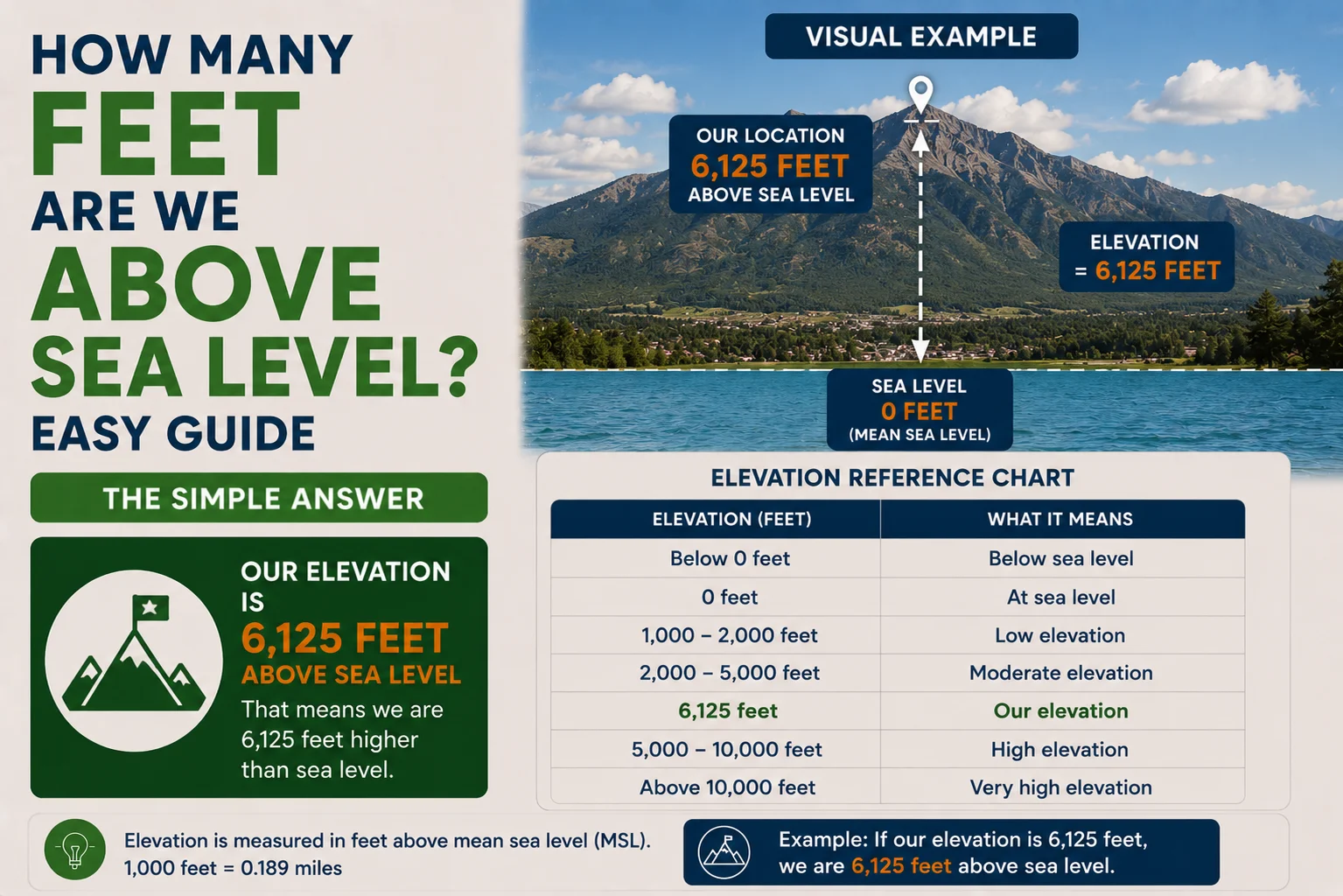
“Above sea level” refers to the vertical distance between a location and the average level of the world’s oceans, known as mean sea level (MSL).
If a town sits 500 feet above sea level, it means the land is 500 feet higher than the average ocean surface.
Simple Example
- Beachfront home: 10 feet above sea level
- Denver, Colorado: 5,280 feet above sea level
- Mount Everest: 29,032 feet above sea level
Sea level serves as the baseline from which scientists and mapmakers measure elevation across the planet.
How Many Feet Are We Above Sea Level Right Now?
The answer depends entirely on your location.
Someone standing in Miami may be only a few feet above sea level, while someone in Denver is about 5,280 feet above sea level.
To answer how many feet are we above sea level, you need your exact location. Elevation can vary dramatically even within the same city.
For example:
- Ground floor in a coastal town: 15 feet
- Nearby hill: 300 feet
- Mountain overlook: 6,000 feet
That is why tools like GPS and digital elevation maps are so useful.
Why Elevation Matters in Daily Life
Elevation affects more aspects of life than many people realize.
Weather and Climate
Higher elevations tend to be cooler. Temperatures can drop by about 3.5°F for every 1,000 feet of elevation gain.
Health and Breathing
At higher altitudes, the air contains less oxygen. Some people experience headaches or fatigue above 8,000 feet.
Flood Risk
Homes at low elevations are more vulnerable to flooding and storm surges.
Cooking and Baking
Water boils at lower temperatures at higher elevations, changing cooking times.
Fitness and Sports
Athletes often train at elevation to improve endurance.
Aviation
Pilots constantly monitor altitude to ensure safe flight.
How to Find Your Elevation Above Sea Level
If you are asking, how many feet are we above sea level, there are several easy ways to find out.
Using Your Smartphone
Most modern phones include GPS and barometric sensors.
Search:
- “What is my elevation?”
- “How high above sea level am I?”
Many weather and compass apps also show altitude in feet.
Using Online Tools
Reliable sources include:
Using GPS Devices
Dedicated hiking and aviation GPS units provide highly accurate altitude readings.
Using Topographic Maps
Contour lines on topographic maps indicate changes in elevation.
Average Elevations of Popular Cities
| City | Elevation Above Sea Level |
|---|---|
| New York City | 33 feet |
| Los Angeles | 305 feet |
| Chicago | 594 feet |
| Denver | 5,280 feet |
| Mexico City | 7,350 feet |
| Kathmandu | 4,600 feet |
| La Paz | 11,975 feet |
Sea Level vs Altitude vs Elevation
These terms are often used interchangeably, but they have different meanings.
| Term | Meaning |
|---|---|
| Sea Level | Average ocean height used as a reference point |
| Elevation | Height of land above sea level |
| Altitude | Height of an object above the Earth’s surface or sea level |
For example, your house has an elevation, while an airplane has an altitude.
How Scientists Measure Sea Level
Sea level is not perfectly flat. It changes due to:
- Tides
- Winds
- Ocean currents
- Temperature changes
- Melting glaciers
Scientists use:
- Tide gauges
- Satellite altimeters
- GPS stations
Organizations like the National Oceanic and Atmospheric Administration (NOAA) and U.S. Geological Survey (USGS) track these changes continuously.
What Happens at Higher Elevations?
As elevation increases, atmospheric pressure decreases.
At 5,000 Feet
Some people notice mild shortness of breath.
At 8,000 Feet
Altitude sickness may begin.
Above 14,000 Feet
Oxygen becomes significantly limited.
On Mount Everest
Supplemental oxygen is commonly used.
Common Mistakes When Checking Elevation
Confusing Building Height with Ground Elevation
A 20-story building at sea level is still located at approximately sea level.
Using Inaccurate Phone Readings
GPS altitude may vary by several feet or more.
Assuming Entire Cities Have One Elevation
Terrain can change considerably across urban areas.
Forgetting Weather Effects
Barometric pressure changes can affect readings.
Practical Uses for Knowing Elevation
Understanding how many feet you are above sea level can help with:
- Hiking and camping
- Real estate decisions
- Flood insurance
- Gardening
- Road trip planning
- Fitness training
- Scientific research
Interesting Facts About Elevation and Sea Level
- Apollo 11 Moon Landing astronauts trained in high-altitude environments.
- Death Valley is about 282 feet below sea level.
- Dead Sea lies over 1,400 feet below sea level.
- Nepal has some of the world’s highest inhabited settlements.
- Amsterdam contains areas below sea level protected by dikes.
9. Frequently Asked Questions
1. How many feet above sea level am I right now?
Use your smartphone GPS, a weather app, or an elevation website to determine your exact height above sea level.
2. What is considered high elevation?
Many people consider elevations above 5,000 feet to be high, especially if they are not acclimated.
3. Is altitude the same as elevation?
Not exactly. Elevation usually refers to land, while altitude often refers to aircraft and other objects.
4. Can locations be below sea level?
Yes. Places like Death Valley and the Dead Sea are well below sea level.
5. Why does elevation matter?
Elevation affects weather, health, flood risk, and even cooking.
10. Conclusion
So, how many feet are we above sea level? The answer depends on where you are standing right now. You could be only a few feet above sea level near the coast or thousands of feet high in a mountain city.
Knowing your elevation above sea level is more than a fun fact. It helps you understand your environment, prepare for weather, assess flood risk, and make smarter travel and property decisions.