

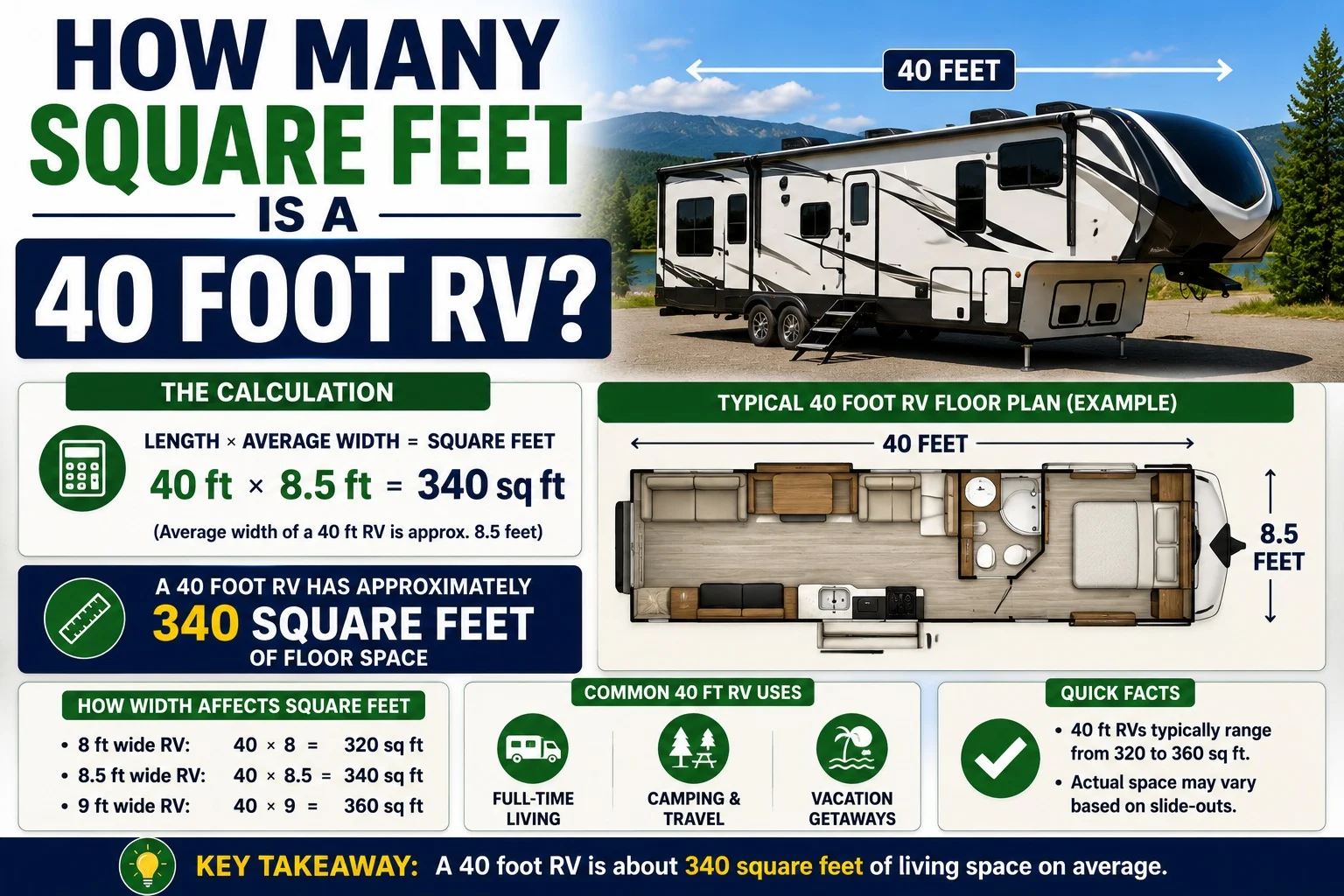
When people look at large recreational vehicles, one of the most common questions is:
How many square feet is a 40-foot RV?
At first glance, you might assume it’s simply “40 feet long,” but square footage depends on both length and width, not just length alone. That means the real usable living space in a 40-foot RV is much different from its overall length.
In this article, we’ll break down exactly how many square feet a 40-foot RV typically has, how RV space is calculated, how slide-outs affect size, and how RV living space compares to apartments and homes.
Quick Answer
A typical 40-foot RV has approximately:
250 to 400 square feet of interior living space
In most standard Class A motorhomes:
40 ft length×8.5 ft width≈340 sq ft
So the average 40-foot RV provides around:
300–350 square feet of usable space
depending on layout and slide-outs.
Why RV Square Footage Is Not Just Length
A common mistake is assuming:
40 feet = 40 square feet
This is incorrect because:
- Feet measure length
- Square feet measure area
To calculate RV space, you need:
Square Feet=Length×Width
So even though an RV is 40 feet long, its width is what determines total living area.
Standard RV Dimensions
Most 40-foot RVs follow U.S. highway limits.
Typical dimensions include:
- Length: 40 feet
- Width: 8 to 8.5 feet
- Height: 12 to 13 feet
Standard width used for calculation:
8.5 feet
Basic Square Foot Calculation
Using standard dimensions:
40×8.5=340 square feet
Final baseline:
A 40-foot RV has about 340 square feet of floor space
This is similar to a small studio apartment.
RV Floor Plans Affect Square Footage
Not all 40-foot RVs feel the same inside.
Manufacturers design layouts differently, which affects usable space.
1. No Slide-Out RVs
- Fixed walls
- More compact interior
Typical space:
280 to 320 sq ft
2. Single Slide-Out RVs
Slide-outs expand living areas when parked.
Typical space:
320 to 380 sq ft
3. Multiple Slide-Out RVs
Luxury models may include 2–4 slide-outs.
Typical space:
380 to 450 sq ft
Interior vs Exterior Space
It’s important to understand:
- Exterior length = 40 feet
- Interior usable space = smaller due to walls, cabinets, and mechanical systems
Lost space includes:
- Driver cabin (motorhomes)
- Engine compartment
- Walls and insulation
- Storage compartments
How RV Square Footage Is Actually Measured
RV manufacturers measure interior livable space, not total outer shell.
Formula:
Interior Length×Interior Width
But usable space also depends on:
- Furniture placement
- Kitchen layout
- Bathroom size
- Hallways
What Does 340 Square Feet Look Like?
To visualize:
A 40-foot RV is similar in size to:
- A small studio apartment
- A large hotel room
- A tiny one-bedroom apartment
Example comparison:
340 sq ft≈18 ft×19 ft room
RV Layout Breakdown
Inside a 40-foot RV, space is divided into:
Living Area
- Sofa
- TV
- Dining space
Approx: 80–120 sq ft
Kitchen
- Stove
- Sink
- Refrigerator
Approx: 40–70 sq ft
Bathroom
- Toilet
- Shower
- Sink
Approx: 25–50 sq ft
Bedroom
- Queen or king bed
- Storage
Approx: 80–120 sq ft
Storage & Walkways
Remaining space:
- Cabinets
- Hallways
- Closets
RV Space Efficiency
Even though RVs are small, they are highly efficient.
Design goals include:
- Multi-purpose furniture
- Vertical storage
- Compact appliances
How Slide-Outs Increase Space
Slide-outs expand RV walls when parked.
Each slide-out can add:
20 to 60 sq ft per slide-out
So 3 slide-outs may add:
60 to 180 sq ft
RV vs Apartment Comparison
| Space Type | Square Feet |
|---|---|
| 40 ft RV | 300–400 sq ft |
| Studio apartment | 400–600 sq ft |
| 1-bedroom apartment | 600–900 sq ft |
So a 40-foot RV is smaller than most apartments but larger than a hotel room.
Why RV Size Matters
Understanding RV square footage helps with:
Travel Planning
Knowing how much space you’ll live in.
Storage Planning
Space is limited for belongings.
Comfort Expectations
Helps set realistic expectations.
Can a Family Live in a 40-Foot RV?
Yes, but space is limited.
Typical occupancy:
- 1–2 people: comfortable
- 3–4 people: manageable
- 5+ people: crowded
Advantages of a 40-Foot RV
Spacious for RV Standards
Among the largest RVs available.
Full Amenities
Includes:
- Kitchen
- Bathroom
- Bedroom
- Living area
Travel Flexibility
Can be driven or towed (depending on type)
Disadvantages of a 40-Foot RV
Limited Space Compared to Homes
Even large RVs are small compared to houses.
Storage Constraints
Closet space is minimal.
Driving Limitations
May require experience to maneuver.
Fuel Efficiency Impact
Larger RVs like 40-foot models:
- Consume more fuel
- Are heavier
- Require stronger engines
Frequently Asked Questions
How many square feet is a 40-foot RV?
Typically 300–400 square feet
Is an RV bigger than a studio apartment?
Sometimes similar, but usually slightly smaller.
Does RV length equal square footage?
No.
Square footage depends on both length and width.
Do slide-outs increase RV size?
Yes.
They can add up to:
180 sq ft or more
Key Takeaways
- A 40-foot RV is about 300–400 sq ft
- Width is just as important as length
- Slide-outs significantly increase usable space
- RV space is comparable to a studio apartment
- Layout greatly affects comfort and livability
Conclusion
So, how many square feet is a 40-foot RV?
The answer is:
A typical 40-foot RV has about 300 to 400 square feet of interior living space, depending on layout and slide-outs.
While the length is 40 feet, the actual livable area depends on width, design, and configuration. RVs are compact but cleverly designed spaces that offer everything needed for travel and living on the road. Understanding their square footage helps you choose the right model and set realistic expectations for comfort and storage.