

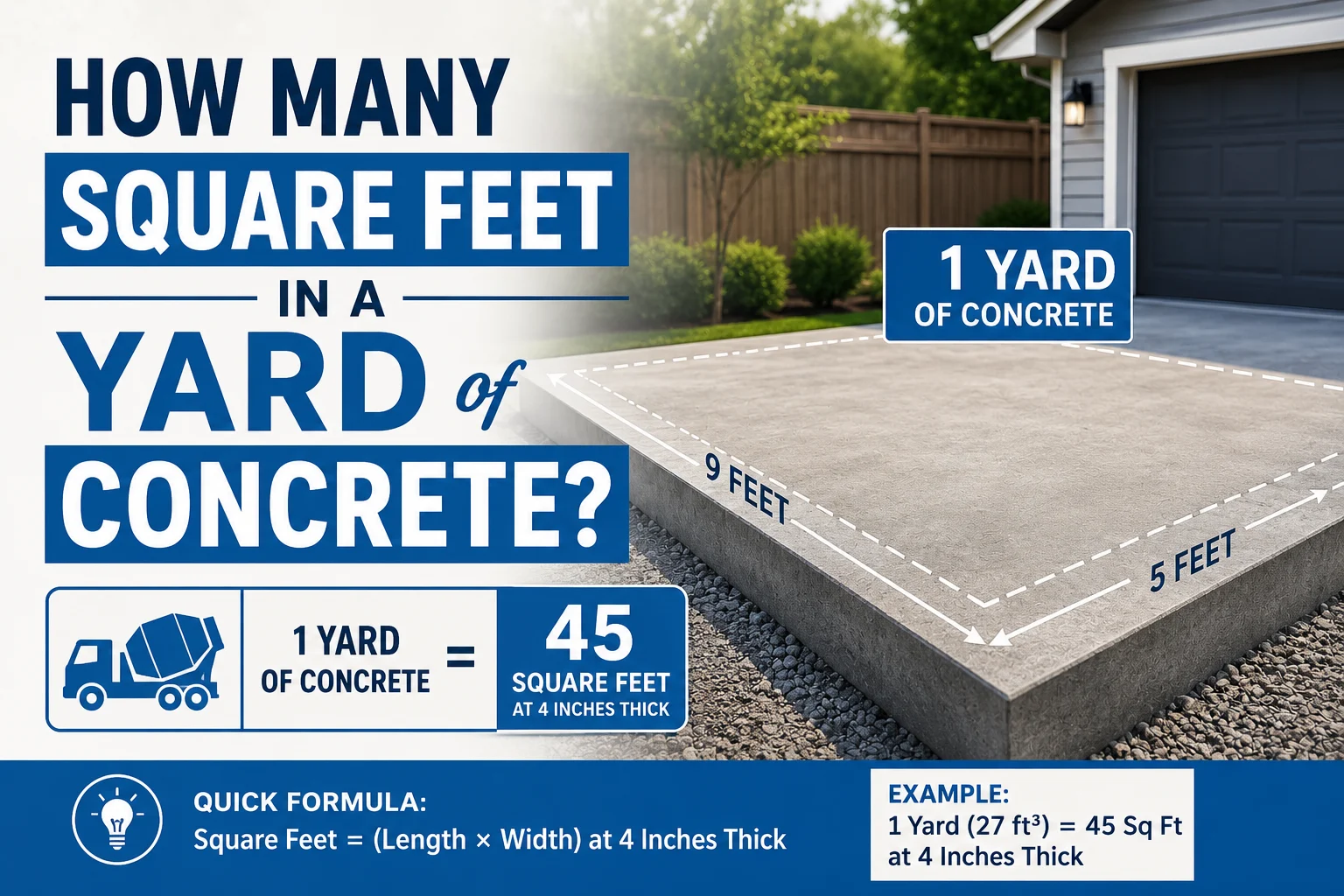
If you are asking, “how many square feet are in a yard of concrete?”, you are likely planning a construction, landscaping, or home improvement project. Concrete is commonly measured in cubic yards, while project areas are usually measured in square feet. Because of this, understanding the relationship between square feet and cubic yards is essential when estimating how much concrete you need.
The answer depends on one important factor:
The thickness (depth) of the concrete slab
A cubic yard of concrete can cover different amounts of square footage depending on how thick the pour will be.
For example:
- At 4 inches thick, one cubic yard covers about 81 square feet
- At 6 inches thick, one cubic yard covers about 54 square feet
- At 2 inches thick, one cubic yard covers about 162 square feet
In this complete guide, you will learn:
- How many square feet are in a yard of concrete
- The concrete coverage formula
- Coverage charts by thickness
- Real-world project examples
- How to calculate concrete volume
- Common mistakes to avoid
- Helpful contractor tips
- Frequently asked questions
Let’s get started.
What Is a Yard of Concrete?
Concrete is usually sold by the:
- Cubic yard
A cubic yard measures volume, not area.
One cubic yard equals:
3 ft×3 ft×3 ft=27 cubic feet
So:
1 cubic yard = 27 cubic feet
This volume is then spread across an area at a certain thickness.
Quick Answer: How Many Square Feet in a Yard of Concrete?
The coverage depends entirely on slab thickness.
Common Concrete Coverage Estimates
| Thickness | Coverage Per Cubic Yard |
|---|---|
| 2 inches | 162 sq ft |
| 3 inches | 108 sq ft |
| 4 inches | 81 sq ft |
| 5 inches | 65 sq ft |
| 6 inches | 54 sq ft |
The most common residential slab thickness is:
- 4 inches
So in most situations:
One cubic yard of concrete covers about 81 square feet at 4 inches thick.
Concrete Coverage Formula
The formula for concrete coverage is:
Square Feet Covered
Coverage=Thickness in Inches324
Why 324?
Because:
27 cubic feet×12=324
This formula converts cubic feet into square-foot coverage based on slab depth.
Example: 4-Inch Concrete Slab
Using the formula:
324÷4=81 square feet
Result:
One cubic yard covers approximately 81 square feet at 4 inches thick.
Why Thickness Matters
Thickness changes how far concrete spreads.
Thin Slabs Cover More Area
A thinner pour spreads farther.
Example:
- 2-inch slab = 162 sq ft coverage
Thick Slabs Cover Less Area
A thicker slab uses more concrete volume.
Example:
- 6-inch slab = 54 sq ft coverage
Common Residential Concrete Thicknesses
Different projects require different slab depths.
Sidewalks
Typical thickness:
- 4 inches
Coverage:
- 81 sq ft per yard
Patios
Typical thickness:
- 4 inches
Coverage:
- 81 sq ft per yard
Driveways
Typical thickness:
- 5–6 inches
Coverage:
- 54–65 sq ft per yard
Garage Floors
Typical thickness:
- 4–6 inches
Coverage varies accordingly.
Concrete Footings
Footings are often much thicker and require more concrete volume.
Real-World Concrete Examples
Understanding practical examples makes estimating easier.
Example 1: Small Patio
Patio dimensions:
- 10 ft × 10 ft
Area:
10×10=100 square feet
At 4 inches thick:
Each yard covers:
- 81 sq ft
Calculation:
100÷81≈1.23 cubic yards
Result:
- Order about 1.5 cubic yards
Example 2: Driveway
Driveway dimensions:
- 20 ft × 20 ft
Area:
20×20=400 square feet
At 5 inches thick:
Coverage:
- 65 sq ft per yard
Calculation:
400÷65≈6.15 cubic yards
Result:
- Order approximately 6.5 cubic yards
How to Calculate Concrete Needed
Step 1: Measure Length and Width
Example:
- 12 ft × 15 ft
Step 2: Calculate Area
12×15=180 square feet
Step 3: Determine Thickness
Example:
- 4 inches
Step 4: Divide by Coverage Rate
At 4 inches:
- 81 sq ft per yard
Calculation:
180÷81≈2.22
Result:
- About 2.5 cubic yards
Why Contractors Order Extra Concrete
Professionals usually order slightly more than calculated.
Reasons include:
- Uneven ground
- Spillage
- Form shifting
- Measurement errors
Typical extra amount:
- 5–10%
Concrete Thickness Conversion Chart
| Thickness | Feet Equivalent |
|---|---|
| 2 inches | 0.167 ft |
| 3 inches | 0.25 ft |
| 4 inches | 0.333 ft |
| 5 inches | 0.417 ft |
| 6 inches | 0.5 ft |
Understanding thickness in feet helps with advanced calculations.
Alternative Concrete Volume Formula
Contractors often use:
Cubic Yards=27Length×Width×Depth in Feet
Example:
- 10 × 10 slab
- 4-inch thickness
Convert depth:
4 inches=0.333 feet
Calculation:
2710×10×0.333≈1.23
Common Concrete Project Sizes
Sidewalk Section
Typical size:
- 4 ft × 20 ft
- 80 sq ft
Requires about:
- 1 cubic yard at 4 inches
Small Shed Pad
Typical size:
- 10 ft × 12 ft
- 120 sq ft
Requires:
- About 1.5 cubic yards
Standard Driveway
Typical size:
- 400–600 sq ft
May require:
- 6–10 cubic yards
Factors Affecting Concrete Requirements
Several variables affect how much concrete you actually need.
Ground Slope
Uneven terrain requires additional concrete.
Reinforcement
Rebar and mesh do not significantly change volume but improve strength.
Waste and Spillage
Some concrete loss is normal during pouring.
Over-Excavation
Digging too deep increases volume requirements.
Bagged Concrete vs Ready-Mix
Small projects may use bagged concrete.
Large projects usually use:
- Ready-mix concrete trucks
How Many Bags Equal One Cubic Yard?
Approximate estimates:
| Bag Size | Bags Per Cubic Yard |
|---|---|
| 40 lb bag | 90 bags |
| 60 lb bag | 60 bags |
| 80 lb bag | 45 bags |
Large projects are usually easier with ready-mix delivery.
Common Concrete Mistakes to Avoid
Forgetting Thickness
Thickness drastically changes coverage.
Ordering Exact Amounts
Always order extra.
Incorrect Measurements
Double-check all dimensions.
Ignoring Slope
Uneven surfaces need additional material.
Contractor Tips for Concrete Projects
Compact the Base Properly
A stable base improves durability.
Use Reinforcement When Needed
Rebar increases slab strength.
Plan Weather Conditions
Avoid pouring during extreme temperatures.
Cure Concrete Properly
Proper curing prevents cracking.
FAQs
How many square feet does one yard of concrete cover?
It depends on thickness.
At 4 inches thick:
- About 81 square feet
How many square feet in a yard of concrete at 6 inches thick?
Approximately:
- 54 square feet
How much concrete do I need for 100 square feet?
At 4 inches thick:
- About 1.25 cubic yards
Why is concrete measured in cubic yards?
Because concrete is sold by volume, not area.
What is the standard thickness for a concrete patio?
Usually:
- 4 inches
How many cubic feet are in a cubic yard?
Exactly:
- 27 cubic feet
Final Thoughts
So, how many square feet are in a yard of concrete?
The answer depends on slab thickness.
The most common residential estimate is:
One cubic yard of concrete covers about 81 square feet at 4 inches thick.
Coverage changes significantly as thickness increases or decreases.
Understanding concrete coverage helps you:
- Estimate project costs
- Avoid material shortages
- Prevent waste
- Plan construction accurately
Whether you are pouring a driveway, patio, sidewalk, garage floor, or shed pad, knowing how to calculate concrete coverage ensures your project runs smoothly and efficiently.