
If you have ever wondered how many feet are in a track lap, you are not alone. Students, runners, coaches, and fitness enthusiasts frequently ask this question when training, calculating distance, or preparing for track and field events.
The answer depends on the type of track being used. However, the standard outdoor running track used in schools, colleges, and professional competitions measures:
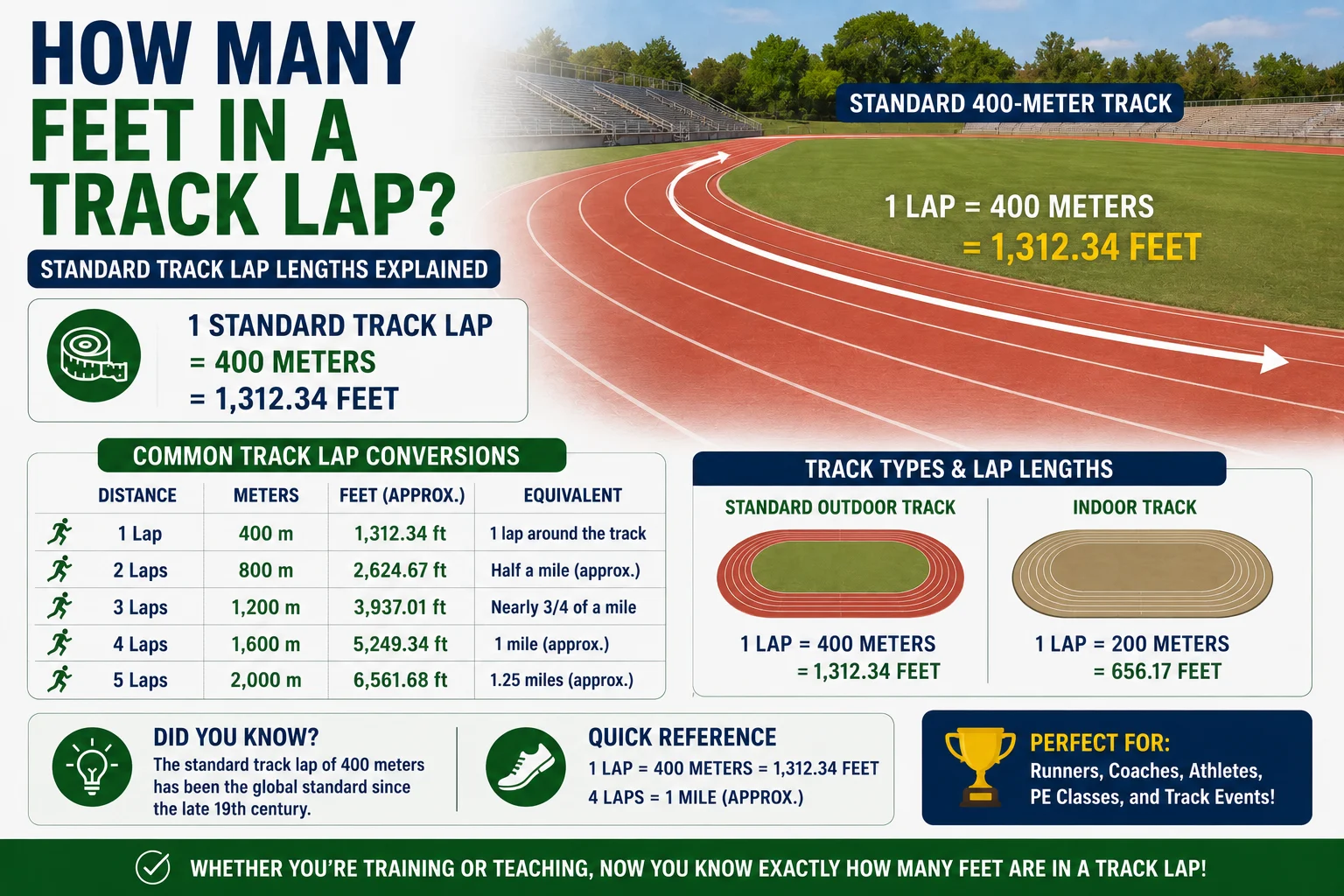
- 400 meters per lap
When converted into feet, this equals approximately:
- 1,312 feet per lap
Understanding track lap measurements is important for:
- Running workouts
- Athletic training
- Physical education classes
- Race preparation
- Distance calculations
- Fitness tracking
In this complete guide, you will learn:
- How many feet are in a standard track lap
- Track lap conversions
- Indoor vs outdoor track sizes
- Common running distances
- Why tracks are measured in meters
- Helpful training examples
- Frequently asked questions
Let’s begin.
How Many Feet in a Track Lap?
A standard outdoor running track lap is:
- 400 meters
Since 1 meter equals 3.28084 feet, the conversion becomes:
400 × 3.28084 = 1,312.34 feet
So:
One standard track lap equals approximately 1,312 feet.
Most people round this to:
- 1,312 feet
- Or about one-quarter mile
Standard Running Track Dimensions
Most outdoor tracks are built according to international athletic standards.
Standard Outdoor Track
A regulation outdoor track includes:
- 400 meters per lap
- 8 running lanes typically
- Oval-shaped layout
- Two straight sections
- Two curved turns
This type of track is commonly found at:
- High schools
- Colleges
- Olympic training facilities
- Public athletic complexes
How Many Feet Are in 400 Meters?
Because tracks are measured in meters, converting them to feet helps people understand the distance more easily.
Conversion Formula
Feet = Meters × 3.28084
Using the formula:
400 × 3.28084 = 1,312.34 feet
Therefore:
- 400-meter lap = approximately 1,312 feet
Why Running Tracks Use Meters Instead of Feet
Modern athletic competitions use the metric system.
Reasons Tracks Use Meters
International Standardization
Most countries use the metric system for sports.
Olympic Regulations
Olympic races are measured in meters, including:
- 100m
- 200m
- 400m
- 800m
- 1500m
Easier Race Organization
Metric measurements create consistent international standards.
Track Lap Compared to a Mile
Many runners compare track laps to miles.
How Many Laps Equal One Mile?
One mile equals:
- 5,280 feet
A standard track lap equals:
- 1,312 feet
Calculation:
5,280 ÷ 1,312 ≈ 4
So:
Four laps around a standard outdoor track equal approximately one mile.
Technically:
- 4 laps = 1,600 meters
- 1 mile = 1,609 meters
This means a true mile is slightly longer than four laps.
Indoor Track Lap Distance
Indoor tracks are usually smaller than outdoor tracks.
Standard Indoor Track
Most indoor tracks measure:
- 200 meters per lap
Converted into feet:
200 × 3.28084 = 656.17 feet
So:
One indoor track lap is approximately 656 feet.
However, indoor track sizes may vary depending on the facility.
Common Running Distances on a Track
Understanding lap distances helps runners calculate workouts.
100 Meters
- One straight section on many tracks
- Approximately 328 feet
200 Meters
- Half a lap
- Approximately 656 feet
400 Meters
- One full lap
- Approximately 1,312 feet
800 Meters
- Two laps
- Approximately 2,625 feet
1600 Meters
- Four laps
- Approximately one mile
Real-Life Uses for Track Lap Measurements
Knowing track distances helps in many situations.
Fitness Training
Runners use laps to monitor:
- Speed
- Endurance
- Calories burned
- Heart rate zones
School Athletics
Students often run laps during:
- Physical education classes
- Fitness tests
- Team conditioning
Marathon Preparation
Distance runners use tracks for:
- Interval workouts
- Pace training
- Timed repetitions
Walking Programs
Walkers use tracks because distances are easy to measure accurately.
How Long Does It Take to Run One Track Lap?
The time depends on fitness level and speed.
Beginner Runner
- 2 to 4 minutes per lap
Intermediate Runner
- 70 to 120 seconds per lap
Elite Athlete
- Under 60 seconds for a 400m lap
Track Lane Differences
Not every lane measures exactly the same.
Lane 1
The official 400-meter distance is measured in lane 1.
Outer Lanes
Outer lanes are slightly longer because the curve radius increases.
This is why staggered starting positions are used in races.
How Track Measurements Are Calculated
Running tracks use precise engineering standards.
Measurement Method
Tracks are measured:
- 30 centimeters from the inner curb
- Along lane 1
This ensures fairness in competition.
Historical Evolution of Track Sizes
Older tracks were sometimes measured in yards instead of meters.
Traditional Quarter-Mile Tracks
Older American tracks often measured:
- 440 yards
This equals:
- 1,320 feet
Modern tracks switched to:
- 400 meters
Which is slightly shorter.
Outdoor Track Surface Types
Track materials can affect running performance.
Common Track Surfaces
Rubberized Synthetic Tracks
Most modern tracks use synthetic materials for:
- Cushioning
- Speed
- Weather resistance
Asphalt Tracks
Some recreational facilities use asphalt.
Dirt or Cinder Tracks
Older tracks sometimes used dirt or cinder materials.
How Many Calories Can You Burn Per Lap?
Calories burned depend on:
- Weight
- Speed
- Running intensity
Approximate estimate:
- Running one lap may burn 8–20 calories
Longer workouts naturally burn more.
Walking vs Running a Track Lap
Walking
A lap may take:
- 4 to 8 minutes
Running
A lap may take:
- Under 2 minutes for experienced runners
Why Tracks Are Popular for Training
Tracks provide several advantages.
Accurate Distance Measurement
Unlike roads, tracks provide exact distances.
Safer Running Surface
Tracks are generally softer than concrete.
Controlled Environment
Tracks help athletes maintain pacing consistency.
Easier Interval Training
Runners can easily count laps and time splits.
Common Mistakes About Track Distance
Many people misunderstand track measurements.
Mistake 1: Assuming Every Track Is the Same
Some school and recreational tracks differ slightly.
Mistake 2: Forgetting Lane Differences
Outer lanes add extra distance.
Mistake 3: Confusing Yards and Meters
Older tracks may use yard measurements.
Helpful Track Distance Conversion Chart
| Distance | Feet |
|---|---|
| 100 meters | 328 feet |
| 200 meters | 656 feet |
| 400 meters | 1,312 feet |
| 800 meters | 2,625 feet |
| 1600 meters | 5,249 feet |
| 1 mile | 5,280 feet |
This chart helps runners estimate distances quickly.
Tips for New Runners Using a Track
Start Slowly
Avoid sprinting every lap.
Use Proper Shoes
Running shoes improve comfort and reduce injury risk.
Track Your Laps
Counting laps helps measure progress.
Stay Hydrated
Bring water during longer sessions.
Warm Up First
Dynamic stretching helps prevent injuries.
Frequently Asked Questions
How many feet are in one lap around a track?
A standard outdoor track lap equals approximately:
- 1,312 feet
Is one lap around a track a mile?
No.
Four laps are approximately equal to one mile.
How many laps equal two miles?
About:
- 8 laps
How many feet are in an indoor track lap?
Most indoor tracks are approximately:
- 656 feet per lap
Why are tracks measured in meters?
Because international athletic competitions use the metric system.
How many laps is a 5K?
A 5K equals:
- 12.5 laps on a standard 400m track
Final Thoughts
So, how many feet are in a track lap?
The answer is:
A standard outdoor running track lap equals approximately 1,312 feet.
This measurement comes from the official 400-meter track standard used worldwide in athletics.
Understanding track distances is useful for:
- Running workouts
- Athletic training
- Fitness tracking
- Race preparation
- Walking programs
- Sports education
Whether you are preparing for a race, improving your fitness, or simply curious about track measurements, knowing the distance of one lap helps you train more effectively and accurately.