

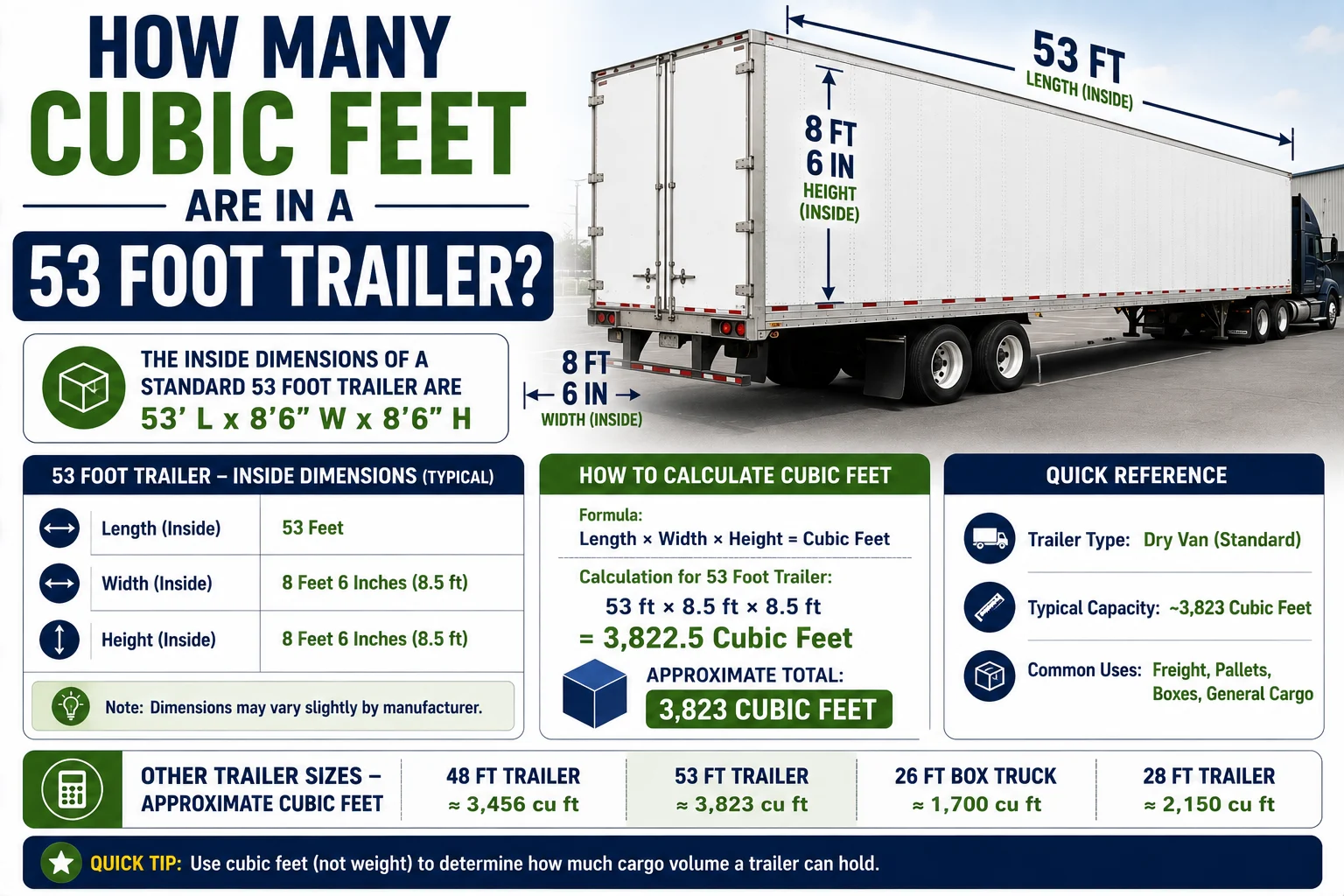
If you’re shipping freight or trying to determine how much cargo a trailer can hold, you may wonder how many cubic feet are in a 53 foot trailer.
A standard 53-foot dry van trailer typically has an interior volume of roughly 3,800 to 4,000 cubic feet, depending on the trailer’s exact interior dimensions, wall construction, roof design, and manufacturer.
A commonly used estimate is approximately 3,900 cubic feet.
For example, if a trailer has interior dimensions of about:
- 53 feet long
- 8.2 feet wide
- 8.5 feet high
the theoretical volume is approximately:
53 × 8.2 × 8.5 = 3,695.3 cubic feet
However, actual trailer specifications vary, and some modern 53-foot trailers have greater interior height or width. Using dimensions around 53 × 8.5 × 9 feet produces approximately 4,054.5 cubic feet.
That’s why it is important to check the actual interior dimensions of the trailer rather than relying only on its exterior length.
Quick Answer: How Many Cubic Feet Are in a 53 Foot Trailer?
A typical 53-foot dry van has approximately 3,800–4,000 cubic feet of interior volume.
A useful planning estimate is:
About 3,900 cubic feet
However, there is no single exact number for every 53-foot trailer.
The volume depends on:
- Interior length
- Interior width
- Interior height
- Wall thickness
- Roof design
- Door configuration
- Trailer manufacturer
- Trailer model
The most accurate method is to multiply the trailer’s actual interior length × interior width × interior height.
What Is the Cubic Capacity of a 53-Foot Trailer?
Cubic capacity refers to the total three-dimensional space available inside a trailer.
The basic formula is:
Length × Width × Height = Cubic Feet
For example, suppose a trailer has interior dimensions of:
53 ft × 8.5 ft × 9 ft
The theoretical volume would be:
53 × 8.5 × 9 = 4,054.5 cubic feet
That does not necessarily mean you can use every cubic foot for cargo.
Cargo shape, pallets, load restrictions, doors, wheel wells, loading equipment, and required clearance can reduce usable space.
Therefore, cubic capacity and practical cargo capacity are not always the same thing.
Standard 53-Foot Trailer Dimensions
A typical 53-foot dry van may have dimensions close to the following:
| Dimension | Approximate Measurement |
|---|---|
| Exterior length | 53 ft |
| Interior length | About 52–53 ft |
| Interior width | About 8.2–8.5 ft |
| Interior height | About 8.5–9 ft |
| Approximate volume | 3,800–4,000+ cu ft |
Exact measurements vary between manufacturers and models.
The advertised trailer length refers to the trailer’s overall nominal length, not necessarily the exact usable interior length.
For freight planning, always use the carrier’s actual specifications.
How to Calculate Cubic Feet in a 53-Foot Trailer
Calculating trailer volume is straightforward.
Step 1: Find the Interior Length
Use the actual interior length rather than the nominal exterior length whenever possible.
Step 2: Find the Interior Width
Measure from the inside wall to the opposite inside wall.
Step 3: Find the Interior Height
Measure from the trailer floor to the usable interior ceiling height.
Step 4: Multiply the Dimensions
Use:
Length × Width × Height
For example:
53 × 8.5 × 9
= 4,054.5 cubic feet
This gives the theoretical internal volume.
Keep in mind that the actual usable cargo volume can be lower.
Why a 53-Foot Trailer Doesn’t Always Have the Same Cubic Feet
Not every 53-foot trailer has identical interior dimensions.
Two trailers can both be described as 53-foot trailers while having slightly different:
- Interior heights
- Interior widths
- Interior lengths
- Door openings
- Wall thicknesses
- Roof designs
- Flooring systems
For example, one trailer may have an interior height of 8.5 feet while another may provide close to 9 feet.
That difference can create hundreds of additional cubic feet.
Therefore, the trailer’s specification sheet is the best source for an exact capacity calculation.
53-Foot Trailer Cubic Feet Examples
Here are some examples using different interior dimensions.
| Length | Width | Height | Approx. Volume |
| 52 × 8.2 × 8.5 ft | 3,624 cu ft | ||
| 53 × 8.2 × 8.5 ft | 3,695 cu ft | ||
| 52 × 8.5 × 9 ft | 3,978 cu ft | ||
| 53 × 8.5 × 9 ft | 4,055 cu ft | ||
| 53 × 8.5 × 9.2 ft | 4,145 cu ft |
These calculations illustrate why the exact dimensions matter.
How Many Pallets Fit in a 53-Foot Trailer?
Cubic feet is only one way to measure trailer capacity.
Pallet configuration is often more useful for freight planning.
A standard 53-foot trailer can commonly accommodate around 26 standard 48 × 40-inch pallets when loaded in a typical single-layer configuration, although the actual number depends on pallet dimensions, orientation, load requirements, and trailer configuration.
Some loading arrangements can use the available space more efficiently.
For example, freight dimensions may allow different pallet orientations or double-stacking.
The actual number of pallets is therefore not determined solely by cubic footage.
Cubic Feet vs. Pallet Capacity
These two measurements answer different questions.
Cubic Feet
Tells you how much three-dimensional space is available.
Pallet Capacity
Tells you approximately how many pallets can physically be positioned inside the trailer.
A shipment might have plenty of cubic capacity but still not fit because the pallets are too wide or cannot be arranged efficiently.
Conversely, a lightweight shipment could fill the trailer’s floor space before reaching the trailer’s maximum weight limit.
How Much Weight Can a 53-Foot Trailer Carry?
Cubic feet describes volume, not weight.
A trailer may have approximately 4,000 cubic feet of space but still be unable to carry certain cargo if the shipment exceeds legal or equipment weight limits.
The actual payload depends on factors such as:
- Tractor weight
- Trailer weight
- Axle configuration
- Gross vehicle weight limits
- Federal and state regulations
- Cargo distribution
- Carrier requirements
For this reason, both volume and weight must be considered when planning a load.
A large shipment may be volumetrically small but extremely heavy.
Another shipment may be very large but relatively lightweight.
How Much Cargo Can a 53-Foot Trailer Hold?
A 53-foot dry van is designed to transport a large amount of general freight.
Its practical capacity depends on the shipment.
For example, a shipment containing lightweight boxes may primarily be limited by available cubic space.
A shipment containing dense products such as machinery or heavy materials may reach the weight limit long before the trailer is full.
Therefore, “how much can it hold?” depends on both:
Volume + Weight
The trailer must remain within applicable legal and equipment limits.
What Is a 53-Foot Dry Van?
A 53-foot dry van is an enclosed freight trailer commonly used for transporting general cargo.
The cargo area is protected from normal weather exposure.
Dry vans are commonly used for:
- Consumer goods
- Packaged food
- Furniture
- Retail products
- Appliances
- Boxes
- Palletized freight
- Manufactured goods
Unlike refrigerated trailers, dry vans are not primarily designed to maintain refrigerated temperatures.
53-Foot Dry Van vs. 48-Foot Trailer
A 53-foot trailer is longer than a 48-foot trailer, providing additional cargo space.
A simplified comparison might look like this:
| Feature | 48-Foot Trailer | 53-Foot Trailer |
| Nominal length | 48 ft | 53 ft |
| Floor space | Lower | Higher |
| Cubic capacity | Lower | Higher |
| Common pallet capacity | Varies | Often around 26 standard pallets |
| Common use | General freight | General freight and larger loads |
Exact capacities vary according to trailer specifications.
Why Interior Height Matters
People often focus on the trailer’s 53-foot length, but height is equally important when calculating cubic capacity.
Suppose two trailers are both 53 feet long and 8.5 feet wide.
Trailer A has an interior height of 8.5 feet:
53 × 8.5 × 8.5 = 3,828.25 cubic feet
Trailer B has an interior height of 9 feet:
53 × 8.5 × 9 = 4,054.5 cubic feet
The second trailer provides approximately:
4,054.5 − 3,828.25 = 226.25 cubic feet
of additional theoretical volume.
That is a significant difference for high-volume freight.
Why Interior Width Matters
Width also has a major impact.
Suppose a trailer is 53 feet long and 9 feet high.
At 8.2 feet wide:
53 × 8.2 × 9 = 3,911.4 cubic feet
At 8.5 feet wide:
53 × 8.5 × 9 = 4,054.5 cubic feet
The difference is approximately:
143.1 cubic feet
This shows why using the exact interior width is important.
Usable Volume vs. Theoretical Volume
The mathematical volume of a trailer assumes the entire rectangular space can be filled.
Real freight loading is different.
Some space may be lost because of:
- Irregular cargo shapes
- Pallet dimensions
- Gaps between loads
- Trailer walls
- Door clearance
- Load securing equipment
- Packaging
- Loading restrictions
- Weight distribution
Therefore, you shouldn’t assume that a shipment can use 100% of the theoretical cubic footage.
A well-planned load can improve space utilization, but some unused space is normal.
How to Maximize Cubic Space in a 53-Foot Trailer
If you’re trying to maximize trailer utilization, consider the following:
1. Measure Every Shipment
Know the exact length, width, and height of each item.
2. Use Compatible Pallet Sizes
Standard pallet dimensions can simplify loading.
3. Stack When Safe
If freight is designed for stacking and weight restrictions allow it, vertical space can be used more efficiently.
4. Reduce Packaging Waste
Excess packaging can consume valuable volume.
5. Plan the Loading Pattern
Determine the arrangement before loading whenever possible.
6. Consider Weight Distribution
Don’t maximize volume at the expense of safe weight distribution.
7. Secure the Freight
Cargo must be properly secured according to applicable requirements.
Common Mistakes When Calculating Trailer Capacity
Mistake 1: Using Exterior Dimensions
Exterior measurements can overstate usable cargo space.
Use interior dimensions.
Mistake 2: Assuming Every 53-Foot Trailer Is Identical
Manufacturers and models can have different specifications.
Mistake 3: Confusing Cubic Feet With Weight
Cubic feet measures volume, not pounds.
Mistake 4: Ignoring Pallet Dimensions
A mathematically sufficient cubic volume does not guarantee that pallets will fit.
Mistake 5: Ignoring Cargo Shape
Irregular cargo can create significant empty space.
Mistake 6: Forgetting Height Restrictions
Cargo cannot always use every inch of vertical space.
How Many Cubic Feet Are in a 53-Foot Trailer Compared With a Shipping Container?
A 53-foot trailer generally offers substantially more interior volume than common shipping containers.
For example, a standard 40-foot shipping container has a significantly shorter internal length.
A 53-foot dry van is specifically designed for highway freight and can provide roughly 3,800–4,000+ cubic feet of theoretical interior volume depending on its specifications.
However, shipping containers and trailers are designed for different transportation systems, so capacity comparisons should consider loading method, dimensions, weight limits, and transportation requirements.
Real-World Example: Calculating a 53-Foot Trailer’s Volume
Suppose you have a 53-foot trailer with these interior dimensions:
- Length: 53 feet
- Width: 8.5 feet
- Height: 9 feet
First multiply length and width:
53 × 8.5 = 450.5 square feet
Then multiply by height:
450.5 × 9 = 4,054.5 cubic feet
Therefore, the theoretical interior volume is:
4,054.5 cubic feet
For practical freight planning, you should verify the actual manufacturer’s specifications and account for loading limitations.
How Many Boxes Can Fit in a 53-Foot Trailer?
There is no single answer because box dimensions vary.
Suppose every box measures:
2 feet × 2 feet × 2 feet
Each box occupies:
2 × 2 × 2 = 8 cubic feet
If the trailer has 4,000 cubic feet of theoretical volume:
4,000 ÷ 8 = 500 boxes
Mathematically, that is 500 box-volumes.
However, you would not necessarily be able to load exactly 500 boxes because of:
- Gaps
- Door openings
- Loading pattern
- Weight
- Packaging
- Structural clearances
- Palletization
This example demonstrates how cubic volume can be used for rough planning.
How Many Cubic Feet Are in a 53-Foot Reefer Trailer?
A 53-foot refrigerated trailer, or reefer, can have a different interior volume than a dry van.
Insulated walls and refrigeration equipment can reduce usable interior dimensions.
Depending on the model and configuration, its capacity may be somewhat lower than a comparable dry van.
If you’re planning temperature-controlled freight, use the specific reefer’s interior dimensions rather than assuming the same volume as a dry van.
53-Foot Trailer Capacity: Quick Reference
| Measurement | Approximate Value |
| Nominal trailer length | 53 ft |
| Typical interior width | 8.2–8.5 ft |
| Typical interior height | 8.5–9+ ft |
| Approximate cubic capacity | 3,800–4,000+ cu ft |
| Common standard pallet count | Around 26, depending on layout |
| Exact capacity | Depends on trailer specifications |
These figures are useful for general planning, but actual equipment specifications should be used for a final freight plan.
Frequently Asked Questions
1. How many cubic feet are in a 53-foot trailer?
A typical 53-foot dry van contains approximately 3,800 to 4,000+ cubic feet of theoretical interior volume. The exact capacity depends on its interior length, width, and height.
2. How do you calculate the cubic feet of a 53-foot trailer?
Multiply the trailer’s interior dimensions:
Length × Width × Height = Cubic Feet
For example, 53 × 8.5 × 9 equals approximately 4,054.5 cubic feet.
3. How many pallets fit in a 53-foot trailer?
A standard 53-foot dry van can commonly accommodate around 26 standard 48 × 40-inch pallets in a typical single-layer arrangement, although actual capacity depends on pallet orientation, freight dimensions, loading requirements, and trailer specifications.
4. Is 4,000 cubic feet a realistic estimate for a 53-foot trailer?
Yes. Approximately 4,000 cubic feet is a reasonable general planning estimate for some 53-foot dry vans with larger interior dimensions. Other models may provide less.
5. Does cubic feet determine how much weight a trailer can carry?
No. Cubic feet measures volume, while payload capacity concerns weight. A shipment must satisfy both the available physical space and applicable weight limits.
Conclusion
So, how many cubic feet are in a 53 foot trailer? A typical 53-foot dry van provides approximately 3,800 to 4,000+ cubic feet of theoretical interior volume, with around 3,900 cubic feet serving as a useful general estimate.
The exact number depends on the trailer’s interior dimensions.
To calculate it yourself, multiply:
Interior Length × Interior Width × Interior Height
For example, a trailer measuring 53 feet long, 8.5 feet wide, and 9 feet high has a theoretical volume of:
53 × 8.5 × 9 = 4,054.5 cubic feet
However, theoretical volume is not the same as usable cargo space. Pallet dimensions, cargo shape, loading patterns, weight limits, securing requirements, and available clearances can all reduce practical capacity.
If you’re planning a shipment, don’t rely only on the trailer’s nominal 53-foot length. Check the actual interior dimensions and equipment specifications before calculating how much freight you can load.