
When planning a concrete project, one of the most important questions is:
How many square feet does one yard of concrete cover?
Whether you’re pouring a driveway, patio, sidewalk, garage floor, shed foundation, or concrete slab, knowing how much area a cubic yard of concrete can cover helps you order the correct amount and avoid expensive mistakes.
The answer depends on one critical factor:
The thickness of the concrete slab.
A cubic yard of concrete always contains the same volume, but the area it covers changes depending on how thick the concrete is poured.
In this guide, you’ll learn exactly how many square feet one yard of concrete covers at different thicknesses, how to calculate coverage for your project, and how contractors estimate concrete requirements.
Quick Answer
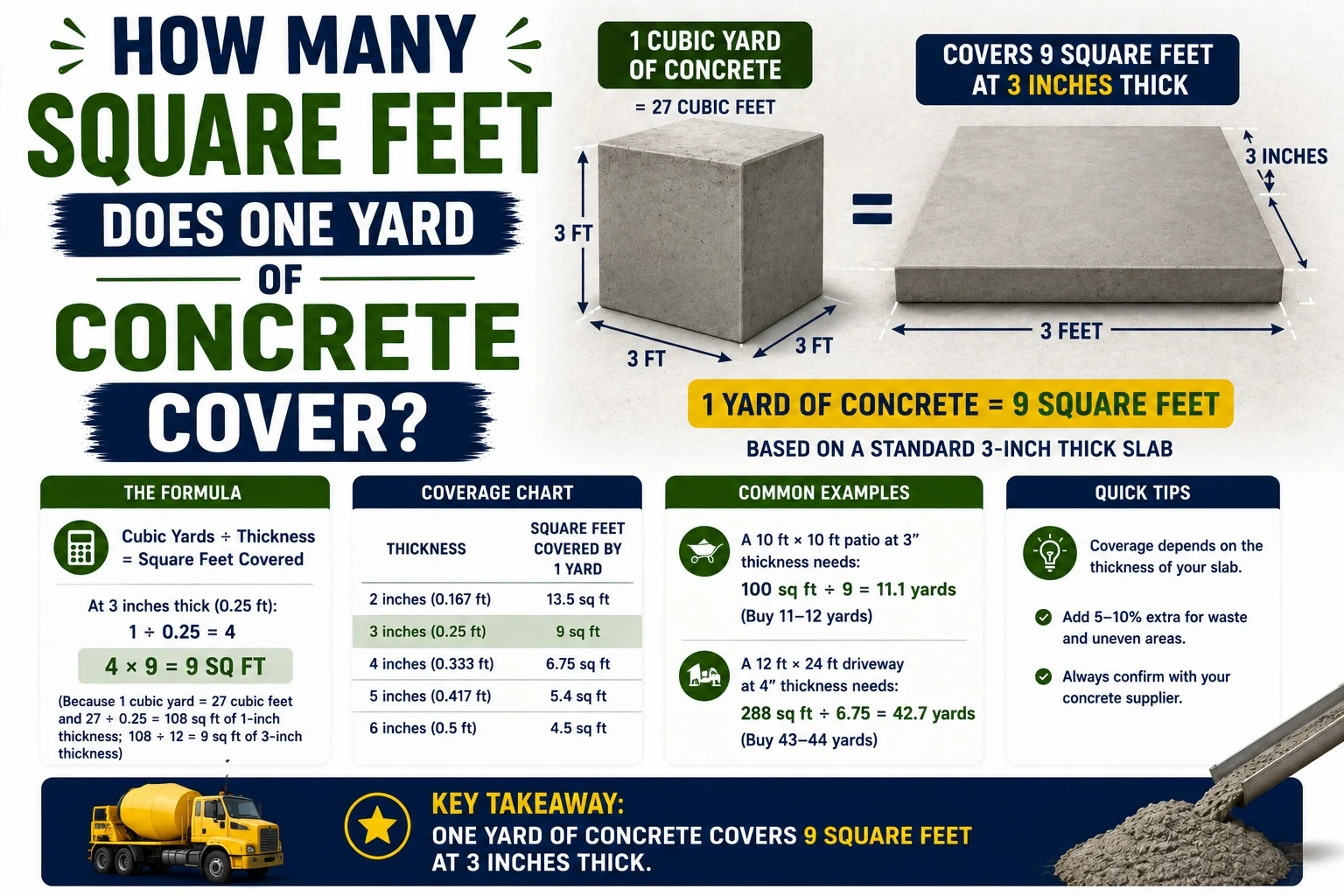
One cubic yard of concrete contains:
1 cubic yard=27 cubic feet
At a thickness of 4 inches (the most common residential slab thickness), one cubic yard covers approximately:
81 square feet
Final Answer
One cubic yard of concrete covers about 81 square feet at a depth of 4 inches.
However, coverage varies significantly depending on slab thickness.
Understanding Concrete Measurements
Concrete is sold by volume.
Contractors and ready-mix suppliers measure concrete in:
- Cubic yards
- Cubic feet
Most residential and commercial projects use cubic yards.
What Is a Cubic Yard?
A cubic yard is a cube measuring:
- 3 feet long
- 3 feet wide
- 3 feet high
Volume calculation:
3×3×3=27 cubic feet
Therefore:
One cubic yard equals 27 cubic feet.
Why Coverage Depends on Thickness
Concrete coverage is calculated using volume.
Since a cubic yard always contains:
27 cubic feet
the thickness determines how much area that volume can spread across.
A thinner slab covers more area.
A thicker slab covers less area.
The Basic Coverage Formula
To calculate coverage:
Coverage Area=ThicknessVolume
When using feet for thickness:
Area equals cubic feet divided by slab depth.
Coverage at 4 Inches Thick
Four inches is the most common thickness for:
- Patios
- Sidewalks
- Residential slabs
Convert thickness:
4 inches=124=0.333 feet
Coverage:
27÷0.333≈81 square feet
Result:
One yard covers approximately 81 square feet at 4 inches thick.
Coverage at 3 Inches Thick
Convert thickness:
3 inches=0.25 feet
Coverage:
27÷0.25=108 square feet
Result:
One cubic yard covers approximately 108 square feet.
Coverage at 5 Inches Thick
Convert thickness:
5 inches=0.417 feet
Coverage:
27÷0.417≈64.8 square feet
Result:
Approximately 65 square feet.
Coverage at 6 Inches Thick
Convert:
6 inches=0.5 feet
Coverage:
27÷0.5=54 square feet
Result:
One yard covers about 54 square feet.
Concrete Coverage Chart
| Thickness | Coverage Per Cubic Yard |
|---|---|
| 2 inches | 162 sq ft |
| 3 inches | 108 sq ft |
| 4 inches | 81 sq ft |
| 5 inches | 65 sq ft |
| 6 inches | 54 sq ft |
| 8 inches | 40.5 sq ft |
| 12 inches | 27 sq ft |
This chart is widely used by contractors.
Why 4 Inches Is Common
Residential concrete slabs are frequently poured at:
4 inches
because it provides:
- Good durability
- Cost efficiency
- Adequate strength for foot traffic and light vehicles
This is why many estimates use:
81 square feet per cubic yard
as a quick reference.
Patio Example
Suppose you’re pouring a patio measuring:
- 12 feet × 18 feet
Area:
12×18=216 square feet
At 4 inches thick:
Yards required:
216÷81≈2.67 cubic yards
Contractors would typically order:
3 cubic yards
to allow for waste.
Sidewalk Example
Sidewalk dimensions:
- 4 feet wide
- 40 feet long
Area:
4×40=160 square feet
Concrete needed at 4 inches:
160÷81≈1.98 cubic yards
Result:
About 2 cubic yards.
Garage Slab Example
Garage dimensions:
- 20 feet × 24 feet
Area:
20×24=480 square feet
At 4 inches:
480÷81≈5.93 cubic yards
Order:
Approximately 6 cubic yards.
Driveway Example
Driveway dimensions:
- 20 feet × 40 feet
Area:
20×40=800 square feet
At 6 inches thick:
Coverage per yard:
54 square feet
Concrete required:
800÷54≈14.8 cubic yards
Result:
Approximately 15 cubic yards.
Why Contractors Order Extra Concrete
Concrete calculations are estimates.
Additional concrete accounts for:
- Uneven ground
- Form variations
- Spillage
- Measurement errors
Many contractors add:
- 5% to 10% extra
for safety.
Cost Estimation
Suppose ready-mix concrete costs:
$170 per cubic yard
One yard covers:
81 square feet at 4 inches.
Cost per square foot:
170÷81≈2.10
Material cost:
Approximately $2.10 per square foot
before labor.
Factors Affecting Concrete Needs
Slab Thickness
The biggest factor affecting coverage.
Waste
Projects rarely use every cubic inch efficiently.
Reinforcement
Rebar and wire mesh do not significantly affect volume requirements.
Ground Conditions
Uneven excavation can increase concrete usage.
Common Mistakes
Forgetting Thickness
Many people calculate only area and ignore depth.
Depth is essential.
Ordering Exactly the Calculated Amount
Running short is often more expensive than ordering a little extra.
Mixing Inches and Feet
Always convert thickness to feet before calculating volume.
Ignoring Expansion Areas
Large slabs may require additional material around joints and edges.
Coverage Formula for Any Project
Step 1:
Calculate area.
Area=Length×Width
Step 2:
Convert thickness to feet.
Step 3:
Calculate volume.
Volume=Area×Depth
Step 4:
Convert cubic feet to cubic yards.
Cubic Yards=27Cubic Feet
FAQs
How many square feet does one yard of concrete cover at 4 inches?
Approximately:
81 square feet
How much does one yard cover at 6 inches?
Approximately:
54 square feet
How many cubic feet are in a yard of concrete?
27 cubic feet
Why does coverage vary?
Coverage depends entirely on slab thickness.
Should I order extra concrete?
Most contractors recommend ordering 5–10% extra.
Conclusion
So, how many square feet does one yard of concrete cover?
The most common answer is:
One cubic yard of concrete covers approximately 81 square feet at a thickness of 4 inches.
However, coverage changes with slab depth. At 3 inches thick, a yard covers about 108 square feet, while at 6 inches thick, it covers only about 54 square feet. Understanding the relationship between volume and thickness is essential for accurate project planning, budgeting, and material ordering. Whether you’re pouring a patio, driveway, sidewalk, garage floor, or foundation slab, using the correct coverage calculations ensures your concrete project runs smoothly and efficiently.