

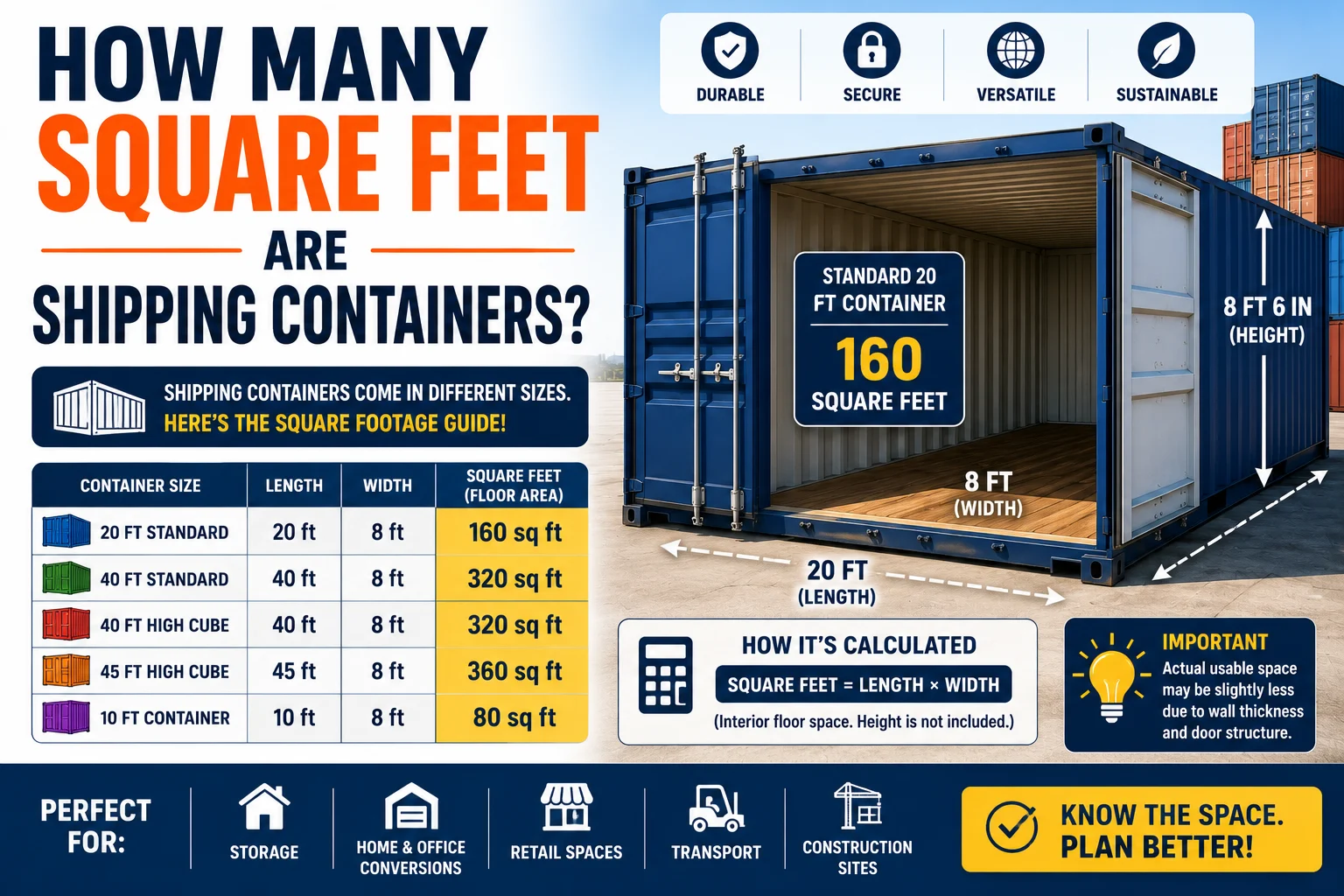
If you’re planning to buy a storage container, build a container home, or compare shipping container sizes, you may be asking how many square feet are shipping containers. The answer depends on the container’s length and width. While shipping containers come in several standard sizes, each offers a different amount of usable floor space.
The most common shipping containers are 10-foot, 20-foot, and 40-foot models. A standard 20-foot shipping container provides about 160 square feet, while a 40-foot container offers approximately 320 square feet of floor area.
In this guide, you’ll learn the square footage, dimensions, and best uses for each container size, along with tips to help you choose the right one.
Quick Answer
Here are the floor areas of the most common shipping container sizes:
| Container Size | Approximate Floor Area |
|---|---|
| 10-foot | 80 sq ft |
| 20-foot | 160 sq ft |
| 40-foot | 320 sq ft |
| 45-foot | 360 sq ft |
A=lw
A=6×4=24
4 rows by 6 columns = 24 square units.
w
w
l
l24 square unitsw = 6l = 4
These figures are based on the standard exterior dimensions. The usable interior floor area is slightly smaller because of the wall thickness.
Standard Shipping Container Sizes
Shipping containers are manufactured to international ISO standards, making them consistent in size and easy to transport worldwide.
10-Foot Shipping Container
A 10-foot shipping container is compact and ideal for small storage needs.
Typical dimensions:
- Length: 10 feet
- Width: 8 feet
Approximate floor area:
10 × 8 = 80 square feet
Common uses include:
- Garden equipment
- Small workshops
- Construction site storage
- Tool storage
20-Foot Shipping Container
The 20-foot container is the most popular size for residential and commercial storage.
Typical dimensions:
- Length: 20 feet
- Width: 8 feet
Floor area:
20 × 8 = 160 square feet
Common uses:
- Household storage
- Small container homes
- Mobile offices
- Retail kiosks
- Equipment storage
40-Foot Shipping Container
A 40-foot container offers twice the floor space of a 20-foot unit.
Typical dimensions:
- Length: 40 feet
- Width: 8 feet
Floor area:
40 × 8 = 320 square feet
These containers are often used for:
- Container homes
- Warehousing
- Commercial storage
- Workshops
- Construction projects
45-Foot Shipping Container
Although less common, 45-foot containers provide additional storage capacity.
Dimensions:
- Length: 45 feet
- Width: 8 feet
Floor area:
45 × 8 = 360 square feet
These are frequently used for large commercial shipments and spacious modular buildings.
Shipping Container Size Chart
| Container | Exterior Dimensions (L × W) | Floor Area |
|---|---|---|
| 10 ft | 10 × 8 ft | 80 sq ft |
| 20 ft | 20 × 8 ft | 160 sq ft |
| 40 ft | 40 × 8 ft | 320 sq ft |
| 45 ft | 45 × 8 ft | 360 sq ft |
This table provides a quick comparison when deciding which container best fits your needs.
Interior vs. Exterior Square Footage
Although shipping containers are often described by their exterior dimensions, the usable interior floor area is slightly smaller due to the thickness of the steel walls and interior framing.
For example:
| Container | Exterior Floor Area | Approximate Interior Floor Area |
|---|---|---|
| 20 ft | 160 sq ft | About 150 sq ft |
| 40 ft | 320 sq ft | About 300 sq ft |
If you’re designing a container home or workspace, always use the interior dimensions for planning.
High Cube Shipping Containers
High cube containers have the same floor area as standard containers but provide an extra foot of interior height.
For example:
- Standard 20-foot container:
- Floor area: 160 sq ft
- Height: 8 ft 6 in
- High cube 20-foot container:
- Floor area: 160 sq ft
- Height: 9 ft 6 in
The extra height creates more storage volume and a more spacious interior, making high cube containers popular for homes and offices.
Common Uses by Container Size
10-Foot Container
Best for:
- Garden storage
- Small business inventory
- Tools and equipment
20-Foot Container
Ideal for:
- Household moves
- Small workshops
- Tiny homes
- Construction sites
40-Foot Container
Commonly used for:
- Large storage projects
- Container houses
- Retail spaces
- Warehouses
- Modular offices
45-Foot Container
Suitable for:
- Commercial freight
- Large modular buildings
- Industrial storage
How to Choose the Right Shipping Container
Selecting the right container depends on your project and available space.
Consider these factors:
- Required floor area
- Height requirements
- Storage volume
- Transportation costs
- Local zoning rules
- Future expansion plans
For most homeowners, a 20-foot container provides enough space for storage while remaining easy to transport.
If you’re planning a container home or office, a 40-foot container offers significantly more living space.
Common Mistakes
Avoid these common errors when comparing shipping containers:
- Confusing floor area with storage volume.
- Using exterior dimensions for interior design.
- Ignoring door clearance.
- Forgetting local permit requirements.
- Underestimating future storage needs.
Taking accurate measurements before purchasing can save time and money.
Expert Tips
- Measure the installation site before ordering a container.
- Choose a high cube container if interior height is important.
- Verify interior dimensions from the manufacturer.
- Leave extra space around the container for access and maintenance.
- Consider insulation if the container will be used as living or office space.
FAQs
1. How many square feet is a 20-foot shipping container?
A standard 20-foot shipping container has approximately 160 square feet of exterior floor space.
2. How many square feet is a 40-foot shipping container?
A standard 40-foot shipping container provides about 320 square feet of floor area.
3. Are shipping container dimensions standardized?
Yes. Most shipping containers follow ISO standards, making their dimensions consistent worldwide.
4. Does a high cube container have more square feet?
No. A high cube container has the same floor area as a standard container but offers one additional foot of interior height.
5. Which shipping container size is best for a tiny home?
A 40-foot shipping container is often preferred because it provides approximately 320 square feet of floor space, making it more suitable for comfortable living.
Conclusion
Understanding how many square feet are shipping containers helps you choose the right size for storage, construction, or residential projects. Standard shipping containers range from 80 square feet for a 10-foot container to 360 square feet for a 45-foot container, with the popular 20-foot and 40-foot models offering 160 and 320 square feet, respectively.
Before purchasing, remember to compare both exterior and interior dimensions, especially if you’re planning a container home or workspace. By selecting the right container size and accounting for usable interior space, you can maximize efficiency and ensure your project meets your storage or living requirements.