
If you’re installing a fence, planting trees, building a driveway, or buying a home, you may wonder how many feet from the road is public property. Many homeowners assume the edge of the pavement marks the beginning of their property, but that’s often not the case.
In reality, there is no single nationwide distance. The amount of land reserved for public use depends on the road’s right-of-way (ROW), local government regulations, and your property’s survey. In many residential areas, the public right-of-way extends 25 to 50 feet from the road’s centerline, although some county roads and highways have much wider rights-of-way.
Understanding where public property ends and private property begins can help you avoid costly mistakes when building, landscaping, or making improvements.
Quick Answer
There is no universal number of feet from the road that is always public property.
Typical public right-of-way widths include:
| Road Type | Typical Right-of-Way Width |
|---|---|
| Residential Street | 40–60 feet |
| Collector Road | 60–80 feet |
| County Road | 60–100 feet |
| State Highway | 80–200+ feet |
Because these measurements are usually taken across the entire width of the road corridor, the public property may extend well beyond the edge of the pavement.
What Is Public Right-of-Way?
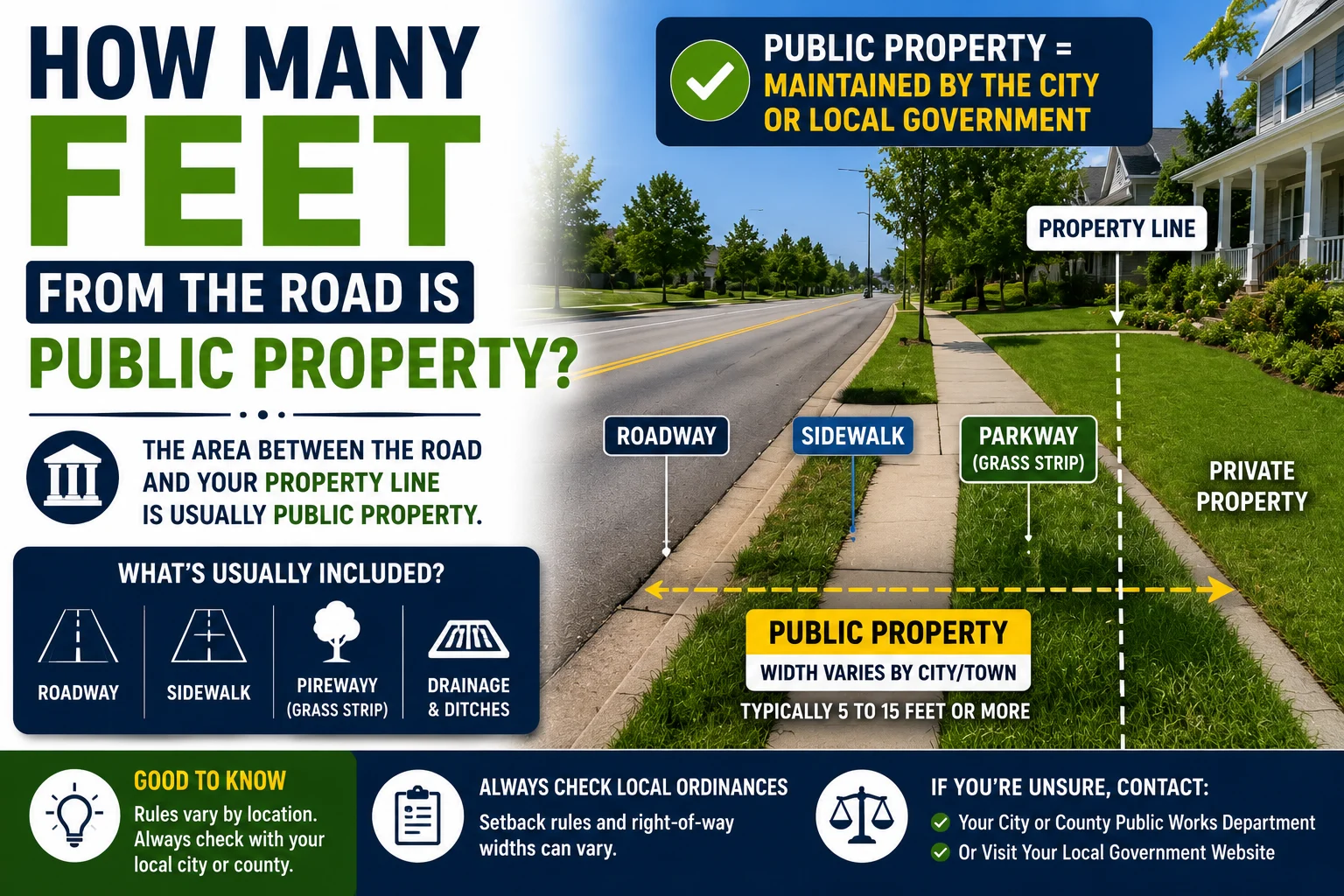
A public right-of-way (ROW) is land reserved for public transportation and utility purposes. It often includes more than just the paved roadway.
A typical right-of-way may contain:
- The road surface
- Shoulders
- Sidewalks
- Curbs
- Drainage ditches
- Utility lines
- Bicycle lanes
- Future road expansion space
In many neighborhoods, the grassy strip between the sidewalk and the street is also part of the public right-of-way, even if the homeowner is responsible for maintaining it.
Public Property vs. Private Property
It’s important to distinguish between ownership and use.
In some cases:
- You may own the land.
- The city or county has a permanent easement allowing public access and utility work.
In other cases:
- The government owns the right-of-way outright.
This is why a utility company may legally access the front portion of your property to repair underground lines.
Why Right-of-Way Exists
Governments reserve roadside land for several reasons:
- Road maintenance
- Snow removal
- Utility installation
- Drainage improvements
- Sidewalk construction
- Future road widening
- Public safety
Without a right-of-way, expanding or maintaining roads would be much more difficult.
Is There a Standard Distance?
No. The public right-of-way varies depending on:
- City regulations
- County regulations
- State transportation standards
- Age of the subdivision
- Road classification
- Property plat
For example:
A neighborhood street may have a 50-foot right-of-way, while a major highway may have a 150-foot or wider right-of-way.
Because the roadway is usually centered within the right-of-way, the public land often extends beyond the pavement on both sides.
Typical Road Right-of-Way Widths
Although every jurisdiction has its own standards, these are common examples.
| Road Type | Typical Total ROW Width |
|---|---|
| Local Residential Street | 40–60 ft |
| Subdivision Street | 50–60 ft |
| Collector Road | 60–80 ft |
| Rural County Road | 60–100 ft |
| State Highway | 80–200+ ft |
| Interstate Highway | 150–300+ ft |
These are general ranges and should not be used to determine your exact property boundary.
How to Find Your Actual Property Line
The only reliable way to determine whether land near the road is public or private is to verify your property’s legal boundaries.
Review Your Property Survey
A professional land survey shows:
- Property corners
- Boundary lines
- Easements
- Right-of-way lines
This is the most accurate source of information.
Check Your Deed or Plat Map
Your property deed or subdivision plat may identify:
- Road right-of-way
- Utility easements
- Setback requirements
- Lot dimensions
Use County GIS Maps
Many counties provide online GIS property maps that display parcel boundaries and public rights-of-way. These maps are useful for preliminary research but may not be as precise as a survey.
Contact Your Local Public Works Department
If you’re planning to build near the road, your local public works or transportation department can often tell you the official right-of-way width for your street.
Can You Build Near the Road?
It depends on both the right-of-way and local setback requirements.
Many municipalities prohibit structures such as:
- Permanent fences
- Retaining walls
- Garages
- Sheds
- Decks
within the public right-of-way.
Even if the land appears to be part of your front yard, building there without approval could result in fines or removal orders.
Always obtain the necessary permits before starting construction.
Common Misunderstandings
Many homeowners mistakenly believe:
- The edge of the pavement marks their property line.
- The sidewalk always marks the property boundary.
- They own everything they mow.
- The city cannot access the grassy strip near the road.
In reality, public rights-of-way and easements often extend beyond visible road features.
Expert Tips
To avoid disputes and unexpected expenses:
- Review your property survey before installing fences or landscaping.
- Contact your local building department before digging.
- Don’t assume roadside grass is entirely private property.
- Verify utility easements before planting large trees.
- Obtain permits when building near roads or sidewalks.
These simple steps can prevent legal issues and protect your investment.
FAQs
1. How many feet from the road is public property?
There is no universal distance. Public right-of-way widths commonly range from 40 to 100 feet on local roads and can be much wider along highways.
2. Does the public right-of-way start at the edge of the pavement?
Not necessarily. In many areas, the right-of-way extends beyond the pavement to include sidewalks, shoulders, drainage areas, and utility corridors.
3. How can I find my property’s exact boundary?
The most accurate method is to review a professional land survey or consult your property’s deed and plat map.
4. Can I plant trees or build a fence near the road?
You may need approval if the work is within the public right-of-way or a utility easement. Always check local regulations before beginning construction.
5. Who owns the grass between the sidewalk and the street?
Ownership varies by location. In some communities, homeowners own the land but the local government has a public easement. In others, the municipality owns it outright.
Conclusion
Understanding how many feet from the road is public property is important before installing fences, planting trees, or beginning any construction near the street. While many people look for a single measurement, there is no nationwide standard. The amount of public land depends on the road’s right-of-way, local regulations, and your property’s legal survey.
In many residential neighborhoods, rights-of-way range from 40 to 60 feet wide, while county roads and highways may have significantly wider corridors. To determine your exact property boundary, rely on a professional survey, your deed, or local government records rather than estimating from the edge of the pavement. This approach helps ensure your project stays within legal property lines and avoids costly disputes.