
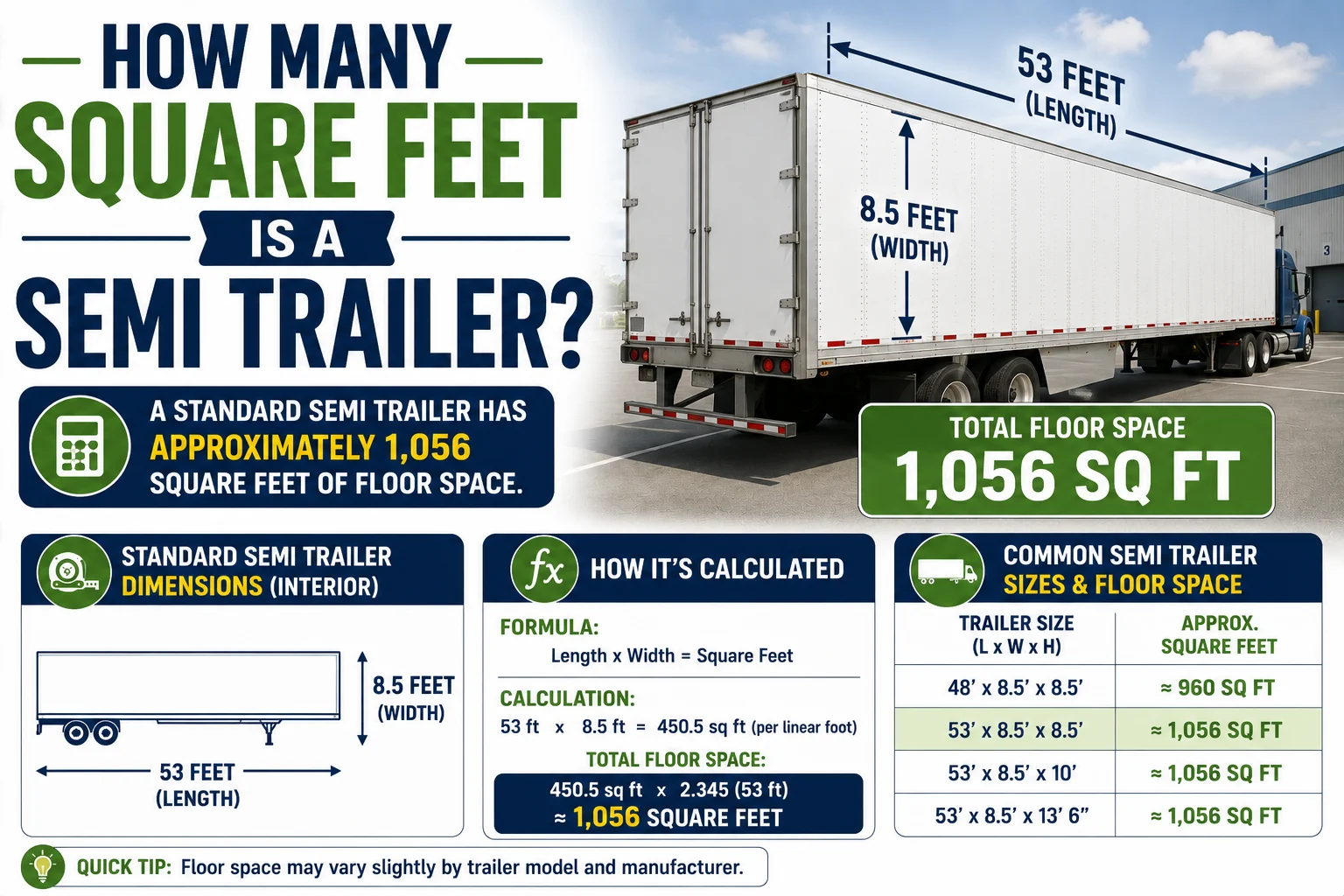
If you’re wondering how many square feet is a semi trailer, the answer depends mainly on the trailer’s length and width.
A common 53-foot semi-trailer is approximately 8.5 feet wide externally, which gives a simple footprint of:
53 × 8.5 = 450.5 square feet
However, the actual usable interior floor area is somewhat smaller because interior width is less than the exterior width, and the interior length may also differ slightly from the advertised overall length.
For example, a typical 53-foot dry van may have an interior width of around 8.2 feet. Using an illustrative 53-foot interior length:
53 × 8.2 = 434.6 square feet
So, a typical 53-foot trailer may provide roughly 430–450 square feet of floor area, depending on its exact dimensions and construction.
Smaller trailers have less space. A 48-foot trailer may provide around 390–410 square feet, while a 28-foot trailer may provide roughly 225–240 square feet.
This guide explains how to calculate semi-trailer square footage, compares common trailer sizes, and explains why floor area is different from cargo volume and weight capacity.
Quick Answer: How Many Square Feet Is a Semi Trailer?
A standard semi-trailer does not have one universal square-foot measurement because trailers come in different lengths and configurations.
Here are approximate examples:
| Trailer Length | Approx. Width | Approx. Footprint |
|---|---|---|
| 28 ft | 8.5 ft | 238 sq ft |
| 40 ft | 8.5 ft | 340 sq ft |
| 45 ft | 8.5 ft | 382.5 sq ft |
| 48 ft | 8.5 ft | 408 sq ft |
| 53 ft | 8.5 ft | 450.5 sq ft |
These calculations use the trailer’s overall length and nominal exterior width.
The usable interior floor area is usually smaller.
For a typical 53-foot dry van, a reasonable general estimate is approximately 430–450 square feet of floor space, depending on the specific trailer.
What Is a Semi Trailer?
A semi-trailer is a cargo trailer designed to be pulled by a tractor unit.
Unlike a full trailer, a semi-trailer doesn’t have a complete front axle arrangement supporting its entire weight. Part of its weight is supported by the tractor through the fifth-wheel connection.
Semi-trailers are used to transport:
- Packaged goods
- Food products
- Furniture
- Building materials
- Machinery
- Retail products
- Palletized freight
- Industrial equipment
Different trailer types have different dimensions and usable floor areas.
Common types include:
- Dry van trailers
- Refrigerated trailers
- Flatbed trailers
- Step-deck trailers
- Specialized trailers
When people ask about the square footage of a semi-trailer, they’re usually referring to the enclosed floor area of a dry van or refrigerated trailer.
How Do You Calculate the Square Feet of a Semi Trailer?
The basic formula is:
Square feet = Length × Width
For example, suppose a trailer is:
- 53 feet long
- 8.5 feet wide
The calculation is:
53 × 8.5 = 450.5 square feet
Therefore, its exterior footprint is approximately 450.5 square feet.
However, this is not necessarily the amount of usable cargo floor space.
For a more accurate estimate, use the trailer’s interior length and interior width.
How Many Square Feet Is a 53-Foot Semi Trailer?
A 53-foot trailer is one of the most common long trailer configurations in North American freight transportation.
Using an exterior width of approximately 8.5 feet:
53 × 8.5 = 450.5 square feet
So the exterior footprint is about 450.5 square feet.
The usable interior floor area is lower.
For example, if the interior is approximately 53 feet long and 8.2 feet wide:
53 × 8.2 = 434.6 square feet
That gives an approximate interior floor area of 435 square feet.
The exact figure depends on the manufacturer, trailer design, wall thickness, doors, interior fittings, and other construction details.
How Many Square Feet Is a 48-Foot Semi Trailer?
A 48-foot trailer with an exterior width of 8.5 feet has:
48 × 8.5 = 408 square feet
Therefore, its approximate exterior footprint is 408 square feet.
If the interior width is approximately 8.2 feet:
48 × 8.2 = 393.6 square feet
So the usable interior floor area may be around 394 square feet, depending on the actual trailer.
This makes a 48-foot trailer somewhat smaller than a 53-foot trailer.
How Many Square Feet Is a 40-Foot Semi Trailer?
A 40-foot trailer with an 8.5-foot exterior width has:
40 × 8.5 = 340 square feet
Therefore, the exterior footprint is approximately 340 square feet.
If the interior width is approximately 8.2 feet:
40 × 8.2 = 328 square feet
So the interior floor area could be approximately 328 square feet.
Always use the manufacturer’s actual interior measurements when determining cargo space.
How Many Square Feet Is a 28-Foot Semi Trailer?
A 28-foot trailer with an 8.5-foot width has:
28 × 8.5 = 238 square feet
Therefore, its exterior footprint is approximately 238 square feet.
Using an illustrative interior width of 8.2 feet:
28 × 8.2 = 229.6 square feet
That gives approximately 230 square feet of interior floor area.
These shorter trailers are often used in applications where a full-length 48- or 53-foot trailer isn’t practical.
Semi Trailer Square Footage Chart
Here’s a quick comparison using an approximate 8.5-foot exterior width:
| Trailer Length | Approx. Exterior Area |
| 28 ft | 238 sq ft |
| 32 ft | 272 sq ft |
| 36 ft | 306 sq ft |
| 40 ft | 340 sq ft |
| 45 ft | 382.5 sq ft |
| 48 ft | 408 sq ft |
| 53 ft | 450.5 sq ft |
These are mathematical footprint calculations, not guaranteed usable cargo areas.
Exterior Square Feet vs. Interior Square Feet
This distinction is important.
When someone says a trailer is 53 feet long and 8.5 feet wide, those measurements commonly describe the trailer’s overall dimensions.
The cargo area inside the trailer is smaller.
Interior dimensions can be reduced by:
- Wall thickness
- Door structures
- Interior panels
- Refrigeration equipment
- Wheel-well configurations
- Bulkheads
- Other equipment
For cargo planning, always use the interior dimensions supplied by the trailer manufacturer or carrier.
How Much Floor Space Does a 53-Foot Trailer Have?
A typical 53-foot dry van provides approximately 430–450 square feet of floor area, depending on the exact interior dimensions.
A commonly used approximate interior size might be:
- Length: about 52–53 feet
- Width: about 8.2 feet
- Height: around 8.5–9 feet
For example:
52.5 × 8.2 = 430.5 square feet
This is a useful planning estimate.
However, the actual usable area can differ.
If you’re loading freight, the trailer’s loadable floor dimensions and pallet configuration are more useful than a simple square-foot estimate.
How Many Pallets Fit in a Semi Trailer?
Square footage alone doesn’t determine how many pallets can fit.
Pallet dimensions and loading patterns matter.
For example, a common standard pallet measures approximately:
48 × 40 inches
That equals:
4 × 3.333 feet
or approximately:
13.33 square feet
A 53-foot trailer has enough floor area for many pallets, but you can’t simply divide total square footage by pallet area because pallets must be arranged within the trailer’s actual width and length.
A common 53-foot dry van can often accommodate approximately 26 standard 48×40-inch pallets, depending on pallet orientation, freight dimensions, loading restrictions, and the specific trailer.
The actual number can vary.
Why Pallet Count Isn’t the Same as Square Footage
Suppose a trailer has approximately 435 square feet of interior floor area.
If a pallet occupies about 13.33 square feet:
435 ÷ 13.33 ≈ 32.6
You might incorrectly conclude that more than 32 pallets can fit.
But that doesn’t account for the trailer’s rectangular shape.
Pallets cannot be cut into pieces or arranged arbitrarily. Their dimensions must fit the trailer’s width and length.
This is why real-world pallet capacity can be lower than a simple area calculation suggests.
How Much Cargo Volume Does a Semi Trailer Have?
Square footage only describes the floor area.
A trailer also has height, so its total internal space is measured in cubic feet.
The formula is:
Cubic feet = Length × Width × Height
For example, using illustrative dimensions of:
- 53 feet long
- 8.2 feet wide
- 8.5 feet high
The approximate volume would be:
53 × 8.2 × 8.5 = 3,687.7 cubic feet
So the trailer could have roughly 3,688 cubic feet of interior volume under these assumptions.
Actual usable volume varies by trailer type and dimensions.
Square Feet vs. Cubic Feet in a Semi Trailer
These two measurements answer different questions.
Square Feet
Measures the floor area.
Useful for:
- Pallet planning
- Floor loading
- Flooring calculations
- Layout planning
Cubic Feet
Measures three-dimensional cargo volume.
Useful for:
- Boxes
- Lightweight bulky freight
- Storage planning
- Capacity calculations
For example, a trailer may have approximately 435 square feet of floor space but several thousand cubic feet of total interior volume.
Does Trailer Type Affect Square Footage?
Yes.
Different semi-trailers have different dimensions and designs.
Dry Van
A dry van is an enclosed trailer commonly used for general freight.
It typically provides a large rectangular cargo area.
Refrigerated Trailer
A refrigerated trailer, often called a reefer, also has an enclosed cargo area but includes insulation and refrigeration equipment.
The interior dimensions can differ from those of a dry van.
Flatbed Trailer
A flatbed has an open deck.
Its floor area can be calculated from deck length and width, but there is no enclosed cargo volume.
Step-Deck Trailer
A step-deck trailer has different deck levels, so the usable floor area depends on the configuration.
Specialized Trailer
Tankers, lowboys, auto haulers, and other specialized trailers have unique shapes and capacities.
Therefore, there is no single square-foot measurement for every semi-trailer.
What Is the Standard Width of a Semi Trailer?
Many standard North American semi-trailers are approximately 8.5 feet wide externally.
The usable interior width is typically narrower.
A commonly encountered interior width is around 8.2 feet, although exact specifications vary.
This difference matters when loading:
- Pallets
- Machinery
- Large boxes
- Furniture
- Construction materials
Always check the trailer’s actual interior width before planning a load.
What Is the Standard Height of a Semi Trailer?
Trailer height varies by design.
A typical dry van may have an interior height of roughly 8.5 to 9 feet, although some trailers have higher or lower clearances.
The exterior height is greater because it includes:
- Roof structure
- Flooring
- Chassis
- Other components
When transporting tall cargo, use the actual interior clearance, not the trailer’s exterior height.
Can a Semi Trailer Be Used as Storage?
Yes, an unused or stationary trailer can provide substantial storage space.
A 53-foot trailer may offer approximately 430–450 square feet of floor area, depending on its interior dimensions.
That’s comparable to the floor area of a relatively large room or small apartment.
However, using a trailer for permanent storage can involve:
- Zoning requirements
- Property restrictions
- Fire regulations
- Local permits
- Security considerations
- Structural concerns
Check local rules before placing a trailer on private property for long-term storage.
Can You Turn a Semi Trailer Into a Living Space?
People sometimes convert trailers or shipping containers into alternative living or workspace structures.
A 53-foot trailer can provide a surprisingly large floor area.
For example, approximately 430 square feet could potentially accommodate:
- Sleeping areas
- Kitchen space
- Bathroom
- Living area
- Storage
- Office space
However, converting a freight trailer into a legal dwelling is much more complicated than simply adding furniture.
You may need to consider:
- Building codes
- Insulation
- Electrical systems
- Plumbing
- Ventilation
- Fire safety
- Emergency exits
- Heating and cooling
- Zoning
- Foundation or support requirements
Always verify local regulations before starting such a conversion.
How Much More Floor Space Does a 53-Foot Trailer Have Than a 48-Foot Trailer?
Using the same 8.5-foot exterior width:
53-Foot Trailer
53 × 8.5 = 450.5 square feet
48-Foot Trailer
48 × 8.5 = 408 square feet
Difference:
450.5 − 408 = 42.5 square feet
So the 53-foot trailer has approximately 42.5 more square feet of exterior footprint than the 48-foot trailer at the same width.
That additional length can make a meaningful difference when loading freight.
Factors That Affect Usable Trailer Floor Space
The actual usable area can be affected by:
- Trailer walls
- Interior lining
- Doors
- Refrigeration equipment
- Wheel-well structures
- Bulkheads
- Load bars
- Interior partitions
- Floor construction
- Cargo restraints
This is why a mathematical calculation should be considered an estimate rather than an exact cargo-loading specification.
Common Mistakes When Calculating Trailer Square Footage
Mistake 1: Using Exterior Width for Interior Cargo Planning
An 8.5-foot exterior width doesn’t mean you have 8.5 feet of usable interior width.
Mistake 2: Ignoring Trailer Length
A 53-foot trailer and a 48-foot trailer don’t have the same floor area.
Mistake 3: Confusing Floor Area With Cargo Volume
Square feet measure floor area. Cubic feet measure volume.
Mistake 4: Assuming Every 53-Foot Trailer Is Identical
Different manufacturers and trailer types can have different interior dimensions.
Mistake 5: Using Square Footage Alone for Pallet Planning
Pallet orientation and loading patterns determine actual pallet capacity.
Mistake 6: Ignoring Weight Limits
A trailer may have enough physical space for cargo but still be unable to legally carry its weight.
Tips for Calculating a Semi Trailer’s Exact Floor Area
If you need an accurate measurement, follow these steps:
Step 1: Measure the Interior Length
Measure from the usable front wall to the inside of the rear doors.
Step 2: Measure Interior Width
Measure the usable distance between the interior walls.
Step 3: Multiply the Measurements
Use:
Length × Width = Floor Area
Step 4: Account for Permanent Structures
If equipment, partitions, or other structures occupy floor space, subtract their area when necessary.
Step 5: Verify the Manufacturer’s Specifications
For commercial freight planning, manufacturer specifications are preferable to estimates.
Example: Calculating a 53-Foot Trailer’s Floor Area
Suppose a trailer has an interior length of 52.5 feet and an interior width of 8.2 feet.
Calculate:
52.5 × 8.2 = 430.5 square feet
Therefore, the trailer has approximately:
430.5 square feet of interior floor area
If the same trailer were 53 feet long internally:
53 × 8.2 = 434.6 square feet
The difference shows why exact measurements matter.
Frequently Asked Questions
1. How many square feet is a semi trailer?
It depends on the trailer’s length and width. A typical 53-foot semi-trailer has an exterior footprint of about 450.5 square feet, while its usable interior floor area is often around 430–450 square feet, depending on its exact dimensions.
2. How many square feet is a 53-foot semi trailer?
Using a nominal exterior width of 8.5 feet:
53 × 8.5 = 450.5 square feet
The actual interior floor area is smaller and may be around 430–440 square feet, depending on the trailer.
3. How many square feet is a 48-foot trailer?
Using an exterior width of 8.5 feet:
48 × 8.5 = 408 square feet
The actual interior floor area will be somewhat smaller.
4. How many pallets fit in a 53-foot trailer?
A typical 53-foot dry van can often accommodate approximately 26 standard 48×40-inch pallets, depending on pallet orientation, loading arrangement, freight dimensions, and trailer specifications.
5. How do you calculate the square footage of a semi trailer?
Multiply the trailer’s length by its width:
Length × Width = Square Feet
For the most accurate cargo estimate, use the interior length and width rather than exterior dimensions.
Conclusion
So, how many square feet is a semi trailer? There is no single answer because semi-trailers come in several lengths and configurations.
A common 53-foot semi-trailer with an approximate exterior width of 8.5 feet has an exterior footprint of about 450.5 square feet. Its actual interior floor area is generally somewhat smaller, often around 430–450 square feet, depending on the trailer’s exact specifications.
A 48-foot trailer has an approximate exterior footprint of 408 square feet, while a 40-foot trailer has about 340 square feet at the same nominal width.
Remember that floor area isn’t the same as cargo volume. If you need to calculate how much freight a trailer can carry, you also need to consider interior height, pallet dimensions, loading configuration, cargo weight, axle limits, and applicable regulations.
For accurate shipping or loading plans, use the trailer manufacturer’s interior dimensions or the carrier’s specifications rather than relying on a general square-foot estimate.
The simple formula is:
Length × Width = Approximate Floor Area
For a 53-foot trailer:
53 × 8.5 = 450.5 square feet
That makes a standard 53-foot semi-trailer roughly 450 square feet in exterior footprint, with slightly less usable interior floor space.