
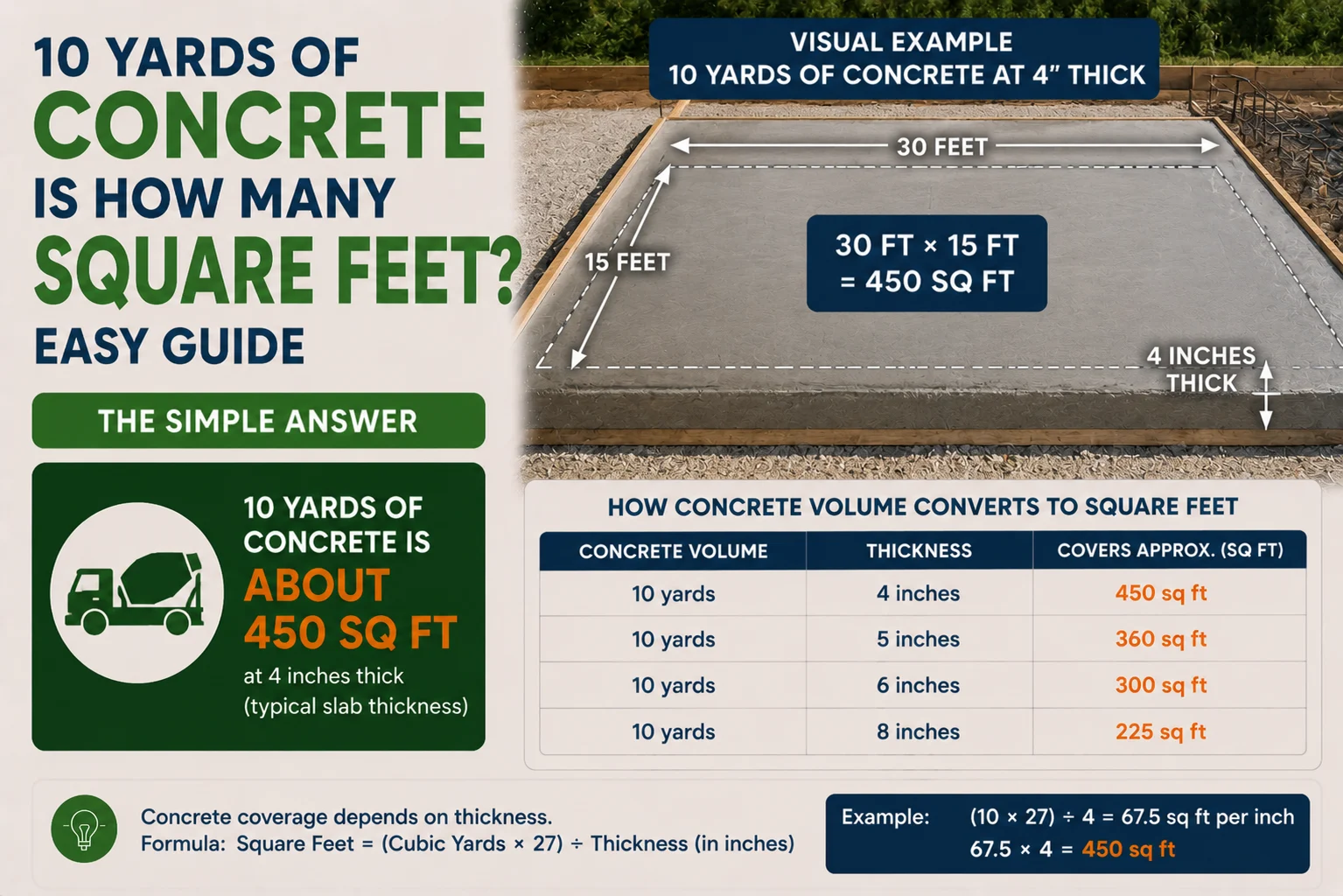
If you are wondering 10 yards of concrete is how many square feet, the answer depends on one important factor: how thick the concrete slab will be.
Concrete is sold by cubic yards, which measure volume. Square feet measure surface area. To convert cubic yards into square feet, you must know the slab thickness in inches.
For the most common residential slab thickness of 4 inches, 10 cubic yards of concrete will cover approximately 810 square feet.
This guide explains the exact formula, coverage by thickness, and practical examples for patios, driveways, sidewalks, and foundations.
Why There Is No Single Answer
A cubic yard measures three-dimensional volume, while square feet measure two-dimensional area.
That means 10 yards of concrete can cover:
- A large area if poured thin
- A smaller area if poured thick
The thicker the slab, the fewer square feet the concrete will cover.
The Most Common Answer: 4-Inch Thick Slab
For many patios, sidewalks, and residential slabs, 4 inches is the standard thickness.
With a 4-inch slab, 10 cubic yards of concrete covers about 810 square feet.
This is the answer most homeowners are looking for when asking, 10 yards of concrete is how many square feet.
Formula to Convert Concrete Yards to Square Feet
The standard formula is:
Square Feet=Thickness in FeetCubic Yards×27
Since 4 inches equals 1/3 of a foot:
1/310×27=810 square feet
Quick Rule of Thumb
At common slab thicknesses, one cubic yard covers:
- 2 inches thick → about 162 sq ft
- 3 inches thick → about 108 sq ft
- 4 inches thick → about 81 sq ft
- 5 inches thick → about 65 sq ft
- 6 inches thick → about 54 sq ft
Multiply these numbers by 10 to find the coverage for 10 cubic yards.
Coverage Chart by Thickness
| Thickness | Coverage for 10 Cubic Yards |
|---|---|
| 2 inches | 1,620 sq ft |
| 3 inches | 1,080 sq ft |
| 4 inches | 810 sq ft |
| 5 inches | 648 sq ft |
| 6 inches | 540 sq ft |
| 8 inches | 405 sq ft |
Real-World Examples
Patio Installation
A backyard patio measuring 27 feet by 30 feet has:
27×30=810 square feet
Ten cubic yards is enough to pour this patio at 4 inches thick.
Driveway
A driveway measuring 18 feet by 45 feet also equals 810 square feet, making 10 yards a good estimate for a standard residential driveway section.
Sidewalk
A 4-foot-wide sidewalk could extend approximately:
810÷4=202.5 feet long
How to Estimate Your Concrete Needs
Step 1: Measure Length and Width
Find the total area in square feet.
Step 2: Decide on Thickness
Typical thicknesses:
- Patio: 4 inches
- Sidewalk: 4 inches
- Driveway: 4–6 inches
- Garage slab: 4–6 inches
- Heavy equipment pads: 6 inches or more
Step 3: Use a Coverage Chart
Match your thickness to the corresponding square footage.
Step 4: Add Extra Concrete
Most contractors order 5% to 10% extra to account for waste, uneven subgrades, and spillage.
Typical Concrete Project Sizes
| Project Type | Common Thickness | Approximate Coverage with 10 Yards |
|---|---|---|
| Patio | 4 inches | 810 sq ft |
| Sidewalk | 4 inches | 810 sq ft |
| Residential Driveway | 5 inches | 648 sq ft |
| Garage Floor | 4 inches | 810 sq ft |
| Workshop Slab | 6 inches | 540 sq ft |
How Much Does 10 Yards of Concrete Weigh?
Concrete weighs roughly 4,000 pounds per cubic yard.
Ten cubic yards can weigh approximately:
- 40,000 pounds
- About 20 tons
This is why ready-mix trucks and proper site preparation are essential.
Cost Considerations
The cost of 10 yards of ready-mix concrete varies by region, mix design, and delivery fees. Contractors typically also factor in labor, reinforcement, finishing, and site preparation.
Because prices change frequently, it is best to request quotes from local suppliers.
Common Mistakes to Avoid
Confusing Cubic Yards with Square Feet
Concrete is purchased by volume, not area.
Ignoring Thickness
A thicker slab covers less area.
Forgetting Waste
Always order a little extra.
Not Accounting for Reinforcement
Rebar or wire mesh does not change coverage, but it does affect total project cost.
Expert Tips
- Double-check all measurements before ordering.
- Round up rather than down.
- Consider thicker slabs for driveways and heavy loads.
- Ask suppliers about minimum delivery requirements.
- Schedule enough labor to place and finish the concrete quickly.
Benefits of Accurate Concrete Estimation
Knowing exactly how much area 10 cubic yards can cover helps you:
- Avoid costly shortages
- Reduce excess material
- Plan budgets more accurately
- Schedule deliveries efficiently
- Complete projects with fewer delays
9. Frequently Asked Questions
1. 10 yards of concrete is how many square feet at 4 inches thick?
Approximately 810 square feet.
2. How many square feet does 10 yards cover at 6 inches thick?
About 540 square feet.
3. Why does slab thickness matter?
Thicker slabs use more concrete per square foot, reducing total coverage.
4. Is 10 yards enough for a patio?
Yes, it can cover a large patio of about 810 square feet at 4 inches thick.
5. Should I order extra concrete?
Yes. Most professionals recommend adding 5% to 10% for waste and uneven grades.
10. Conclusion
So, 10 yards of concrete is how many square feet? The answer depends on slab thickness, but for the most common 4-inch slab, 10 cubic yards of concrete covers approximately 810 square feet.
This amount is enough for a large patio, garage floor, or substantial section of driveway. By understanding how cubic yards and square feet relate, you can estimate materials accurately and avoid expensive mistakes.
When in doubt, measure carefully, choose the correct slab thickness, and order a little extra to ensure your project goes smoothly.