

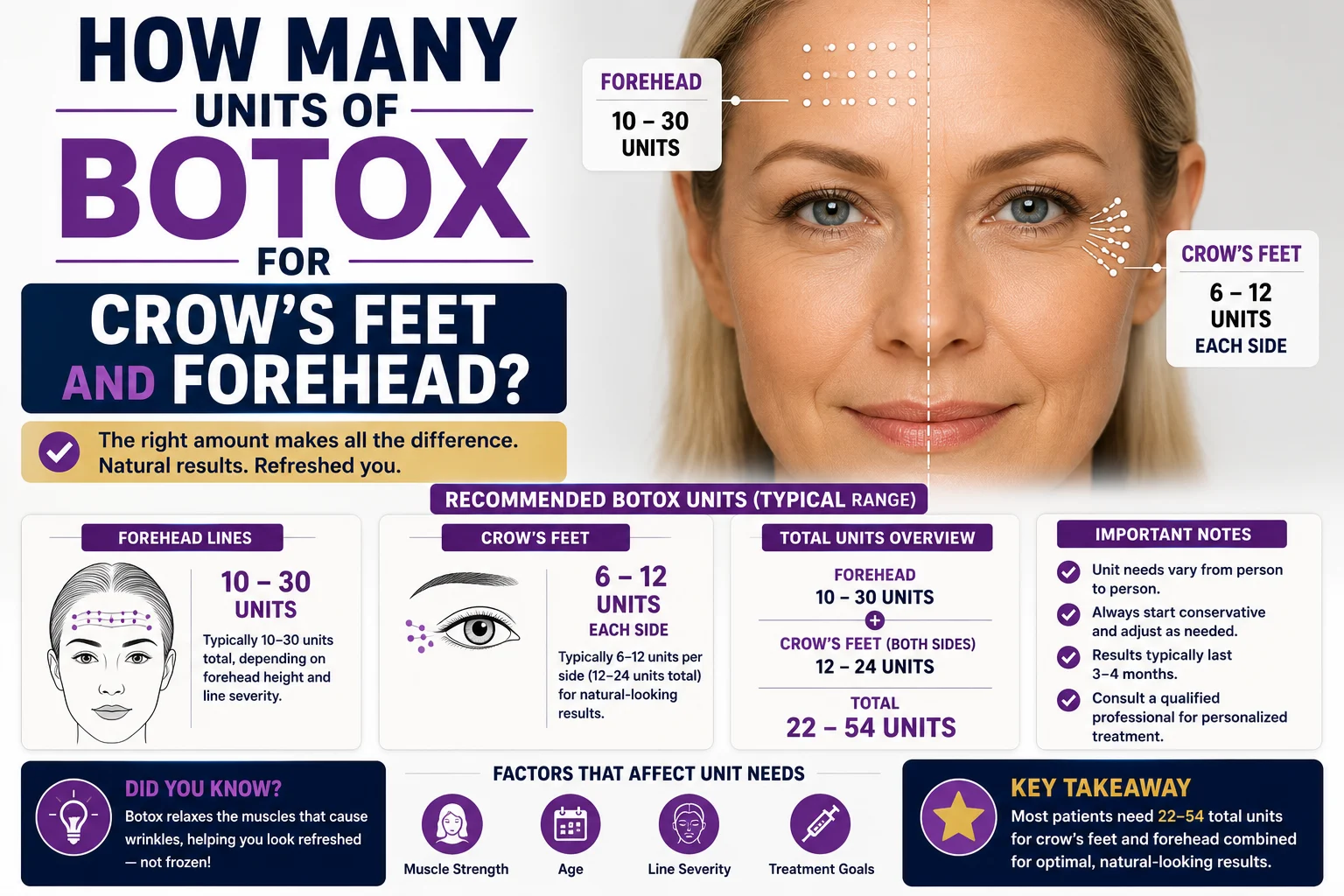
Botox is one of the most popular cosmetic treatments in the world, helping millions of people reduce the appearance of dynamic wrinkles caused by facial expressions. Among the most commonly treated areas are the forehead and crow’s feet, the fine lines that develop around the outer corners of the eyes.
One of the first questions many people ask before scheduling treatment is:
How many units of Botox are needed for crow’s feet and forehead lines?
The answer depends on several factors, including muscle strength, wrinkle severity, age, facial anatomy, treatment goals, and whether you’re seeking a subtle or more dramatic result.
In this comprehensive guide, you’ll learn typical Botox unit ranges for crow’s feet and forehead treatments, how providers determine dosing, what affects results, expected costs, and important considerations before treatment.
Understanding Botox Units
Before discussing specific treatment areas, it’s important to understand what a Botox unit means.
Botox dosing is measured in units, which represent the potency of the medication rather than a volume measurement.
More units generally mean:
- Greater muscle relaxation
- Stronger wrinkle reduction
- Potentially longer-lasting effects
However, more is not always better. The goal is to achieve a natural appearance while preserving facial expression.
What Is Botox?
Botox is the brand name for a purified form of botulinum toxin type A.
The medication works by temporarily reducing muscle activity in targeted areas.
When injected into facial muscles, Botox can soften:
- Forehead lines
- Crow’s feet
- Frown lines
- Bunny lines
- Chin dimpling
- Neck bands
Because dynamic wrinkles are caused by repeated muscle contractions, relaxing those muscles can significantly reduce visible lines.
How Many Units of Botox for Crow’s Feet?
Crow’s feet are the lines that appear at the outer corners of the eyes.
These wrinkles become more visible when:
- Smiling
- Squinting
- Laughing
Typical Botox dosing for crow’s feet is:
6 to 15 units per side
This often results in a total treatment range of:
12 to 30 units total
for both eyes combined.
Common Treatment Range
Many providers use:
24 units
as a standard starting point for bilateral crow’s feet treatment.
However, dosing may be adjusted based on individual anatomy and desired results.
How Many Units of Botox for Forehead Lines?
The forehead develops horizontal lines through repeated eyebrow elevation.
These lines often become more pronounced with age.
Typical forehead treatment requires:
10 to 30 units
depending on:
- Muscle strength
- Forehead size
- Line severity
- Gender
- Treatment goals
Many patients receive:
10 to 20 units
for moderate forehead wrinkles.
Combined Botox for Crow’s Feet and Forehead
When treating both areas during the same appointment, total Botox requirements typically range from:
22 to 60 units
A common treatment plan may include:
Forehead
15–20 units
Crow’s Feet
12–24 units
Combined total:
27 to 44 units
This range is frequently used in cosmetic practice.
Why Botox Dosage Varies
No two patients receive exactly the same number of units.
Several factors influence dosing decisions.
Muscle Strength
Individuals with stronger facial muscles often require more units.
Examples include:
- Frequent facial expressions
- Larger muscle groups
- Long-term muscle activity
Wrinkle Severity
Deeper wrinkles may require additional units for optimal improvement.
Gender
Men often require higher doses because facial muscles are typically larger and stronger.
For example:
- Women may require 10–20 forehead units.
- Men may require 20–30 forehead units.
Desired Appearance
Some patients prefer:
- Natural movement
- Soft wrinkle reduction
Others prefer:
- Maximum smoothing
- Minimal muscle activity
Treatment plans are customized accordingly.
Botox and Facial Balance
Experienced injectors rarely treat one area in isolation.
The forehead and surrounding muscles work together.
For example:
- Forehead muscles lift eyebrows.
- Frown muscles pull eyebrows downward.
Proper balance helps prevent:
- Drooping brows
- Uneven appearance
- Overly frozen results
This is why Botox treatment often involves multiple facial regions.
What Happens During Treatment?
A typical appointment lasts:
- 10–20 minutes
The process generally includes:
Consultation
The provider evaluates:
- Facial anatomy
- Wrinkle patterns
- Muscle movement
Injection Mapping
Specific injection points are selected.
Treatment
Small amounts of Botox are injected using fine needles.
Most patients experience minimal discomfort.
When Do Results Appear?
Botox does not work immediately.
Typical timeline:
Days 1–3
Minimal visible changes.
Days 4–7
Muscles begin relaxing.
Days 10–14
Most results become noticeable.
Two Weeks
Full effect is usually achieved.
How Long Does Botox Last?
Results generally last:
3 to 4 months
Some patients experience:
- Longer duration
- Shorter duration
depending on metabolism and muscle activity.
Average Botox Costs
Pricing is often based on units used.
Typical pricing ranges:
- $10–$20 per unit
Example:
30 units at $15 per unit:
30×15=450
Estimated cost:
$450
Costs vary by location and provider expertise.
Benefits of Treating Crow’s Feet
Crow’s feet treatment may provide:
- Smoother skin
- More youthful appearance
- Reduced eye-area wrinkles
- Refreshed facial expression
Many patients report looking less tired after treatment.
Benefits of Treating Forehead Lines
Forehead Botox may help:
- Reduce horizontal wrinkles
- Prevent deeper line formation
- Improve overall facial smoothness
- Create a rejuvenated appearance
Can Botox Prevent Wrinkles?
Many younger adults use Botox preventively.
The theory is simple:
- Reduced muscle movement
- Less repetitive folding of skin
- Slower wrinkle development
Preventive Botox has become increasingly popular among adults in their twenties and thirties.
Potential Side Effects
Most side effects are mild and temporary.
Possible reactions include:
- Redness
- Swelling
- Bruising
- Mild tenderness
Rare complications may include:
- Eyelid drooping
- Uneven results
- Headache
Choosing an experienced injector helps minimize risks.
Who Is a Good Candidate?
Botox may be suitable for adults seeking treatment of:
- Forehead lines
- Crow’s feet
- Dynamic facial wrinkles
Candidates should have realistic expectations and good overall health.
Alternatives to Botox
Other cosmetic treatments may include:
Dermal Fillers
Used primarily for volume loss rather than muscle-related wrinkles.
Laser Treatments
Can improve skin texture and pigmentation.
Microneedling
Promotes collagen production.
Skin Care Products
Retinoids and sunscreen may help prevent wrinkle progression.
Frequently Asked Questions
How many units of Botox are used for crow’s feet?
Typically:
12–30 units total
for both sides.
How many units are used for forehead lines?
Typically:
10–30 units
depending on muscle activity and treatment goals.
How many units are needed for both areas together?
Many patients receive:
25–45 units total
although requirements vary.
Does more Botox mean better results?
Not necessarily.
The goal is balanced, natural-looking muscle relaxation.
How long do results last?
Most treatments last:
3–4 months.
Choosing the Right Injector
Successful Botox treatment depends heavily on provider expertise.
Look for:
- Proper medical credentials
- Extensive injection experience
- Strong patient reviews
- Before-and-after examples
- Thorough consultations
A skilled injector customizes treatment rather than relying on fixed dosing formulas.
Conclusion
So, how many units of Botox are typically needed for crow’s feet and forehead lines?
Most patients receive approximately 12–30 units for crow’s feet and 10–30 units for forehead lines, resulting in a combined treatment range of roughly 22–60 units. The exact number depends on factors such as muscle strength, wrinkle severity, facial anatomy, age, gender, and desired results.
Botox remains one of the most effective non-surgical treatments for reducing dynamic wrinkles and creating a smoother, more youthful appearance. Because every face is unique, the best way to determine the ideal number of units is through a consultation with a qualified medical professional who can develop a personalized treatment plan tailored to your goals and facial structure.