

Whether you’re measuring a trail, estimating distances while hiking, learning military land navigation, or simply curious about traditional measurement methods, you’ve probably encountered the term pace. One of the most common questions people ask is:
How many feet are in a pace?
The answer is not always straightforward because the length of a pace can vary depending on the person, purpose, and context. In everyday usage, a pace is often considered a single step, while in surveying and military navigation, a pace may represent two steps.
Understanding the difference can help you make more accurate distance estimates and avoid confusion when reading maps, measuring land, or following navigation instructions.
In this comprehensive guide, you’ll learn what a pace is, how many feet are in a pace, the history of pacing, common applications, conversion methods, and practical examples.
Quick Answer
In general:
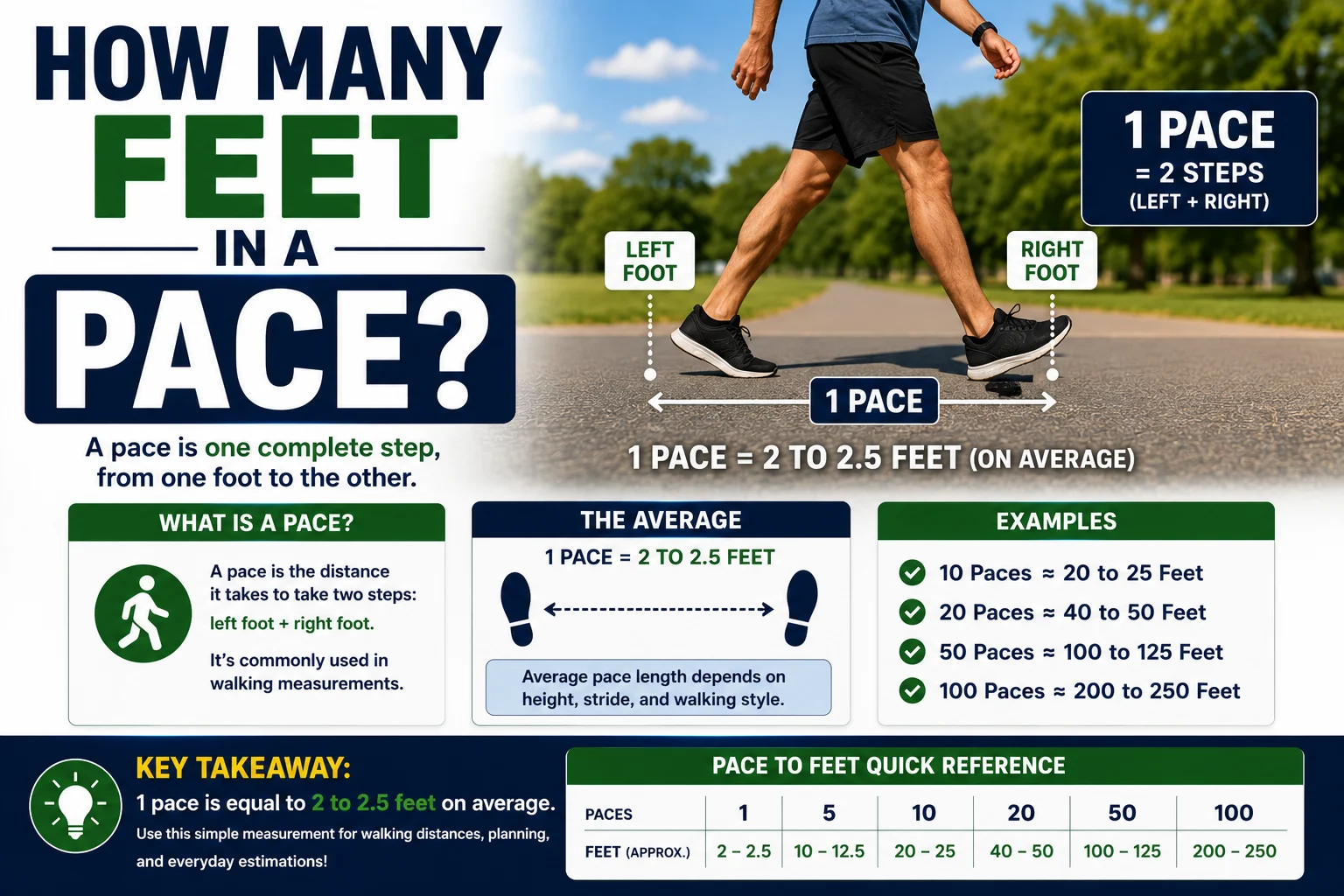
One pace is approximately 2.5 to 3 feet.
A commonly accepted average is:
1 pace≈2.5 feet
However, the exact distance depends on:
- Individual stride length
- Walking speed
- Measurement purpose
- Terrain conditions
What Is a Pace?
A pace is a unit of distance based on human walking movement.
Historically, people measured distances using their steps long before standardized measuring tools existed.
A pace generally refers to:
The distance covered during one natural walking step or stride.
Because human movement varies, pace length is not universally fixed.
Historical Origins of the Pace
The concept of pacing dates back thousands of years.
Ancient civilizations used body-based measurements such as:
- Foot
- Cubit
- Hand
- Pace
The Roman Empire used a measurement known as the passus, meaning “step.”
A Roman passus consisted of:
- Two consecutive steps
and measured approximately:
5 Roman feet
This historical measurement influenced many modern distance estimation methods.
Standard Pace Length
Most references define an average pace as approximately:
2.5 feet
This value is widely used for rough calculations and everyday distance estimation.
For example:
10 paces would equal:
10×2.5=25 feet
Pace vs. Step
Many people use the terms interchangeably, but there can be important differences.
Step
A step is the movement from one foot to the other.
Pace
In some systems, a pace represents a complete stride, meaning:
- Left foot to left foot
- Right foot to right foot
This distinction becomes important in surveying and military applications.
Military Pace Measurement
Military land navigation often uses pacing to estimate travel distance.
In many military systems:
One pace equals two steps.
This measurement is commonly called a pace count.
A military pace typically averages:
5 feet
although it varies by individual.
Soldiers often determine their personal pace length through training exercises.
Surveying and Land Measurement
Before modern GPS technology, surveyors frequently relied on pacing.
Even today, pacing remains useful for:
- Preliminary measurements
- Property inspections
- Field assessments
- Outdoor navigation
Surveyors often calculate their individual pace length for improved accuracy.
Average Human Stride Length
Stride length varies significantly among individuals.
Adult Men
Average stride length:
2.5 to 2.8 feet
Adult Women
Average stride length:
2.2 to 2.5 feet
Children
Stride lengths are generally shorter and vary with age.
Factors That Affect Pace Length
Several variables influence the length of a pace.
Height
Taller individuals typically have longer strides.
Walking Speed
Faster walking often increases stride length.
Terrain
Uneven ground tends to shorten paces.
Fitness Level
Athletic individuals may naturally take longer strides.
Age
Stride length often changes throughout life.
How to Measure Your Own Pace
Determining your personal pace length is relatively simple.
Step 1
Measure a known distance.
For example:
100 feet
Step 2
Walk the distance at a natural pace.
Step 3
Suppose you take:
40 paces
Step 4
Calculate pace length:
100÷40=2.5 feet per pace
You now know your average pace length.
Converting Paces to Feet
The basic formula is:
Feet=Paces×Pace Length
Using an average pace of 2.5 feet:
10 Paces
10×2.5=25 feet
50 Paces
50×2.5=125 feet
100 Paces
100×2.5=250 feet
Converting Feet to Paces
The reverse formula is:
Paces=Feet÷Pace Length
Example:
Convert 200 feet using a 2.5-foot pace:
200÷2.5=80 paces
Common Applications of Pacing
Hiking
Hikers use pacing to estimate trail distances.
Hunting
Hunters often pace distances to landmarks.
Camping
Pacing helps measure campsite layouts.
Construction
Contractors may use pacing for rough measurements.
Landscaping
Landscape designers sometimes estimate distances using paces before detailed measurements.
Advantages of Using Paces
No Equipment Needed
You always have your feet available.
Quick Estimates
Pacing provides immediate distance estimates.
Useful Outdoors
Works well where measuring tapes are impractical.
Helpful Backup Method
Useful when electronic devices fail.
Limitations of Pacing
Although convenient, pacing is not perfectly accurate.
Human Variation
Stride lengths change naturally.
Terrain Changes
Hills and obstacles affect pace length.
Fatigue
Tired individuals often shorten their stride.
Environmental Conditions
Mud, snow, and uneven surfaces impact accuracy.
Military Pace Count Example
Suppose a soldier determines:
- One pace = 5 feet
If they count:
120 paces
Distance traveled:
120×5=600 feet
This method is commonly used in land navigation exercises.
Pace Compared to Other Measurements
| Unit | Equivalent Feet |
|---|---|
| 1 Foot | 1 Foot |
| 1 Yard | 3 Feet |
| 1 Pace (average) | 2.5 Feet |
| 1 Military Pace | ~5 Feet |
| 1 Mile | 5,280 Feet |
This comparison helps place pace measurements in context.
How Many Paces in a Mile?
Using an average pace of:
2.5 feet
Calculation:
5280÷2.5=2112 paces
Approximately:
2,112 paces per mile
for the average walker.
FAQs
How many feet are in one pace?
Typically:
2.5 to 3 feet
for a single pace.
Is a pace the same as a yard?
Not exactly.
A yard equals:
3 feet
while a pace is often around 2.5 feet.
How many feet is a military pace?
Many military systems use a pace of approximately:
5 feet
representing two steps.
Can I use pacing for land measurement?
Yes, but pacing is best for rough estimates rather than precise surveys.
How accurate is pacing?
Accuracy depends on:
- Consistent stride length
- Terrain conditions
- Experience
Many people achieve surprisingly reliable estimates with practice.
Tips for More Accurate Pacing
Measure Your Pace Length
Know your average stride distance.
Practice Regularly
Consistency improves accuracy.
Maintain a Natural Walking Speed
Avoid exaggerating your stride.
Recalibrate on Different Terrain
Your pace length may change on hills or uneven ground.
Double-Check Important Measurements
Use measuring tools when precision is required.
Conclusion
So, how many feet are in a pace?
The most commonly accepted answer is:
One pace equals approximately 2.5 feet.
However, pace length varies depending on the individual, walking conditions, and measurement system being used. In military navigation, a pace may represent two steps and average about 5 feet, while everyday pacing typically ranges from 2.5 to 3 feet. Despite the availability of GPS devices and laser measuring tools, pacing remains a practical, reliable, and time-tested method for estimating distances in hiking, surveying, construction, landscaping, and outdoor navigation. By understanding your own pace length and practicing regularly, you can quickly and effectively estimate distances almost anywhere.