
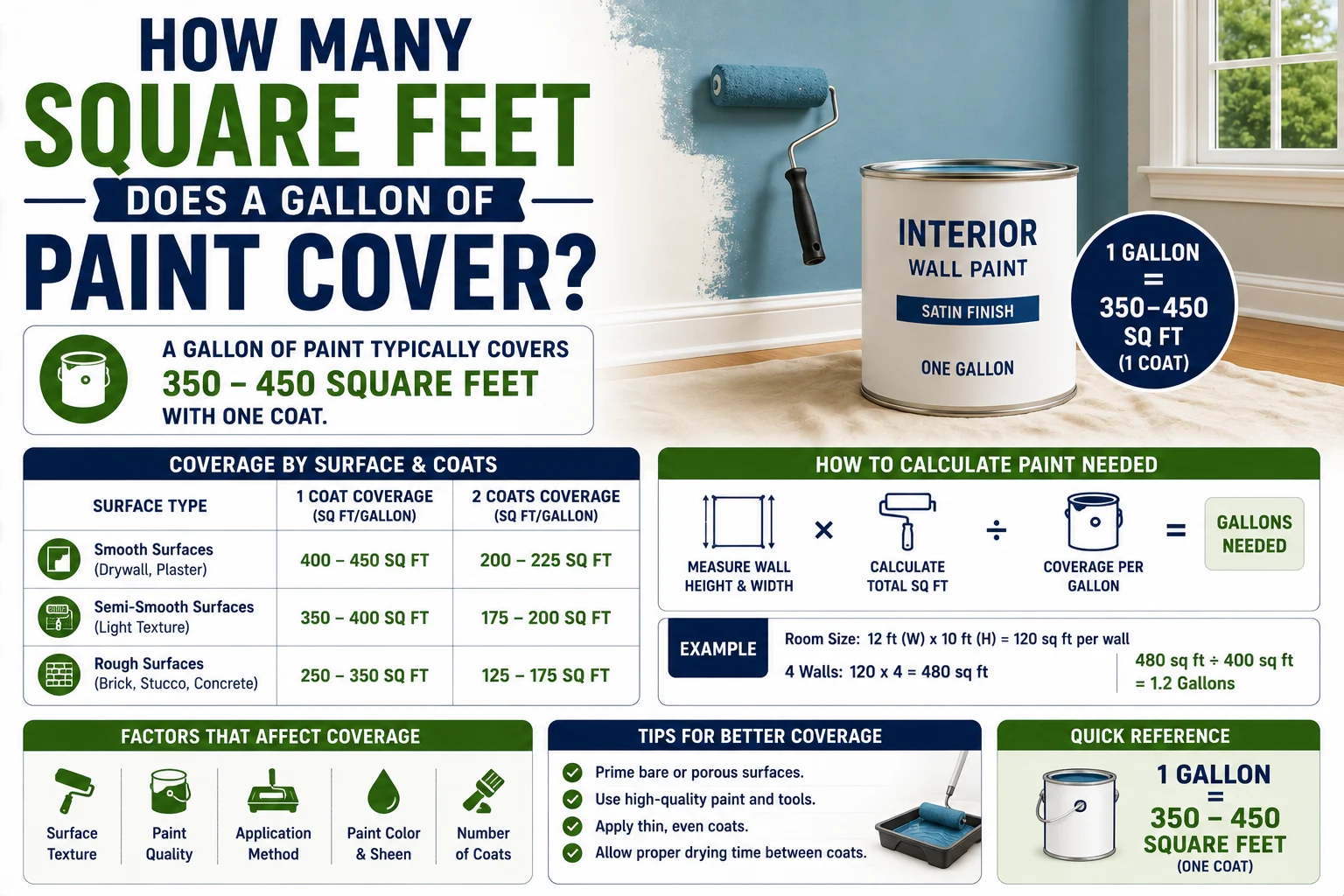
If you’re planning a painting project, one of the first questions you may ask is how many square feet covers a gallon of paint. In general, one gallon of paint typically covers about 350 to 400 square feet for one coat on a smooth, properly prepared surface.
However, the actual coverage can vary considerably.
A gallon may cover closer to 400 square feet when applied to a smooth, sealed surface. Rough, porous, or textured surfaces may absorb more paint and reduce coverage. The type of paint, application method, color change, and number of coats can also affect how much you need.
For example, if you have 1,000 square feet of paintable wall area and your paint covers 400 square feet per gallon:
1,000 ÷ 400 = 2.5 gallons
You would generally purchase at least 3 gallons for one coat, allowing a little extra for waste and touch-ups.
For two coats, the requirement would be approximately twice as much.
Understanding paint coverage before you shop can help you avoid running out of paint halfway through a project or buying much more than necessary.
Quick Answer: How Many Square Feet Does a Gallon of Paint Cover?
A typical gallon of paint covers approximately:
350–400 square feet for one coat
This is a general estimate rather than a guarantee.
| Surface Condition | Approximate Coverage per Gallon |
|---|---|
| Smooth, sealed surface | 350–400 sq ft |
| Average interior wall | 300–400 sq ft |
| Textured surface | 250–350 sq ft |
| Rough or porous surface | 200–300+ sq ft |
| Two coats on smooth surface | 175–200 sq ft |
Always check the manufacturer’s coverage information on the paint can or product specifications because formulas vary.
What Does Paint Coverage Mean?
Paint coverage refers to the amount of surface area a particular amount of paint can cover with one coat.
It is usually expressed as:
Square feet per gallon
For example, if a paint label states that one gallon covers 400 square feet, that means one gallon should theoretically cover 400 square feet with one coat under the manufacturer’s testing conditions.
Real-world coverage may be lower.
Factors such as surface texture, paint application, temperature, porosity, and the condition of the wall can change the amount of paint required.
That’s why it’s smart to treat the listed coverage as an estimate rather than an exact guarantee.
How Many Square Feet Does 1 Gallon of Paint Cover?
For many common interior paints, one gallon covers roughly 350–400 square feet per coat.
Suppose your paint has a stated coverage of 400 square feet per gallon.
You have a 1,200-square-foot paintable surface.
The calculation is:
1,200 ÷ 400 = 3 gallons
So you would need approximately 3 gallons for one coat.
For two coats:
3 × 2 = 6 gallons
In practice, you may want to purchase a little extra for touch-ups and areas that absorb more paint.
How Much Paint Do You Need for 500 Square Feet?
If one gallon covers 400 square feet:
500 ÷ 400 = 1.25 gallons
For one coat, you would therefore need approximately 1.25 gallons.
Since paint is commonly sold in standard container sizes, you may purchase a gallon plus a smaller container, depending on the product and availability.
For two coats:
1.25 × 2 = 2.5 gallons
A practical purchase might be 3 gallons to provide some additional coverage.
How Much Paint Do You Need for 1,000 Square Feet?
For a surface measuring 1,000 square feet, assume coverage of 400 square feet per gallon.
1,000 ÷ 400 = 2.5 gallons
Therefore:
- One coat: about 2.5 gallons
- Two coats: about 5 gallons
If the surface is rough or porous, you may need more.
For example, using an estimated 300 square feet per gallon:
1,000 ÷ 300 = 3.33 gallons
That means approximately 3.5–4 gallons may be needed for one coat.
This demonstrates why surface condition matters.
How Much Paint Do You Need for 1,500 Square Feet?
Using 400 square feet of coverage per gallon:
1,500 ÷ 400 = 3.75 gallons
So you need approximately:
- 4 gallons for one coat
- 7.5 gallons for two coats
For two coats, you would normally round up and allow additional paint for touch-ups.
A purchase of around 8 gallons could be reasonable for a two-coat project at this coverage rate, depending on the exact surface and product.
How Much Paint Do You Need for 2,000 Square Feet?
At 400 square feet per gallon:
2,000 ÷ 400 = 5 gallons
Therefore:
- One coat: approximately 5 gallons
- Two coats: approximately 10 gallons
At 350 square feet per gallon:
2,000 ÷ 350 ≈ 5.71 gallons
So the actual requirement could be closer to 6 gallons for one coat.
For a large project, use the manufacturer’s coverage rate and measure the actual paintable area for a more accurate estimate.
Paint Coverage Chart
The following chart assumes approximately 400 square feet per gallon for one coat.
| Paintable Area | One Coat | Two Coats |
| 250 sq ft | 0.63 gal | 1.25 gal |
| 500 sq ft | 1.25 gal | 2.5 gal |
| 750 sq ft | 1.88 gal | 3.75 gal |
| 1,000 sq ft | 2.5 gal | 5 gal |
| 1,250 sq ft | 3.13 gal | 6.25 gal |
| 1,500 sq ft | 3.75 gal | 7.5 gal |
| 2,000 sq ft | 5 gal | 10 gal |
| 2,500 sq ft | 6.25 gal | 12.5 gal |
| 3,000 sq ft | 7.5 gal | 15 gal |
These figures are estimates. Actual coverage depends on the paint and surface.
Does One Coat or Two Coats Change Paint Coverage?
Yes.
If a gallon covers 400 square feet with one coat, the same gallon does not suddenly cover 800 square feet with two coats.
Instead, two coats require approximately twice the paint.
For example:
1,000 sq ft ÷ 400 = 2.5 gallons per coat
For two coats:
2.5 × 2 = 5 gallons
Two coats are often recommended when:
- Changing from a dark color to a light color
- Painting over uneven colors
- Covering stains
- Painting new drywall
- Seeking a more uniform finish
- The manufacturer’s instructions recommend multiple coats
Some high-quality paints may provide good coverage in one coat under suitable conditions, but this depends on the product and surface.
Does Wall Texture Affect Paint Coverage?
Absolutely.
Smooth surfaces generally require less paint than heavily textured or porous surfaces.
Smooth Walls
Paint spreads more evenly and tends to achieve better coverage.
Approximate coverage:
350–400+ square feet per gallon
Lightly Textured Walls
Texture creates additional surface area and can increase paint consumption.
Approximate coverage:
300–350 square feet per gallon
Rough or Highly Textured Walls
Deep texture may require significantly more paint.
Coverage could fall below:
250–300 square feet per gallon
These are broad estimates. The actual result depends on the specific wall and paint.
Does New Drywall Need More Paint?
Yes, unfinished drywall can absorb paint quickly.
New drywall usually requires appropriate preparation and often a drywall primer before applying finish paint.
Without proper priming, the surface may absorb paint unevenly, resulting in:
- Patchy appearance
- Uneven sheen
- Increased paint consumption
- Visible joint-compound areas
- More coats than expected
Priming properly can create a more uniform surface and improve the finish coat’s performance.
Does Paint Color Affect Coverage?
Yes, color can influence how many coats are needed.
For example, covering a dark wall with a very light color may require multiple coats.
Similarly, bright or highly saturated colors may require a suitable primer or additional coats to achieve an even finish.
A dramatic color change can therefore increase total paint consumption even if the wall’s square footage stays exactly the same.
How to Calculate Paintable Square Feet
Before calculating how many gallons you need, determine the actual area you’re painting.
For a rectangular wall:
Wall area = Width × Height
Suppose a wall is:
- 15 feet wide
- 8 feet high
Then:
15 × 8 = 120 square feet
If you have four similar walls:
120 × 4 = 480 square feet
You can then subtract doors and windows if you want a more precise estimate.
Should You Subtract Windows and Doors?
You can.
If you’re estimating paint for a large project, subtracting major areas that won’t be painted can improve accuracy.
For example, suppose the total wall area is:
1,200 square feet
And doors and windows account for:
150 square feet
The paintable area is:
1,200 − 150 = 1,050 square feet
At 400 square feet per gallon:
1,050 ÷ 400 = 2.625 gallons
You would need roughly 2.6 gallons for one coat, before adding an allowance for waste and touch-ups.
For small projects, many people simply use the total wall area and buy a little extra.
Paint Coverage for Ceilings
Ceilings can also be calculated using square footage.
For example, a ceiling measuring 20 feet by 15 feet has:
20 × 15 = 300 square feet
At 400 square feet per gallon:
300 ÷ 400 = 0.75 gallon
So approximately three-quarters of a gallon would theoretically cover one coat.
However, ceilings can sometimes absorb more paint, especially if they have a porous finish or textured surface.
Paint Coverage for Exterior Walls
Exterior paint coverage can differ from interior paint.
Outdoor surfaces may include:
- Wood siding
- Stucco
- Brick
- Concrete
- Fiber cement
- Vinyl siding
- Previously painted surfaces
Rough or porous materials generally require more paint.
Weather conditions can also affect application.
For exterior projects, always follow the product’s recommended application conditions and coverage rate.
How Much Paint Covers 100 Square Feet?
If your paint covers 400 square feet per gallon:
100 ÷ 400 = 0.25 gallon
So one gallon can theoretically cover 100 square feet four times under those conditions.
For one coat, 100 square feet requires approximately one quart.
However, actual coverage depends on the product and surface.
How Much Paint Covers 200 Square Feet?
At 400 square feet per gallon:
200 ÷ 400 = 0.5 gallon
Therefore, approximately half a gallon is needed for one coat.
For two coats:
0.5 × 2 = 1 gallon
This makes 200 square feet a useful reference point when estimating smaller painting projects.
How Much Paint Covers 300 Square Feet?
At 400 square feet per gallon:
300 ÷ 400 = 0.75 gallon
So approximately three-quarters of a gallon is needed for one coat.
For two coats:
0.75 × 2 = 1.5 gallons
Again, actual coverage may differ.
How Much Paint Covers 400 Square Feet?
If the paint’s coverage rating is 400 square feet per gallon:
1 gallon = 400 square feet for one coat
For two coats, one gallon covers approximately:
200 square feet
This is why the label’s stated coverage should always be interpreted in terms of the number of coats being applied.
Paint Type and Coverage
Different paints can have different coverage rates.
Latex Paint
Commonly used for interior walls and ceilings. Coverage varies by product and surface.
Acrylic Paint
Often used for interior and exterior applications. Coverage depends on formulation.
Oil-Based Paint
Can provide a durable finish but may have different application and coverage characteristics.
Primer
Primer is designed to prepare and seal the surface rather than act as a final decorative coat.
Always check the specific product label instead of assuming every gallon covers the same area.
How to Get Better Paint Coverage
Good preparation can help you get more consistent results.
Clean the Surface
Remove dirt, grease, dust, and other contaminants.
Repair Damage
Fill holes and cracks before painting.
Sand When Appropriate
Sanding can create a smoother and more uniform surface.
Prime Porous Surfaces
Primer can reduce uneven absorption.
Use the Correct Roller
Choose a roller nap appropriate for the surface texture.
Avoid Overloading
Too much paint can lead to drips and waste.
Maintain a Wet Edge
This can help produce a more consistent finish.
Follow the Manufacturer’s Instructions
The paint manufacturer’s coverage and application guidance should take priority over general estimates.
Common Mistakes When Estimating Paint
Mistake 1: Assuming Every Gallon Covers 400 Square Feet
Coverage varies by product and surface.
Mistake 2: Forgetting the Second Coat
If you need two coats, your paint requirement is approximately doubled.
Mistake 3: Ignoring Texture
Textured surfaces usually consume more paint.
Mistake 4: Forgetting Doors and Windows
Large areas that won’t be painted can affect your estimate.
Mistake 5: Not Accounting for Waste
Some paint remains in rollers, trays, brushes, containers, and equipment.
Mistake 6: Buying Too Little
Running out of paint can create color or sheen differences if you have to purchase another batch later.
Should You Buy Extra Paint?
Usually, having a small amount left over is useful.
Extra paint can be used for:
- Future touch-ups
- Repairs
- Small scuffs
- Trim corrections
- Matching damaged areas
For large projects, a modest allowance for waste and touch-ups can be helpful.
However, avoid buying excessive amounts without first calculating the actual paintable area.
Gallon vs. Quart vs. Pint
Paint is commonly sold in several container sizes.
| Container | Approximate Volume |
| Pint | 1/8 gallon |
| Quart | 1/4 gallon |
| Half gallon | 1/2 gallon |
| Gallon | 1 gallon |
| 5-gallon bucket | 5 gallons |
If a gallon covers 400 square feet, a quart theoretically covers about:
400 ÷ 4 = 100 square feet
A half-gallon would cover approximately:
400 ÷ 2 = 200 square feet
These are mathematical estimates based on the assumed 400-square-foot coverage rate.
Real-World Example: Painting a Bedroom
Suppose a bedroom has four walls.
Each wall is:
12 feet × 8 feet = 96 square feet
Four walls:
96 × 4 = 384 square feet
Suppose there is a door measuring 21 square feet and a window measuring 15 square feet.
Subtract:
384 − 21 − 15 = 348 square feet
At 400 square feet per gallon:
348 ÷ 400 = 0.87 gallon
For one coat, you need approximately 0.87 gallon.
For two coats:
0.87 × 2 = 1.74 gallons
In practice, buying approximately 2 gallons would provide a practical amount for two coats, depending on the paint’s actual coverage.
Frequently Asked Questions
1. How many square feet does a gallon of paint cover?
A gallon of paint typically covers about 350–400 square feet for one coat on a smooth, properly prepared surface. Rough, textured, or porous surfaces may require more paint.
2. How much paint do I need for 1,000 square feet?
At 400 square feet per gallon, 1,000 square feet requires approximately 2.5 gallons for one coat or 5 gallons for two coats. Actual requirements depend on the paint and surface.
3. Does two coats of paint double the amount needed?
Generally, yes. If one coat requires 3 gallons, two coats will require roughly 6 gallons, although actual consumption varies with surface conditions and the paint product.
4. How much area does a quart of paint cover?
If one gallon covers 400 square feet, a quart theoretically covers approximately 100 square feet for one coat. The actual coverage depends on the product and application surface.
5. Does textured wall paint cover fewer square feet?
Usually, yes. Textured or rough surfaces have more surface area and can absorb or consume more paint. Coverage may be lower than the manufacturer’s smooth-surface estimate.
Conclusion
So, how many square feet covers a gallon of paint? As a general estimate, one gallon of paint covers approximately 350–400 square feet for one coat on a smooth, properly prepared surface.
However, this number isn’t universal. Paint type, wall texture, surface porosity, color changes, application method, and the number of coats can all affect coverage.
For a quick estimate, divide your paintable square footage by the manufacturer’s stated coverage per gallon:
Gallons needed = Paintable square feet ÷ Coverage per gallon
Then multiply by the number of coats you plan to apply.
For example, a 1,000-square-foot surface using paint rated at 400 square feet per gallon requires approximately 2.5 gallons for one coat or 5 gallons for two coats.
Before purchasing paint, measure the actual area, subtract major unpainted surfaces when appropriate, check the paint label, and allow a little extra for touch-ups and surface variation.