

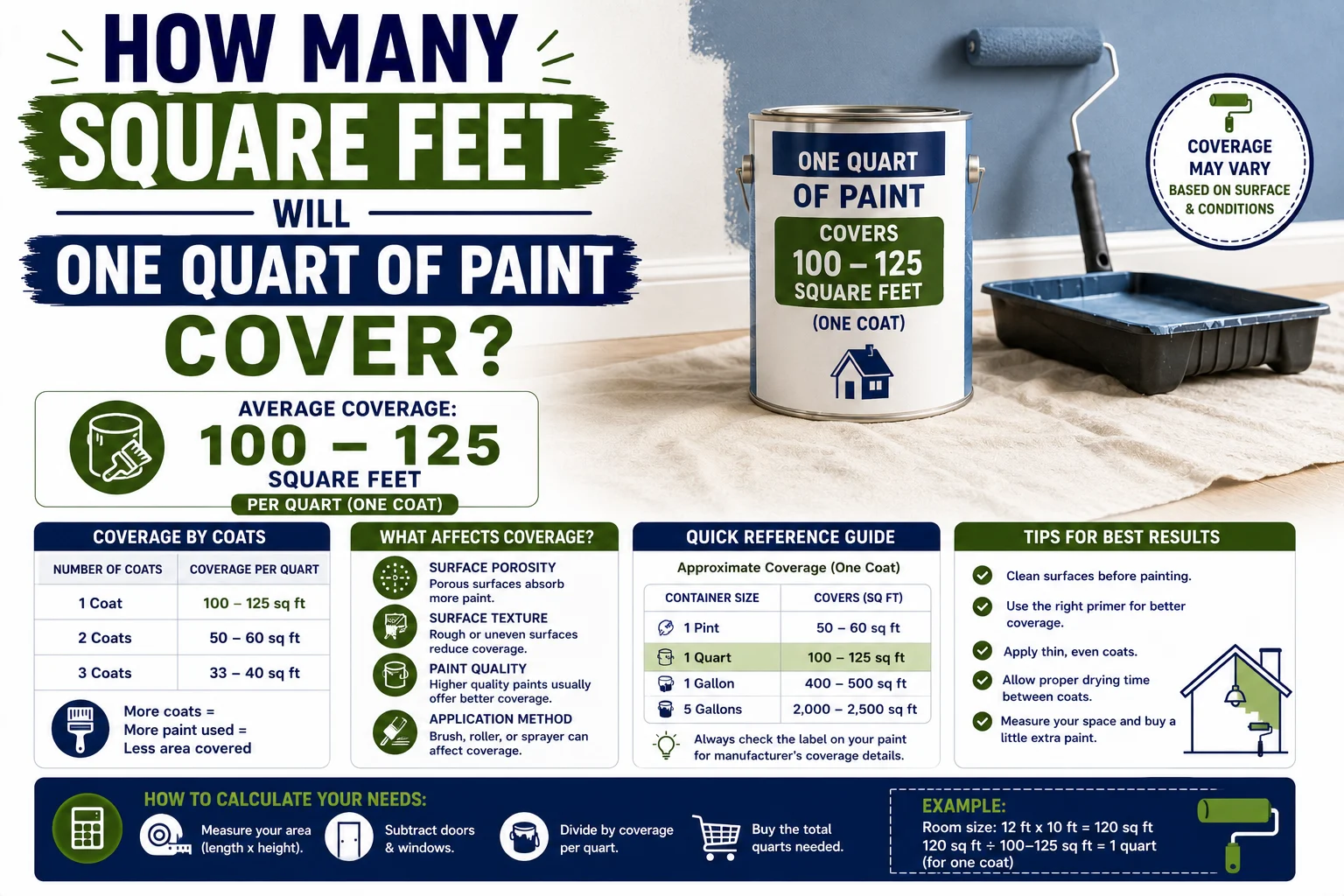
If you’re working on a small painting project, buying an entire gallon of paint may be unnecessary. That’s why many homeowners wonder, how many square feet will one quart of paint cover?
As a general estimate, one quart of paint can cover approximately 100 square feet for one coat when the paint has a coverage rate of about 400 square feet per gallon.
Since:
1 gallon = 4 quarts
and:
400 square feet ÷ 4 = 100 square feet
one quart theoretically covers about 100 square feet at that assumed coverage rate.
However, this is only a planning estimate. Actual coverage varies by paint product, surface texture, porosity, color, application method, and number of coats.
The best way to determine the exact amount is to check the coverage information printed on the paint container.
Quick Answer
One quart of paint typically covers about 75–100 square feet for one coat.
A useful rule of thumb is:
1 quart ≈ 100 square feet
when the paint is rated at approximately 400 square feet per gallon.
For two coats, that same quart might cover approximately:
50 square feet
because the same amount of paint is being used twice.
However, the actual coverage can be higher or lower depending on the product and surface.
A=lw
A=6×4=24
4 rows by 6 columns = 24 square units.
w
w
l
l24 square unitsw = 6l = 4
Give feedback
How Does One Quart Compare With One Gallon?
A gallon contains four quarts.
Therefore:
1 gallon = 4 quarts
If a gallon covers approximately 400 square feet:
400 ÷ 4 = 100 square feet
So the proportional estimate is:
| Paint Amount | Approximate Coverage* |
|---|---|
| 1 pint | 50 sq ft |
| 1 quart | 100 sq ft |
| ½ gallon | 200 sq ft |
| 1 gallon | 400 sq ft |
| 2 gallons | 800 sq ft |
| 5 gallons | 2,000 sq ft |
*Based on an assumed coverage rate of 400 square feet per gallon for one coat.
Actual product coverage may differ.
How to Calculate Paint Coverage for One Quart
The basic calculation is straightforward.
Suppose your paint covers 400 square feet per gallon.
Since one gallon contains four quarts:
400 ÷ 4 = 100 square feet
Therefore:
One quart covers approximately 100 square feet per coat.
If your paint’s stated coverage is different, use this formula:
Quart Coverage = Gallon Coverage ÷ 4
For example, if a paint covers 360 square feet per gallon:
360 ÷ 4 = 90 square feet
So one quart would theoretically cover approximately 90 square feet for one coat.
How Many Square Feet Does One Quart Cover for Two Coats?
The number of coats makes a significant difference.
If one quart covers 100 square feet for one coat, applying two coats means the same quart can cover approximately:
100 ÷ 2 = 50 square feet
Therefore:
One quart ≈ 50 square feet for two coats
under the same assumed coverage conditions.
For three coats:
100 ÷ 3 ≈ 33.3 square feet
So the estimated coverage becomes smaller as you increase the number of coats.
One Quart Paint Coverage Chart
Using a 400-square-foot-per-gallon coverage assumption:
| Number of Coats | Approx. Coverage From 1 Quart |
|---|---|
| 1 coat | 100 sq ft |
| 2 coats | 50 sq ft |
| 3 coats | 33 sq ft |
| 4 coats | 25 sq ft |
These are theoretical estimates. Actual paint usage depends on the surface and product.
How Much Wall Can One Quart of Paint Cover?
A quart can be useful for relatively small wall sections.
For example, if a wall section is:
10 feet long × 10 feet high
its area is:
10 × 10 = 100 square feet
At an assumed coverage of 100 square feet per quart, one quart could theoretically cover that area with one coat.
However, if you need two coats, you would likely need approximately two quarts.
Can One Quart Paint a Small Room?
It depends on the room size and what you’re painting.
A quart may be enough for:
- An accent wall
- A small bathroom
- A closet
- A section of a wall
- Trim
- Doors
- Furniture
- Small cabinets
- Touch-up work
But one quart is generally not enough to paint all the walls of a typical bedroom, especially if two coats are required.
The total paintable wall area is usually much larger than the room’s floor area.
How Much Wall Area Is in a 10 × 10 Room?
Consider a 10 × 10-foot room with 8-foot ceilings.
The perimeter is:
10 + 10 + 10 + 10 = 40 feet
Wall area:
40 × 8 = 320 square feet
Therefore, the room has approximately:
320 square feet of wall surface
before subtracting doors and windows.
If one quart covers 100 square feet per coat:
320 ÷ 100 = 3.2 quarts
So approximately 3.2 quarts would be needed for one coat under the assumed coverage rate.
For two coats:
3.2 × 2 = 6.4 quarts
In practice, you would purchase an appropriate combination of containers and allow for actual coverage differences.
How Much Paint Does One Quart Cover on a Ceiling?
Suppose you have a ceiling measuring:
10 × 10 feet
The ceiling area is:
10 × 10 = 100 square feet
Therefore, one quart could theoretically cover approximately 100 square feet with one coat if its coverage rate works out to 100 square feet per quart.
For two coats, approximately two quarts would be required under the same assumptions.
How Much Paint Does One Quart Cover on a Door?
A standard interior door may have a relatively small paintable surface compared with a wall.
For example, suppose one side of a door measures approximately:
3 × 7 feet
Its area is:
3 × 7 = 21 square feet
One quart of paint could theoretically cover several coats or multiple doors, depending on the paint, application method, and whether both sides are painted.
Remember to calculate the actual surface area rather than assuming all doors are the same size.
How Much Paint Does One Quart Cover on Furniture?
A quart can be particularly useful for small furniture projects.
Depending on the piece, one quart may cover:
- A small table
- Several chairs
- A nightstand
- A small dresser
- Shelving
- Cabinets
- Decorative pieces
Furniture often has more complicated shapes than walls, so coverage can vary considerably.
Brush application can also result in different paint consumption compared with rolling a smooth wall.
Factors That Affect How Much One Quart Covers
The 100-square-foot estimate is useful, but actual coverage can vary.
1. Surface Texture
Smooth walls generally require less paint than rough surfaces.
Textured walls have more surface area and can consume more paint.
2. Surface Porosity
New drywall, unfinished wood, masonry, and other porous materials can absorb paint.
This may reduce the effective coverage of one quart.
3. Existing Color
Covering a similar color may require fewer coats than covering a dramatically different color.
For example, painting white over a light neutral color can be easier than painting white over a very dark color.
4. Paint Type
Different paints have different formulations and coverage rates.
Always check the manufacturer’s specifications.
5. Application Method
Brushes, rollers, and sprayers can produce different material usage.
6. Number of Coats
Two coats generally require roughly twice the amount of paint used for one coat.
7. Primer
Primer can improve the consistency of a surface and reduce absorption on some substrates.
Does One Quart of Exterior Paint Cover 100 Square Feet?
It can, but exterior coverage varies substantially.
Exterior surfaces may include:
- Wood siding
- Vinyl siding
- Brick
- Stucco
- Concrete
- Masonry
- Previously painted surfaces
Rough and porous materials can require more paint than smooth surfaces.
Therefore, don’t automatically assume one quart will cover exactly 100 square feet outdoors.
Check the specific exterior paint’s coverage rate.
Does One Quart of Interior Paint Cover 100 Square Feet?
Approximately, in many cases.
If an interior paint is rated at about 400 square feet per gallon, the proportional coverage is:
400 ÷ 4 = 100 square feet per quart
Therefore:
1 quart ≈ 100 square feet for one coat
But the manufacturer’s stated coverage should always take priority.
How Many Quarts of Paint Do I Need?
Use this formula:
Quarts Needed = Total Paintable Area ÷ Coverage per Quart × Number of Coats
For example, suppose you have 300 square feet to paint and one quart covers 100 square feet.
For one coat:
300 ÷ 100 = 3 quarts
For two coats:
3 × 2 = 6 quarts
So you’d need approximately 6 quarts under those assumptions.
How Many Quarts for 200 Square Feet?
At 100 square feet per quart:
200 ÷ 100 = 2 quarts
Therefore:
2 quarts for one coat
For two coats:
2 × 2 = 4 quarts
How Many Quarts for 300 Square Feet?
At 100 square feet per quart:
300 ÷ 100 = 3 quarts
Therefore:
3 quarts for one coat
For two coats:
6 quarts
How Many Quarts for 400 Square Feet?
At 100 square feet per quart:
400 ÷ 100 = 4 quarts
Since four quarts equal one gallon:
400 square feet ≈ 1 gallon
for one coat at the assumed coverage rate.
How Many Quarts for 500 Square Feet?
At 100 square feet per quart:
500 ÷ 100 = 5 quarts
Therefore:
5 quarts for one coat
That’s equivalent to:
1.25 gallons
For two coats:
10 quarts = 2.5 gallons
How Many Quarts for 1,000 Square Feet?
At 100 square feet per quart:
1,000 ÷ 100 = 10 quarts
Therefore:
10 quarts = 2.5 gallons
for one coat.
For two coats:
20 quarts = 5 gallons
Again, this assumes 100 square feet of coverage per quart.
Quart vs. Gallon Paint Coverage
| Container | Approx. Coverage at 400 sq ft/gal |
|---|---|
| 1 pint | 50 sq ft |
| 1 quart | 100 sq ft |
| 2 quarts | 200 sq ft |
| 3 quarts | 300 sq ft |
| 4 quarts | 400 sq ft |
| 1 gallon | 400 sq ft |
| 2 gallons | 800 sq ft |
| 5 gallons | 2,000 sq ft |
This makes it easy to scale your estimate according to the amount of paint you need.
Is It Better to Buy a Quart or a Gallon?
For a small project, a quart can make more sense.
Choose a quart when:
- You need to paint a small area.
- You’re doing touch-ups.
- You’re painting furniture.
- You’re testing a color.
- You’re painting trim or a door.
- You only need a small amount.
Choose a gallon when:
- You’re painting multiple walls.
- You’re painting an entire room.
- You need several coats.
- You have a large surface.
- The cost per unit makes the gallon more economical.
The best choice depends on the project’s total area and the amount of paint required.
Should You Buy Extra Paint?
It’s usually wise to avoid buying exactly the theoretical amount needed.
Some paint can be lost through:
- Roller absorption
- Brush loading
- Spills
- Overspray
- Uneven surfaces
- Touch-ups
- Additional coats
However, buying too much paint can create unnecessary expense and storage problems.
A careful calculation using the manufacturer’s coverage rate is the best starting point.
How to Get Better Paint Coverage
You can improve your chances of getting good coverage by properly preparing the surface.
Clean the surface
Remove dirt, grease, dust, and loose material.
Repair imperfections
Fill holes and cracks where appropriate.
Sand when necessary
A suitable surface helps paint adhere consistently.
Use primer when appropriate
Primer can help seal porous surfaces and create a uniform base.
Use the correct application tool
Choose the appropriate roller, brush, or sprayer for the paint and surface.
Apply the recommended amount
Avoid spreading paint excessively thin simply to make it cover more area.
Common Mistakes When Estimating Quart Paint Coverage
Mistake 1: Assuming Every Quart Covers Exactly 100 Square Feet
The 100-square-foot estimate assumes a 400-square-foot-per-gallon coverage rate.
Actual products differ.
Mistake 2: Forgetting Multiple Coats
If one quart covers 100 square feet for one coat, two coats may require two quarts for the same 100-square-foot area.
Mistake 3: Using Floor Area as Wall Area
A 100-square-foot room doesn’t necessarily have 100 square feet of walls.
Wall area depends on the perimeter and ceiling height.
Mistake 4: Ignoring Surface Texture
Rough surfaces can consume more paint.
Mistake 5: Forgetting Doors and Windows
For larger projects, subtracting significant openings can improve the estimate.
FAQs
1. How many square feet will one quart of paint cover?
One quart of paint can cover approximately 75–100 square feet for one coat, depending on the product. A common planning estimate is 100 square feet per quart when the paint covers about 400 square feet per gallon.
2. Is one quart of paint enough for a wall?
It can be. If the wall is approximately 100 square feet and the paint covers 100 square feet per quart, one quart may cover one coat. Larger walls or multiple coats require more paint.
3. How many square feet does one quart cover with two coats?
If one quart covers 100 square feet for one coat, it would cover approximately 50 square feet for two coats.
4. How many quarts are in a gallon of paint?
There are 4 quarts in one gallon.
5. How many quarts of paint do I need for 400 square feet?
At 100 square feet per quart, you need approximately 4 quarts for one coat, which equals one gallon.
6. How many quarts do I need for 1,000 square feet?
At 100 square feet per quart, approximately 10 quarts are needed for one coat, equivalent to 2.5 gallons.
7. Does surface texture affect quart coverage?
Yes. Rough, porous, or textured surfaces can consume more paint and reduce actual coverage.
8. Should I use primer before painting?
Primer can be beneficial on new, porous, patched, stained, or dramatically different surfaces. Follow the recommendations for your specific paint and substrate.
Conclusion
So, how many square feet will one quart of paint cover?
As a practical rule of thumb:
One quart of paint covers approximately 75–100 square feet for one coat.
A convenient estimate is 100 square feet per quart when the paint’s coverage rate is around 400 square feet per gallon.
Remember that actual coverage depends on the specific paint, surface condition, texture, color, application method, and number of coats. For example, if one quart covers 100 square feet for one coat, the same quart may cover only about 50 square feet when two coats are required.
For the most accurate estimate, measure your paintable surface, check the manufacturer’s coverage rate, account for the number of coats, and round your purchase upward when necessary. This will help you avoid running out of paint in the middle of a project while minimizing unnecessary waste.