

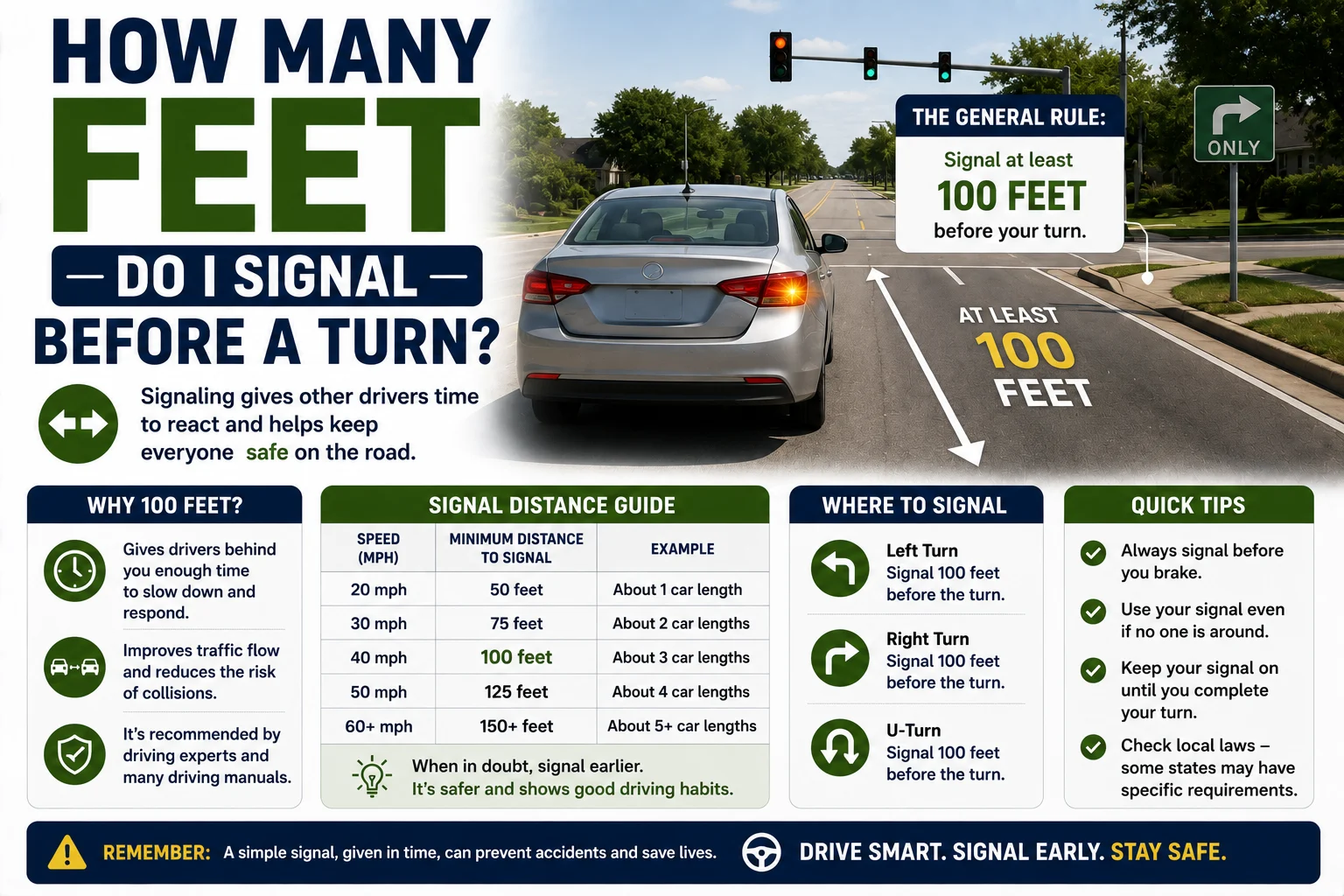
Knowing when to use your turn signal is one of the most important basic driving skills. If you’re wondering how many feet do I signal before a turn, the answer depends on where you are driving because signaling requirements are established by state and local traffic laws.
In many U.S. states, drivers are required to signal a turn or lane movement a specific distance before the maneuver. A commonly used distance is 100 feet before turning, while some jurisdictions require a different distance, particularly at higher speeds.
For example, California generally requires a continuous signal during the last 100 feet before turning. New York requires a signal for at least 100 feet before turning or stopping, while some states use 300 feet in certain circumstances.
So, the practical rule is:
Signal well before the turn often at least 100 feet but check your state’s exact requirement.
Signaling isn’t simply about meeting a legal distance. The purpose is to give other road users enough time to understand what you’re about to do.
Quick Answer
How many feet should you signal before a turn?
In many U.S. jurisdictions, the required distance is 100 feet before the turn.
However, there is no single nationwide distance that applies to every road and every state.
Depending on the jurisdiction, the requirement may be:
- 100 feet
- 200 feet
- 300 feet
- Or another specified distance
For example, California’s Vehicle Code requires a signal during the last 100 feet before turning, while New York’s law specifies at least 100 feet.
Always follow the traffic law applicable to your location.
Why Do You Need to Signal Before a Turn?
Turn signals communicate your intentions to other road users.
When you activate your signal before turning, you give:
- Drivers behind you time to react
- Oncoming drivers information about your intended movement
- Pedestrians additional information
- Cyclists an indication of your planned direction
- Other vehicles time to adjust their speed or position
A signal is especially important when traffic is heavy or visibility is limited.
The goal isn’t merely to signal at a particular number of feet. The goal is to communicate your intention early enough for others to respond safely.
Is 100 Feet the Standard Turn-Signal Distance?
100 feet is a common requirement, but it isn’t universal.
Different states have different traffic laws.
For example:
| Example Jurisdiction | General Requirement |
|---|---|
| California | 100 feet before turning |
| New York | 100 feet before turning or stopping |
| Some jurisdictions | Different distances may apply |
| Higher-speed situations | May require greater advance warning under applicable law |
Because traffic laws can change, the safest approach is to check your state’s current driver handbook or traffic code.
If you’re preparing for a driving test, use the rule taught in your state’s official driver’s manual rather than relying on a general 100-foot rule.
How Early Should You Signal Before Turning?
Even when your state specifies a distance, timing matters.
A good sequence is:
1. Check your surroundings
Look for:
- Vehicles
- Pedestrians
- Cyclists
- Traffic signs
- Road markings
- Intersections
2. Activate your signal
Turn on the appropriate signal before beginning the maneuver.
3. Check your mirrors and blind spot
Make sure the intended movement is safe.
4. Position your vehicle
Move into the appropriate lane or turning position when safe.
5. Reduce speed appropriately
Brake smoothly rather than waiting until the last moment.
6. Complete the turn
Keep the signal active through the maneuver and cancel it afterward if it doesn’t automatically switch off.
How Many Feet Before a Right Turn Should You Signal?
In jurisdictions where the requirement is 100 feet:
Signal at least 100 feet before your right turn.
For example, if you’re approaching a right turn, activate the right turn signal early enough to provide the legally required warning.
Don’t wait until you’re already at the intersection.
A late signal can fail to give the driver behind you enough time to understand that you’re slowing or turning.
How Many Feet Before a Left Turn Should You Signal?
The same basic principle applies to left turns.
Where the applicable rule is 100 feet:
Signal at least 100 feet before the left turn.
Before turning left, check:
- Rear traffic
- Oncoming traffic
- Pedestrians
- Bicycle traffic
- Lane markings
- Traffic signals
- Signs
Your signal tells other road users what you intend to do, but signaling does not give you the right of way.
You must still yield whenever required.
Do You Signal Before Changing Lanes?
Yes.
Turn signals aren’t only for left and right turns at intersections. They are also used to communicate lane changes.
The exact legal requirements vary by jurisdiction, but the general safety principle is the same:
Signal before moving into another lane.
A safe lane-change sequence is:
Mirror → Signal → Blind-spot check → Move when safe
Don’t activate the signal and immediately move over without checking your surroundings.
Do You Need to Signal at a Stop Sign?
If you’re turning at a stop sign, you generally need to signal your intended direction of travel when required by applicable traffic law.
For example:
Stop → Signal → Check traffic → Turn when safe
The presence of a stop sign doesn’t eliminate the need to communicate a turn.
Do You Signal When Turning Into a Driveway?
A driveway turn can also involve a change in direction that affects other road users.
If you’re traveling along a public road and turning across traffic into a driveway, signaling can help drivers behind you understand why you’re slowing down.
Use the signal required by local law and activate it early enough to provide meaningful warning.
Do You Signal in a Roundabout?
Yes, but the signaling rules for roundabouts can differ depending on the jurisdiction and the maneuver you’re making.
Before entering a roundabout:
- Reduce speed
- Yield as required
- Identify your exit
- Use the appropriate signal according to local rules
- Check for pedestrians and cyclists
Because roundabout signaling conventions vary, follow the instructions in your state’s driver’s handbook.
What Happens If You Signal Too Late?
Signaling too late can create several problems.
A driver behind you may:
- Continue at the same speed
- Attempt to pass
- Brake suddenly
- Misinterpret your movement
For example, if you wait until you’re only a few feet from the intersection before turning on your signal, the driver behind you may not have enough time to react.
This is why early signaling is generally safer than last-second signaling.
What Happens If You Signal Too Early?
Signaling extremely early can also cause confusion.
For example, if you activate your turn signal several hundred feet before an intersection with multiple possible driveways or side streets, another driver may misunderstand which turn you intend to make.
The ideal timing is:
Early enough to provide meaningful warning, but not so early that your intended maneuver becomes unclear.
Follow your state’s required minimum distance while considering road conditions.
How Do You Estimate 100 Feet While Driving?
You don’t need to measure 100 feet with a ruler.
With practice, you can develop a visual sense of the distance.
Some drivers use fixed objects such as:
- Road signs
- Driveways
- Utility poles
- Buildings
- Lane markings
However, don’t focus so much on counting feet that you stop paying attention to traffic.
For a driving test, learn the specific distance requirement and practice recognizing approximately how far it is.
How Long Is 100 Feet?
For perspective:
100 feet = 33⅓ yards
It is also:
- 1,200 inches
- Approximately 30.48 meters
A football field is 360 feet long including the end zones, so 100 feet is a little over one-quarter of its total length.
This gives you a rough mental picture of the commonly used 100-foot signaling distance.
How Many Seconds Before a Turn Should You Signal?
Traffic laws are usually expressed in distance rather than seconds, so there’s no universal number of seconds that replaces the legal distance.
However, signaling should give other road users sufficient time to recognize your intention.
Your actual timing depends on:
- Vehicle speed
- Traffic density
- Road design
- Weather
- Visibility
- Traffic conditions
At higher speeds, 100 feet passes much more quickly than it does at lower speeds.
That’s why drivers should remain attentive to the road and signal in accordance with local requirements.
Turn Signal Rules for Driving Tests
If you’re studying for a learner’s permit or driver’s license test, signaling is usually an important part of safe driving.
During a road test, remember:
Signal before the maneuver.
Don’t wait until you’re already turning.
A good routine is:
Check → Signal → Check again → Move/turn
For a lane change:
Mirror → Signal → Blind spot → Lane change
For a turn:
Mirror → Signal → Position → Slow → Turn
Your state’s official driver handbook should be your primary source for the exact legal requirements.
Common Turn-Signal Mistakes
1. Signaling at the Last Second
Turning on the signal immediately before turning doesn’t give other drivers enough warning.
2. Forgetting to Signal
Some drivers become focused on traffic and forget the signal entirely.
Develop a consistent routine.
3. Signaling Without Checking
A signal communicates an intention. It doesn’t mean the maneuver is automatically safe.
Always check your surroundings.
4. Leaving the Signal On
A continuously flashing signal after completing a turn can confuse other drivers.
Cancel it when necessary.
5. Using the Wrong Signal
Make sure the left or right signal matches the direction you’re moving.
6. Assuming 100 Feet Applies Everywhere
Traffic laws differ among jurisdictions. Always check your local rules.
Does Signaling Give You the Right of Way?
No.
A turn signal communicates your intention, but it does not automatically give you the right of way.
For example, signaling for a left turn doesn’t mean you can turn across an oncoming vehicle.
You still need to:
- Yield when required
- Check for pedestrians
- Check for cyclists
- Watch oncoming traffic
- Follow traffic lights and signs
- Make sure the maneuver is safe
Think of your signal as communication, not permission.
Turn Signal Distance: Practical Guide
| Situation | General Practice |
|---|---|
| Right turn | Signal before the turn |
| Left turn | Signal before the turn |
| Lane change | Signal before moving |
| Entering a driveway | Signal before turning |
| Leaving a parking space | Signal as required |
| Roundabout | Follow local signaling rules |
| Driving test | Follow your state’s handbook |
| Typical U.S. distance | Often 100 feet |
The exact legal requirement should always be checked for the jurisdiction where you’re driving.
Why Early Signaling Improves Road Safety
Turn signals are one of the simplest communication tools available to drivers.
A properly timed signal helps other people anticipate:
- Where you’re going
- Whether you’re slowing down
- Whether you’re changing lanes
- Whether they need to wait
- Whether they can safely proceed
Good signaling becomes particularly important in:
- Heavy traffic
- Busy intersections
- Parking lots
- Multi-lane roads
- High-speed roads
- Poor visibility
- Areas with pedestrians and cyclists
The purpose of signaling is ultimately to make your actions more predictable.
FAQs
1. How many feet do I signal before a turn?
100 feet is a common requirement in many U.S. jurisdictions, but the exact legal distance varies by state. Check your local traffic law or driver’s handbook.
2. Is 100 feet the rule in every state?
No. States can establish different signaling requirements. Some laws specify different distances depending on the road or situation.
3. Should I signal before a left turn?
Yes. Activate your left turn signal before making the turn, following the distance required by local law.
4. Should I signal before a right turn?
Yes. Signal your intended right turn early enough to comply with local law and give other road users adequate warning.
5. Do I have to signal when changing lanes?
Generally, yes. Drivers should communicate lane changes with a turn signal, subject to applicable local traffic laws.
6. Does using my turn signal give me the right of way?
No. A signal communicates your intention but doesn’t override right-of-way rules.
7. How far is 100 feet?
100 feet equals 33⅓ yards, 1,200 inches, or approximately 30.48 meters.
8. Is it better to signal early or late?
You should signal early enough to give other road users meaningful warning, while avoiding signaling so early that your intended maneuver becomes confusing. Always follow your local legal requirement.
Conclusion
So, how many feet do I signal before a turn?
A commonly used U.S. standard is:
100 feet before the turn
However, there is no single signaling distance that applies everywhere in the United States. State traffic laws can specify different distances and requirements. For example, California and New York generally use a 100-foot requirement for ordinary turns, while other jurisdictions may use different distances or additional rules.
The most important habit is to signal before the maneuver, check your surroundings, and make sure the movement is safe. A turn signal is a communication tool—it lets other drivers, cyclists, and pedestrians know what you intend to do.
If you’re preparing for a driving test, use your state’s official driver’s handbook for the exact distance you are expected to know.