

When shopping for an air conditioner or mini-split system, one of the most common questions homeowners ask is:
How many square feet will a 9,000 BTU air conditioner cool?
Choosing the correct BTU rating is one of the most important decisions when purchasing a cooling system. An undersized unit may struggle to keep a room comfortable, while an oversized unit can waste energy, cycle on and off too frequently, and create humidity problems.
A 9,000 BTU air conditioner is a popular option for bedrooms, home offices, apartments, and smaller living spaces. However, the actual area it can effectively cool depends on more than just square footage. Ceiling height, insulation quality, climate, sun exposure, and occupancy all influence cooling performance.
In this guide, you’ll learn how many square feet a 9,000 BTU unit can cool, how BTU sizing works, and what factors affect real-world performance.
Quick Answer
Under typical conditions:
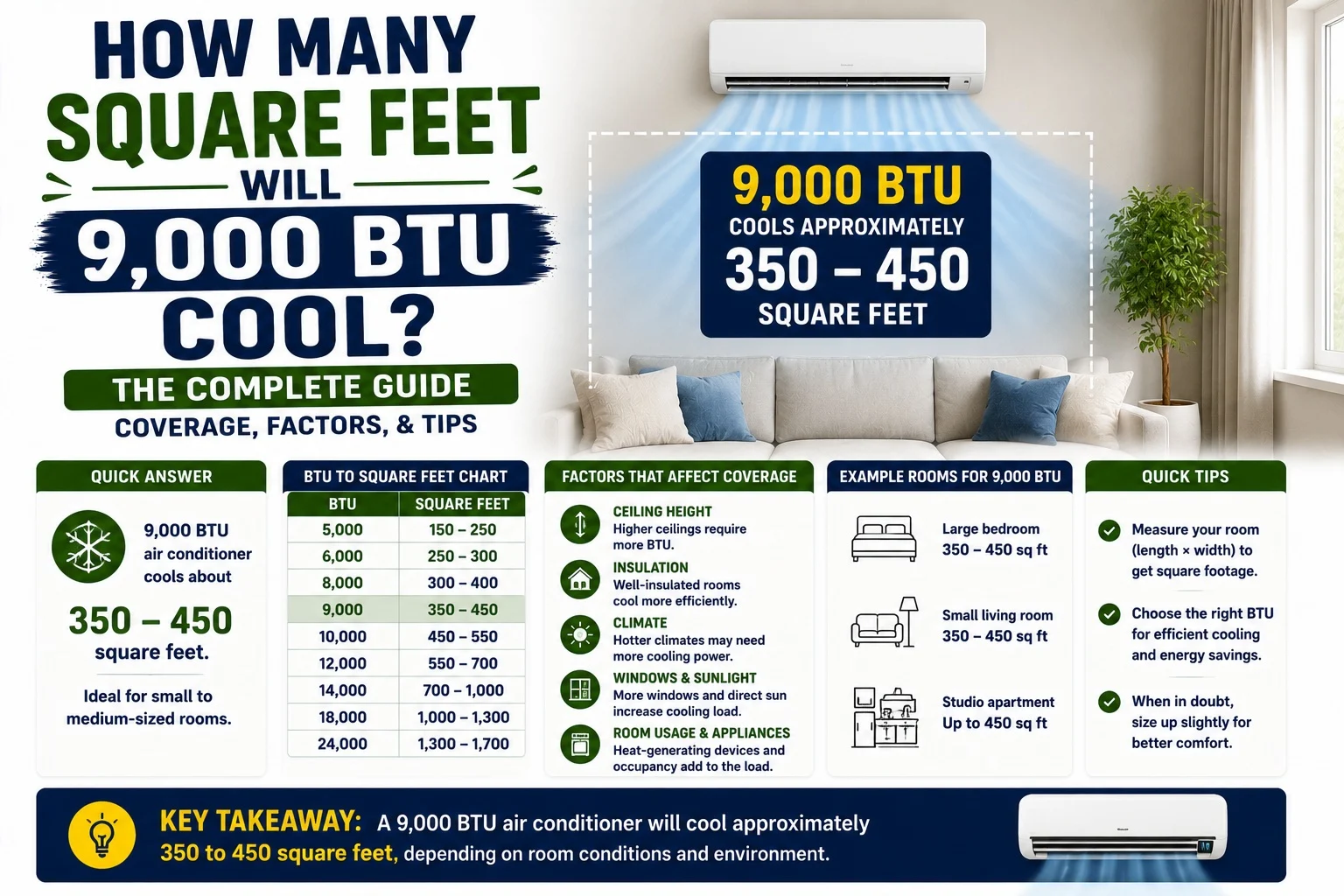
A 9,000 BTU air conditioner can cool approximately 300 to 400 square feet.
Many HVAC professionals use:
9,000 BTU≈350 square feet
as a practical average.
General Coverage Range
| BTU Rating | Approximate Coverage |
|---|---|
| 5,000 BTU | 100–150 sq ft |
| 6,000 BTU | 150–250 sq ft |
| 8,000 BTU | 250–350 sq ft |
| 9,000 BTU | 300–400 sq ft |
| 12,000 BTU | 450–550 sq ft |
Therefore:
A 9,000 BTU unit is typically ideal for rooms between 300 and 400 square feet.
What Does BTU Mean?
BTU stands for:
British Thermal Unit
A BTU measures the amount of heat an air conditioner can remove from a room per hour.
The higher the BTU rating:
- The greater the cooling capacity
- The larger the area the unit can cool
Understanding Cooling Capacity
Air conditioners do not create cold air.
Instead, they remove heat from indoor spaces.
A 9,000 BTU system removes approximately:
9,000 BTU per hour
from the room.
This heat-removal capability determines the recommended room size.
The Basic BTU Rule
A common sizing guideline is:
20 BTU per square foot
Using this formula:
9,000÷20=450 square feet
This suggests a maximum theoretical coverage of about 450 square feet.
However, real-world conditions usually reduce effective coverage to around 300–400 square feet.
Why Manufacturers Recommend 300–400 Square Feet
Cooling recommendations account for:
- Average insulation
- Standard ceiling heights
- Typical occupancy
- Normal climate conditions
These assumptions create more realistic sizing guidelines.
Rooms a 9,000 BTU Unit Can Cool
A properly sized 9,000 BTU system often works well in:
Bedrooms
Most bedrooms range from:
- 120 to 300 square feet
A 9,000 BTU unit is usually more than adequate.
Home Offices
Many home offices measure:
- 100 to 250 square feet
A 9,000 BTU air conditioner can comfortably cool these spaces.
Studio Apartments
Small studio apartments often range from:
- 300 to 400 square feet
A 9,000 BTU unit is commonly used in these applications.
Small Living Rooms
Many smaller living rooms fall within the recommended cooling range.
Example Room Sizes
Room Measuring 15 × 20 Feet
Area:
15×20=300 square feet
A 9,000 BTU unit should cool this room effectively.
Room Measuring 18 × 20 Feet
Area:
18×20=360 square feet
Still within the recommended range.
Room Measuring 20 × 20 Feet
Area:
20×20=400 square feet
Near the upper limit for a 9,000 BTU system.
Factors That Affect Cooling Coverage
Square footage alone doesn’t determine cooling needs.
Several important variables affect performance.
Ceiling Height
Most BTU charts assume:
8-foot ceilings
Higher ceilings increase room volume.
For example:
- 10-foot ceilings contain 25% more air than 8-foot ceilings.
This increases cooling requirements.
Insulation Quality
Well-insulated homes retain cooled air more effectively.
Poor insulation causes:
- Heat gain
- Longer run times
- Reduced efficiency
A well-insulated room may cool effectively with fewer BTUs.
Sun Exposure
Rooms receiving direct sunlight often require additional cooling.
Examples:
- South-facing rooms
- West-facing rooms
- Large window areas
These spaces may need larger systems.
Climate Zone
A 9,000 BTU unit performs differently depending on location.
Mild Climates
Examples:
- Coastal regions
- Northern climates
Coverage may approach:
400−450 square feet
Hot Climates
Examples:
- Desert regions
- Southern states
Coverage may decrease to:
250−350 square feet
Occupancy Levels
People generate heat.
A crowded room requires more cooling capacity.
Additional occupants increase BTU requirements.
Kitchen Heat
If the room includes cooking appliances:
- Ovens
- Stoves
- Dishwashers
Additional BTUs may be needed.
Electronics and Equipment
Computers, gaming systems, and televisions generate heat.
Home offices often require extra cooling capacity.
Mini Split vs Window AC
A 9,000 BTU rating can apply to:
Mini Split Systems
Benefits:
- Higher efficiency
- Quieter operation
- Better temperature control
Window Air Conditioners
Benefits:
- Lower cost
- Easy installation
Coverage remains similar, although efficiency may differ.
Energy Efficiency Considerations
Modern systems often include:
- Inverter technology
- Smart thermostats
- Variable-speed compressors
These features improve comfort and reduce energy consumption.
What Happens If the Unit Is Too Small?
An undersized air conditioner may:
- Run constantly
- Fail to reach desired temperature
- Increase electricity costs
- Wear out faster
What Happens If the Unit Is Too Large?
Oversized units can:
- Short cycle
- Reduce humidity removal
- Create uneven temperatures
- Increase equipment wear
Proper sizing is essential.
Sample BTU Calculation
Suppose a room measures:
16 × 22 feet
Area:
16×22=352 square feet
Using the guideline:
352×20=7,040 BTU
A 9,000 BTU unit would provide comfortable cooling with additional capacity for warmer conditions.
Comparing Common Mini Split Sizes
| BTU Rating | Typical Coverage |
|---|---|
| 6,000 BTU | 150–250 sq ft |
| 9,000 BTU | 300–400 sq ft |
| 12,000 BTU | 450–550 sq ft |
| 18,000 BTU | 700–1,000 sq ft |
| 24,000 BTU | 1,000–1,500 sq ft |
Is a 9,000 BTU Unit Enough for an Apartment?
For many studio and one-bedroom apartments:
Yes.
If the apartment falls within:
- 300–400 square feet
a 9,000 BTU unit is often ideal.
Larger apartments may require multiple indoor units or larger systems.
Common Applications
A 9,000 BTU air conditioner is frequently used for:
- Bedrooms
- Guest rooms
- Home offices
- Small apartments
- Sunrooms
- Small living rooms
- Workshops
FAQs
How many square feet will 9,000 BTU cool?
Typically:
300–400 square feet
Can a 9,000 BTU mini split cool 450 square feet?
Possibly under ideal conditions, but performance may be limited in hotter climates.
Is 9,000 BTU enough for a bedroom?
Yes. Most bedrooms are well within the recommended coverage range.
Is a 9,000 BTU unit energy efficient?
When properly sized, it can be very efficient.
What ceiling height is assumed?
Most sizing recommendations assume:
8-foot ceilings
Conclusion
So, how many square feet will a 9,000 BTU air conditioner cool?
The general answer is:
A 9,000 BTU unit can effectively cool approximately 300 to 400 square feet under normal conditions.
While this range works well for bedrooms, home offices, studio apartments, and smaller living areas, actual performance depends on insulation, climate, ceiling height, sun exposure, occupancy, and other heat-generating factors. Choosing the right BTU capacity helps maximize comfort, improve energy efficiency, and extend the life of your cooling system. Before purchasing an air conditioner or mini split, consider both square footage and room conditions to ensure the best cooling performance possible.