
When thinking about Earth, most people imagine continents, oceans, and countries—but rarely do we think about its total surface area in terms of square feet. A common question is:
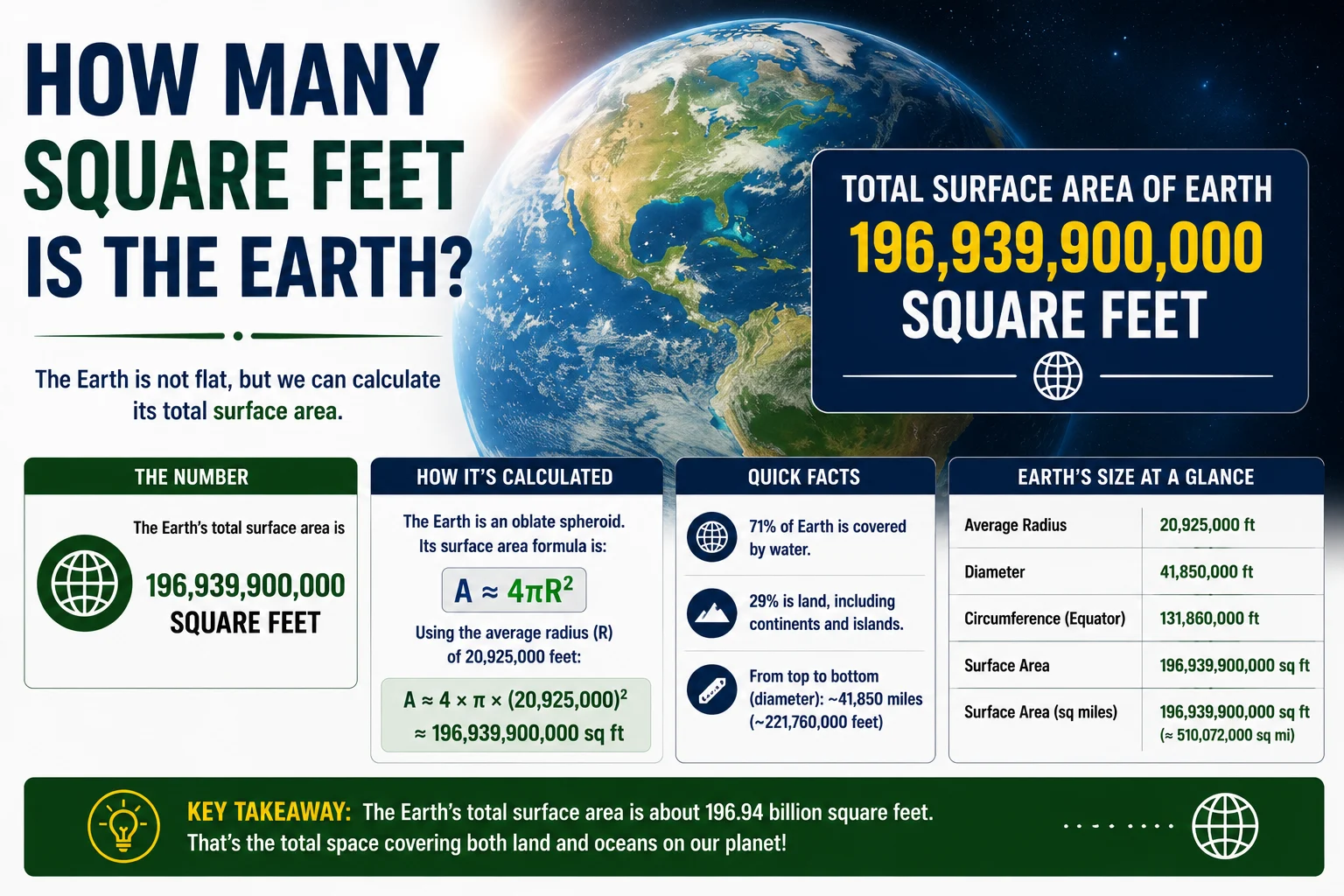
How many square feet is the Earth?
The answer involves a massive scale conversion from scientific units (square kilometers) into square feet, producing a number so large it is difficult to fully comprehend.
In this article, we’ll break down Earth’s total surface area, convert it into square feet, explain land vs water distribution, and help you visualize just how enormous our planet really is.
Quick Answer
Earth’s total surface area is approximately:
510 million square kilometers
When converted to square feet:
5.5 \times 10^{15}\text{ square feet (approximate)
Final Answer:
Earth has about 5.5 quadrillion square feet of surface area
Step 1: Understanding Earth’s Surface Area
Earth is not a perfect sphere, but for calculation purposes we treat it as one.
Its total surface area is:
510,000,000 km2
This includes:
- Land
- Oceans
- Ice caps
- Islands
- Inland water bodies
Step 2: Convert Square Kilometers to Square Feet
The key conversion factor is:
1 km2=10,763,910 ft2
So we multiply:
510,000,000×10,763,910
Step 3: Final Calculation
The result is:
5.49×10¹⁵ square feet
Rounded Answer:
≈ 5,500,000,000,000,000 square feet
What Does 5.5 Quadrillion Square Feet Mean?
This number is extremely large and difficult to visualize. Let’s break it down.
Earth Compared to Football Fields
A standard American football field (including end zones) is about:
57,600 square feet
Now divide Earth’s surface area:
5.5×10¹⁵÷57,600≈95 billion football fields
Earth could fit about 95 billion football fields on its surface.
Land vs Water Breakdown
Earth is mostly water.
Total Surface:
510 million km2
Land Area:
149 million km2
Water Area:
361 million km2
Convert Land Area to Square Feet
Land Only:
149,000,000×10,763,910
≈1.6×10¹⁵ square feet
Convert Water Area to Square Feet
Oceans:
361,000,000×10,763,910
≈3.9×10¹⁵ square feet
Earth Is Mostly Water
Percentage breakdown:
71% water
29% land
This explains why oceans dominate Earth’s total area.
Visualizing Earth’s Surface Area
To make sense of the scale:
Earth vs U.S. Size
The United States is about:
9.8 million km2
So Earth is:
510÷9.8≈52 times larger
Earth in Square Miles (for reference)
Earth’s surface area in square miles:
196.9 million square miles
Converted comparison:
1 square mile=27,878,400 square feet
Why Square Feet Is Not Common for Earth
Square feet are rarely used at planetary scale because:
- Numbers become extremely large
- Hard to visualize
- Scientific fields prefer km²
- Unit becomes impractical
Instead, scientists use:
- Square kilometers
- Square miles
- Hectares (for land)
Earth Surface Area Formula (Conceptual)
For a sphere:
A=4πr2
r
S=4πr2≈113.10r = 3.0
Where Earth’s radius is:
r≈6,371 km
This produces the total surface area.
How Big Is Earth Compared to the Moon?
Moon surface area:
37.9 million km2
Earth is:
510÷37.9≈13.4 times larger
How Big Is Earth Compared to Mars?
Mars surface area:
144.8 million km2
Earth is:
510÷144.8≈3.5 times larger
Real-World Comparison of Earth’s Surface
If Earth were scaled down:
- Oceans would still dominate
- Continents would appear as small clusters
- Human land use would be almost invisible
Why the Number Is So Large
Earth’s huge surface area comes from:
- Large radius (~6,371 km)
- Spherical geometry
- 3D curvature expanding surface coverage
Because area grows with square of radius:
r2 effect increases size dramatically
Key Takeaways
- Earth surface area = 510 million km²
- Converted to square feet = ~5.5 quadrillion ft²
- About 95 billion football fields
- 71% of Earth is water
- Land is only 29%
FAQs
How many square feet is Earth?
≈5.5×10¹⁵ square feet
How much of Earth is land in square feet?
≈1.6×10¹⁵ square feet
How much of Earth is water in square feet?
≈3.9×10¹⁵ square feet
Why don’t we measure Earth in square feet?
Because the numbers are too large and impractical for scientific use.
Conclusion
So, how many square feet is the Earth?
The answer is:
Earth has approximately 5.5 quadrillion square feet of total surface area.
This massive number reflects the true scale of our planet, highlighting just how vast Earth is compared to human-scale measurements like feet or miles. While square feet help us understand everyday spaces, Earth’s size shows why larger scientific units like square kilometers are much more practical for global measurements.