
If you’re planning to install a new lawn, one of the first questions you’ll ask is: how many square feet in one pallet of sod?
It’s a simple question—but the answer can vary depending on several factors like grass type, sod size, and supplier.
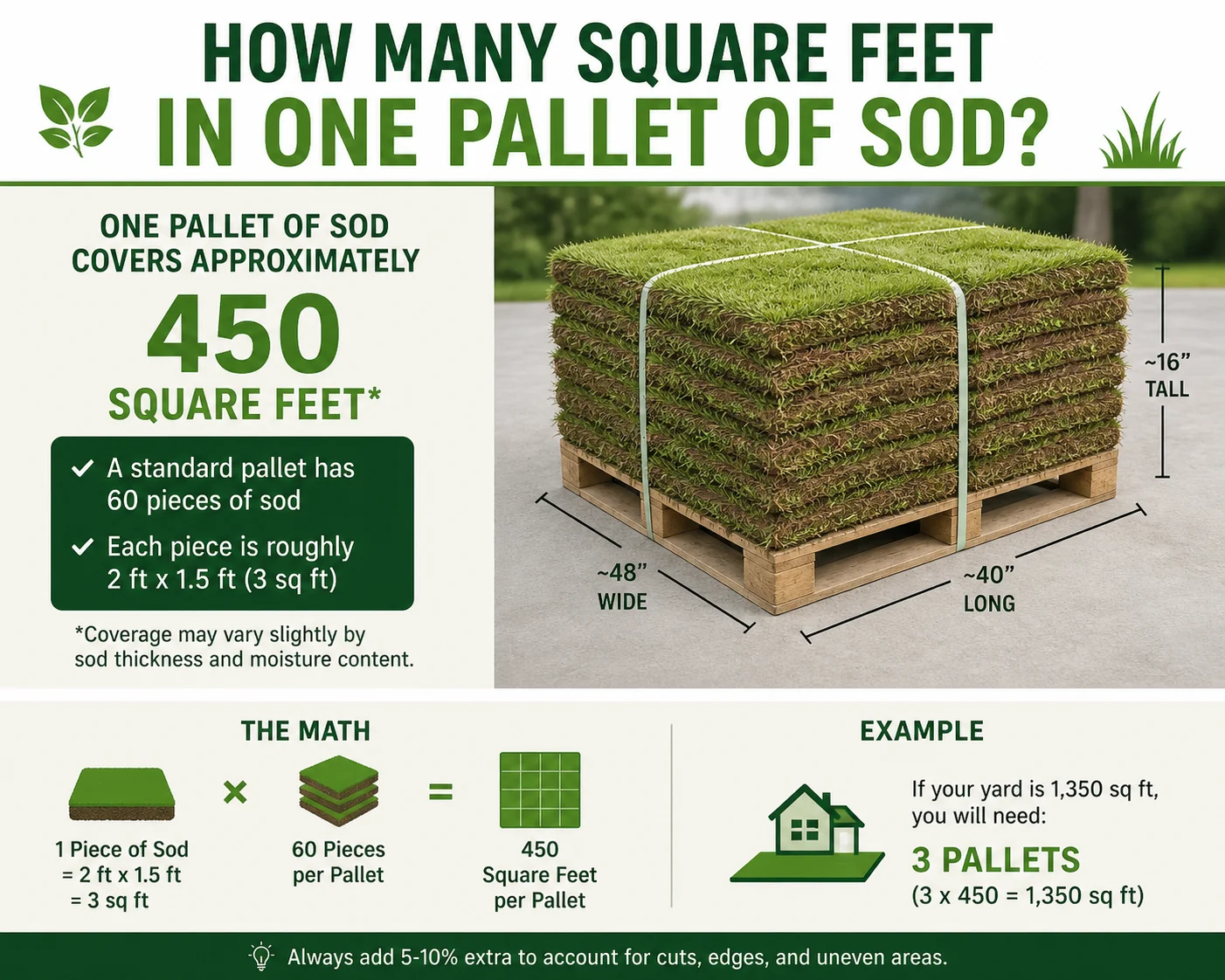
In most cases, one pallet of sod covers between 400 and 500 square feet. However, understanding why that range exists is key to avoiding costly mistakes when ordering.
This guide breaks everything down in plain language. By the end, you’ll know exactly how much sod you need—and how to calculate it like a pro.
Quick Answer: Standard Sod Pallet Coverage
Here’s the straightforward answer:
- Average pallet coverage: 450 square feet
- Typical range: 400–500 square feet
- Number of pieces per pallet: 150–200 pieces
Each piece of sod usually measures about:
- 16 inches × 24 inches (common size)
- Equal to 2.67 square feet per piece
So, when you multiply the number of pieces, you get the total coverage per pallet.
What Is a Pallet of Sod?
A pallet of sod is a stack of pre-grown grass pieces harvested with soil attached. These pieces are cut, stacked, and delivered ready to install.
Think of it like instant lawn carpet.
Sod Roll vs Sod Slab Sizes
Sod comes in different forms depending on the supplier:
| Type | Size (Approx.) | Coverage Per Piece |
|---|---|---|
| Slabs | 16″ × 24″ | 2.67 sq ft |
| Rolls | 18″ × 24″ | 3 sq ft |
| Mini Rolls | Smaller variations | 1–2 sq ft |
Even though sizes vary slightly, the total pallet coverage stays within the 400–500 sq ft range.
Typical Sod Coverage Chart
Here’s a helpful breakdown to visualize how many pallets you might need:
| Lawn Size (sq ft) | Pallets Needed |
|---|---|
| 500 sq ft | 1 pallet |
| 1,000 sq ft | 2–3 pallets |
| 2,000 sq ft | 4–5 pallets |
| 5,000 sq ft | 10–12 pallets |
Tip: Always order 5–10% extra sod to cover cuts, waste, and irregular edges.
Factors That Affect Sod Coverage
While the average answer works for most situations, several factors can change the exact number.
Grass Type
Different grasses are grown and cut differently:
- Bermuda grass: Often tighter, more uniform pieces
- St. Augustine: Larger, thicker slabs
- Zoysia: Denser and sometimes smaller pieces
These differences slightly impact how much fits on a pallet.
Sod Piece Size
Not all suppliers use identical dimensions.
For example:
- Smaller pieces = more pieces per pallet
- Larger rolls = fewer pieces but similar total coverage
So always confirm square footage per pallet, not just piece count.
Supplier Differences
Each farm or supplier may package sod differently.
Some pallets include:
- 400 sq ft exactly
- Others go up to 500 sq ft
Before buying, ask:
- “How many square feet per pallet?”
- “What are the dimensions of each piece?”
This avoids guesswork.
How to Calculate How Much Sod You Need
Knowing how many square feet in one pallet of sod is only half the job. You also need to calculate your lawn size accurately.
Here’s a simple step-by-step method.
Step 1: Measure Your Lawn
Break your yard into basic shapes:
- Rectangles
- Squares
- Circles
Measure each section using a tape measure.
Step 2: Convert to Square Feet
Use these formulas:
- Rectangle: Length × Width
- Square: Side × Side
- Circle: 3.14 × radius²
Add all sections together to get total square footage.
Step 3: Divide by Pallet Coverage
Now divide your total area by pallet coverage.
Example:
- Lawn size: 1,800 sq ft
- Pallet coverage: 450 sq ft
Calculation:
1,800 ÷ 450 = 4 pallets
Add 10% extra → Order 4.5 to 5 pallets
Real-Life Examples
Example 1: Small Backyard
- Area: 600 sq ft
- Coverage: 450 sq ft per pallet
Result:
600 ÷ 450 = 1.33 → Order 2 pallets
Example 2: Medium Lawn
- Area: 2,200 sq ft
2,200 ÷ 450 = 4.88 → Order 5–6 pallets
Example 3: Large Property
- Area: 5,000 sq ft
5,000 ÷ 450 = 11.1 → Order 12 pallets
These examples show why rounding up is always safer.
Cost Per Pallet and Coverage Value
Understanding coverage also helps you estimate costs.
Average Sod Prices
- Per pallet: $150–$450
- Per square foot: $0.30–$0.80
Cost Breakdown Example
If one pallet covers 450 sq ft and costs $300:
- Cost per sq ft = $300 ÷ 450
- = $0.67 per sq ft
This helps you compare suppliers more accurately.
Common Mistakes to Avoid
Many homeowners overpay or run short because of simple mistakes.
Here are the most common ones:
1. Not Measuring Correctly
Guessing lawn size leads to major errors.
Always measure.
2. Ignoring Waste Factor
Cuts, curves, and obstacles create waste.
Always add 5–10% extra sod.
3. Assuming All Pallets Are Equal
They’re not.
Coverage varies by supplier.
4. Ordering Too Little
Running out mid-project can delay installation.
Sod must be installed fresh.
5. Not Considering Lawn Shape
Complex shapes require more sod than simple rectangles.
Expert Tips for Buying Sod
Want a smooth installation? Follow these expert tips.
Buy Fresh Sod
Sod should be installed within 24–48 hours of delivery.
Fresh sod roots faster and survives better.
Ask for Exact Coverage
Always confirm:
- Square feet per pallet
- Piece size
- Grass type
Prepare Your Soil First
Before laying sod:
- Remove weeds
- Level the ground
- Add topsoil if needed
This improves root growth.
Water Immediately
After installation:
- Water thoroughly
- Keep soil moist for 2–3 weeks
This helps sod establish roots.
Install Quickly
Don’t leave sod stacked for long.
Heat can damage it.
FAQs
1. How many square feet in one pallet of sod exactly?
Most pallets cover 400 to 500 square feet, with 450 sq ft being the average.
2. How many pieces of sod are in a pallet?
Typically 150 to 200 pieces, depending on size and supplier.
3. How do I calculate sod for an irregular yard?
Break the yard into simple shapes, calculate each area, and add them together.
4. Should I order extra sod?
Yes. Always add 5–10% extra for waste and trimming.
5. Does sod coverage vary by grass type?
Yes. Different grass types and cutting styles can slightly change coverage per pallet.
Conclusion
So,how many square feet in one pallet of sod?
The simple answer is around 400 to 500 square feet, with 450 square feet being the most common estimate.
But the real key is understanding what affects that number:
- Sod size
- Grass type
- Supplier packaging
By measuring your lawn carefully and using the right calculations, you can order the exact amount you need—without overspending or running short.
If you remember one thing, make it this:
Always calculate your total square footage and divide by pallet coverage, then add extra.
That small step can save you time, money, and frustration—and help you create a perfect, green lawn from day one.