
If you’re planning to build a court, install sports flooring, or simply satisfy your curiosity, you may be wondering how many square feet are in a basketball court. The answer depends on the level of play, as court dimensions vary slightly between professional, college, high school, and youth basketball.
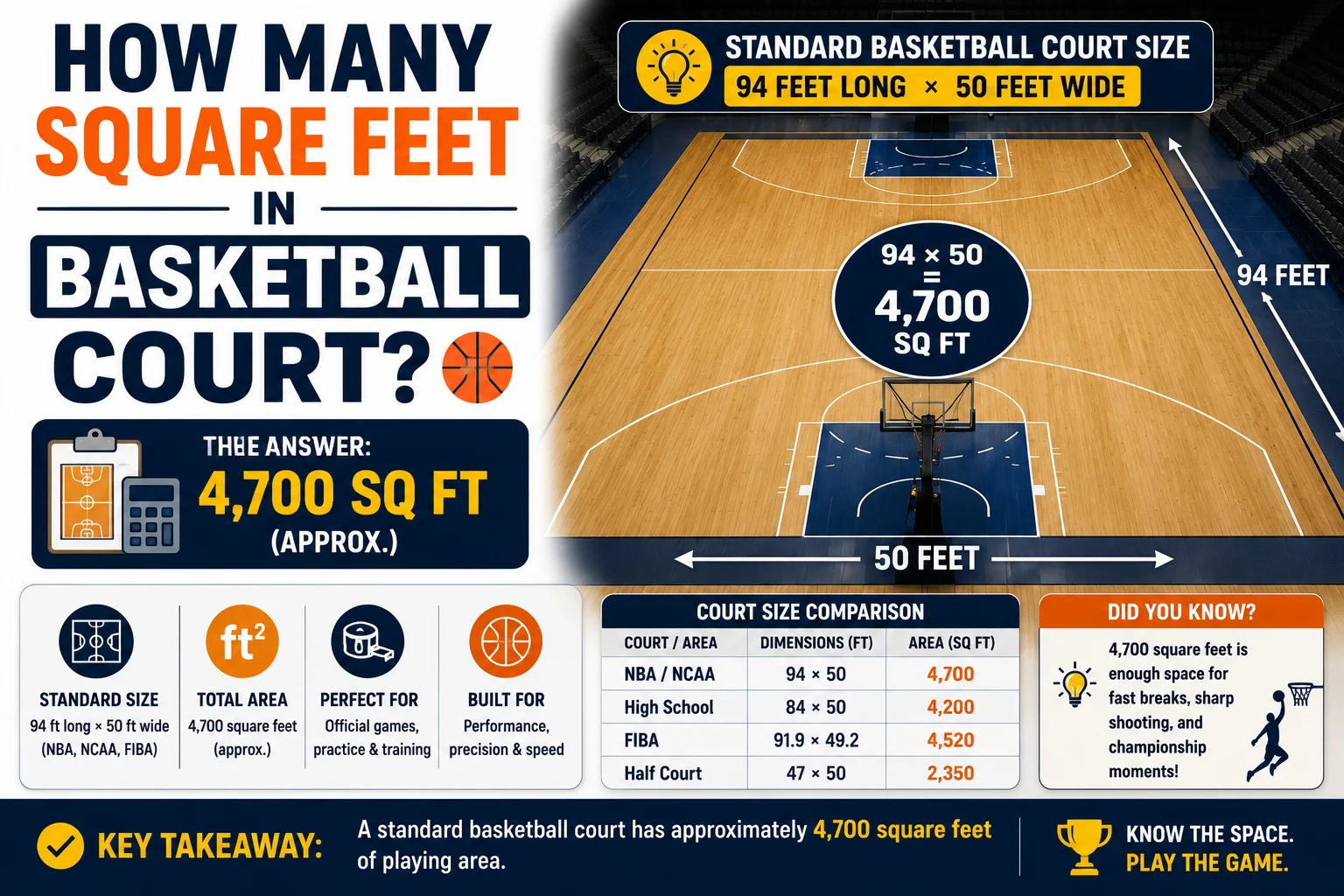
A regulation NBA and NCAA basketball court measures 94 feet long by 50 feet wide, giving it a total area of 4,700 square feet. High school courts are slightly shorter, while youth courts are smaller to accommodate younger players.
This guide explains basketball court sizes, compares different court dimensions, and provides practical examples to help you visualize the space required.
Quick Answer
A standard full-size basketball court measures:
- Length: 94 feet
- Width: 50 feet
This equals:
94 × 50 = 4,700 square feet
A=lw
A=6×4=24
4 rows by 6 columns = 24 square units.
w
w
l
l24 square unitsw = 6l = 4
Here is a quick comparison:
| Court Type | Dimensions | Square Feet |
|---|---|---|
| NBA | 94 × 50 ft | 4,700 sq ft |
| NCAA (College) | 94 × 50 ft | 4,700 sq ft |
| High School | 84 × 50 ft | 4,200 sq ft |
| Junior High | 74 × 42 ft | 3,108 sq ft |
Standard Basketball Court Dimensions
Basketball court sizes are established by governing organizations and vary depending on the age and competition level.
NBA Basketball Court
The National Basketball Association (NBA) uses the largest standard court in North America.
Dimensions:
- Length: 94 feet
- Width: 50 feet
Total area:
4,700 square feet
These dimensions are also used by the Women’s National Basketball Association (WNBA).
NCAA (College) Basketball Court
College basketball courts use the same playing dimensions as NBA courts.
- Length: 94 feet
- Width: 50 feet
Area:
4,700 square feet
Although court markings differ slightly, the playing surface is the same size.
High School Basketball Court
Most U.S. high schools use a slightly shorter court.
Dimensions:
- Length: 84 feet
- Width: 50 feet
Area:
84 × 50 = 4,200 square feet
Junior High and Youth Courts
Youth basketball courts vary depending on the league.
A common junior high court measures:
- 74 feet × 42 feet
Area:
3,108 square feet
Some recreational leagues use even smaller courts.
Basketball Court Size Comparison Chart
| Court Type | Length | Width | Total Area |
|---|---|---|---|
| NBA | 94 ft | 50 ft | 4,700 sq ft |
| NCAA | 94 ft | 50 ft | 4,700 sq ft |
| High School | 84 ft | 50 ft | 4,200 sq ft |
| Junior High | 74 ft | 42 ft | 3,108 sq ft |
This chart makes it easy to compare the most common basketball court sizes.
Full Court vs. Half Court
Many homeowners and schools install half courts instead of full courts.
Typical half-court dimensions:
- 47 feet × 50 feet
Area:
2,350 square feet
Half courts require less space and are ideal for:
- Driveways
- Backyards
- Recreation centers
- Practice facilities
Why Court Size Matters
Knowing the square footage of a basketball court is useful for:
- Estimating construction costs
- Purchasing sports flooring
- Installing outdoor court tiles
- Planning landscaping
- Calculating paint quantities
- Designing gym layouts
Accurate measurements help ensure your project meets official standards if you’re building a regulation court.
Real-World Comparisons
To better visualize 4,700 square feet, consider these examples:
- Roughly the size of two average suburban homes.
- Larger than many residential backyards.
- Approximately 47 parking spaces, assuming about 100 square feet per parking space.
- Nearly 30 times larger than a standard 160-square-foot shipping container.
These comparisons highlight the amount of space required for a full-size basketball court.
Indoor vs. Outdoor Basketball Courts
The playing surface dimensions remain the same for regulation courts, whether indoors or outdoors.
However, outdoor courts usually require additional space for:
- Safety run-off areas
- Benches
- Fencing
- Drainage
- Walkways
If you’re building a backyard court, it’s recommended to allow extra space beyond the official playing area.
Common Mistakes
Avoid these common misconceptions:
- Assuming every basketball court is the same size.
- Forgetting to include safety clearance around the court.
- Confusing full-court and half-court dimensions.
- Measuring only the playing surface when planning construction.
- Ignoring local building codes and setback requirements.
Expert Tips
Before building a basketball court:
- Measure your available land carefully.
- Leave at least 5 to 10 feet of extra space around the court for safety.
- Choose durable sports flooring suitable for your climate.
- Consider lighting if you’ll play at night.
- Verify local zoning regulations before construction.
Proper planning helps create a safer and more enjoyable playing environment.
FAQs
1. How many square feet is a full basketball court?
A regulation NBA or NCAA basketball court measures 4,700 square feet (94 feet × 50 feet).
2. How many square feet is a high school basketball court?
A standard U.S. high school basketball court measures 4,200 square feet (84 feet × 50 feet).
3. How many square feet is a half basketball court?
A typical half court measures approximately 2,350 square feet.
4. Are NBA and college basketball courts the same size?
Yes. Both NBA and NCAA regulation courts measure 94 feet by 50 feet, totaling 4,700 square feet.
5. How much extra space is needed around a basketball court?
For safety, many builders recommend leaving 5–10 feet of additional clearance around the playing surface, depending on the installation and local requirements.
Conclusion
If you’re wondering how many square feet are in a basketball court, the answer depends on the level of play. A regulation NBA and NCAA court measures 4,700 square feet, while a typical high school court measures 4,200 square feet. Youth courts are generally smaller to match the age and skill level of the players.
Whether you’re building a backyard court, designing a gymnasium, or estimating construction materials, understanding standard court dimensions helps ensure accurate planning. By measuring both the playing surface and the recommended safety clearance, you can create a basketball court that is functional, safe, and ready for years of play.