

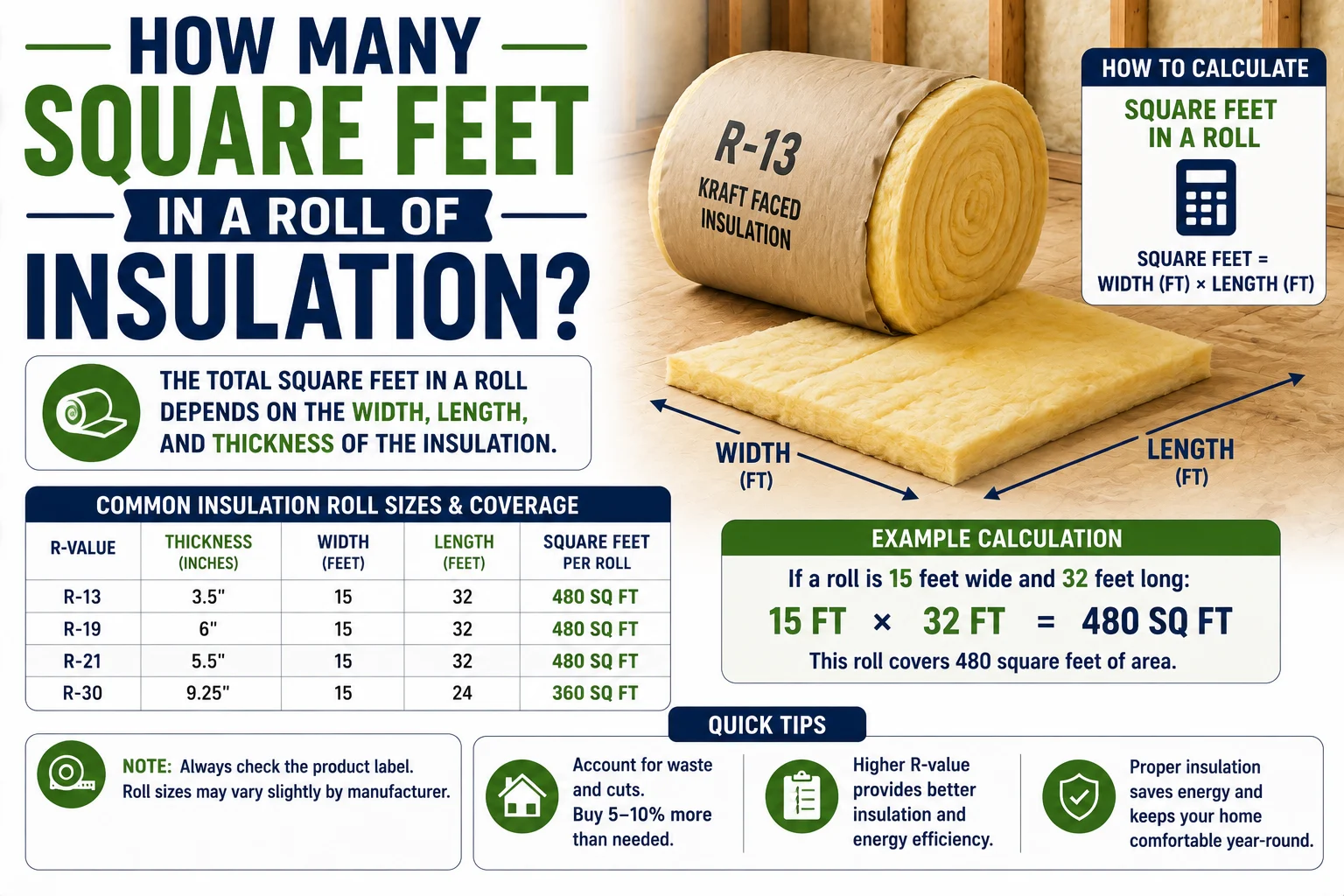
If you’re planning a home improvement project, one of the first questions you may have is how many square feet in a roll of insulation.
The answer depends on the type, thickness, width, and length of the insulation roll. There is no universal square-foot coverage for every roll.
A typical fiberglass insulation roll may cover anywhere from roughly 30 to more than 100 square feet, while larger contractor-style rolls can cover several hundred square feet.
For example, if a roll is 16 inches wide and 25 feet long, its coverage is:
1.33 feet × 25 feet = 33.25 square feet
If another roll is 24 inches wide and 50 feet long, it covers:
2 feet × 50 feet = 100 square feet
Therefore, the best way to determine how many square feet are in a roll of insulation is to check the package’s coverage area or calculate it from the roll’s dimensions.
Quick Answer: How Many Square Feet Are in a Roll of Insulation?
A roll of insulation can cover about 30 to 100+ square feet, depending on its dimensions and R-value.
There is no standard coverage amount for every roll.
The basic calculation is:
Width in feet × Length in feet = Square Feet
For example:
2 feet × 50 feet = 100 square feet
So a roll that is 2 feet wide and 50 feet long covers approximately 100 square feet.
Always check the manufacturer’s package because insulation rolls with greater thickness or higher R-values may have different dimensions and coverage.
Why Do Insulation Rolls Have Different Square Footages?
Insulation manufacturers produce rolls in many sizes to suit different building applications.
The coverage depends primarily on:
- Roll width
- Roll length
- Insulation thickness
- R-value
- Product type
- Intended application
- Manufacturer
A thin roll designed for one application may be longer than a thick roll designed for another.
Likewise, insulation intended for walls may have a different width than insulation designed for attic floors.
Therefore, two rolls that look similar may not cover the same area.
What Is a Roll of Insulation?
A roll of insulation is a flexible insulation product supplied in a continuous rolled form.
Fiberglass is one of the most common types.
Other rolled insulation products can include:
- Mineral wool
- Natural fiber insulation
- Cotton insulation
- Reflective insulation
- Certain foam-based products
Roll insulation is commonly used in:
- Attics
- Exterior walls
- Interior walls
- Floors
- Ceilings
- Crawl spaces
The product is installed between or across building framing members to help slow heat transfer.
How to Calculate Square Feet in a Roll of Insulation
If the manufacturer’s label doesn’t clearly state the coverage, you can calculate it yourself.
Step 1: Measure the Width
Determine the roll’s width.
If the width is listed in inches, convert it to feet.
For example:
16 inches ÷ 12 = 1.33 feet
Step 2: Measure the Length
Determine the total length of the roll in feet.
Step 3: Multiply Width by Length
Use:
Width × Length = Coverage
For example:
1.33 × 25 = 33.25 square feet
So the roll covers approximately 33 square feet.
Common Insulation Roll Coverage
There is a wide range of products on the market.
Here are simplified examples:
| Roll Width | Roll Length | Approx. Coverage |
|---|---|---|
| 16 in | 25 ft | 33 sq ft |
| 16 in | 50 ft | 67 sq ft |
| 24 in | 25 ft | 50 sq ft |
| 24 in | 50 ft | 100 sq ft |
| 32 in | 50 ft | 133 sq ft |
| 48 in | 50 ft | 200 sq ft |
These are mathematical examples, not universal product specifications.
Actual insulation rolls can have different dimensions.
How Many Square Feet Does a Roll of Fiberglass Insulation Cover?
Fiberglass insulation rolls come in many sizes.
Some residential rolls may cover around 30–100 square feet, while larger rolls designed for contractors may cover considerably more.
For example, suppose a fiberglass roll is:
15 inches wide × 40 feet long
Convert 15 inches to feet:
15 ÷ 12 = 1.25 feet
Then:
1.25 × 40 = 50 square feet
That roll would provide approximately 50 square feet of coverage.
The package label should always be checked because product dimensions can vary significantly.
How Many Square Feet in a Roll of R-13 Insulation?
R-13 insulation is available in different widths and lengths.
Therefore, R-13 does not automatically mean a specific square-foot coverage.
R-13 describes the insulation’s approximate thermal resistance, while the roll dimensions determine its area.
For example, if an R-13 roll is 16 inches wide and 50 feet long:
16 ÷ 12 = 1.33 feet
Then:
1.33 × 50 ≈ 66.7 square feet
So that particular roll would cover about 67 square feet.
Another R-13 product could have a different coverage.
How Many Square Feet in a Roll of R-19 Insulation?
The same principle applies to R-19 insulation.
The R-value tells you about thermal resistance, not the total square footage in the package.
Suppose an R-19 product measures:
24 inches × 50 feet
Convert the width:
24 ÷ 12 = 2 feet
Then calculate:
2 × 50 = 100 square feet
So that hypothetical roll covers 100 square feet.
Always use the actual dimensions printed on the package.
How Many Square Feet in a Roll of R-30 Insulation?
R-30 insulation is often thicker than lower-R-value products.
That means the roll may have different dimensions and coverage.
For example, if a product is 24 inches wide and 40 feet long:
2 × 40 = 80 square feet
So it would cover approximately 80 square feet.
However, another R-30 product could have a different roll size.
The important point is:
R-value does not directly determine square-foot coverage.
How Many Rolls of Insulation Do I Need?
To determine the number of rolls required, first calculate the total area you need to insulate.
Then divide the area by the coverage per roll.
The basic formula is:
Total Area ÷ Coverage Per Roll = Number of Rolls
For example, suppose your attic is:
1,000 square feet
and each roll covers:
50 square feet
Then:
1,000 ÷ 50 = 20 rolls
You would need approximately 20 rolls, before accounting for cuts, waste, and installation conditions.
How Many Rolls of Insulation for 500 Square Feet?
Suppose you need to cover:
500 square feet
and each roll covers:
50 square feet
Calculation:
500 ÷ 50 = 10 rolls
You would need approximately 10 rolls.
If the insulation comes in a different coverage size, the number of rolls changes.
For example, with 75 square feet per roll:
500 ÷ 75 = 6.67
You would need to purchase at least 7 rolls.
How Many Rolls of Insulation for 1,000 Square Feet?
For a 1,000-square-foot project:
| Coverage Per Roll | Approx. Rolls Needed |
| 40 sq ft | 25 rolls |
| 50 sq ft | 20 rolls |
| 60 sq ft | 17 rolls |
| 75 sq ft | 14 rolls |
| 80 sq ft | 13 rolls |
| 100 sq ft | 10 rolls |
| 150 sq ft | 7 rolls |
| 200 sq ft | 5 rolls |
Always round up to a whole roll.
You may also need extra material for waste.
How Much Insulation Do I Need for a 1,500-Square-Foot House?
If you’re insulating a 1,500-square-foot area and each roll covers 100 square feet:
1,500 ÷ 100 = 15 rolls
So you would need approximately 15 rolls.
However, this calculation assumes that the entire 1,500 square feet requires the same insulation product.
A house may have different insulation requirements for:
- Attic
- Walls
- Floors
- Basement
- Crawl space
- Ceilings
Therefore, measure each area separately when planning a complete insulation project.
Should You Buy Extra Insulation?
It’s often wise to allow for some waste.
Insulation may need to be cut around:
- Windows
- Doors
- Electrical boxes
- Pipes
- Ducts
- Structural framing
- Corners
- Irregular spaces
For a simple project, a small extra allowance may be sufficient.
For example, if your calculated requirement is 1,000 square feet and you allow 5% extra:
1,000 × 1.05 = 1,050 square feet
This gives you approximately 50 additional square feet.
The appropriate allowance depends on the project layout and material.
Does Insulation Thickness Affect Coverage?
Thickness can affect the dimensions and packaging of insulation, but it doesn’t change the basic area calculation.
For example, two rolls might both be:
2 feet × 50 feet
Both provide:
100 square feet
even if their thicknesses differ.
However, they may have different R-values and intended applications.
Therefore, don’t choose insulation based only on square footage.
You also need to select the appropriate R-value and product type for the application.
What Is R-Value?
R-value measures how well insulation resists heat flow.
Generally, a higher R-value means greater resistance to heat transfer.
The appropriate R-value depends on factors such as:
- Climate
- Building location
- Part of the building
- Construction type
- Local energy requirements
For example, attic insulation may have different R-value recommendations than wall insulation.
Always follow applicable building codes and manufacturer instructions.
Roll Insulation vs. Batt Insulation
Rolls and batts are both common forms of flexible insulation.
Roll Insulation
Rolls are supplied in long continuous lengths.
They can be useful for long, uninterrupted areas.
Batt Insulation
Batts are pre-cut sections.
They can be convenient for standard wall cavities and spaces with predictable dimensions.
| Feature | Roll | Batt |
| Form | Continuous roll | Pre-cut pieces |
| Best for | Long areas | Standard cavities |
| Cutting | Cut to length | Often fewer cuts |
| Coverage | Varies | Varies |
| Common material | Fiberglass | Fiberglass/mineral wool |
Neither is automatically better. The best choice depends on the project.
How to Measure an Area for Insulation
Accurate measurement can help prevent overbuying or running short.
Step 1: Measure the Length
Measure the length of the area in feet.
Step 2: Measure the Width
Measure the width in feet.
Step 3: Multiply
For a rectangular area:
Length × Width = Square Feet
For example:
20 × 30 = 600 square feet
Step 4: Subtract Large Openings
If necessary, subtract areas that don’t need insulation.
Step 5: Add a Small Waste Allowance
Account for cuts and irregular areas.
Example: Insulating a 20 × 30 Attic
Suppose your attic floor is:
20 feet × 30 feet
The area is:
20 × 30 = 600 square feet
If each insulation roll covers 75 square feet:
600 ÷ 75 = 8 rolls
You would need approximately 8 rolls.
If you want a 5% allowance:
600 × 1.05 = 630 square feet
Then:
630 ÷ 75 = 8.4
You would need approximately 9 rolls.
Example: Insulating a 1,200-Square-Foot Area
Suppose the total area is:
1,200 square feet
Each roll covers:
80 square feet
Calculation:
1,200 ÷ 80 = 15 rolls
With a 5% allowance:
1,200 × 1.05 = 1,260 square feet
Then:
1,260 ÷ 80 = 15.75
So you would need approximately 16 rolls.
Common Mistakes When Buying Insulation
Mistake 1: Assuming Every Roll Has the Same Coverage
Different products have different widths and lengths.
Mistake 2: Looking Only at R-Value
R-value doesn’t tell you the roll’s square-foot coverage.
Mistake 3: Forgetting Waste
Cuts around obstacles can reduce usable material.
Mistake 4: Buying Based on House Size Alone
A 1,500-square-foot house does not necessarily have exactly 1,500 square feet of insulation area.
Walls, ceilings, floors, and attics may all have different dimensions.
Mistake 5: Choosing the Wrong Product
Insulation must be appropriate for the location and construction.
Mistake 6: Ignoring Local Requirements
Building codes and energy standards may specify insulation requirements.
How to Save Money When Buying Insulation
You can often reduce unnecessary costs by planning carefully.
Measure First
Don’t estimate the area from the property’s advertised square footage.
Compare Coverage
Look at the number of square feet covered by each package.
Compare R-Value
Two products may have different prices because they provide different thermal performance.
Buy the Correct Width
Choosing insulation that matches the framing can reduce cutting and waste.
Consider Installation
Some insulation products are easier to install than others.
Avoid Overbuying
Extra material is useful, but excessive unused insulation wastes money.
Is More Insulation Always Better?
More insulation isn’t automatically better if it is installed incorrectly.
Proper installation matters.
Common problems include:
- Gaps
- Compression
- Voids
- Incorrect fit
- Moisture problems
- Poor air sealing
Insulation should be installed according to the product’s instructions and the requirements of the building assembly.
Air sealing is also an important part of improving building energy performance.
How Many Square Feet in a Roll of Insulation: Quick Chart
| Roll Coverage | 5 Rolls | 10 Rolls | 20 Rolls |
| 40 sq ft | 200 sq ft | 400 sq ft | 800 sq ft |
| 50 sq ft | 250 sq ft | 500 sq ft | 1,000 sq ft |
| 60 sq ft | 300 sq ft | 600 sq ft | 1,200 sq ft |
| 75 sq ft | 375 sq ft | 750 sq ft | 1,500 sq ft |
| 80 sq ft | 400 sq ft | 800 sq ft | 1,600 sq ft |
| 100 sq ft | 500 sq ft | 1,000 sq ft | 2,000 sq ft |
| 150 sq ft | 750 sq ft | 1,500 sq ft | 3,000 sq ft |
| 200 sq ft | 1,000 sq ft | 2,000 sq ft | 4,000 sq ft |
This chart is useful for estimating material requirements once you know the coverage printed on the package.
FAQs
1. How many square feet are in a roll of insulation?
A roll can cover approximately 30 to 100+ square feet, although larger contractor rolls may cover significantly more. The exact coverage depends on the roll’s width and length.
2. How do I calculate insulation roll coverage?
Convert the roll width to feet and multiply it by the roll’s length in feet.
Width × Length = Square Feet
For example, a 2-foot-wide, 50-foot-long roll covers 100 square feet.
3. How many rolls of insulation do I need for 1,000 square feet?
It depends on the coverage per roll. If each roll covers 50 square feet, you need 20 rolls. If each covers 100 square feet, you need 10 rolls.
4. Does R-value determine how many square feet are in a roll?
No. R-value measures thermal resistance. The roll’s physical width and length determine its square-foot coverage.
5. Should I buy extra insulation?
Usually, some extra material is helpful because insulation often needs to be cut around framing, pipes, windows, doors, and other obstacles. The appropriate amount depends on the project.
Conclusion
So, how many square feet in a roll of insulation? There isn’t one universal answer. A typical residential insulation roll may cover roughly 30 to 100+ square feet, while larger rolls can cover several hundred square feet.
The most reliable method is to check the package for its listed coverage. If the coverage isn’t provided, calculate it using:
Width in feet × Length in feet = Square Feet
For example, a roll that is 2 feet wide and 50 feet long covers:
2 × 50 = 100 square feet
When planning an insulation project, don’t look only at square footage. Also consider the required R-value, insulation type, thickness, installation area, framing dimensions, local requirements, and potential material waste.
To estimate how many rolls you need, divide the total area by the coverage per roll and round up. Adding a modest allowance for cutting and waste can also help prevent running out of material.