
If you’re trying to cool a home, apartment, office, or open living space, you may be wondering how many BTU for 720 square feet.
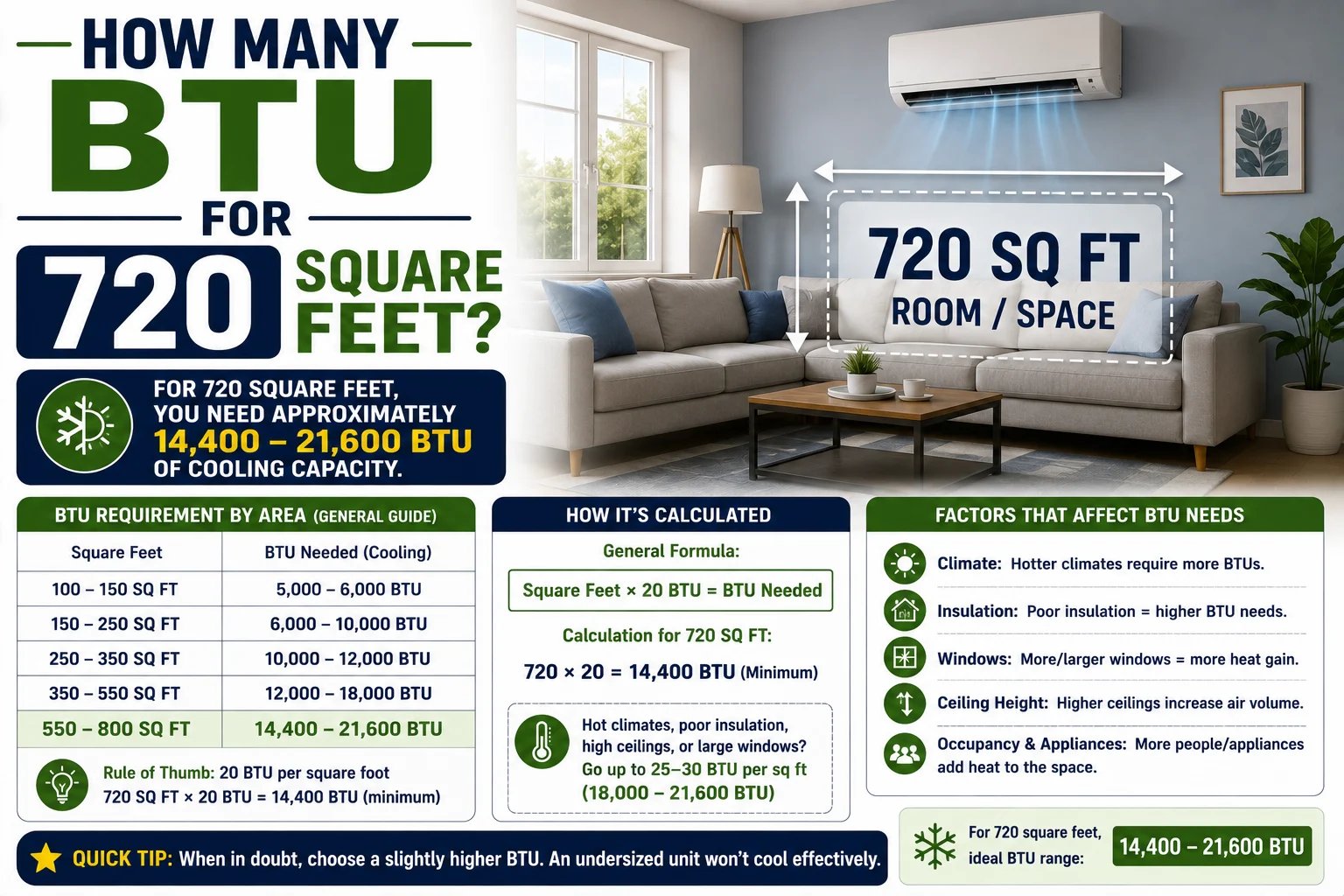
For a typical 720-square-foot space, a reasonable starting point is around 14,000 to 16,000 BTU of cooling capacity, depending on climate, insulation, ceiling height, sun exposure, windows, and how the space is used.
However, square footage alone does not determine the correct air conditioner size.
For example, a well-insulated 720-square-foot apartment in a mild climate may need less cooling than a poorly insulated space in a very hot climate. A room with large south- or west-facing windows can also require more cooling.
As a general planning estimate, around 15,000 BTU can be a useful starting point for 720 square feet, but an HVAC professional should perform a proper load calculation for a permanent system.
Quick Answer: How Many BTU for 720 Square Feet?
A 720-square-foot space may require approximately:
14,000–16,000 BTU
for typical cooling conditions.
A simple estimate can be based on roughly 20 BTU per square foot:
720 × 20 = 14,400 BTU
Rounding that figure gives approximately 14,000–15,000 BTU.
However, this is only a rough estimate.
| Space Condition | Approximate BTU Range |
|---|---|
| Mild climate, good insulation | 12,000–14,000 BTU |
| Average conditions | 14,000–16,000 BTU |
| Hot climate or more sun | 16,000–18,000 BTU+ |
| Poor insulation/high heat gain | May require more |
The exact requirement depends on the building’s cooling load.
What Does BTU Mean?
BTU stands for British thermal unit.
In air conditioning, BTU is commonly used to describe cooling capacity.
A higher BTU rating generally means an air conditioner can remove more heat from a space.
For example:
- 8,000 BTU = lower cooling capacity
- 10,000 BTU = moderate cooling capacity
- 12,000 BTU = higher cooling capacity
- 15,000 BTU = still higher capacity
- 18,000 BTU = significantly higher capacity
Choosing the right size matters because bigger is not always better.
An oversized air conditioner can cool a room quickly but may cycle on and off too often. This can reduce comfort and humidity control.
An undersized unit may run continuously while struggling to maintain the desired temperature.
How Do You Calculate BTU for 720 Square Feet?
A basic estimate can be made by multiplying the area by an approximate BTU-per-square-foot factor.
For example:
720 square feet × 20 BTU = 14,400 BTU
So the basic estimate is:
14,400 BTU
This can then be adjusted based on the room’s conditions.
A simple square-footage estimate is useful for preliminary shopping, but it does not replace a professional HVAC load calculation.
Is 12,000 BTU Enough for 720 Square Feet?
A 12,000 BTU air conditioner may be enough in some situations, but it may be undersized for others.
It could work reasonably well when:
- The climate is mild
- The space is well insulated
- Ceilings are standard height
- There are limited windows
- Windows have good energy performance
- There is little direct sunlight
- The space has relatively low heat gain
However, if the 720-square-foot area is in a hot climate or has poor insulation, 12,000 BTU may not provide enough cooling.
For a larger open area, you should consider the actual cooling load rather than choosing solely by square footage.
Is 15,000 BTU Good for 720 Square Feet?
A 15,000 BTU air conditioner can be a reasonable capacity range for a 720-square-foot space under many typical conditions.
Using the simple estimate:
720 × 20 = 14,400 BTU
A 15,000 BTU unit is close to that estimate.
It may be appropriate when the space has average insulation and moderate heat gain.
However, not every manufacturer offers a 15,000 BTU model. You may instead find a unit rated around 14,000, 15,000, or 16,000 BTU depending on the product category.
Is 18,000 BTU Too Much for 720 Square Feet?
An 18,000 BTU unit may be oversized for some 720-square-foot spaces, but it could be appropriate under demanding conditions.
For example, additional cooling capacity may be needed when the space has:
- Very high outdoor temperatures
- Poor insulation
- Large windows
- Strong direct sunlight
- High ceilings
- Several occupants
- Heat-producing appliances
- Significant air leakage
The goal is not to select the largest air conditioner available.
The goal is to match the equipment to the actual cooling load.
720 Square Feet AC Size Chart
The following chart provides a rough starting point:
| Area | Approx. Basic BTU Estimate |
| 500 sq ft | 10,000 BTU |
| 600 sq ft | 12,000 BTU |
| 700 sq ft | 14,000 BTU |
| 720 sq ft | 14,400 BTU |
| 800 sq ft | 16,000 BTU |
| 900 sq ft | 18,000 BTU |
| 1,000 sq ft | 20,000 BTU |
These figures are simplified estimates based on approximately 20 BTU per square foot.
Actual HVAC sizing should consider more than floor area.
What Factors Affect BTU Requirements?
Square footage is important, but several other factors affect the amount of cooling a space needs.
1. Climate
A building in a hot, humid climate generally needs more cooling than the same building in a mild climate.
Outdoor temperature and humidity influence the cooling load.
2. Insulation
Good insulation helps keep outdoor heat from entering the building.
Poor insulation can increase the amount of cooling required.
3. Windows
Large windows can allow significant solar heat gain.
Energy-efficient windows and appropriate shades can reduce that heat gain.
4. Ceiling Height
A room with 8-foot ceilings contains less air volume than one with 12-foot ceilings.
Higher ceilings can therefore affect the cooling requirement.
5. Sun Exposure
Rooms with strong direct sunlight may require more cooling than shaded spaces.
West-facing windows can be particularly important because they receive strong afternoon sun.
6. Number of Occupants
People generate heat.
A room regularly occupied by several people may require more cooling than an otherwise identical space occupied by one person.
7. Appliances
Ovens, computers, televisions, refrigerators, lighting, and other equipment generate heat.
A kitchen or office may therefore require more cooling than a bedroom of the same size.
Does a 720-Square-Foot Apartment Need the Same BTU?
Not necessarily.
Two apartments can both measure 720 square feet but have very different cooling requirements.
Apartment A
- Good insulation
- Double-pane windows
- Shaded exterior
- Standard ceilings
- Mild climate
This apartment may require less cooling.
Apartment B
- Poor insulation
- Large unshaded windows
- High ceilings
- Hot climate
- Several occupants
This apartment may need significantly more capacity.
This is why square footage should be treated as a starting point, not a complete sizing method.
What Size Window AC for 720 Square Feet?
Window air conditioners are often selected based on room or area size.
For a 720-square-foot area, a unit around 14,000–16,000 BTU may be a reasonable starting range under average conditions.
However, window AC sizing can depend on:
- Room layout
- Climate
- Sun exposure
- Ceiling height
- Insulation
- Number of people
- Whether the area is divided into multiple rooms
If the 720 square feet consists of several closed rooms, one window unit may not distribute air effectively throughout the entire space.
An open floor plan is easier for one unit to cool.
What Size Portable AC for 720 Square Feet?
Portable air conditioners require special attention because their performance can differ from window units.
A portable AC advertised for a particular square footage may use a different rating system than a traditional window unit.
For a 720-square-foot area, you may see portable AC recommendations in the 14,000 BTU class or higher, depending on the model and conditions.
Always compare the unit’s stated cooling capacity and the manufacturer’s recommended room size.
Don’t select a portable AC based only on the largest marketing number on the box.
What Size Mini Split for 720 Square Feet?
A mini-split system is another option for cooling 720 square feet.
Depending on the building’s cooling load, a system around 15,000–18,000 BTU may be considered, but actual sizing can vary substantially.
Mini-splits are particularly useful when:
- There is no existing ductwork
- You want zone control
- The space has an open layout
- You want efficient cooling
- Individual rooms need different temperatures
For a permanent mini-split installation, professional sizing is recommended.
Can a 10,000 BTU AC Cool 720 Square Feet?
A 10,000 BTU air conditioner may cool a 720-square-foot space under favorable conditions, but it is likely to be undersized for many typical situations.
For example, if the space is:
- Very well insulated
- Mildly conditioned
- Shaded
- Lightly occupied
10,000 BTU might provide useful cooling.
But in a hot climate or poorly insulated building, the unit may struggle.
An undersized AC can run for long periods without reaching the desired temperature.
Can a 12,000 BTU AC Cool 720 Square Feet?
Yes, a 12,000 BTU unit can cool 720 square feet in some conditions, particularly when the space has low heat gain.
However, 12,000 BTU is below the simple 20-BTU-per-square-foot estimate:
720 × 20 = 14,400 BTU
Therefore, you should evaluate the space carefully before choosing a 12,000 BTU unit.
Can a 15,000 BTU AC Cool 720 Square Feet?
Yes. 15,000 BTU is close to the basic estimated requirement for 720 square feet.
Using the simple calculation:
720 × 20 = 14,400 BTU
A 15,000 BTU unit is therefore a reasonable starting point for many average-condition spaces.
Still, the actual cooling load can be higher or lower.
Can a 18,000 BTU AC Cool 720 Square Feet?
Yes, an 18,000 BTU AC can cool 720 square feet.
The important question is whether it is appropriately sized.
An oversized unit can reach the thermostat setting quickly and shut off before adequately removing humidity.
That can result in:
- Uneven comfort
- Short cycling
- Higher operating costs
- Poor humidity control
However, in a space with unusually high heat gain, 18,000 BTU may be justified.
720 Square Feet: BTU Comparison
| AC Capacity | Possible Suitability for 720 sq ft |
| 8,000 BTU | Usually too small |
| 10,000 BTU | May be too small |
| 12,000 BTU | Possible in favorable conditions |
| 14,000 BTU | Reasonable starting range |
| 15,000 BTU | Close to basic estimate |
| 16,000 BTU | Suitable for many average conditions |
| 18,000 BTU | May be needed for high heat gain |
| 24,000 BTU | Often excessive unless load is unusually high |
This is a general comparison rather than a professional sizing chart.
What Happens if Your AC Is Too Small?
An undersized air conditioner may struggle to cool the room.
Common signs include:
- The AC runs almost constantly
- The temperature never reaches the thermostat setting
- The room remains warm during peak afternoon hours
- The unit struggles during heat waves
- Energy consumption may increase because of long operating periods
If these problems occur, check whether the unit is properly sized and whether there are insulation, ductwork, airflow, or equipment issues.
What Happens if Your AC Is Too Large?
An oversized air conditioner can also cause problems.
It may:
- Cool the room very quickly
- Shut off frequently
- Provide less effective dehumidification
- Create uneven temperatures
- Increase wear from frequent cycling
The best system is appropriately sized for the building.
Bigger does not automatically mean better.
How to Improve Cooling in a 720-Square-Foot Space
Before buying a larger AC, consider reducing heat gain.
Improve Insulation
Proper insulation can reduce heat entering the building.
Seal Air Leaks
Seal gaps around doors, windows, and other openings.
Use Window Shades
Blinds, curtains, or shades can reduce solar heat gain.
Improve Ventilation
Ensure appropriate ventilation without allowing excessive hot outdoor air into the conditioned space.
Maintain the AC
Clean filters and maintain airflow according to the manufacturer’s instructions.
Reduce Indoor Heat
Energy-efficient lighting and appliances can reduce internal heat production.
These improvements may reduce the cooling load and improve comfort.
How Many BTU per Square Foot Should You Use?
A rough planning estimate of 20 BTU per square foot is sometimes used for basic calculations.
For 720 square feet:
720 × 20 = 14,400 BTU
However, this should not be treated as a universal HVAC rule.
Real HVAC design uses a much more detailed calculation that considers:
- Outdoor design temperature
- Indoor target temperature
- Building envelope
- Insulation
- Windows
- Solar gain
- Occupancy
- Appliances
- Air infiltration
- Duct losses
- Orientation
For a central AC system, a professional Manual J load calculation is a much better approach.
Energy Efficiency Matters Too
BTU tells you about cooling capacity, but it doesn’t tell you everything about operating cost.
When comparing air conditioners, also consider efficiency ratings and the equipment’s actual performance.
An efficient unit can provide the required cooling while using less electricity than a less efficient model of similar capacity.
Look at:
- Efficiency rating
- Energy Star certification where applicable
- Compressor technology
- Fan efficiency
- Variable-speed operation
- Seasonal performance
The most efficient choice is still one that is correctly sized for the space.
Common Mistakes When Choosing an AC for 720 Square Feet
Mistake 1: Choosing the Biggest AC
A larger unit is not automatically better.
Mistake 2: Looking Only at Square Footage
Climate, insulation, windows, and occupancy matter.
Mistake 3: Ignoring Ceiling Height
High ceilings can change the cooling load.
Mistake 4: Forgetting Sun Exposure
Direct sunlight can add substantial heat.
Mistake 5: Ignoring Humidity
A system needs appropriate run time to remove moisture effectively.
Mistake 6: Using One AC for Multiple Closed Rooms
Air distribution may be poor if doors and walls separate the space.
Mistake 7: Ignoring Manufacturer Ratings
Always compare the actual specifications of the unit you’re considering.
Real-World Example: 720-Square-Foot Apartment
Imagine a 720-square-foot apartment with:
- 8-foot ceilings
- Average insulation
- Moderate window area
- Several windows with some sun exposure
- Two occupants
- A warm summer climate
A simple estimate gives:
720 × 20 = 14,400 BTU
A unit around 14,000–16,000 BTU may therefore be a reasonable starting range.
But a professional load calculation could produce a different result.
Real-World Example: Well-Insulated 720-Square-Foot Space
Now imagine the same floor area with:
- Excellent insulation
- Energy-efficient windows
- Heavy shade
- Few occupants
- Mild outdoor temperatures
The cooling requirement may be lower than the simple 14,400-BTU estimate.
This shows why a square-foot calculation is only a preliminary guide.
Real-World Example: Hot and Poorly Insulated 720-Square-Foot Space
Consider a 720-square-foot building with:
- Poor insulation
- Large unshaded windows
- High ceilings
- Hot outdoor temperatures
- Several occupants
- Heat-producing appliances
The cooling load may be substantially higher than the basic estimate.
In this case, simply purchasing a 14,000-BTU unit without evaluating the building could result in inadequate cooling.
Frequently Asked Questions
1. How many BTU do I need for 720 square feet?
A rough starting estimate is around 14,000–16,000 BTU for average conditions. A simple 20-BTU-per-square-foot calculation gives 14,400 BTU, but actual requirements vary.
2. Is 12,000 BTU enough for 720 square feet?
It can be enough under favorable conditions, such as good insulation, mild weather, shade, and low heat gain. In a hot climate or poorly insulated space, it may be undersized.
3. Is 15,000 BTU enough for 720 square feet?
A 15,000-BTU air conditioner is close to the basic estimated requirement for 720 square feet and may work well under average conditions. Actual sizing depends on the building.
4. Is 18,000 BTU too much for 720 square feet?
It may be oversized for a typical 720-square-foot space, but high heat gain, poor insulation, high ceilings, or a very hot climate can increase the required capacity.
5. How many BTU per square foot should I use?
For a quick estimate, around 20 BTU per square foot can provide a starting point. However, professional HVAC sizing considers many additional factors and should be used for permanent systems.
Conclusion
So, how many BTU for 720 square feet? A reasonable starting estimate for an average space is approximately 14,000–16,000 BTU.
Using a simple estimate of 20 BTU per square foot:
720 × 20 = 14,400 BTU
That puts a 720-square-foot space near the 14,000–15,000 BTU range, although actual requirements can vary.
A well-insulated space in a mild climate may need less cooling, while a poorly insulated property with large sunny windows in a hot climate may need considerably more.
When choosing an air conditioner, consider:
- Climate
- Insulation
- Ceiling height
- Window size
- Sun exposure
- Number of occupants
- Appliances
- Building layout
- Air leakage
For a window or portable AC, use the manufacturer’s recommended room-size guidance along with its cooling-capacity rating. For a central AC or permanent mini-split system, a professional load calculation is the safest way to determine the correct size.