

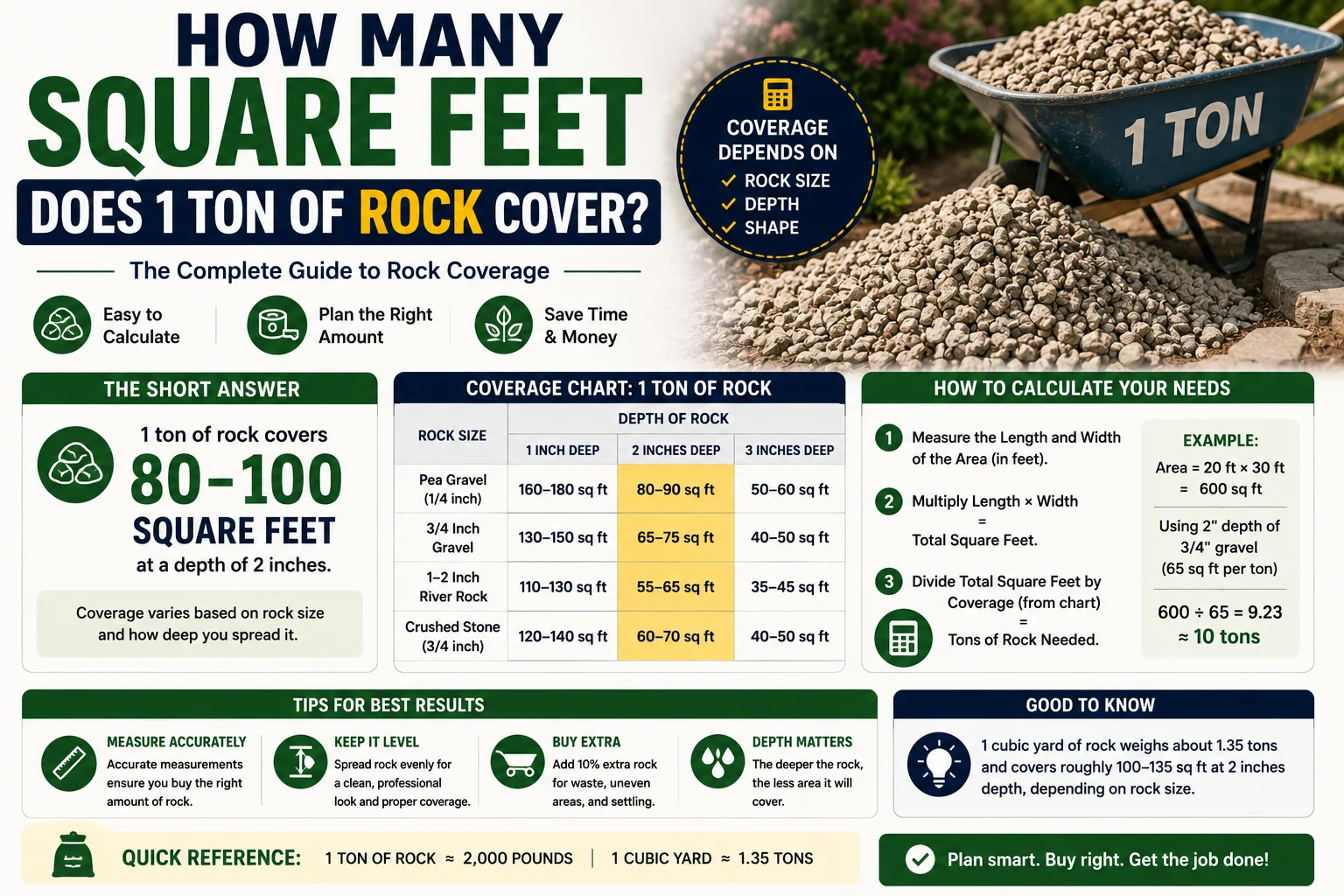
If you are planning a landscaping or construction project, you may be asking, how many square feet does 1 ton of rock cover? The answer depends mainly on the depth of the rock layer and the type of stone you choose.
As a general rule:
- At a depth of 1 inch, 1 ton of rock covers about 240 square feet.
- At a depth of 2 inches, 1 ton covers about 120 square feet.
- At a depth of 3 inches, 1 ton covers about 80 square feet.
- At a depth of 4 inches, 1 ton covers about 60 square feet.
Because landscaping rocks vary in size and density, these numbers are estimates. However, they provide a good starting point when planning a project.
Whether you are covering a driveway, garden bed, walkway, or patio, understanding rock coverage will help you buy the right amount and avoid unnecessary costs.
Quick Answer
The table below shows the approximate coverage of 1 ton of rock at different depths.
| Depth of Rock | Approximate Coverage |
|---|---|
| 1 inch | 240 sq ft |
| 2 inches | 120 sq ft |
| 3 inches | 80 sq ft |
| 4 inches | 60 sq ft |
For most landscaping projects, installers recommend a depth of 2 to 3 inches.
Rock Coverage Chart by Depth
Here is a more detailed coverage chart.
| Rock Depth | Coverage per Ton |
|---|---|
| 1 inch | 240 square feet |
| 1.5 inches | 160 square feet |
| 2 inches | 120 square feet |
| 2.5 inches | 96 square feet |
| 3 inches | 80 square feet |
| 4 inches | 60 square feet |
| 5 inches | 48 square feet |
As the layer becomes deeper, the amount of area covered decreases.
Why Coverage Depends on Depth
Many people assume that one ton of rock always covers the same amount of space. In reality, the coverage changes based on how thick the rock layer is.
One-Inch Layer
A thin, 1-inch layer is often used for:
- Decorative gardens
- Flower beds
- Light ground cover
Coverage:
- Approximately 240 square feet.
Two-Inch Layer
A 2-inch layer is one of the most common choices.
It works well for:
- Walkways
- Landscaping borders
- Backyard projects
Coverage:
- About 120 square feet.
Three-Inch Layer
A 3-inch depth provides better durability and weed control.
It is often used for:
- Play areas
- Drainage zones
- Larger landscape projects
Coverage:
- Around 80 square feet.
How to Calculate Rock Coverage
To estimate how much rock you need, follow these steps.
Step 1: Measure the Area
Measure the length and width of the space.
A=lw
A=6×4=24
4 rows by 6 columns = 24 square units.
w
w
l
l24 square unitsw = 6l = 4
For example:
- Length: 20 feet
- Width: 10 feet
Area:
20 × 10 = 200 square feet.
Step 2: Choose the Desired Depth
Decide how thick the rock layer should be.
Common depths:
- 1 inch
- 2 inches
- 3 inches
- 4 inches
Step 3: Estimate the Tons Needed
Suppose you want to cover 200 square feet at a depth of 2 inches.
Since one ton covers approximately 120 square feet:
200 ÷ 120 = 1.67 tons.
You would need about 1.7 tons of rock.
Coverage by Rock Type
Different types of rock may provide slightly different coverage because their density and shape vary.
Gravel
Gravel is commonly used for:
- Driveways
- Pathways
- Drainage
Average coverage:
- 100–120 square feet per ton at a depth of 2 inches.
Crushed Stone
Crushed stone compacts tightly and is often used for:
- Foundations
- Roads
- Parking areas
Coverage:
- About 90–120 square feet per ton.
River Rock
River rock is larger and more decorative.
Typical uses:
- Landscaping
- Water features
- Garden beds
Coverage:
- Approximately 70–110 square feet per ton.
Decorative Rock
Decorative stones vary greatly in size.
Coverage depends on:
- Rock diameter
- Shape
- Weight
Always check the supplier’s recommendations.
Common Landscaping Projects and Coverage Estimates
Here are some common projects and the amount of rock they may require.
| Project | Area | Approximate Tons Needed |
|---|---|---|
| Small flower bed | 100 sq ft | 1 ton |
| Garden path | 120 sq ft | 1 ton |
| Backyard seating area | 240 sq ft | 2 tons |
| Driveway section | 480 sq ft | 4 tons |
These estimates assume a depth of about 2 inches.
Factors That Affect Rock Coverage
Several factors influence how much area one ton of rock will cover.
Rock Size
Larger rocks leave more empty spaces between pieces.
Shape
Rounded river rock covers differently than crushed stone.
Compaction
Compacted rock takes up less space than loose rock.
Moisture Content
Wet rock can weigh more than dry rock.
Installation Depth
The deeper the layer, the smaller the coverage area.
Common Mistakes When Buying Rock
Avoid these common errors.
Ignoring Depth
Many people forget that depth dramatically changes coverage.
Underestimating Waste
Always order a little extra material.
Experts often recommend buying:
- 5–10% more than your estimate.
Choosing the Wrong Rock Type
Decorative rocks and construction gravel are designed for different purposes.
Forgetting Delivery Costs
Rock is heavy, and delivery fees can add significantly to the total cost.
Tips for Ordering Landscaping Rock
To get the best results:
- Measure carefully.
- Decide on the desired depth.
- Compare rock types.
- Ask suppliers for coverage charts.
- Order extra material.
- Consider drainage needs.
Proper planning helps prevent delays and extra expenses.
Rock Coverage Compared to Cubic Yards
Rock is often sold by both weight and volume.
Here are some rough conversions:
| Material | Approximate Volume |
|---|---|
| 1 ton of gravel | 0.67 cubic yards |
| 1 ton of crushed stone | 0.75 cubic yards |
| 1 ton of river rock | 0.70 cubic yards |
Keep in mind that actual values vary by supplier.
FAQs
How many square feet does 1 ton of gravel cover?
At a depth of 2 inches, one ton of gravel typically covers about 120 square feet.
How many square feet does 1 ton of rock cover at 3 inches deep?
At a depth of 3 inches, one ton usually covers approximately 80 square feet.
How many tons of rock do I need for 500 square feet?
At a depth of 2 inches, you would need roughly 4.2 tons of rock.
Does river rock cover more area than gravel?
Not always. Coverage depends on the rock’s size, shape, and density.
Should I buy extra rock?
Yes. Most professionals recommend ordering 5–10% extra to account for waste and settling.
Conclusion
Now you know the answer to how many square feet does 1 ton of rock cover. In most cases, one ton covers between 60 and 240 square feet, depending on the depth and type of rock.
Before starting your landscaping project, measure the area carefully, choose the right depth, and order a little extra material. With accurate planning, you can save money and create a beautiful outdoor space that lasts for years.