

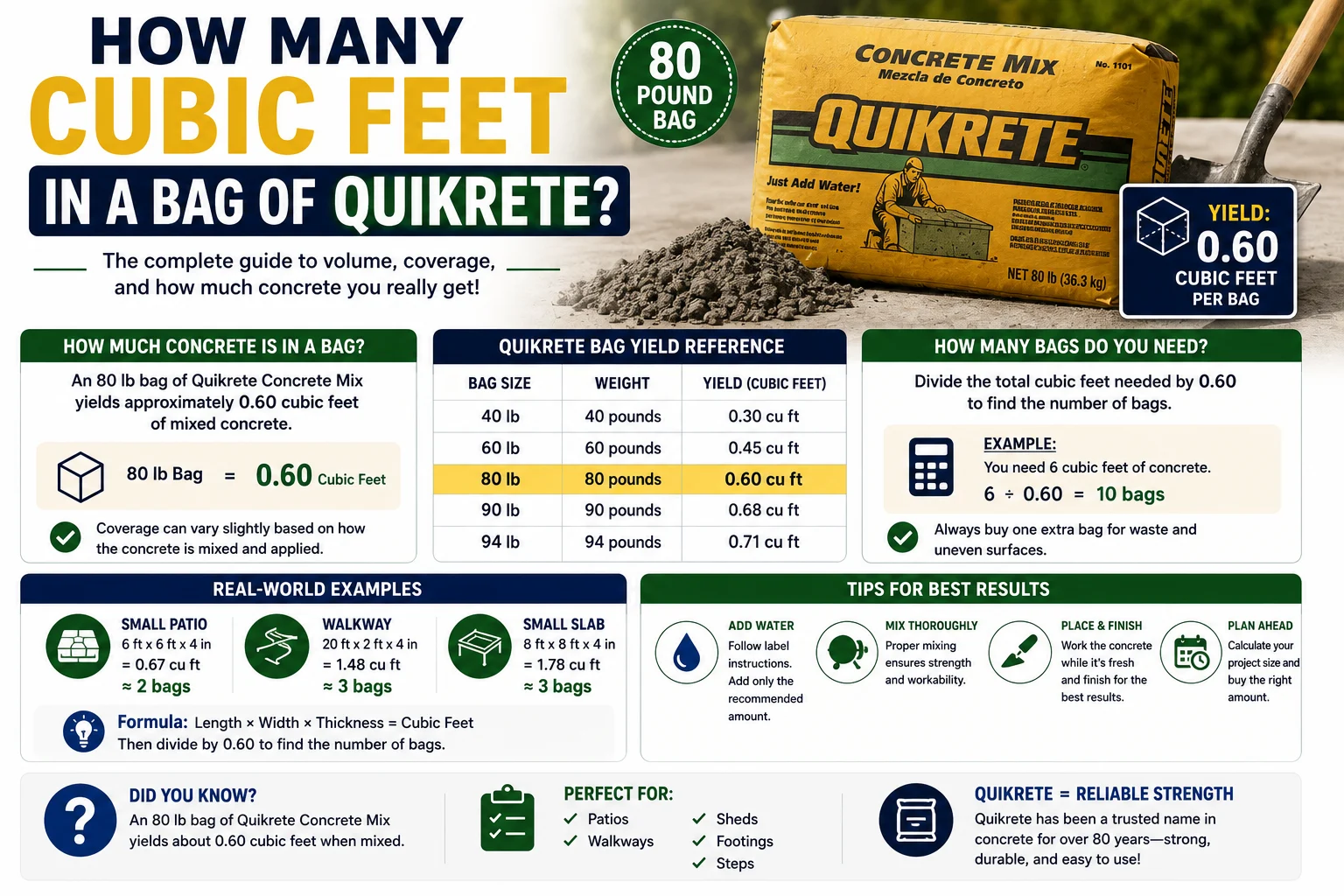
If you’re planning a concrete project, one of the first questions you’ll probably ask is: how many cubic feet in a bag of Quikrete?
The answer depends on the size of the bag. Quikrete sells several bag sizes, and each produces a different amount of mixed concrete.
Here is the quick answer:
- A 40-pound bag yields about 0.30 cubic feet.
- A 50-pound bag yields about 0.37 cubic feet.
- A 60-pound bag yields about 0.45 cubic feet.
- An 80-pound bag yields about 0.60 cubic feet.
Knowing these numbers can help you avoid buying too much or too little concrete for your project.
Whether you are pouring a patio, setting fence posts, or building footings, this guide explains everything you need to know about Quikrete bag yields.
Quick Answer
The amount of concrete produced by a bag of Quikrete varies by weight.
| Bag Size | Approximate Yield |
|---|---|
| 40 lb | 0.30 cubic feet |
| 50 lb | 0.37 cubic feet |
| 60 lb | 0.45 cubic feet |
| 80 lb | 0.60 cubic feet |
In general, the larger the bag, the greater the volume of mixed concrete.
Quikrete Yield Chart by Bag Size
The following chart shows the most common Quikrete bag sizes and their yields.
| Quikrete Bag | Cubic Feet Produced |
|---|---|
| 40-pound bag | 0.30 cu ft |
| 50-pound bag | 0.37 cu ft |
| 60-pound bag | 0.45 cu ft |
| 80-pound bag | 0.60 cu ft |
These values represent the amount of concrete after mixing with water.
Understanding Cubic Feet and Concrete Yield
Before buying materials, it helps to understand what cubic feet actually means.
What Is a Cubic Foot?
A cubic foot is a measurement of volume.
It represents a cube that measures:
- 1 foot long
- 1 foot wide
- 1 foot high
The formula for calculating volume is:
V=lwh
V=4×3×2=24
l
l
w
w
h
hl = 4h = 2w = 3
For example:
- A box measuring 1 × 1 × 1 foot contains exactly 1 cubic foot.
Why Quikrete Yield Matters
Knowing the yield helps you:
- Estimate material costs.
- Avoid extra trips to the store.
- Prevent project delays.
- Reduce waste.
- Calculate the number of bags required.
How Much Concrete Does Each Bag Make?
Different bag sizes are suited for different jobs.
40-Pound Bag
A 40-pound bag yields approximately 0.30 cubic feet of concrete.
Common uses include:
- Small repairs
- Mailbox posts
- Minor patchwork
50-Pound Bag
A 50-pound bag yields approximately 0.37 cubic feet.
Typical projects:
- Garden edging
- Small footings
- Sidewalk repairs
60-Pound Bag
A 60-pound bag yields approximately 0.45 cubic feet.
This size is often used for:
- Fence posts
- Deck supports
- Medium-sized slabs
80-Pound Bag
An 80-pound bag produces approximately 0.60 cubic feet.
It is commonly used for:
- Patios
- Driveways
- Larger construction projects
Because each bag covers more volume, contractors often prefer the 80-pound option.
How to Calculate the Number of Bags You Need
To estimate how many bags of Quikrete you need:
Step 1: Measure Your Project
Measure:
- Length
- Width
- Depth
Step 2: Calculate the Volume
Multiply:
Length × Width × Depth
For example:
A slab measuring:
- 10 feet long
- 4 feet wide
- 4 inches thick
First, convert 4 inches to feet:
4 ÷ 12 = 0.33 feet
Now calculate:
10 × 4 × 0.33 = 13.2 cubic feet
Step 3: Divide by Bag Yield
If you use 80-pound bags:
13.2 ÷ 0.60 = 22 bags
You would need approximately 22 bags of Quikrete.
Common Quikrete Projects and Bag Requirements
The number of bags needed depends on the project.
Fence Posts
A standard fence post hole may require:
- 1–2 bags of 50-pound Quikrete.
- 1 bag of 80-pound Quikrete.
Sidewalks
A small sidewalk project often requires:
- 15–25 bags.
Concrete Slabs
A 10 × 10-foot slab that is 4 inches thick requires approximately:
- 56 bags of 60-pound Quikrete.
- 37 bags of 80-pound Quikrete.
Deck Footings
Deck supports generally require:
- 1–3 bags per footing.
Quikrete Bags Compared
Here is a side-by-side comparison.
| Bag Size | Yield | Typical Use |
|---|---|---|
| 40 lb | 0.30 cu ft | Repairs |
| 50 lb | 0.37 cu ft | Posts |
| 60 lb | 0.45 cu ft | Footings |
| 80 lb | 0.60 cu ft | Slabs |
Choosing the right bag size can save both time and effort.
Common Mistakes When Buying Concrete
Many people make avoidable mistakes when estimating concrete.
Forgetting to Convert Inches to Feet
Always convert thickness measurements before calculating volume.
Underestimating Waste
Concrete projects usually require extra material.
Most contractors recommend adding:
- 5–10% extra.
Buying the Wrong Bag Size
Larger bags reduce the number of bags you need but can be harder to carry.
Ignoring Project Shape
Round footings and post holes require different calculations than rectangular slabs.
Tips for Working With Quikrete
For the best results:
- Read the bag instructions.
- Use the recommended amount of water.
- Mix thoroughly.
- Wear gloves and safety glasses.
- Work quickly before the mix begins to set.
- Buy slightly more than you think you’ll need.
Proper preparation can make your project much easier.
Quikrete Bag Yield in Cubic Yards
Large projects are often measured in cubic yards.
| Bag Size | Cubic Yards |
|---|---|
| 40 lb | 0.011 cu yd |
| 50 lb | 0.014 cu yd |
| 60 lb | 0.017 cu yd |
| 80 lb | 0.022 cu yd |
One cubic yard equals 27 cubic feet.
FAQs
How many cubic feet are in an 80-pound bag of Quikrete?
An 80-pound bag yields approximately 0.60 cubic feet of concrete.
How many cubic feet are in a 60-pound bag of Quikrete?
A 60-pound bag produces about 0.45 cubic feet.
How many 80-pound bags make one cubic yard?
One cubic yard requires approximately 45 bags of 80-pound Quikrete.
How many bags of Quikrete do I need for a slab?
It depends on the slab dimensions and thickness. Measure the volume first and divide by the bag yield.
Is Quikrete the same as cement?
No. Quikrete is a ready-mix concrete product that contains cement, sand, and aggregate.
Conclusion
Now you know how many cubic feet are in a bag of Quikrete. Depending on the bag size, a single bag can yield anywhere from 0.30 to 0.60 cubic feet of concrete.
Before starting your next project, measure carefully, calculate the total volume, and buy a little extra material to avoid running short. Understanding Quikrete yields will help you complete your project efficiently and with confidence.